Automatically translated by AI.
The recent mobilizations of the Panamanian people revive a long tradition of resistance to colonial domination. The history of the Panama Canal is the most complete representation of imperialist interference in the region, crossed by tensions between the local and foreign classes. A brief tour of the signed treaties, the people’s struggle and the political debates allows us to better understand the current situation, facing one of the most felt popular causes in Latin America.
By Manuel Velasco
Hegemony with clubs
The nineteenth century of Latin America was characterized both by the end of Spanish and Portuguese colonial rule and by the disputes between the various capitalist powers (the United Kingdom, the United States and France) for hegemony in the region. Towards the second half of the century imperialism began to emerge as a novel model of domination that quickly found its limits to delimit the control of territories. At the Berlin Conference (1884-1885) fourteen countries divided up the dominance of Africa, marking the beginning of a new order dominated by colonial imperialisms that would later erupt in the First World War (1914). However, what usually tries to be shown as a conflict between nations actually meant a conflict between dominant and dependent classes.
In Central America, the United States finished displacing the Spanish colony with its defeat in the War of 1898 and the signing of the Treaty of Paris in the same year. The Yankee “manifest destiny” advanced in the region interspersing diplomacy with military intervention. With the realization of the Second Pan-American Conference (1901-1902) in Mexico, the USA USA. he put his focus on the domination of Central America. But even more decisive for the Yankee aspirations was the use of military force framed in the strategy that President Roosevelt called “big stick policy”.
The Platt Amendment (1901) approved by the U.S. Senate reserved to the U.S. power itself the right to intervene militarily first in Cuba and then, through the Roosevelt Corollary (1906), throughout Central America to prevent the interference of other imperialist countries but also to exercise rigid control over the rebellious peoples.
The result was the semi-colonization of the region under an enclave economy and the primarization of production. Although the main beneficiary of the model was Yankee imperialism, the local ruling classes (national bourgeoisie and landowners) also got their cut, being the administrators of the dependent countries.
From the Hay-Banau-Varilla Treaty (1903) to Torrijos-Carter (1977)
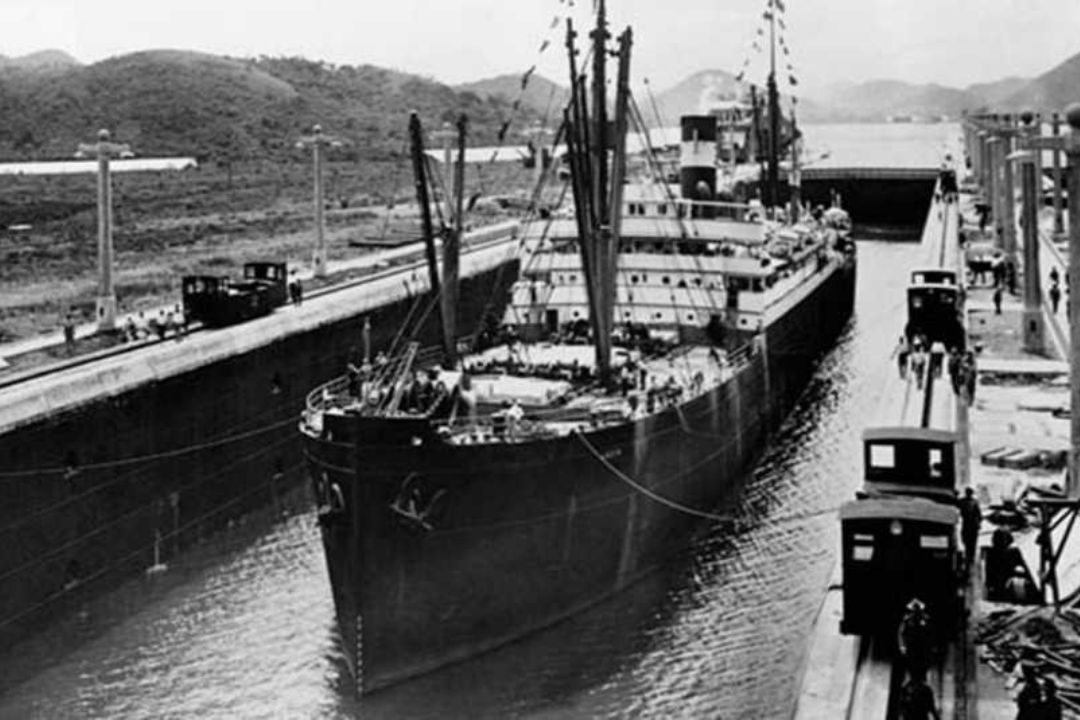
The construction of the Panama Canal was an essential chapter in the process of the expansion of capitalism and the consolidation of the American “international police” in Latin America during the first half of the twentieth century. Prior to the agreement with the US. USA., a French company was the owner of the project, although the political-military and economic strength of the United States allowed it to snatch the rights from it. The next step was the Panamanian independence from Colombia, where the American interference in the process was recognized in 1922 with the compensation to Colombia.
British imperialism was also displaced after the signing of the Hay-Pauncefote Treaty (1901), by which it ceded to the United States permission for the construction and future control of the canal in Central America. Years later, with the Hay-Bunau-Varilla Treaty (1903), Panama finally ceded the rights for the construction of the canal and, in perpetuity, the use, occupation, control, maintenance, operation, sanitation and its protection. In this way, a military and commercial enclave was established under North American jurisdiction, covering about 94,000 hectares.
From that moment on, Panamanian history was marked by US military interference, protected by Article 136 of the constitution of the new country that authorized US intervention. USA. anywhere in the national territory. From 1912 to 1925 there were three invasions and some more threats from the White House, both to maintain an institutional “order” favorable to their interests and to suppress popular protests.
After the war, the class struggle imposed the discussion on national sovereignty, a banner that was even taken over by sectors of the native Latin American bourgeoisies in their respective countries. At the same time, the Cuban revolution was the confirmation of the possibility of beating Yankee imperialism in its “backyard” and that the socialist path was the only one that could truly guarantee the definitive independence of the region. A short time later, the defeat of the empire in Vietnam finally confirmed the end of the era of the United States as an invincible capitalist power.
As part of this cycle of rising mobilization, the coming to power of General Omar Torrijos in 1968 led, for the first time in the history of Panama, to a president denouncing the treaty that awarded the canal and its territory to Yankee imperialism in perpetuity. In addition, he gained the support of the masses thanks to the promotion of a series of progressive measures such as the promulgation of the Labor Code, increased schooling for the population, land distribution among peasants and the development of a social security and housing system.
However, Torrijos’ questioning of Panama’s structural dependence was limited. His commitment to American capital led to his government finally taking on a reactionary character, reversing the concessions previously granted. He removed the right to strike and collective agreements; allowed increases in basic necessities; repressed protests against the increases. At the same time, foreign capital multiplied in the country, revealing the contradictions typical of bourgeois nationalisms and their permanent commitment to the USA. USA.
The timid anti-imperialism of Torrijos resulted in the Torrijos-Carter Treaties (1977) by which it was agreed to cede control of the canal gradually to Panama ending with the total surrender in 1999, but the historical claim for total sovereignty and the suppression of the Yankee military presence in the territory was not heeded. On the other hand, the Neutrality Pact enabled the United States to “intervene in Panama after the year 2000 to guarantee the neutrality of the canal” (words of President Carter). But it didn’t take that long for a new invasion…
After the death of Torrijos in 1981, General Manuel A. Noriega became president with the support of the Pentagon. Even so, the alliance broke up and consequently the U.S. USA. he invaded Panama again on December 20, 1989. There, the Yankee army implemented methods and weaponry that would later be used in the Gulf Wars. In this way, an authoritarian and neoliberal regime was imposed from the north that meant decades of misery for the people.
The resistance in Central America: revolutions, bourgeois nationalism and bureaucracies
Undoubtedly, Panama’s fight for sovereignty has historical achievements, but unfortunately they were partial. Although the administrative control of the Canal by the local authorities was eventually conquered, the economic power of the region remained in foreign hands. Everything that could be advanced was due to the inalienable struggle of the people for total control of their economy and territory, favored by the moments of weakening of imperialism.
The limit was set by the bourgeois nationalist leaderships that, at first, relied on popular demands to get to power and then bet on demobilization with the aim of making a pact with imperialism behind the backs of the working class. Bourgeois nationalisms never abandoned their semi-colonial commitments, betting on reformism instead of direct confrontation with foreign power, sentencing Latin countries to a very relative independence where the last word was reserved for the USA. USA.
In all cases, the masses were progressively questioning the nationalist governments until they confronted them. Unfortunately, in most cases, the force failed to be channeled towards a definitive break with imperialism due to the absence of a coherent revolutionary leadership. Instead, the bureaucracy of the CPS acted as a force vest to prevent the extension of the most combative experiences in Central America.
The cases of Cuba first and then Nicaragua showed that the complicity of Stalinism was an obstacle to the development of a comprehensive process of mobilization and expropriation of the means of production. Not coincidentally, the last tragic episode of the Yankee invasion of Panama occurred ten years after the Nicaraguan revolution, where Sandinismo and Castro aborted the possibility of making “a new Cuba,” which would have injected enough energy to repel any imperialist aggression on the region.
Out with the imperialisms of Panama and Central America
The perpetuation of imperialist domination took on a neoliberal character towards the end of the previous century. At present, as a result, the peoples of Panama and all of Central America suffer from being cornered between the misery of those who stay on their land and the destruction of those who migrate.
Although the weakening of the neoliberal order at the beginning of the century allowed Latin America’s structural dependence to be questioned again, the progressives preferred to pivot between hypocrisy and the displacement of an old imperialism by a new one. The progress of trade relations with China sadly replicates episodes of the past. The Hong Kong company Hutchison Port Holdings controls the ports of Balboa and Cristóbal, while 22% of the traffic through the canal corresponds to China, surpassed only by 72.5% corresponding to the USA. USA.
In these days, a new opportunity has opened up to resume the historical claim for definitive independence, never abandoned by Panamanians and shared by the whole of Latin America. The current situation of global disorder and instability of US imperialism once again enables the voices of the peoples to rise up and achieve new conquests, that is, not only resistance but also concrete triumphs.
The fight for real sovereignty over the canal is a significant part of the ongoing struggle. The only guarantee for this to really happen is abandoning confidence in the management of any capitalist state official, giving way to the total control and defense of the canal by the Panamanian working class. A conquest of these proportions would put in the hands of the people a key resource to reverse the semi-colonial base of the country and all of Latin America. The false campy dilemma that limits the debate to the sale of our commons and territories to the highest bidder does not offer a real solution to structural dependence. Therefore, it is necessary to break with all illusion in the bourgeois parties and the bureaucratic left to give way to the organization in a revolutionary and internationalist alternative that unifies the anti-imperialist fight and raises the flag of socialism.