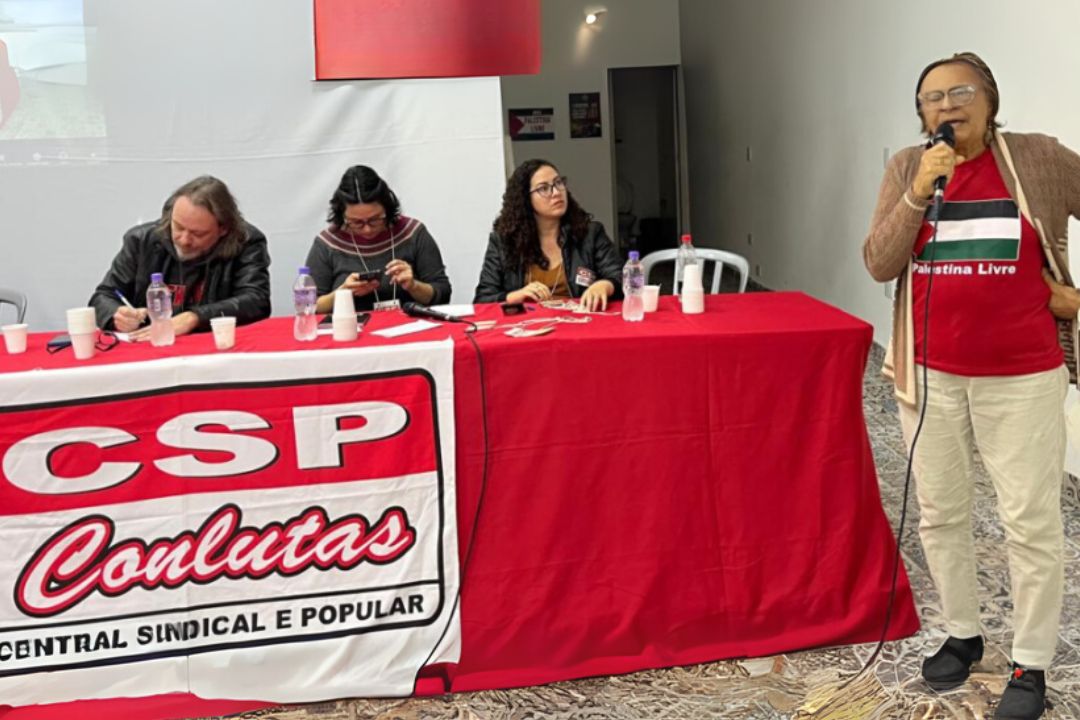
On August 15, 16 and 17, the National Coordination of the CSP-Conlutas met in the city of Sao Paulo, Brazil, bringing together workers from all over the country. On this occasion, a debate was held on the COP30 to be held in the city of Belém. We reproduce a report of this important panel.
National Coordination COP30 debate and business that drives environmental destruction
The second round table of the meeting of the National Coordination of the CSP-Conlutas, which took place on Friday afternoon (15), entitled The Climate Crisis and COP 30, was an important moment to deepen the realization of this climate event and its implications for the environment, the working class and traditional peoples, especially in Brazil.
Guests Jefferson Choma, master’s degree in Geography from USP and editor of the newspaper Opinião Socialista; agronomist Rosi Pantoja, from the State Executive of CSP-Conlutas PA; and journalist Douglas Diniz, coordinator of Portal Info Revolução and Repórter Sem Fronteiras, addressed different aspects of COP30 (30th Conference of the Parties to the United Nations Framework Convention on Climate Change).
Jefferson Choma
The geographer made a review from the beginning of the first COP in 1995, as a result of the ECO92 held in Rio de Janeiro, to the present. He presented the intentions disclosed, the agreements and the unfulfilled decisions.
He cited as an example the Kyoto Protocol, signed in 1997, whose main objective was to reduce greenhouse gas emissions. “The agreement established targets for developed countries to decrease global greenhouse gas emissions by 5.2% from 1990 levels, with an initial commitment period between 2008 and 2012. The Kyoto Protocol was not met and was replaced by the Paris Agreement in 2015,” he explained.
The Paris Agreement was adopted by 195 countries at COP21 in Paris in 2015, with a commitment to limit global temperature rise to well below 2°C above pre-industrial levels, with efforts to limit it to 1.5°C.
Brazil committed to reduce its greenhouse gas emissions by 37% by 2025 compared to 2005 levels, and by 43% by 2030.
“And the Paris Agreement is far from achieving its commitment to limit global warming to 1.5°C. From ECO92 to 2021, what we have is a brutal increase in carbon emissions, with a decrease in 2020 only due to the pandemic,” Jefferson reiterated.
He also recalled that two COPs, COP18 and COP28, in Doha (Qatar, 2012) and Dubai (United Arab Emirates, 2023), were promoted by countries whose economies are essentially oil-based.
He warned about what he described as a climate catastrophe in Brazil, a country that ranks fourth in emissions, behind the U.S., China and Russia, not because of industrialization, but because of burning. “If Brazil wanted to comply with the Paris Agreement in 2030, it would be enough to put an end to burning,” he added.
The geographer also pointed out the role of the Lula government, which vetoes articles of the “PL of Devastation”, but in practice makes destruction more flexible by authorizing burnings so as not to upset agribusiness, which receives millionaire investments through the Safra Plan; the interest in oil exploitation in the Equatorial Margin and the asphalting of the BR-319 to export Amazonian production to developed countries, “birds of prey”.
Rosi Pantoja
“COP 30 will be a great business market that will bring the discussion that financing is needed to invest in the preservation of the global environment,” said Rosi, who then stressed that this is a great fallacy because the great powers that make up the capitalist system are interested in continuing to extract more natural resources, such as monocultures, minerals and fuels.
The agronomist affirmed that the COP will further increase deforestation and favor large works to guarantee the export of agribusiness and mining. “Several works are being built for this purpose, further impacting the environment,” she said, pointing out that the government intends to raise 1.3 trillion reais in financing.
“But the result of these investments in practice will serve the capitalists and deepen the climate crisis, fundamentally affecting the working class, indigenous peoples, quilombolas and traditional communities such as the riparians,” he said.
According to the leader, Helder Barbalho’s government is carrying out a great devastation in Pará, besides exposing serious problems in the city, such as the lack of sanitation, since almost 50% of the state does not have drinking water.
Rosi also denounced the fallacy of the Lula government, which touts the defense of the Amazon and the environment while supporting oil exploitation, financialization and carbon credits, which only transfer environmental degradation from one country to another and monetize it.
Monoculture, as a factor of environmental destruction, is also advancing by leaps and bounds with soybeans, oil palm and now açaí. “Soybean, which is used to feed pigs in China,” Jefferson recalled, while Rosi emphasized the advance of açaí monoculture for export.
The CSP-Conlutas PA leader also stressed the need for the Central to participate in the activities opposing COP30 and in the People’s Summit and mobilizations that will take place.
“We are going to participate in the Peoples’ Summit, we will take caravans from the state of Pará, from Anapú, Moju, important localities and struggles, and we will make national mobilizations to see which unions will participate. We need to organize our intervention”, he reinforced.
Douglas Diniz
Journalist Douglas pointed out that COP30 must be seen by workers and poor people as part of the global systemic economic, social, political and climate crisis.
The announcement of Belém as the venue for COP30 was celebrated by the governments of Lula, Helder and, above all, by former mayor Edmilson Rodrigues, of Primavera Socialista/PSOL, as an opportunity for investment in the city.
Since its announcement, the illusion was sold that the climate crisis and the demands of the peoples of the countryside, the rivers and the jungle would be debated on equal terms with heads of state and capitalists responsible for this crisis.
However, this did not happen. During 2024 there were strikes in the public sector that already warned about COP30. “Beyond the demands of the category, these strikes strongly denounced the COP30 works, at that time under strong suspicions of corruption and diversion of public resources,” Douglas highlighted.
The indigenous and quilombola occupation of the Secretariat of Education in January 2025 strengthened the struggle for the repeal of Law 10.820/2024, which imposed virtual education, even in indigenous villages without the minimum infrastructure to operate virtually.
“In this struggle, indigenous leader Alessandra Munduruku, in response to a question from Portal InfoRevolução about the expectations of indigenous peoples about COP30, stated that ‘there were no expectations: the COP is nothing more than a business’ and concluded: ‘unlike other COPs, in this one the Brazilian government, if it does not attend to the demands of the peoples of the countryside, the rivers and the jungle, there will be no COP, there will be struggle’,” the journalist recalled.
According to Douglas, the occupation of Seduc set off the alarms of the federal and state governments, which directed their allies in the social movements in Brazil, and especially in the Amazon, to control and “hijack” the organization of the People’s Summit.
“COP30 will be ultra-militarized. Armored vehicles have already started to arrive in Belém, and the Lula government will issue a Law and Order Guarantee (GLO), transferring the security of the event to the Armed Forces and the National Security Force”, he stressed.
Regarding the objectives of the conference, he stated that the COP will discuss the implementation of IIRSA (Initiative for the Integration of Regional Infrastructure in South America), a project involving 12 South American countries, especially Brazil and the northern states of Pará, Amazonas and Amapá.
This multi-million dollar project includes investments in energy, with new hydroelectric plants, in addition to Belo Monte on the Xingu River and Jirau and Santo Antônio on the Madeira River. In transportation, it envisages waterways, railroads and the BR-319 highway. These works will destroy forests and cross indigenous villages, with the aim of exporting Amazonian products, mainly to European and Asian markets.
Douglas also highlighted the oil in the Equatorial Margin and the Alter do Chão Aquifer, the largest in the world, located in Pará, Amazonas and Amapá. “This aquifer was discovered by UFPA researchers; it is larger than the Guarani, previously considered the largest in the world, and is transboundary, between Brazil, Argentina, Paraguay and Uruguay,” he said.
He stated that the “PL of Devastation” is a mechanism that seeks to simplify the entire delivery process, eliminating environmental licenses and all legal mechanisms that could impede the advance of capitalist projects in the northern region.
Thus, Douglas defends: “We have the opportunity to make politics, debate an ecosocialist program as a way out of the climate crisis and discuss the construction of political and trade union alternatives for the working class and poor people”.
According to the journalist, Unidos Pra Lutar, a grouping that integrates the Central, invites all the sectors of the CSP-Conlutas and the political organizations of the independent left to intervene in this process. “To dispute a left and revolutionary policy for the oppressed peoples of the world, for those who suffer environmental racism and for the majority of the population”, he concluded.
After the presentations of the guests, the debate was opened, which also prepares the Central’s action in the activities that oppose the COP30. Denouncing the destruction of the environment and the objective of the Lula government and the state government of Helder Barbalho to transform the Climate Conference into a real business market with the delivery of the wealth of the Amazon.
*Facebook/Twitter disclosure photo https://cspconlutas.org.br/noticias/n/19632/coordenacao-nacional-debate-cop30-e-os-negocios-que-dao-salto-na-destruicao-do-meio-ambiente