By: Francisco Torres
Automatically translated by AI.
Nepal, the small Himalayan country nestled between India and China, officially known as the Democratic Federal Republic of Nepal, is experiencing one of the most massive, convulsed and radicalized popular rebellions of recent years, with its rebellious youth, which forced the resignation of the government. The crisis unleashed in Nepal raised the number of people killed by repression and social violence to 30.
Some 25 people died on Monday, mostly killed by police repression on the first day of protests, including the wife of former Prime Minister Jhalanath Khanal, burned alive in her home. The body of a man also appeared in one of the burned houses. Then there was the murder at the hands of the police of five other people, in the riot and attempted escape from the Banke juvenile correctional center, in the west of the country.
The Nepalese Army also opened fire on prisoners who wanted to escape from the Dhading district prison, leaving one dead and seven wounded. This is happening in the face of massive escapes with more than 3,000 prisoners who fled from other prisons, even freeing imprisoned opposition political leaders.
Kathmandu and other regions set fire to symbols of power
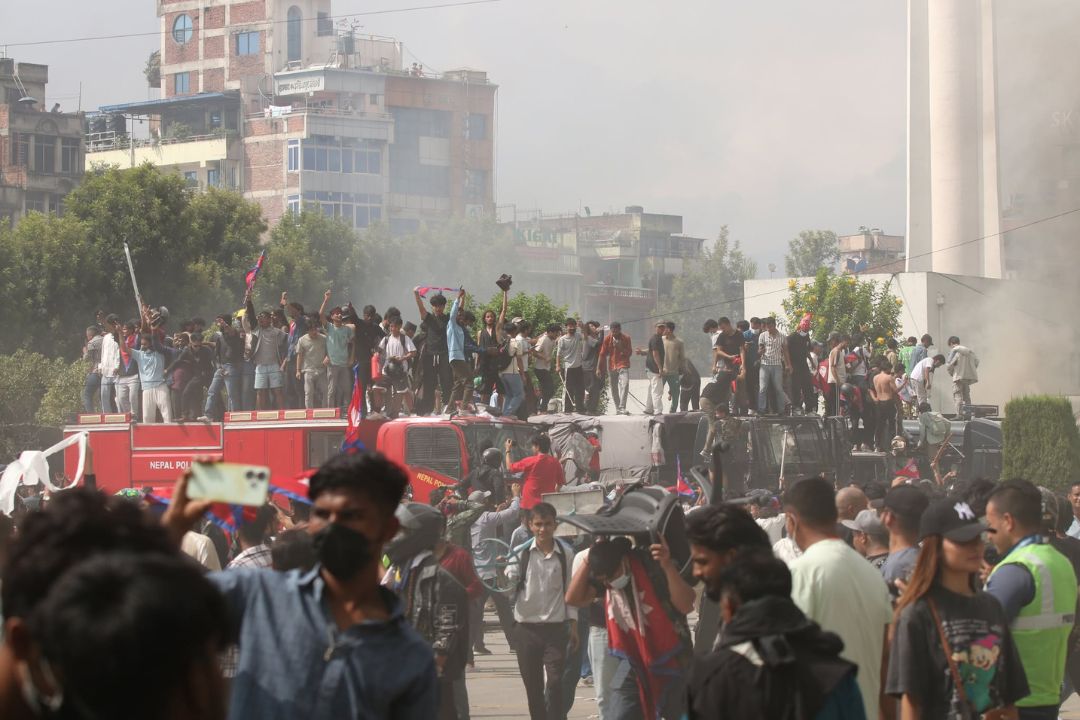
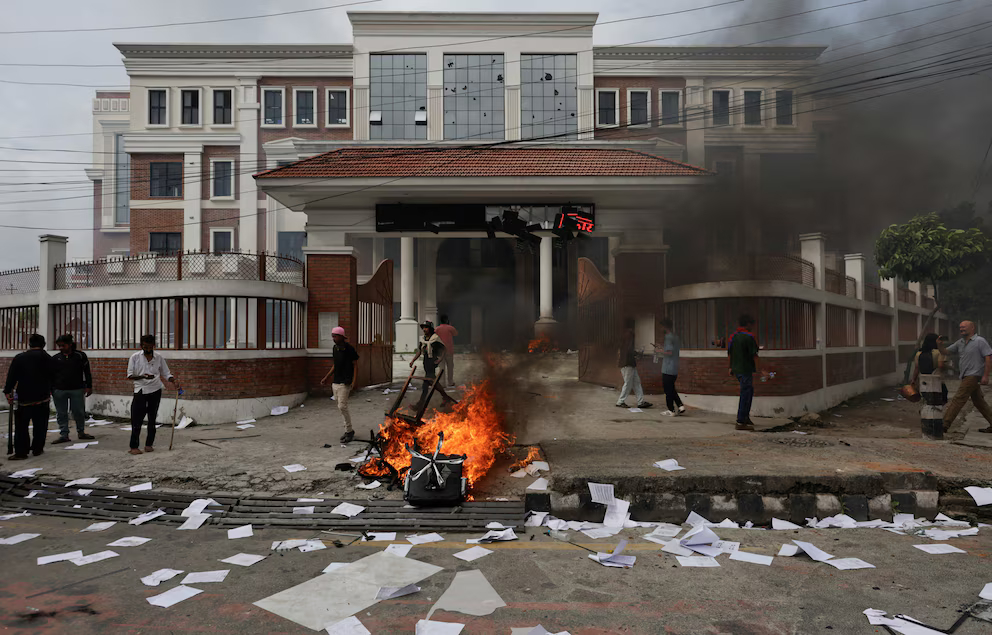
The burning of the main government buildings, the parliament, the judiciary and the headquarters of political parties, the private homes of more than twenty government officials; the beating of the former prime minister and the death of his wife, burned in the occupation of their home, the persecution and the attack on the Minister of Economy, Bishnu Paudel, who was stripped of his clothes, beaten and thrown into the Bagmati River half-naked, are the postcards that travel the world about a rebellion that does not stop.
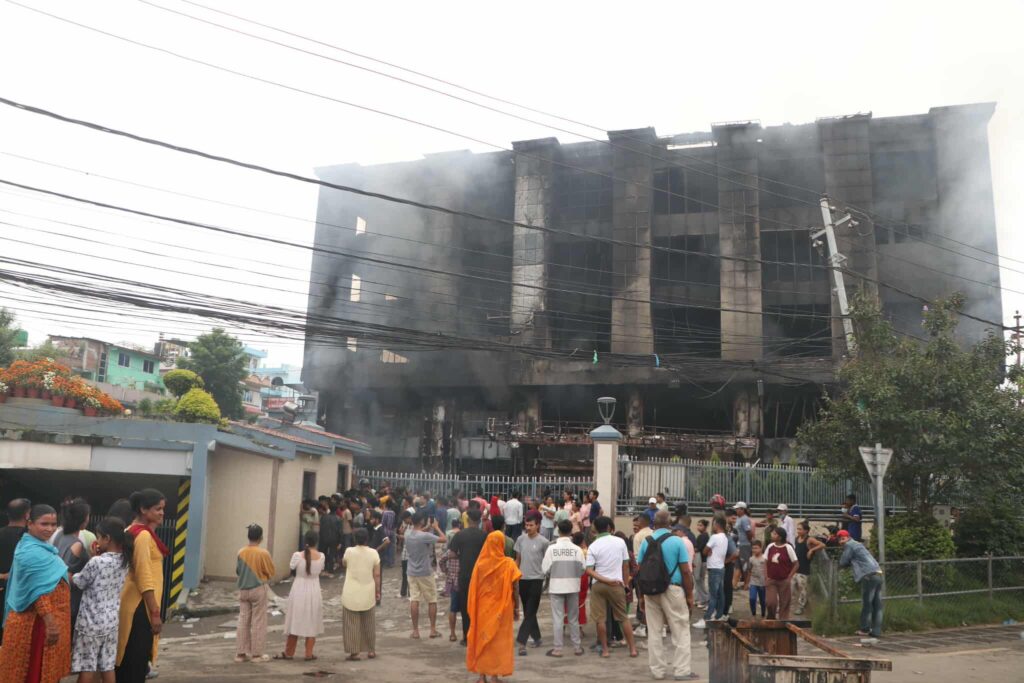
On Tuesday, the capital of Nepal, Kathmandu, appeared filled with columns of black smoke and intense flames that continued to burn, the product of two days of angry and massive protests that defied the curfew, faced a brutal repression and forced the resignation of Prime Minister Khadga Prasad Sharma Oli, of the Communist Party of Nepal (Unified Marxist-Leninist, CPN-UML), who had been leading the government of Nepal since July 2024. Other ministers also resigned, but accusing their own government of ”dictatorial behavior.” The fact is that until Wednesday the 10th, the fire had not been extinguished in most of the government offices… The rebellion is still on.
We are thus witnessing a semi-popular insurrection, led by the youth of the so-called “Generation Z”, fed up of living in misery in the face of the ostentatious corruption of the political and business class. The widespread revolt in the country opened a huge political crisis, a power vacuum that led to the resignation and the fall of the main representatives of the government.

The trigger: misery, censorship and bullets
The spark was the government’s ban on the use of social networks, but the popular indignation comes from years of capitalist misery. The protests of the youth affected all sectors, both political, economic, social, education, health, transport, trade and actions spread throughout the country.
Instagram Facebook The international and local press say that the spark of this rebellion was the government’s decision to block 26 social networks (such as Facebook, WhatsApp, Instagram and YouTube), under the pretext of stopping the “fake news”. For millions of young people it was an attempt to censor critical voices and attack freedom of expression. Thus the protest, organized even from those same networks, erupted with force.
On Monday the 8th, tens of thousands marched to Parliament. The police responded with gas, hydrant carts and bullets. The government had to back down with that ban, but it was too late. The resignation came after that brutal repression ordered, when the security forces opened fire on tens of thousands of protesters who surrounded the parliament, killing 19 people with gunshot wounds.
According to a doctor at the National Trauma Center, the country’s main hospital, “many are in serious condition and seem to have been shot in the head and chest,” as he received several of the dead and dozens of injured.
On Tuesday evening, Army Chief of Staff Ashok Raj Sikdel announced that the army would take over “security control” and called on the population not to leave except for their essential jobs. He spoke of “protecting the country and the Nepalese” by wanting to impose an indefinite curfew, but the mobilizations had not stopped that day and discontent was growing after the victory by overthrowing the government.
The army then called for political talks and negotiations to seek a way out of the crisis, saying that “any protest involving vandalism, looting, arson or attacks will be treated as a criminal act.” Of course, he could have said this after the country was razed by flames, against the main symbols of capitalist political and economic power. In principle, these formal talks should take place on Wednesday at the request of the army and President Poudel of Nepal. Nothing good will come from there for the people and their young rebels.
Irruption of anger of young people, workers and popular sectors
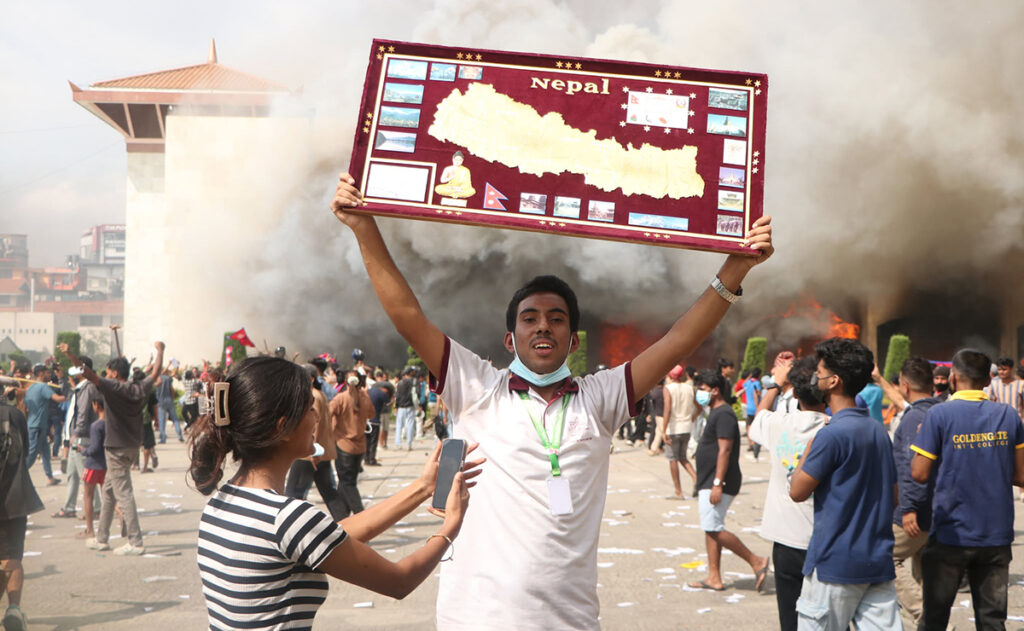
The youth, the workers and the most punished sectors of the population stormed with fury against poverty, corruption and the authoritarian measures of the government. The attacks on official buildings, residences of ministers and the burning of the Government Palace (Singha Durbar, with its ministerial offices and the Council of Ministers); the Parliament building in Baneshwor; the official residence of the President of Nepal (Sheetal Niwas); the Supreme Court; the Special Court and the District Court of Kathmandu, everything was razed by flames and social indignation.
It was a national process: the residence of the former minister of Internal affairs was joined by the looting and the flames against the residence of the vice president of Lumbini province and almost all government offices in Butwal, the metropolitan subcity and economic center of Lumbini province, in western Nepal. The residence of the mayor of the municipality of Tilottama, the house of the leader of the UML (Communist Party of Nepal), as well as the residences of most of the municipal mayors and deputy mayors and businesses run by leaders close to the Congress and the UML were set on fire.
The popular anger caused the residences of at least two dozen ministers to burn down, including the private home of the deposed Oli. The popular anger did not distinguish between parties: both the ruling Communist Party (UML), the Nepali Congress and the Maoists were targets of repudiation.
The offices of the Kantipur Media Group, the country’s largest media conglomerate, were also attacked and set on fire. The Nepali television in Singha Durbar and the Nepal TV office were set on fire. The protesters also set fire to the luxurious Hilton Hotel in Kathmandu, there were looting and fire in businesses and shops.
They are the expressions of that anger and social rebellion accumulated for years. The fed-up with a privileged, corrupt political class far removed from the popular suffering that exploded in this uprising that is once again modifying the political situation of the Himalayan country. The protest was against corruption, nepotism and impunity. The networks viralized the hashtag #NepoKids, referring to the ostentatious luxury of the children of the elite, in contrast to the poverty of the majority.

Beautiful country, with immense peaks, but impoverished
Nepal, in the middle of the Himalayas, is famous for its mountains and the highest peaks on the planet such as Mount Everest and others of the “eight-thousanders” for their very high peaks. It has an outstanding cultural heritage and an area similar to Mendoza or half of the province of Buenos Aires, but with almost 30 million inhabitants.
Behind this tourist image and rugged beauty, the country drags a harsh reality of poverty and structural inequality: 20% of its population has remained in extreme poverty for more than a decade, a third of its children under the age of five suffer stunted growth due to malnutrition and more than 40% of its GDP depends on the money that millions of migrants send from abroad to their families.
The economy is still based on subsistence agriculture, with low productivity and lack of investment. While the political and business elite amasses fortunes, it shows obscene luxuries with impunity and perpetuates a system of privileges that generated this deep discontent.
Corruption explains the lack of employment, inflation, the precariousness of the peasantry and the absence of basic services as fertile ground for this mass revolt. 43% of its population is between 15 and 40 years old and faces youth unemployment close to 13%, forcing thousands to migrate every day to India, Malaysia and other countries to send money to their families.
From the deposed monarchy to a failed republic
Until 2006, Nepal was ruled by a monarchy with more than two centuries. The civil war, armed struggle and the Maoist insurgency claimed 13,000 deaths, although it ended the monarchy and proclaimed a republic in 2008. But the emerging bourgeois democracy did not solve the popular demands, leading to the permanent rotation of governments, corruption and adjustments that are endemic, with unfulfilled promises in the last decade and a half. The 2015 Constitution did not close these wounds and there were different governments that did not exceed two years, without any response to hunger, unemployment or the lack of basic infrastructure. It was the breeding ground for this urban and social insurrection.
The strength of youth. Nepal and the world: the same struggle
The undisputed role belongs to the youth. Unemployment and the lack of prospects fueled an accumulated anger that is now overflowing. The massiveness, radicality and extension of the protests show that this is not an isolated episode, but a real rebellion of an entire generation.
The crisis in Nepal is not an isolated event. It is part of the worldwide wave of rebellions against social inequality, adjustments, corruption and capitalist governments that only offer misery and repression. As in Chile in 2019, as in Sri Lanka in 2022, or in the rebellions in the Middle East, the youth is the spark that ignites the popular struggle.
Nepal, one of the 50 poorest countries on the planet, also suffers from imperialist oppression, adjustment programs and the payment of the external debt (more than 12,000 million dollars), mortgaging any development. India and China dispute their influence, while the Nepali people pay the costs.

For a socialist way out
The rebellion in Nepal shows that the youth, the poor peasantry and the working class do not accept to continue paying for the crisis. The people are fed up with a corrupt regime, lack of employment, repression and the privileges of a few.
From the International Socialist League we express our solidarity with the struggle of the youth and the people of Nepal. We reject the repression and demand justice for the murders and injuries. Only a socialist and revolutionary way out, that breaks with capitalism, debt and imperialism, can open a different future for Nepal: expropriate the corrupt and big capitalists, democratically plan the economy and put it at the service of the majorities.
While the UN calls for pacification and dialogue, although without firmly condemning state repression, before social violence, the embassies of Australia, Finland, France, Japan, South Korea, the United Kingdom, Norway, Germany and the United States also issued a joint statement calling for “moderation.”
Even the mayor of Kathmandu called for calm: “Dear Generation Z, the resignation of your murderer has come. Hold back now! The loss of people and property of the country means the loss of their property. You and I need to restrain ourselves… Now, go home”” he wrote while promoting the dialogue proposed by the army.
But the generation revolted in Kathmandu and throughout Nepal is a clear sign that there is plenty of strength, anger and decision to fight for a different country and a different world. The task is to transform this energy into an internationalist revolutionary political project that challenges the privileged castes for power in order to advance towards a socialist solution.