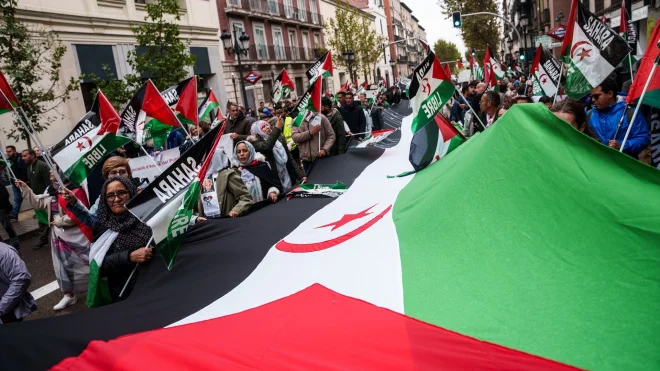
On November 14, 2025, commemorating the 50th anniversary of the Madrid Accords, thousands of people took to the streets of Madrid and other cities to denounce the Moroccan occupation of Western Sahara and demand the right to self-determination for the Saharawi people. The mobilizations, which were also replicated in other cities of the European Union (EU) reflect the persistent struggle against a contemporary colonialism supported by the dominant imperialism.
By Santi González and Flor Salgueiro
Large demonstration in Madrid
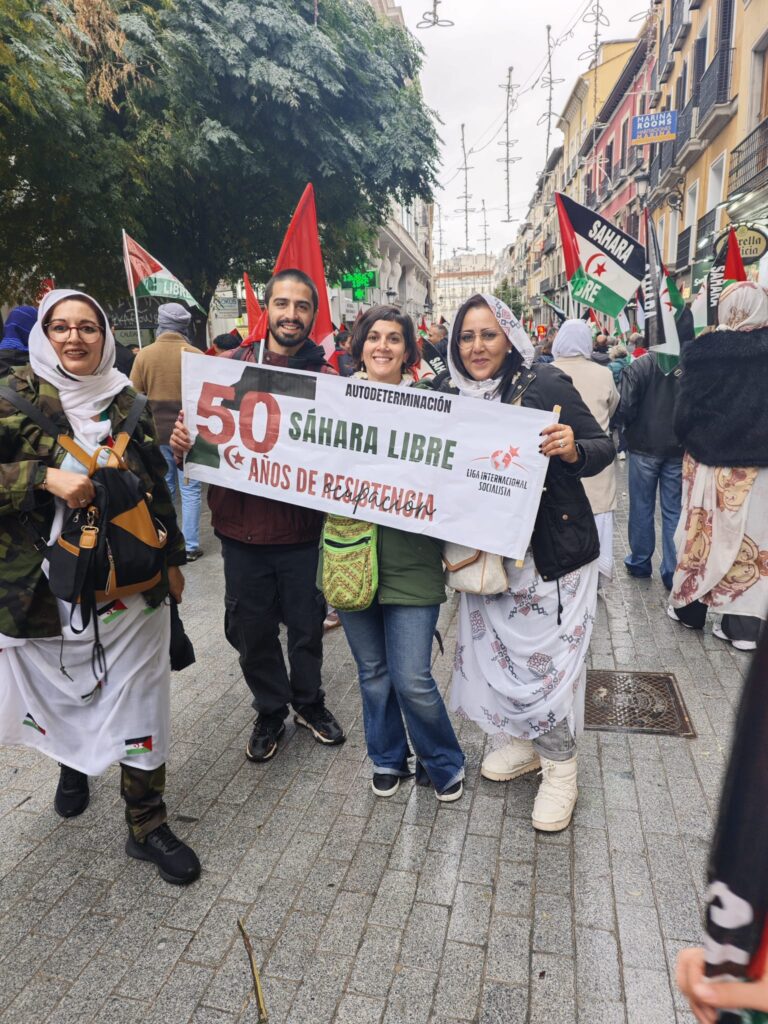
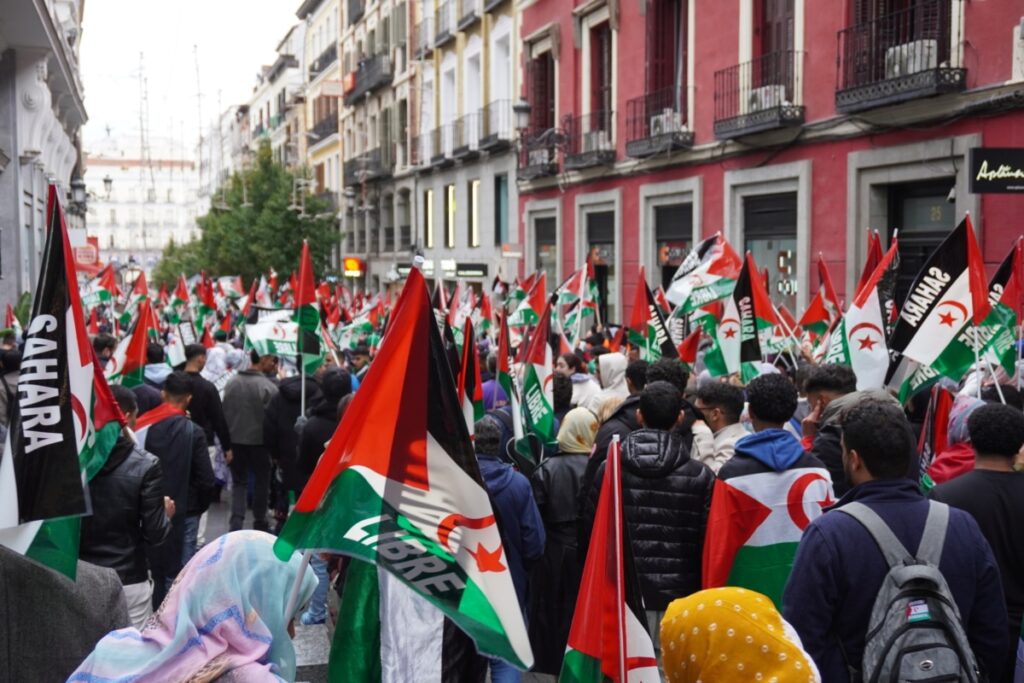
On November 14, thousands of people marched through the streets of Madrid under the slogan “50 years of resistance to the occupation”. With flags, typical costumes and at times in the rain, Saharawis in exile and solidarity activists walked the route from Atocha to Puerta del Sol, where a rally was held with political, trade union and social representatives in solidarity with the cause. The speeches recalled the signing of the Tripartite Agreements of Madrid – November 14, 1975 – denouncing the Spanish betrayal that handed over Western Sahara to Morocco and Mauritania without respecting the right to a referendum of self-determination. And they emphasized the denunciation of the current Spanish government of Pedro Sanchez (PSOE) for its turn towards the oppressive positions of the Kingdom of Morocco.
Abdulah Arabi, representative of the Polisario Front in Spain, also spoke, affirming that the Saharawi people maintain a “total determination to continue their struggle … until they achieve their legitimate right to self-determination and independence”. He also thanked that during these 50 years the Saharawis have never been alone, but “well accompanied by a solidarity movement”. As every year, comrades of Socialismo y Libertad of the Spanish state, as members of the International Socialist League (ISL), took part in the mobilization.
More protests in the EU
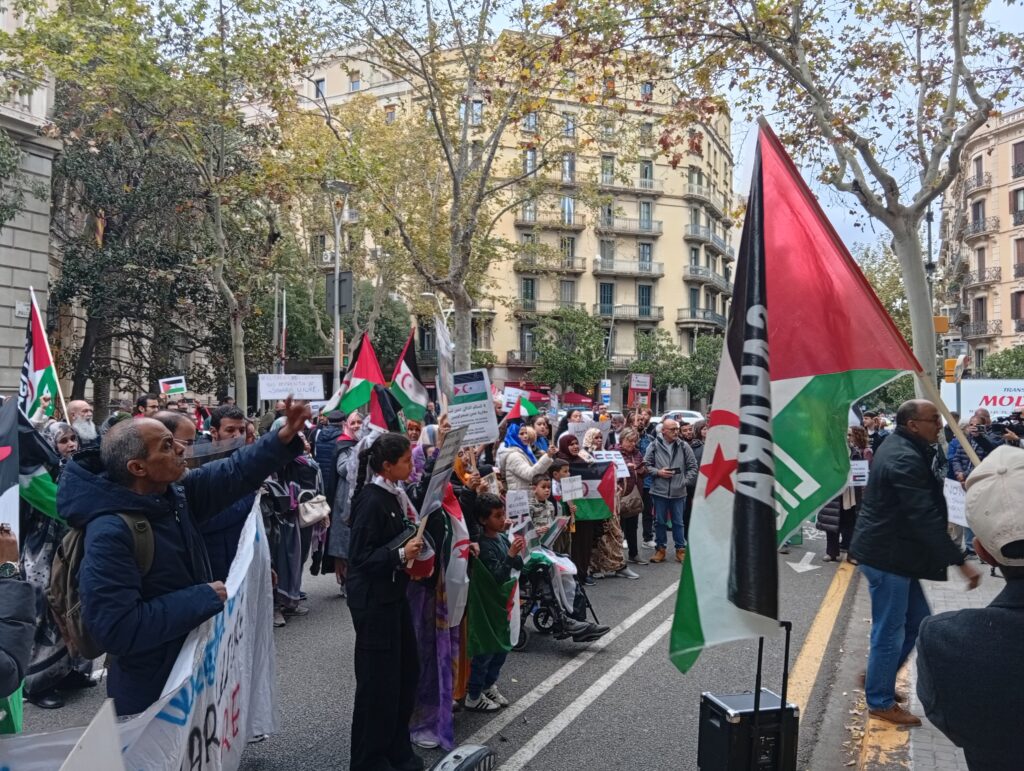
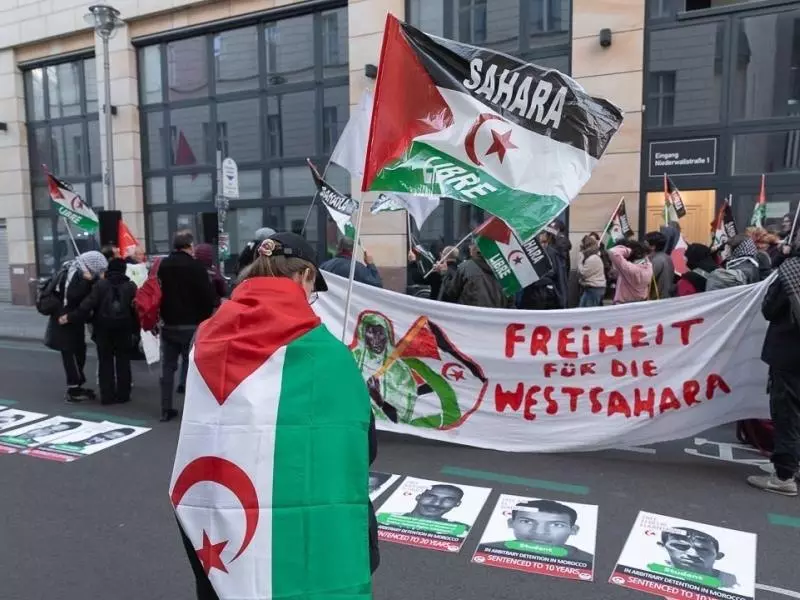
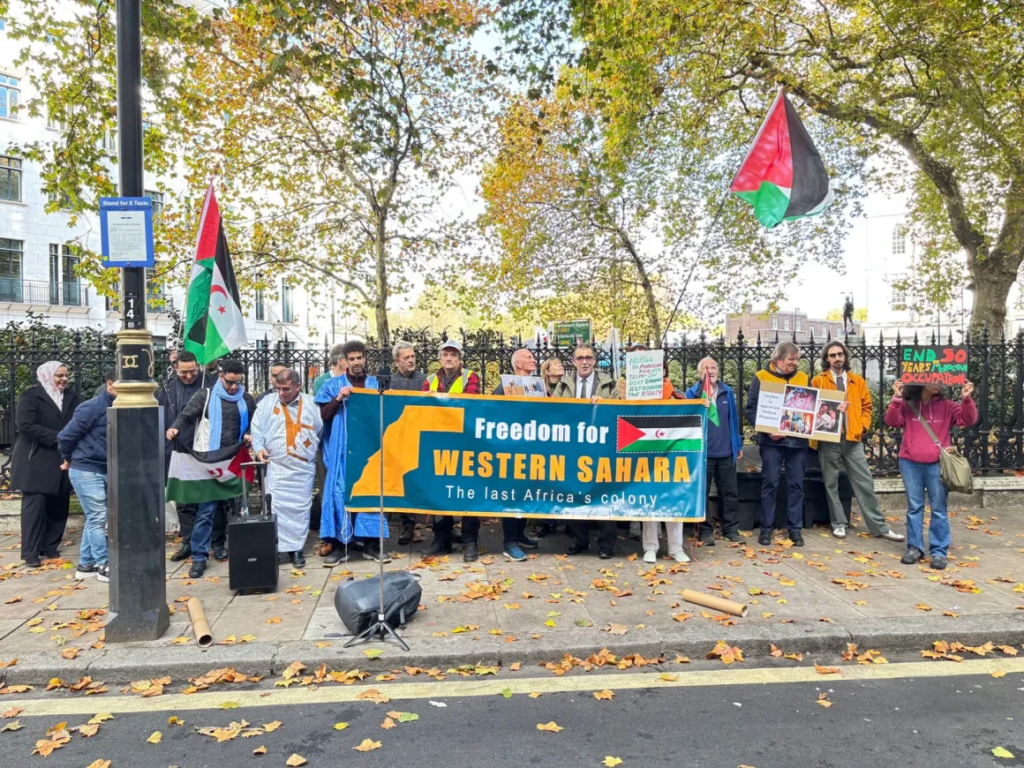
Days before the mobilization in Madrid other protests took place. In Berlin, the Western Sahara Solidarity Network and the Saharawi community in Germany organized a demonstration in front of the Moroccan embassy, with banners demanding freedom, independence and an end to the occupation. In London, Saharawi activists and British sympathizers gathered outside the Moroccan Embassy to demand respect for the right to self-determination. In the Canary Islands, particularly in Tenerife, a mass rally took place in rejection of Donald Trump’s proposal to recognize Moroccan sovereignty over the invaded territories, supported by Israel, in line with the Abraham Accords. These mobilizations, together with those in the Tindouf camps and in other big cities of the EU, show that the Saharawi cause is still alive.
A struggle that continues over time
The history of Western Sahara is marked by a colonial iron hand and many international betrayals. In 1975, Morocco launched the “Green March”, sending 350,000 Moroccans to invade the former Spanish province, while Spain, in its last throes of Francoism, negotiated its exit. That maneuver was not only symbolic: days before the Green March, there was a military intervention. The International Court of Justice had ruled that there were no sovereignty ties between Morocco and Western Sahara, but Morocco used those ties as justification for its invasion.
The Madrid Accords formalized the Spanish withdrawal, but without guaranteeing a referendum of self-determination for the Saharawis. Despite the abandonment, the Saharawi Arab Democratic Republic (SADR) was established under the leadership of the Polisario Front, and an armed conflict that lasted for decades ensued.
Although there was a cease-fire in 1991 and the creation of the UN mission MINURSO to supervise an agreed referendum, that referendum was never held. Today, Morocco controls approximately 80% of the territory, while the Polisario Front controls the Tindouf camps in Algeria.
Moreover, in the face of the most recent negotiations, a UN resolution (2797) has emerged which defines “autonomy under Moroccan sovereignty” as “the most viable solution”, which is a very worrying diplomatic turn of events, although it also states that it must be with the agreement of the Saharawi representation, something which has been rejected both by the Polisario Front and by other Saharawi organizations.
Geopolitical motivations for oppression
The Saharawi struggle cannot be understood without looking at the global chessboard. In recent years, the US has played a decisive role: the Trump Administration recognized Moroccan sovereignty over Western Sahara. That endorsement is not just diplomatic: it reflects broader strategic interests with the attempt to create a new world order that, for the moment, translates into more global disorder. The U.S. proposal that has generated outrage in the Saharawi mobilizations aims to legalize the occupation, erasing the possibility of full self-determination.
Israel is also involved in this complex geopolitical network, allying itself with Morocco on several fronts (military, technological, diplomatic), which consolidates a bloc that not only represses the Saharawi people, but also instrumentalizes its territory for the purpose of expansion and influence in Africa.
Moreover, the African reality adds more layers to this injustice: Western Sahara is rich in phosphates, fisheries and maritime resources. The occupation is not only a denial of a people’s right, but also a systematic plunder. The authoritarian monarchic regime of Mohamed VI, with the endorsement of major powers, turns the exploitation of these resources into another piece of neocolonial domination.
With the Saharawi cause as a flag
Faced with half a century of occupation, we reject autonomy, which is nothing more than the recognition of Moroccan sovereignty, we demand respect for the right to self-determination. From the LIS we will continue to call for the broadest united action in denouncing the colonial policy of the Kingdom of Morocco and denouncing the complicity of the U.S. and Israel. We denounce the violation of human rights in the occupied territories, the repression and demand the release of Saharawi political prisoners.
It is essential to unite the Saharawi cause with other anti-colonial and dispossession struggles in Africa and the world, in the first place, with the Palestinian struggle. It is not only a local conflict: it is a paradigmatic case of imperialism and pending decolonization. All on the road to a socialist solution for the whole continent.
You can also read: “Western Sahara: 50 years of dignity and struggle for self-determination”.