Dear comrades,
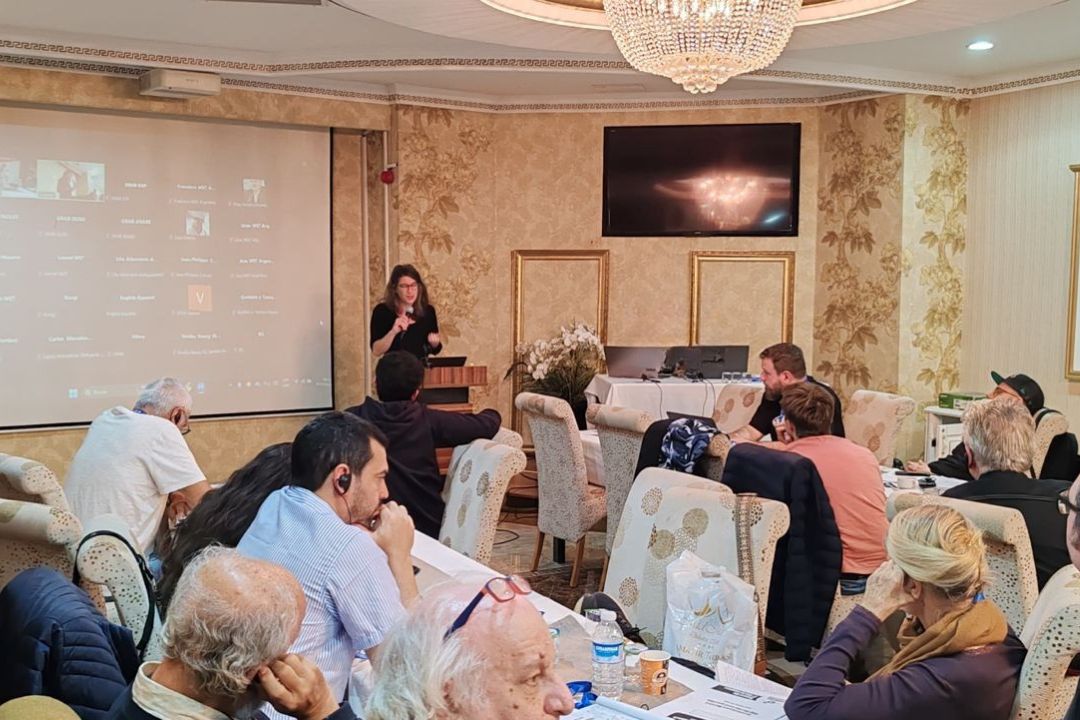
Comrade Hélène Arnaud and comrade Louis Trova, present as representatives of NpaR at the Third World Congress of the ISL held in Istanbul (6-12 December 2025), have signed a critical note on our congress, to which we wish to respond. With the respect due, but also with the utmost frankness. The overall approach of the note seems to us profoundly mistaken. On the one hand, it presents an objectively distorted picture of the ISL congress discussion. On the other hand, it reveals a genuine political divergence in both method and substance – both regarding important aspects of revolutionary politics and the construction of the revolutionary International. We respond here on both points, with the sole aim of fostering a genuine, not evasive or distorted, dialogue between the ISL and NpaR.
First, regarding the LIS World Congress.
We find the picture presented frankly astonishing. It is claimed that the congress “set aside several substantial discussions that revealed divergent opinions among participants (the nature of the Chinese state, ‘ecosocialism,’ feminist perspectives, etc.) in favour of the reorganisation process.” The opposite is true. The congress consolidated and expanded the international revolutionary grouping precisely on the basis of substantial convergence, both programmatic and analytical, across the entire global context. This is demonstrated collectively by the documents discussed and approved, mostly by unanimous vote, as well as by the depth of the accompanying discussions. The alleged “setting aside” of the mentioned topics completely misrepresents the reality of the congress. For example, the seminar decided on the specific characteristics of the new Chinese imperialism is based on the shared characterisation of the Chinese state as imperialist, as outlined in the congress’s central political document. The proposal by some comrades to avoid the term “ecosocialism” (which was, moreover, rejected in the vote) was made within the framework of the shared programmatic and interventionist approach to environmental issues. As for the document “For a Revolutionary Anti-Capitalist Feminism,” it was supported and approved by all delegates. On every text, as is natural in a genuine congress, amendments were voted on, both those approved in various national congresses and those proposed by delegates at the world congress, but always within an underlying agreement on all “substantial” issues. It is striking that comrades who participated as observers in all the congress proceedings claim the exact opposite.
Our question is very simple: what is NpaR’s assessment of the “substantial” programmatic and political documents adopted at the third ISL World Congress?
The comrades’ note is largely evasive in this regard. In passing, in a brief parenthesis, it mentions the “well-known points of disagreement with the ISL”: “a certain fetishisation of the programme, a tendency to support resistance blocs unilaterally while neglecting critique of nationalist leadership, an emphasis on trade union work, and an excessively simplistic connection between democratic and socialist tasks.” Frankly, we doubt that such cryptic and cursory references can make the divergences they allude to comprehensible. We also doubt that these divergences are “well-known.” What, for example, does “fetishisation of the programme” mean? In the Leninist conception, the general programme and the shared framework of principles form the foundation of a revolutionary organisation and its democratic-centralist functioning. Isn’t that so? If “fetishisation of the programme” refers to an abstract, immutable ideological version, the accusation against the ISL is completely unfounded. The programmatic political document and the entire discussion at the World Congress on all “substantial” topics show precisely the opposite: the determination to articulate, develop, and update the transitional programme across all aspects and sectors of revolutionary politics. Where is this “fetishisation” supposed to be?
The “tendency to support resistance blocs” seems to refer to defending Ukraine from Russian imperialism and Palestine from Zionist and imperialist aggression. We confess to this “tendency,” which follows a basic principle of revolutionary politics: the unconditional defence of any people or nationality oppressed by any imperialist and/or colonial power. But it is completely false that we “neglect critique of the nationalist leadership” of the resistance. The opposite is true. Just read, if needed, the resolutions passed by the Third Congress on Ukraine and Palestine. It is true, however, that support for the resistance of attacked nations is “unconditional,” meaning it is independent of the character of the nationalist leadership we criticise, whether it is Zelensky’s pro-imperialist leadership or Hamas’s reactionary Islamist leadership. In other words, we are never equidistant between imperialism and colonialism on the one hand, and resistance to imperialism on the other – regardless of the differences in context – using the nature of their leadership as a pretext. Is this the divergence? Let us discuss it, but let us call things by their proper names.
As for the “emphasis on trade union work” (?), we do not understand what this is supposed to mean. All our organisations’ trade union work, if anything, links union activity to an anti-capitalist perspective and thus to revolutionary politics. The exact opposite of a syndicalist logic. Even more so, it is completely the opposite of the pro-bureaucratic line of an organisation like Lotta Comunista – which NpaR appears to maintain a privileged relationship with, which we consider absurd – which in Italy actively supports the CGIL bureaucracy against its internal left opposition. More generally, it is precisely we who consider a dangerous syndicalist deviation to be highlighted, which appears in your consistent refusal to set transitional political objectives in every struggle taking place in France. On the subject of “well-known” divergences, it would have been useful to pause on this one at the time.
In any case, none of the cryptic references to “well-known divergences” allow one to understand the true divergences they allude to. We are therefore fully ready to confront and clarify them one by one in a genuine political discussion.
The only real divergence that the note from the two comrades makes explicit concerns intervention towards reformist parties. Here, however, a peculiar combination seems to emerge: political misunderstanding, distortion of others’ positions, and a denial of the ABC of Leninist tactics. Let us examine this more closely.
The note presents as a “new area of discussion” the “debate on electoral tactics and neo-reformism.” The ISL congress is said to have been “polarised by debates on the characterisation” of reformist parties, “during which the reluctance to call them ‘bourgeois’ parties or even ‘worker-bourgeois’ as Lenin would say betrayed the desire to justify attempts at infiltration or accommodation. Similarly, on the question of electoral tactics (appeals to vote, critical support, electoral fronts, own candidacies), the insistence on the purely tactical nature of these options suggested, on the contrary, a rather strategic orientation towards these reformist formations.” This is followed by denunciation of reformism and its responsibilities; it is stated that “a critical vote or joining some of these formations fails to reach the workers who turn to them,” and it concludes that “revolutionaries must remain completely independent from the new reformist parties even in elections,” building “a revolutionary force based on the struggles of the movements,” and “not seeking to channel them into the ballot box”: “a pole of revolutionaries affirming its working-class roots, its solidarity with youth uprisings, its perspective of a communist society, in complete independence from the institutional left.”
It is difficult to concentrate so much confusion and oversimplification into a few lines.
First of all, the working-class/bourgeois character of reformist formations is, as is perfectly obvious, not in question. The alleged reluctance to define them as such on the part of the ISL, or of any of its organisations or internal positions, is complete fantasy. Truly incredible for anyone familiar with our politics and discussions, even superficially. Even more so for anyone who has read the documents discussed and voted on at the third ISL congress. Thus, the total political independence of revolutionaries from the politics and programmes of reformist parties, old or new, and the strategic centrality of class struggle and class action as the lever of transformation, as an alternative to any electoral or institutional illusion, is entirely self-evident. It even seems embarrassing in a discussion among revolutionaries to have to point out such obvious truths.
The point is another: whether revolutionary politics must be reduced to reaffirming opposition to reformism, and therefore to its denunciation, in the name of the centrality of struggle; or whether revolutionary politics is instead something more complex, as that historical legacy of Leninism and Trotskyism, formally referenced by us both, teaches us. We believe the latter. We think that the historical tradition of Leninism and Trotskyism on the question of tactics towards reformist parties should not be discarded, or presented as a “strategic” capitulation to the reformists. Rather, it is a fundamental toolbox to draw on precisely for the purposes of revolutionary politics; for exposing the reformists, intervening in the contradictions between base and leadership that traverse or may traverse them; expanding revolutionary influence, “winning the majority” for the revolution, and building an alternative leadership.
In this toolbox there is not only the politics of unity of action (the united front), which, to its credit, your own note cites. There is also the articulation of electoral tactics, when revolutionaries cannot be present independently, or on the occasion of a second electoral round; there is, in particular cases, the possible choice of entryism, when such a choice can favour the development of the revolutionary grouping of new forces, and thus a step forward in building an independent revolutionary party. On electoral tactics, our congress saw partially differentiated positions, which were discussed calmly, as is natural in a democratic organisation; on the possible application of entryist choices (as today in Germany or Great Britain), complete alignment of orientation was recorded, as well as a discussion of real experiences (such as that in Italy which allowed revolutionaries to go from 40 to 400 through revolutionary entryism in Rifondazione Comunista, preparing the birth of the PCL). In any case, on both fronts the methodological premise underlying the discussion was and remains the same: how to develop and articulate revolutionary politics that does not merely say “long live the struggles” and “down with the reformists,” but works to develop a political alternative.
It seems to us that your demonisation of the discussion on tactics, represented as a “strategic following” of reformist parties, is not only a striking misunderstanding of ISL politics and its discussion, but also a profound suppression of what should be the common revolutionary tradition of Leninist and Trotskyist reference and its richness. In other words, a form of minimalist reductionism of revolutionary politics; reduced to a pure sum of movementist agitation on one side and revolutionary propaganda on the other, without a transitional approach that bridges the two levels. For example, your abandonment of the demand “Macron out, for a workers’ government” seems to us emblematic of this limitation.
Finally, on the prospects for building the revolutionary International. We do not understand what your alternative proposal to the construction of the ISL is. To oppose the revolutionary regroupment carried out by the ISL, and its significant international development, with a “comparison of real experiences of activism” and possible “common campaigns” seems improper and misleading to us. Dialogue and common campaigns are always possible and welcome. Nevertheless, to set them against the unity of revolutionary Marxists in a common international organisation is a non‑sense objective. Unless one considers one’s particular experience of intervention, one’s particular tradition of activism, one’s particular current of origin as the alpha and omega of one’s international relations. However, that would be the classic self‑preservative logic of one’s own “faction” that has dispersed and fragmented the Trotskyist movement for years and decades. The revolutionary regroupment around the ISL aims precisely to overcome this logic: it seeks to unite organisations and currents of different traditions on a common programmatic basis to build a new tradition together. The great advances made in this direction by our third World Congress show that this path is not only necessary but possible.
In conclusion, your note states: “In a world in deep transformation it is essential that revolutionaries discuss not only their points of agreement but perhaps even more their disagreements. A future occasion will be the Internationalist Conference in Paris, the fourth edition of which… The objective of this conference will not be to build a new international but to establish a framework for political exchange and experiences of activism. A modest step, but an essential prerequisite for placing proletarian internationalism on solid foundations.”
Unfortunately, this is not the case.
Dear comrades, as you know we actively participate each time in the annual Organisational Conferences promoted mainly by Lotta Comunista and by your party. We will be present at their fourth edition too.
But let us say that assuming the relationship with Lotta Comunista as the main projection of your international initiative not only measures its limit but also has paradoxical implications. Lotta Comunista is an opportunist sect self‑centred, not only complicit with the Italian trade‑union bureaucracy as we have recalled, in some cases with roles of responsibility, but hostile to every movement of solidarity with Palestine to the point of physically clashing in Rome and Milan with Pro‑Palestine activists occupying the universities. These actions have been widely reported and criticised as contrary to genuine internationalist solidarity with the oppressed.
The rise of mass mobilisation for Palestine in Italy between late September and early October, with huge street demonstrations, recorded in the entire Italian left a single conspicuous absence: that of Lotta Comunista. The same occurred for demonstrations in defence of Venezuela against US imperialist piracy: Lotta Comunista holds a defeatist bilateral position between the US and Venezuela in the name of “Scientific Communism,” and according to its own theoretical framework rejects the idea that national liberation causes remain progressive after Vietnam.
The denunciation of imperialism and “war” in their discourse has often been abstract and ideological, failing to translate into active solidarity with oppressed nations and movements.
Naturally, “political exchange and experiences of activism” can be carried out with anyone, and we have no prejudices, not even towards LC. But to say that engagement with Lotta Comunista is “an essential prerequisite for placing internationalism on solid foundations” is truly unsustainable and disconcerting. Especially if the Conference with Lotta Comunista is set against the revolutionary regroupment in the ISL and with the ISL.
Of course, Lotta Comunista, being genetically inward-looking, poses no problems of political‑organisational choice or positioning on the international level, neither for NpaR nor for anyone else more generally. The annual Conference with Lotta Comunista allows all participating organisations to emerge exactly as they entered, guaranteeing each one’s self-preservation. It is not “a step,” “however modest,” towards anything, but a (legitimate) propaganda showcase for each. It appears to us as a small-scale repetition of the hypocritical method of Lutte Ouvrière: in words open to debate, in fact sectarian and closed to any genuine discussion for the regroupment of revolutionaries.
We believe that NpaR deserves something more. The emergence of NpaR in France is potentially a very important fact for the international Trotskyist movement. We believe it cannot and should not end up on the dead-end track of substantial national self-preservation combined with international relations without a future with LC.
The ISL therefore proposes to NpaR a genuine and sincere discussion on the terrain of revolutionary regroupment. A discussion/clarification that does not remove disagreements but avoids diversions.
ISL International Secretariat