POLITICAL LANDSCAPE
Labor reform and austerity package: Can Milei be defeated?
By Francisco Torres
The national political situation is entering key moments, particularly because the Senate is debating the slave-like
labor reform and the glaciers law, plus a package of reactionary bills. Milei arrives better, after the electoral result that allowed him to show himself as the supposed “guarantor” to advance with the pending “structural reforms”.
With the backing of the big groups, the banks, the IMF and imperialism, Milei seeks to pass a package deal: in addition to the labor reform and the glaciers law, they want to add counter-reforms in the criminal, pension and tax areas. And to support the disastrous DNU 941 on intelligence, which violates democratic freedoms, in a vigilant and persecutory line.
February 10 appears as a key date. It is not a question of isolated projects, but of an integral plan of a bosses’ and colonial offensive to consecrate a model of a country for the rich, where the working majorities are condemned to permanent precariousness, without rights.
At the international level, Trump’s aggression against Venezuela and his threats to other countries strengthen the ultra-right governments. Milei feels part of that crusade against the peoples and is emboldened to deepen his adjustment, surrender and repression. From the MST, as part of the Frente de Izquierda Unidad, we reject the aggression and any transition dictated by the US and we call to confront these advances with mobilization and a continental strike, as proposed by Pérez Esquivel.
Country mortgaged to the IMF and vulture funds
Although Milei aligns himself with Trump, he does not move forward smoothly. It comes from suffering parliamentary setbacks in December that left a bitter taste in the Casa Rosada. There are bill-passing, unfulfilled agreements with the governors, and a fierce internal conflict in the “iron triangle” that manages the country. The postponement of the labor counter-reform to February expresses this crisis at the highest levels. Milei does not have it easy, although there is a bourgeois agreement to move forward.
The economic context is complex and does not “spill over”. The country risk does not go down and Argentina has maturities for almost 20 billion dollars this year. Milei and Caputo govern for creditors: by paying debt with more debt and auctioning strategic assets.
On January 9 they paid U$S 4,218 million to the vulture bondholders, equivalent to more than 6 billion pesos. With that, 90,000 popular housing units could be built and 450,000 genuine jobs could be generated, doubling the destruction of employment in these years of government. There are two entire municipalities of Buenos Aires, such as Ituzaingó and Ensenada, which could be built from scratch with that money that is going down the drain of international usury. And in February they will pay U$S 839 million to the IMF, which is equivalent to another 17,000 houses and 85,000 jobs that are being lost due to the swindle of the “eternal” debt.
This while the Central Bank’s reserves continue to lag behind the IMF’s requirements, the tax collection is contracting and the provinces see their accounts suffocated. In December, real tax collection was the lowest in the last 15 years. VAT, being the most regressive tax and at the same time an indicator of consumption, fell more than 7%.
Industry and construction cannot find a floor: industrial activity fell almost 9%, with five months of decline. While consumption is sinking: retail sales fell more than 5% year-on-year in December. Inflation rose again to almost 3% and the poverty and indigence baskets jumped to 4.1%, rates and transportation are skyrocketing and rents are unaffordable. This generates a strong social unrest, ready to take to the streets if summoned.
Falling incomes, job insecurity, layoffs and closings
Wages are still on the floor: in the private sector, they fell in November for the third consecutive month. National government employees lost 33% of their purchasing power and in the provinces, they will end 2025 with a real loss of 6.5%, as of November 2023. Pensions were cut by 27% in real terms and social plans have been frozen for years, when 1 out of every 3 Argentines is poor. In this context, Milei rewarded his caste of ministers and officials with a 90% increase, the same ones who ask for “sacrifices” from the people.
In addition, families are getting into debt to survive: delinquency tripled in one year. Household consumer credit debt climbed to levels not seen in more than a decade: since December 2023, it increased 147%.
In this context, the wave of layoffs and closures does not stop, as a result of two years of chainsaw, of labor reform with the DNU 70/23 -declared unconstitutional by the Labor Courts-, and the Ley Bases with the “modernization” verse. Plus an opening that leads to industrialization with the story of “competition”. Thus, December and January left another string of closures and workers in the street. Since Milei took office, 21,046 companies closed down and 270,852 formal wage earners lost their jobs, which means that 30 companies close down every day, more than one per hour, and 371 people lose their jobs every day!
This is aggravated by the fact that 9 out of every 10 jobs generated are precarious, since only single-employment, informality and self-employment are growing. The “uberization” of the labor market and the phenomenon of poor workers is consolidated: 7 out of every 10 employed persons do not cover the basic food basket.
A slave reform, no “modernization”.
Milei wants to deepen this model with his labor reform, which implies the elimination of severance pay, extension of trial periods, junk contracts, more power for the bosses, limiting the right to strike, having to ask for permission to hold assemblies and suffering a discount for attending, persecution of union activism and legalization of precariousness.
There is no modernization, they want to take us back to the 19th century. They are not going to generate genuine jobs. They are not going to reduce informality. They are going to multiply precarious contracts, poverty wages and permanent instability.
That is why it is key to disprove the official story. There are no “surplus rights” or “trial industry”, it’s all just a bunch of bullshit. Labor rights exist because they were won through historical struggles and are always under attack. It is not true that we have to give them up in order to have a job. What we have is a capitalist system in crisis that wants to unload it on our backs.
52 years ago: only 8% poverty rate and only 10% informality rate
Milei sends fruit with his data, it is false that there is a “record number of jobs” since the level of what they call employment has remained constant in the last 4 years and only one point above 2017, that is, almost the same as 9 years ago. But the situation is more serious if we compare it with Alfonsín, who left his government in the midst of hyperinflation in 1989: “in those days, unemployment reached 8.1% and black labor was around 32%” (Chequeado, 12/13/13).
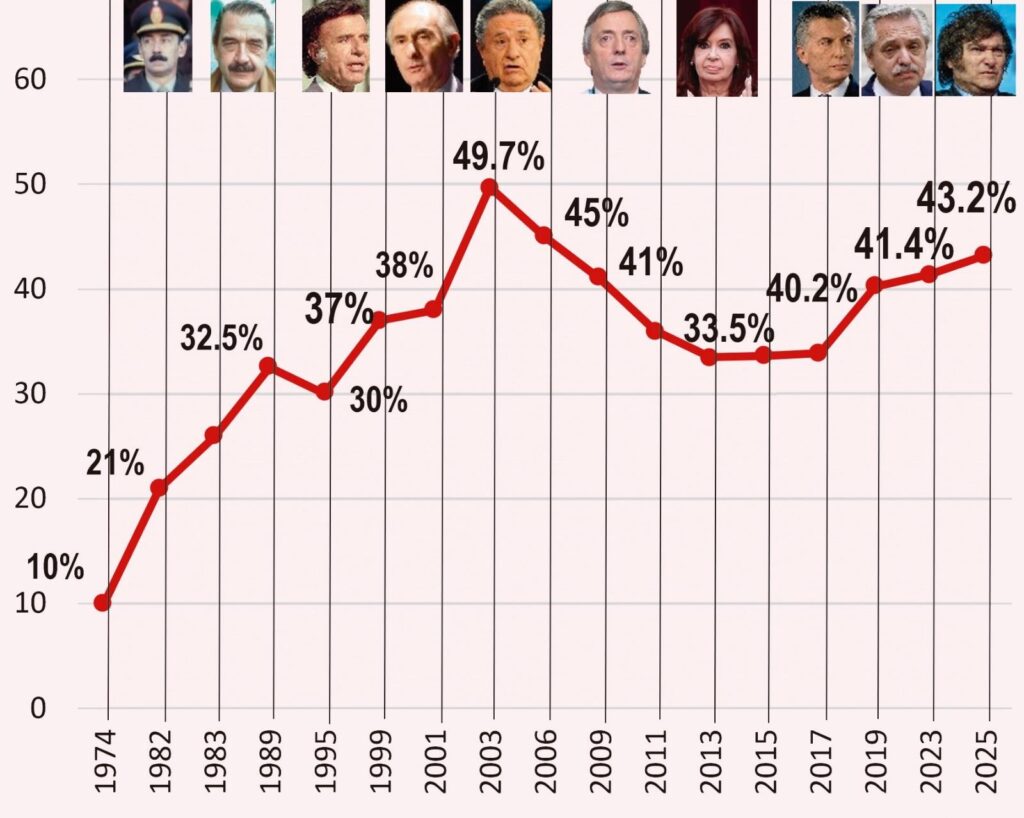
And as Milei likes “historical” comparisons, it gets worse. More than 50 years ago, in 1974, there was only 8% poverty, 10% informality and 2.7% unemployment (Chequeado, 10/22/15). While those figures quadrupled today: poverty climbs to 31.6%, informality jumped to 43.2% (see chart) and official unemployment -quite questioned-, reaches 6.6%. With the youth as those who suffer the most, with 60% in the informal sector (El Economista, 7/10/25).
After two years of applying his anti-worker reforms, Milei has the second worst record in the last 51 years, since “informal or ‘black’ and self-employed jobs continued to rise and already represent 50.6% of total jobs” (Clarín, 11/13). With a level of informality only surpassed by the outbreak of 2001.
The same thing happened in these five decades: each attempt at “labor reform” implied more informality, unemployment and lower wages. The supposed “formal employment” never existed, it is just a slogan to pass the removal of rights. The military, PJ, UCR, Alianza, PRO and the ultra-right governments, promote them in the name of “modernization”, “productivity”, “formal employment” and hypocritically appealing to the needs of young people “without rights or stability”, but they are a consequence of the policies they applied and did nothing more than make working conditions more precarious and facilitate layoffs.
No capitalist “reform” generated genuine work. On the contrary, they increased informality, which jumped from 10% in 1974 to 21% in 1982 with the dictatorship, until it climbed with Milei to 43.2% (see chart). Their project is the most aggressive phase of that anti-worker offensive and there will be no stable work or rights, if we do not confront it with struggle and mobilization, following the path of the Garrahan.
The need for a strike and plan of struggle by the CGT and the CTAs
The CGT and the unions do not warn or explain the brutal consequences of this counter-reform. They talk about “fighting in all spheres”, prioritizing Congress and Justice, without setting a date for an active national strike or a plan of struggle. They dose the claim and bet on negotiation, in which even Bullrich is willing.
The CGT scored as a triumph the postponement of the treatment to February, but it was necessary to use this time to prepare a great national response. It has already been demonstrated that Milei is not invincible. The Omnibus law fell with mobilization, strike and pressure in the streets. They can be defeated again.
This was also demonstrated by Garrahan and other struggles that are a national cause, such as the university or disability. We must demand and set up assemblies in each union, meetings of delegates and activists, draw up base mandates, vote for campaigns of massive explanation and demand that the leaderships call for a national strike in each union and the Central Unions, with a plan of struggle. It is necessary to organize the employed and unemployed, the health, the state workers, the teachers, the precarious workers, the youth and retirees.
Crisis at the top, political weakness and a fragmented PJ
The government has in its favor a PJ in crisis, defeated, fractured and in retreat. Responsible for another frustration due to the disaster with Alberto, Massa and Cristina that paved the way for the ultra-right. And when this government was on the canvas, Peronism ensured its survival and let it recover by not confronting it in the streets.
But there are also crises at the top, internal fights and power disputes, agreements that are not fulfilled and governors who pass bills. This opened a window to postpone the labor reform. Although the board can be rearranged again, with money in exchange for votes, despite the fact that the government has not secured it.
In a context where Peronism no longer calls or raises its banners of social justice, political sovereignty and economic independence, we only do it from the left. Its last governments passed between adjustment, IMF, corruption and not affecting the economic power, leading to the social disaster that enabled Milei.
It does not appear as an alternative for millions, in the province of Buenos Aires the PJ unloads the adjustment on the working people, without touching the rich, the bondholders of the debt or the 1,300 families that own a third of the land in Buenos Aires. The same happens in La Rioja, Formosa, La Pampa or Tierra del Fuego, not to mention Córdoba, Catamarca or Tucumán.
This has an impact on the workers and popular bases of Peronism, where the disappointment and alienation of honest fighters, whom we call for a serious change, is growing. Because the PJ is no longer an alternative, neither of government nor of opposition, and a new alternative, anti-capitalist and socialist, is needed.
Another exit from the left
In the midst of this debate, from the MST in the Frente de Izquierda Unidad, together with Vilma Ripoll and the other benches of the FITU, we presented in Congress a bill for a Labor Emergency Law, to create genuine work with a different perspective:
– Prohibition of layoffs and suspensions
– Reduction of the working day to six hours with no reduction in wages. Sharing of working hours, work less to work for all.
– Young people’s first job plan without precariousness, with equal rights and salaries
– National plan for public works, housing and popular urbanization to generate 2 million genuine jobs
– Increase in salaries, pensions and social programs to the value of the family basket, with automatic indexation for inflation.
– Universal unemployment insurance, equal to the basic food basket. Open enrollment in social programs and increase the amount until the labor emergency is resolved.
– 82% real mobile 82% for pensions and restitution of employer contributions. Defense of the pension funds and private pension systems.
– Reinstatement of precarious employees and contract workers
– Recognition of those who work by application as workers and their rights by companies
– Democratization of trade unions, full freedom of organization and the right to strike.
– Extraordinary taxes on big capital, banks and landowners to finance these measures
– Suspension of debt repayment to allocate these resources to social debt
There is another way out, at the service of the social majorities. We can impose it with struggle and mobilization, with the example of Garrahan.
A political alternative of the left and the workers
The crisis of Peronism opens a scenario of debate and regroupment in workers, youth and popular sectors that dream of another country, one that the PJ neither wants nor can offer. For the Frente de Izquierda Unidad, which we integrate from the MST, this poses a challenge and a strategic opportunity: to be a real option, with mass influence, that disputes the course and political power.
In the face of Milei and the crisis with no way out for the PJ, the task is to build a new political alternative of the left and the workers, that stands up to the adjustment and the surrender, and summons those who seek a fundamental solution. To organize the social anger and turn everything around.
Shortly after the 50th anniversary of the genocidal coup of March 24, 1976, Milei intends to consecrate a repressive regime, in a society of privileges for few and misery for millions. We cannot allow it. March 24 can become a huge national mobilization, broad and united in diversity, against the government that insists on changing the regime for a more authoritarian one.
Let us prepare this course. With a big mobilization on February 10, demanding and promoting a strike of the CGT and the CTA. By being part of the Open Town Hall on February 4 at the Garrahan Hospital, together with trade union, social, environmental, student, human rights, retirees and political organizations.
To form an independent column, proposing to the central organizations the need for an active strike and mobilization. With a program that rejects Milei’s reforms, the Budget 2026, the repudiation of the 44 summary proceedings against the leadership of the triumphant strike at Garrahan, among them our comrade Norma Lezana, and for the effective application of the emergency laws in Health, Disability and University.
More than ever we must win the streets in a united way, until we defeat the labor reform and the entire Milei regime. The ultra-right can be defeated. We have already demonstrated it. Join this fight with the MST in the Frente de Izquierda Unidad.
Click here to access to the Labor Emergency Bill, MST FIT Unidad