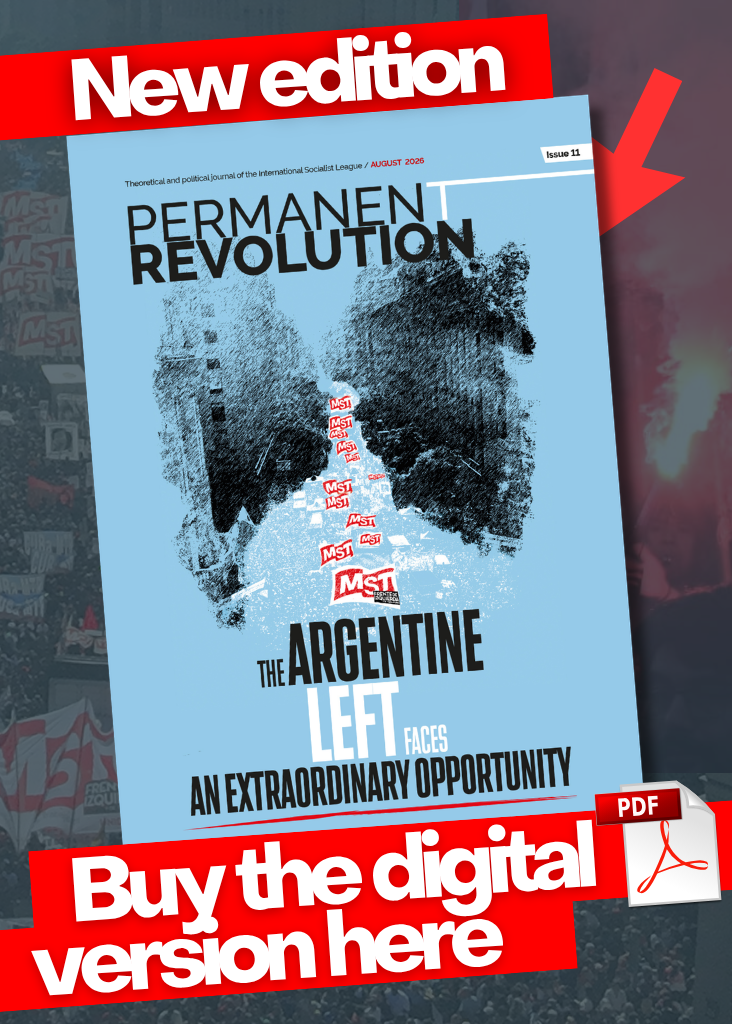
By Guillermo Pacagnini
In the current complex situation, ¿what tasks and strategies does the FITU (Workers Left Front Unity) to build the alternative that is needed? This is a fundamental debate that we must continue to develop with left-wing and fighting activists.
In this momnet, when Milei intends to advance his strategic anti-rights plan, the revolutionary left and fighters face two fundamental challenges in responding to thousands of activists who are seeking ways to organize to defeat him and what steps to take.
One challenge undoubtedly has to do with promoting greater unity in action to mobilize, support and unite struggles by breaking the siege of bureaucracies, improving the coordination of organizations and sectors in struggle and regrouping the militant sectors.
But the other task, more strategic and fundamental than the previous one to develop, has to do with building a political alternative. Because the capitalist crisis and the shifts to the right of regimes and governments impose more and more limits on labor and social struggles, reducing the possibilities for sustaining achievements. Without fundamental changes, without anti-capitalist measures, it is impossible to consolidate social gains.And to achieve these changes, we need an alternative that allows us to overcome once and for all the false choice between the most conservative parties and the false progressivism that has failed time and time again and ended up opening the door to these right-wing variants. This is what happened with the coalitions built around Peronism, which failed and facilitated the arrival of Macri first and now Milei.
The ground gained by the FITU is the clearest expression that thousands are beginning to look for something different and for a space on the left outside the traditional options. But that expression is not organized and has been limited to the electoral and testimonial arena. It must and can grow much more, but only if a change of orientation takes place.
We have made many proposals to promote, expand, and strengthen the FITU, to organize the current of electoral sympathy and class struggle activism that exists around the front, and also to advance in a regrouping of the left that seeks to contest power. However, there was no response from the FITU’s other forces. The PO and IS prioritize and persist in a unionist and conservative perspective. In recent months, we have opened a discussion with the PTS about the public positions we have put forward, which we need to develop and deepen. Our proposal for a unified party of the left with tendencies, their proposal of a Workers Party and others that may arise, are under debate. Milei’s attacks and the crisis of Peronism increase the need and urgency to address this dilemma.
Peronism in its labyrinth
The historical and structural crisis of Peronism has entered a new phase, one of senility. The internal disputes and fragmentation into different factions have intensified, factions that do not differ essentially in their strategic visions, since all have shifted to the right, far from their three historical banners (social justice, economic independence, political sovereignty), and profess an undisguised cult of capitalism varnished with supposed benefits that do not exist in reality. Their different tendencies increasingly express a process of decomposition and decline.
This crisis undoubtedly has an impact on significant sectors of their working-class and popular base, much of which, disappointed and showing signs of demoralization at not finding programmatic answers or ways to fight back, are abandoning them and seeking solutions on the left. This generates greater receptivity to our proposals and to the FITU’s program that offers a way out of the crisis. The issue is that this proposal must be translated into a more powerful and visible alternative with an orientation that seeks to organize these thousands of people seeking in the left for a democratic channel for struggle and real transformation. The FITU has this opportunity. Unfortunately, it is not being exploited to its full potential, and that is what this debate is all about.
Disappointment with Peronism will continue to grow. Peronist leaders showed no intention of defeating Milei’s government, their promise to “stop” him electorally failed, and now some sectors openly collaborate with the government’s stability, with Peronist Congress members supporting its laws and Peronist CGT union bureaucrats negotiating the labor reform. Beyond differences in rhetoric style, the wings of both Governor Kicillof, who has relaunched his movement to contest the next presidential elections, and Cristina Kirchner, who controls part of the Peronist Justice Party but is weakened and under house arrest, agree in this political strategy. In addition to them, there is Massa’s sector, the right wing of Peronism, and Juan Grabois and his Patria Grande wing, which is part of the Peronist electoral front, contributing a “progressist” discourse that attempts to contain the defections to the left. That is why he occasionally engages the FITU in debate to try to weaken it. They are aware of this process.
All of this presents an important opportunity and necessity for the FITU , insofar as we can strike hard with the political need to build something big and different from the left, calling on the Peronist working class to leave that failed experience behind. As the situation of struggles and anger with Milei becomes radicalizes and deepens, this whole debate and the need for a strong force on the left that can seriously compete will become more acute in the social bases.
Significant but insufficient
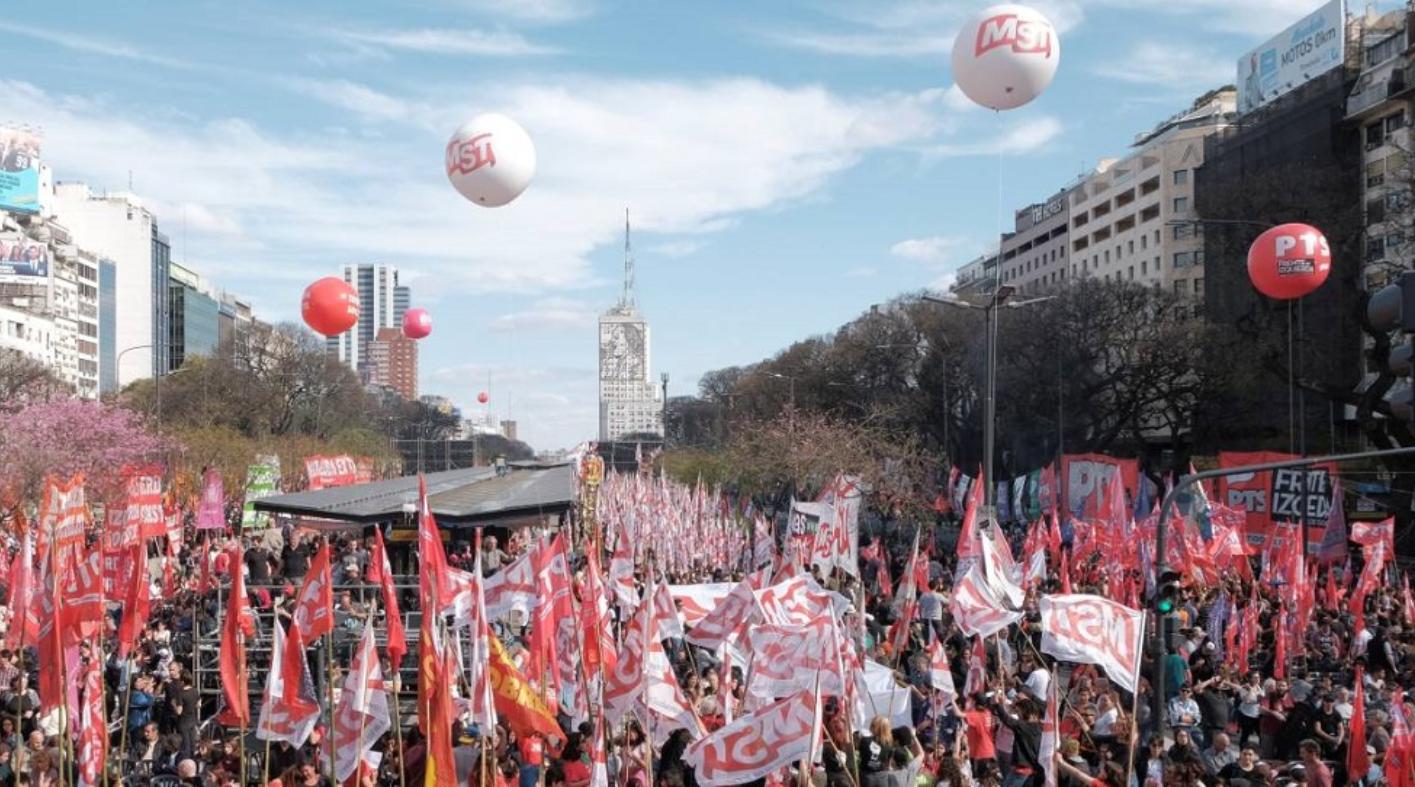
In Argentina, the revolutionary left has tradition and presence in the labor movement, activists in the struggles, and also a foothold in the political-electoral arena. Since the “Argentinazo” rebellion of 2001, the left has grown in social movements and labor unions and in the class struggle. Electoral unity in the FITU has been a step forward, consolidating a political space, but with the problem of being limited exclusively to the electoral arena.
Today, to the left of Peronism, the FITU continues to appear as the main political force that can capitalize, at least in part, on the discontent with the government. In the recent elections, we obtained 4% of the national vote (around 1 million votes) and three National Congress seats, which include MST congress members elect. Outside the induced polarization between the forces of the regime, our front has been the third electoral force in key districts such as the Province of Buenos Aires and CABA, the country’s capital. We have sustained national and provincial legislative seats for many years now. We have also become a reference point and consolidated a position in the political superstructure.
Unfortunately, there are major limitations and the number of votes has stagnated, without making clear new gains. This is not only due to objective reasons related to the relative weight of Peronism or the ups and downs of the class struggle. It is also a consequence of the conceptions and strategies of the three forces that, together with the MST, make up the Left Front: the PTS, the PO, and IS. These limitations have led to not using the FITU’s strong position in the superstructure to promote united front tactics and unity of action to amplify the mobilization to confront the government, encourage the development of the political process, the class struggle, and reform union leaderships. The front’s forces end up intervening separately and often with opposing policies. Often, the model of being a solely electoral front ends up becoming an obstacle to the advancement of processes of struggle organization and to the political organization of thousands in unions, places of study, and working-class neighborhoods. The FITU, as an electoral model, has never acheived a qualitative leap in influence or toward becoming an alternative for sections of the masses because it lacks an adequate strategy and the vocation to fight for political power by organizing and uniting to supporting the mobilization of millions.
What do we do from the FITU?
For years now, the MST has been promoting various proposals to strengthen the FITU: plenary meetings and open assemblies, democratic decision-making mechanisms to incorporate sectors that do not belong to the parties or other groups but adhere to the FITU’s program. These initiatives are not limited to within the front, but seek to engage workers, anti-bureaucratic activists, young people who support the left, intellectuals, and social, socio-environmental, and human rights leaders, among other sectors.
The Left Front has a responsibility to fully assume its place, take the offensive, and overcome the self-imposed limits and political visions that restrict it from within. We have debated with the mistaken conceptions and strategies of the front’s other forces that have a skeptical view of the possibilities of the revolutionary left, which, in turn, leads to policies that oscillate between sectarianism and opportunism, two sides of the same coin. This problem is compounded by electoralist and hegemonic practices that hinder the FITU’s capacity to attract activists and new sectors.
Unfortunately, there are many examples of this. The most grotesque was on March 24 (anniversary of the 1976 military coup), when the PTS, PO, and IS turned their backs on a mass process that called for a united mobilization against Milei, preferring to divide and organize a small and marginal action. In contrast, our party, in unity with the human rights organizations and social movements of the Encuentro Memoria, Verdad y Justicia (Memory, Truth and Justice Encounter), promoted a joint action of all the human rights organizations, achieving a massive demonstration and preventing Peronism from imposing criteria based on its electoral interests. Another case was the struggle of the Garrahan Hospital, where the PO adopted positions that divided the leadership of the conflict and opposed the broad coordination achieved by the Cabildo Abierto and the APyT. In both cases, the result was that the FITU did not play a positive role. These misguided policies are repeated in the labor movement, in the feminist and LGBT movements, in the student movement and in neighborhoods, contributing to the electoral stagnation of the front.
More recently, with the mobilization against the labor reform, the bureaucratic and trade unionist politics of the PO and IS once again prevented the FITU from playing a coordinating role. Any attempt to collectively discuss with the aim of developing a common policy where we intervene, is systematically denied by the front’s other forces. Our insistence has fallen on deaf ears, dispite the fact that, on the few occasions when we have managed to coordinate (e.g. the mobilizations against the IMF or the first actions against Milei’s “bases law”) the results were positive, albeit short-lived. However, in labor conflicts like the SUTNA (tire factories workers union) or the Garrahan, in union elections, and in key events like March 24, the FITU played no role. This directly affects the two central tasks of the left: promoting mobilization and building a political alternative. Limiting the FITU to the electoral arena, refusing to form a united front, and acting in a fragmented manner hinders mobilization, favors the bureaucracy and Peronism, and erases the front’s prominence in times of militant radicalization.
These issues have become recurrent debates in various fronts and in among sectors like the arts, as expressed in the assembly of intellectuals, where the limits of the front were pointed out.
On to the debate
Our party proposes a comprehensive plan based on the current reality of the FITU that seeks to overcome its limitations as a purely electoral front. We propose moving toward a unified left party, with the liberty of forming tendencies. Open to intellectuals, social leaders, independent individuals, groups, and sectors with whom we share campaigns. This party should function with democratic and participatory mechanisms, with ongoing political debate and weekly meetings that address the fundamental political events and class struggles. Our proposal is act as a united front, with a common policy, while maintaining the independence of each sector. No one would lose their identity or organization, but we would promote a deeper collective effort that would by capable of organizing thousands of new militants.
In parallel, the PTS has been promoting its proposal to form a Workers’ Party. We consider it positive that this debate is opening, beyond our differences, and that other proposals could also be raised to break the current deadlock in the FITU and take a qualitative leap forward. Our comrades of the PTS recognize, and we agree, that today there are no independent workers’ currents or militant union sectors promoting a workers’ party as we have seen in other historical times. If a class-independent current with that perspective were to emerge, it would be very positive to build an alternative together. But the question is what to do today, otherwise the proposal remains in the limited realm of propaganda. In that sense, we believe that a change of model in the FITU would better position us as a political alternative, help organize thousands, and encourage anti-bureaucratic workers’ sectors to take a step toward political participation.
There are no irreconcilable positions between our proposal and that of the PTS. A Workers’ Party would necessarily be a party with tendencies, and today those real tendencies exist in the FITU. That step can be taken today with a political decision. The program is already there: we need to open the debate on how to move forward. The FITU is in a position to take that first step. That is why we consider it crucial to develop this discussion, bring the proposals down to earth, and consider what conditions exist to take concrete steps as soon as possible. The situation demands it, activists would welcome it with enthusiasm, and we would offer a channel for sectors abandoning Peronism and for the numerous mass of comrades who sympathize with the FITU but are not yet organized. It is a matter of strengthening a pole of reference capable of seriously contesting power.
For our part, we are willing to facilitate all the necessary conditions for this debate to develop and advance.