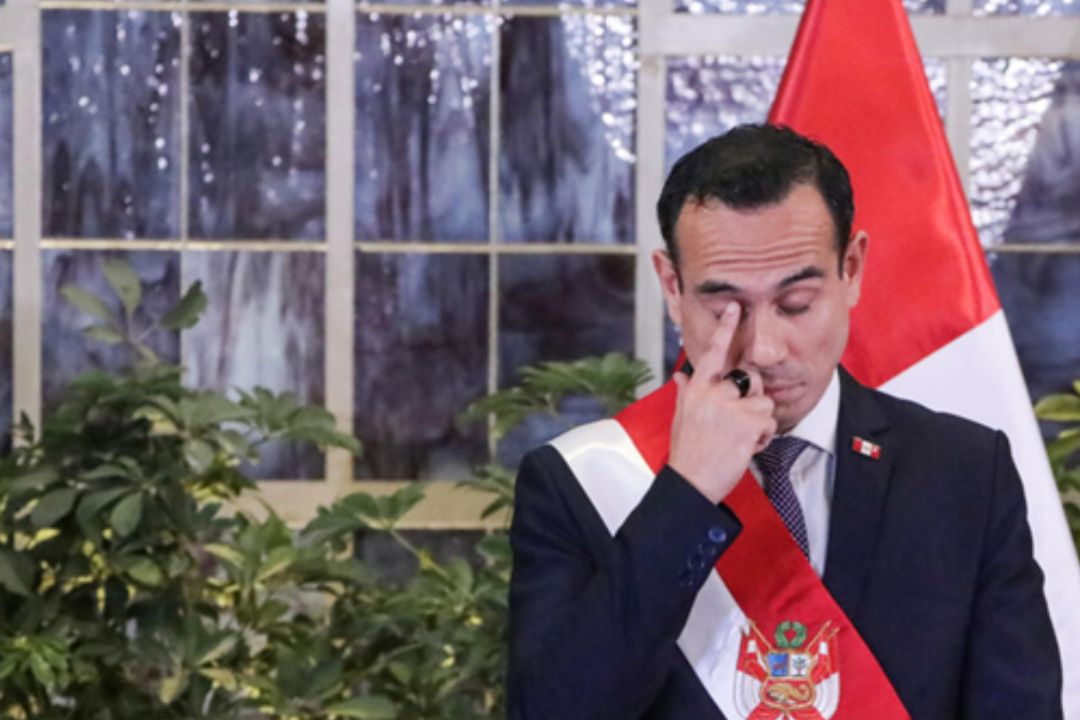
Peru is going through a new episode of political instability in the middle of the transition government set shortly after the vacancy of Dina Boluarte in October 2025. In this scenario, the censure approved with 75 votes in favor and 24 against José Jerí by the Congress of the Republic has already taken place and produces an immediate effect: since Jerí is president of the Congress and, at the same time, in charge of the Presidency of the Republic, his removal from the Parliament implies that he automatically ceases to be the head of the State and returns to his condition of congressman. Therefore, the country enters a new power vacuum within an electoral calendar in progress, while the Congress itself debates the lists and formulas that will allow the designation of who will assume the transitional presidency until April, when the elections will be held.
The figure used to displace Jerí is the parliamentary censure, not the presidential vacancy. The censure is a political measure directed mainly against authorities who occupy positions of trust, such as the president of the Congress, and its approval implies the immediate dismissal from that position without preventing the person from continuing as a parliamentarian. It is approved with a simple majority of the congressmen present in the session; that is to say, if all 130 legislators are present, 66 votes are enough to carry it out. The vacancy, on the other hand, is a constitutional process aimed at removing the president of the Republic for specific reasons, requires a much higher threshold of votes and implies the definitive removal of the president from office without the possibility of immediate reinstatement in Congress or other public functions. In the current case, censure becomes a quicker and politically feasible mechanism to remove the person exercising the transitional presidency through the Parliament.
The motion was admitted for debate in the plenary and discussed for hours in a climate of strong tension between benches, cross negotiations and last minute repositioning. The result is the approval of the censure and the opening of a new dispute for the control of the interim presidency in a fragmented Congress with little social legitimacy. Among the elements that fueled Jerí’s fall, there are allegations of sexual violence, questions about meetings and links with actors associated with Chinese capital, ruptures within the blocs that sustained the political balance after Boluarte’s departure and, above all, the dynamics of confrontation between different fractions of economic and political power in an institutional system that accumulates unresolved crises.
This new panorama cannot be understood as an isolated event or as a democratic response to popular demands. Jerí becomes the transitional president after the fall of Boluarte and is now displaced in one of the multiple rearrangements between sectors of the Peruvian bourgeoisie itself that use a deeply eroded institutional apparatus to settle their internal disputes. In the last decade, the country is on the way to having nine presidents, which translates into a rotation that does not respond to an effective exercise of democratic control from below, but to the inability of the political regime to stabilize its own mechanisms of domination. The names and alliances change, but the same economic orientations and the same power frameworks are preserved. The presidencies become functional insofar as they are useful to the leaderships that control the Parliament and the economic interests that orbit around it.
The Peruvian bourgeoisie, closely linked to international capital, resorts to these replacements to prevent the political crisis from turning into a regime crisis. Thus, censorship does not constitute a form of democratic justice or a structural solution to denunciations or social unrest, but rather operates as a self-regulating mechanism of the system itself to remove figures that become politically costly and guarantee the continuity of the existing order. Parliament does not express the popular will in a substantive sense: it administers the minimum stability necessary to sustain the electoral calendar and preserve the economic model, even when this implies successively replacing those who occupy the head of state in ever shorter periods. The same elites that originate the crisis then present themselves as guarantors of governability and the “national interest”, while seeking to contain its effects without altering the bases that produce it.
In this context, the fall of Jerí is one more expression of a structural crisis that cannot be solved with new replacements within the same power bloc. The reiteration of censures, vacancies and replacements is evidence of the erosion of the political regime and the growing distance between the institutions and the social majorities. Faced with this, it becomes necessary to promote a process of organization and active mobilization from below, led by workers, youth and popular sectors, to transform the current political crisis into an opening towards structural changes. In this perspective, the call for a free and sovereign Constituent Assembly, arising from social mobilization and not from the agreements of the parliamentary leaders, appears as a democratic solution to reconfigure the bases of the political and economic order. It is not only a matter of replacing authorities, but of discussing who holds power, how the State is organized and at the service of whose interests. Without a constituent process driven from below and articulated with social mobilization, the succession of presidents and parliamentary disputes will continue to function as mechanisms to contain a crisis that, far from being resolved, is reproduced for the benefit of those who concentrate economic and political power.
For these reasons is that from Alternativa Socialista Perú we will continue to struggle so that once and for all those who have never governed, the workers and the Peruvian people, will govern. Behind these objectives we also present an alternative so that in the next elections we support our comrade Sofia Martinez (22 Juntos Por el Perú) so that both in the streets and in parliament the voice of those who struggle will be heard. We also call on all those who claim to be anti-capitalists to debate how to organize ourselves and, respecting our differences, confront until we defeat the capitalist monster.
Socialist Alternative Peru