In a session marked by a general strike and police deployment in the streets, the Lower House of Congress approved the government’s labor reform.
Voting results
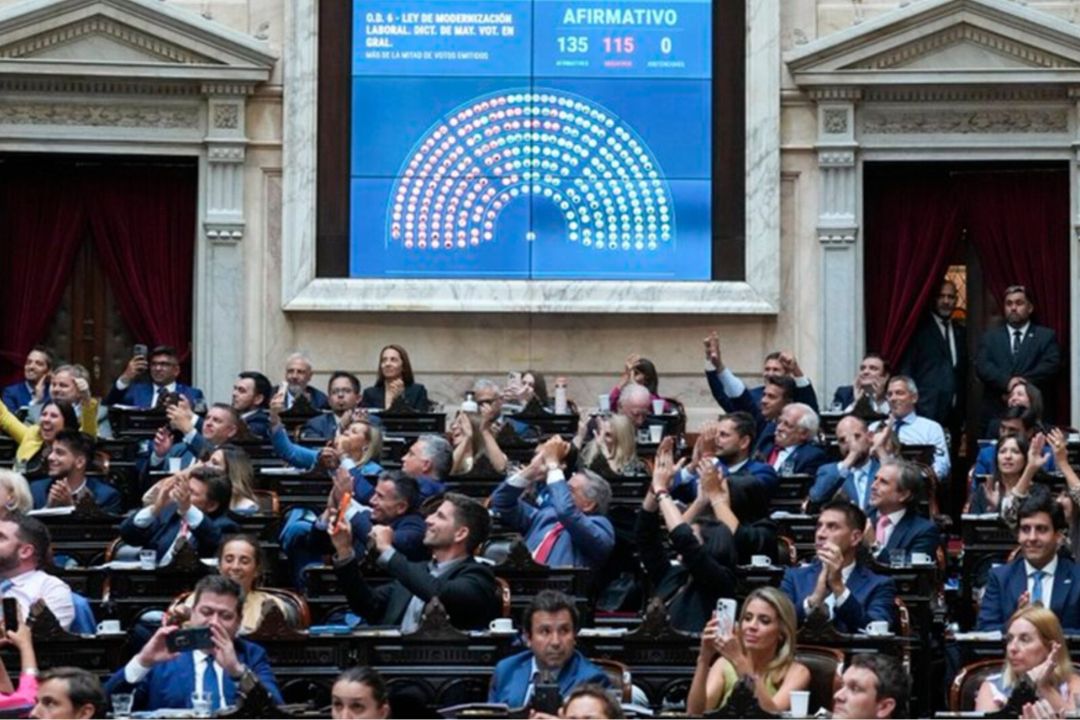
On a day marked by the general strike, Deputies approved by 135 votes in favor and 115 against the labor reform promoted by the Government of Javier Milei. The bill will now have to return to the Senate due to changes introduced in the debate. The vote took place after a tense session and massive mobilizations in the streets, where unions and political and social organizations denounced that the reform represents a structural setback in labor rights and an offensive against the working class.
The text underwent modifications during the treatment in committee and in the plenary of the lower house, among them the elimination of the controversial article 44 on medical leave, a necessary concession to ensure the necessary number of parliamentary support. Due to these changes, the bill will have to return to the Senate for its final ratification before becoming law.
The approval of the bill was possible thanks to the parliamentary alliance of the ruling party with provincial blocks and political forces that respond to its adjustment agenda. Among those who voted in favor were legislators of La Libertad Avanza, the PRO, the UCR, Federal Innovation and members of other provincial spaces and blocks allied to the Government, totaling 135 affirmative votes in the chamber. The ruling party was also helped by Peronist governors and their deputies, who first were key for the government to have a quorum and for the bill to be dealt with, and then gave it two votes from Tucumán in the general support and other key votes in some articles. There were also some sudden absences.
In contrast, the bill was rejected by legislators of the Frente de Izquierda, Unión por la Patria, the Coalición Cívica, and other blocks critical of the initiative, who denounced that the text deepens labor precariousness and weakens the rights that have been conquered.
There were no abstentions, while there were six absences in the vote, reflecting the tension and political dispersion surrounding the project.
Context of the day
The vote took place within the framework of a national strike called by the General Confederation of Labor (CGT), with a massive adhesion in transportation and other services, as an expression of the rejection to the package of labor and economic measures of the Government. A measure which, since it does not include mobilization, nor a plan of struggle to give it continuity, ends up being insufficient and limited. Likewise, large swathes of workers were part of the mobilization called by militant sectors and in spite of the CGT.
The reform not only makes layoffs cheaper and extends the working day, but also represents a systematic attempt to subordinate the labor force to capital and weaken collective bargaining.
No “modernization” was voted, as officially presented by the Executive, but rather a deepening of an adjustment model that unloads the crisis on the backs of the workers and that, in addition, has counted on concessions to governors and provincial blocks to ensure a quorum and favorable votes.
Although one of the most aggressive articles of the original text was eliminated, the reform continues to consolidate a scheme that favors labor flexibilization, reduces protection against layoffs and curtails basic union rights, placing the working class in a position of greater vulnerability vis-à-vis employers and the labor institutions themselves.
The session and the vote are part of a new chapter of confrontation between an official agenda that prioritizes business competitiveness and a popular response that is organizing in the streets to resist these structural changes.
It is necessary to deepen the struggle against this slave reform with a major strike of 36 hours and with mobilization when the bill goes to the Senate. And with new progressive actions against this project, the whole plan of adjustment and in support of Garrahan and the workers of FATE.