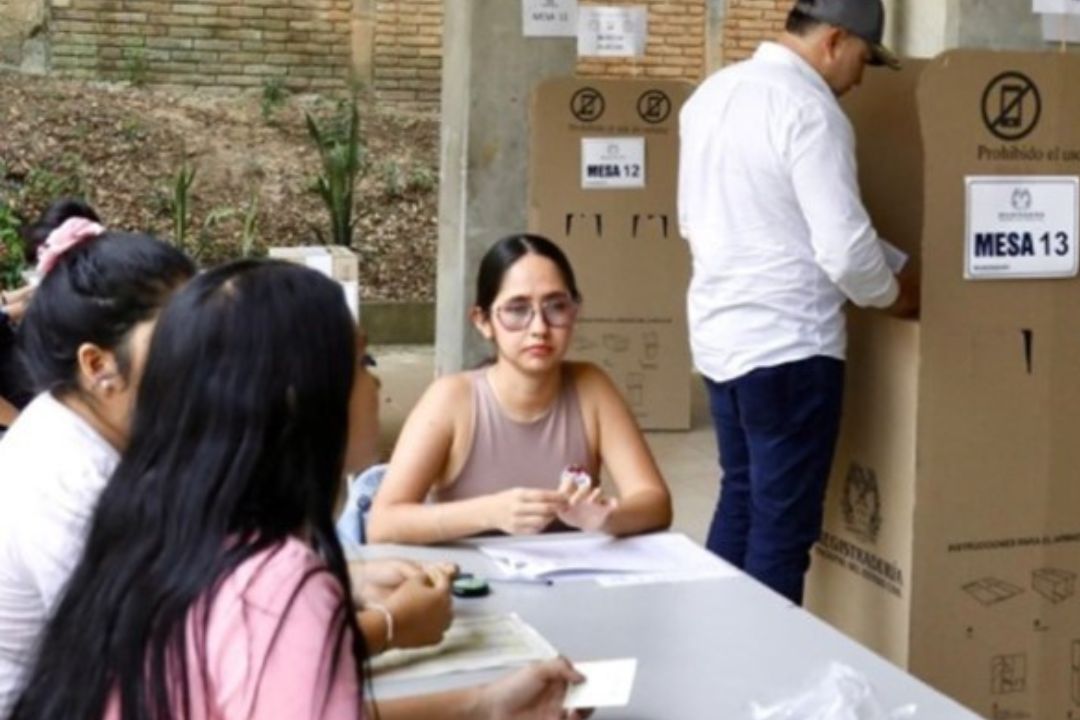
Next March 8, the parliamentary elections will be held. It is the party of clientelism and corruption. Politicians from dozens of parties tour neighborhoods, towns and villages offering that they will work to legislate for the people. Their promises arouse little enthusiasm, since the voters go about their daily lives fighting for survival. Many of them have already committed their vote in exchange for a few pesos or the offer of a miserable job in some State entity, from which they will have to pay a monthly fee to the corrupt politician who recommended them. Half of the electorate will abstain from going to the polls.
It has been demonstrated that very few people know the parties to which the candidates belong and much less the programs they support. The degraded traditional politics has already accustomed us to the fact that the candidates are nothing more than vote-mongers who then do not take the trouble to fulfill their promises or directly betray them in exchange for perks and bargains.
The need for change
It is understandable that broad sectors of workers, peasants and youth see in the lists of the Historic Pact an alternative to the traditional right wing and the hope for the “real change” that, according to the government’s narrative, the ultra-right opposition prevented; however, this is a very limited vision of the situation we are facing. The conformation of their lists, privileging “outsiders” figures and influencers over social leaderships forged in the struggle, added to the instrumentalization of mobilizations to collect signatures and campaign -as in the day of defense of the minimum wage and in the recent teachers’ strike-, show the limits of a project that ends up adapting to the rules of the regime. An example is Vice President Francia Márquez, a fighter of popular extraction, who, marginalized by Petro, now prefers to ally herself with an opportunist like Roy Barreras.
The international experience with other “progressive” governments is sobering. As in the case of Argentina, where the approval of the current slave labor reform bill was possible thanks to the parliamentary alliance of Milei’s minority ruling party with provincial blocs and political forces that respond to its adjustment agenda, but also with the “progressive” Peronist governors and their deputies. Mexico and Brazil also show that even with legislative majorities, measures favorable to the working class are not guaranteed when conciliation with private economic powers takes precedence.
In Colombia, on the other hand, we have shown time and again that even when the traditional parties have parliamentary majorities and the government in power is far-right, thanks to mobilization we have been able to defend rights and achieve new conquests, as in 2006 when, in the middle of Uribe’s government, three grounds for access to the Voluntary Interruption of Pregnancy were guaranteed. In 2011, in Santos’ government, we defeated his attempt to privatize all higher education. And in 2018 we imposed on the Duque government a substantial increase to the budget of public universities. But perhaps the most eloquent example was during Gustavo Petro’s own government when, faced with the agreement to reform the Statutory Law on Education between parliamentarians of the Historic Pact with the pro-Uribe right wing -which violated rights won by teachers in more than six decades of struggle- a national strike was triggered that sank the counter-reform and led to the fall of Minister Aurora Vergara.
For all these reasons, in the previous governments, broad social sectors knew that defending rights or winning new ones depended exclusively on our organization and capacity to struggle. That is how we reached the social outburst that confronted the brutal repression of the pro-Uribe government of Iván Duque. In this one, on the other hand, we are only called to fill the squares so that the president pressures the Congress or reaches agreements with the representatives of the big businessmen, the transnational corporations or the Yankee government, for one or another reform, as has just happened with the increase in the minimum wage.
A Pact to ally with the bourgeoisie or workers’ and popular unity to fight?
Unfortunately, the Historic Pact is a hodgepodge of leftist parties, labor and popular activists, with traditional politicians or careerists of all kinds. Many social fighters find no other way to be elected than to submit to an anti-democratic electoral legislation in exchange for an endorsement. In this way, they end up “carrying bricks” to the regional bosses and to the heads of the lists. Others end up co-opted by all this apparatus and sell their principles.
President Gustavo Petro and his advisors say that they were “forced” to negotiate in Congress with the budget and contracts of the entities under his charge so that some reforms were approved. That is why some of his officials are now facing legal proceedings or are in jail. And, worst of all, these reforms have been so limited that the beneficiaries have only exchanged today’s food for tomorrow’s hunger. The indebtedness of the State, without even contemplating the non-payment of the foreign debt, threatens the real continuity of many of these guarantees.
We cannot deny that an increase in the old age allowance of $230,000! may mitigate somewhat the abandonment of millions of elderly people. But it is a handout; we all know what this pittance of an income is for. It is clear that the 23.7% increase of the now called living wage, improves the income of some two and a half million formal workers, as well as of an important mass of pensioners who earn exactly that figure; but the majority of the working population does not even reach the minimum. For Bogotá alone, it is estimated that a family of four would need $7.6 million a month! And a single person $2.1 million, excluding rent!(El Tiempo, 22/2/2026). Therefore, it is no exaggeration to say that the majority of the population goes hungry. But for a parliamentarian who earns more than fifty million dollars a month, this is incomprehensible.
However, it is necessary to mention that although limited, Petro’s government has had successes that have benefited several social sectors, such as the purchase of 635,000 hectares during the first three years of his administration, the formalization of 1.5 million hectares and the highest number of land restitution (79.1% of the total that the Land Restitution Unit has restituted in 15 years). (urt.gov.co press room).
In education, the increase in the budget allowed for an increase of 347,000 thousand places in higher education; although it is not enough, it is evidenced by its expansion (mineducacion.gov.co). Likewise, there was a decrease in infant mortality (≈39 %), maternal mortality (≈28 %) and deaths due to child malnutrition (≈55 %) between 2022 and 2025.
The decrease in perinatal mortality (≈37.5 %) and premature mortality due to chronic diseases (≈12.7 %) is also indicated. In 2024, according to preliminary data from DANE, 63,527 babies were born to mothers between 15 and 19 years of age and 3,159 to girls between 10 and 14 years of age; the latter figures, although they have decreased, continue to be a serious limitation for the development of the life projects of thousands of girls and adolescents.
Learning from our history and struggles
The socialist revolutionaries of the past taught us that the electoral struggle is only a tribune to agitate our program and that an office in any popularly elected body should be a trench to denounce the very uselessness of those institutions and promote the struggle against the bourgeois state, demolish it and build new, truly democratic institutions. We must unify in a single body the executive, legislative and judicial functions and not give any privilege to the representatives of society; on the contrary, to revoke them from office when they fail to fulfill the social function entrusted to them. It is a lesson we learned with workers’ blood in the Paris Commune. It is the same lesson we learned at the gates of resistance in the National Strike. Today dozens of young people are still being prosecuted for the sole crime of fighting and no amnesty law has been voted for them. Only a new popular insurrection will open the jails full of poor and disinherited, to put in them the thieves and white-collar parapoliticians who today are running for Congress and the presidency.
More than parliamentary majorities,
we need majorities fighting in the streets!
The Workers and Socialist Unity ¡UNÍOS! invites workers and the poor to promote the broadest unity to take up the demands of the past National Strike as our program of struggle and strengthen the anti-imperialist struggle in the face of the blatant aggression of the Trump administration against Latin America and other countries of the world. A National Workers and People’s Meeting is urgent to define a plan of struggle and mobilization.
And in view of the March 8 elections, we call not to vote in any consultation, since they only seek to validate the names of those who want to govern on behalf of those who exploit and oppress us; and to annul the ballot for the parliamentary elections, demonstrating our rejection of all the candidates of the ultra-right, the right or the center, and to pressure the Historical Pact to break the alliances with all the sectors of the bourgeoisie with which it allies itself in the regions and at the national level. Only a true government of the workers will be able to begin to implement the plan of structural social transformations required to build a productive society, with work for all, reduction of working hours, equitable wages and guarantees of housing, health and education as essential rights.
Workers and Socialist Unity ¡UNÍOS!
International Socialist League – ISL
Bogota-Medellin, March 4, 2026