By Martin Suchanek
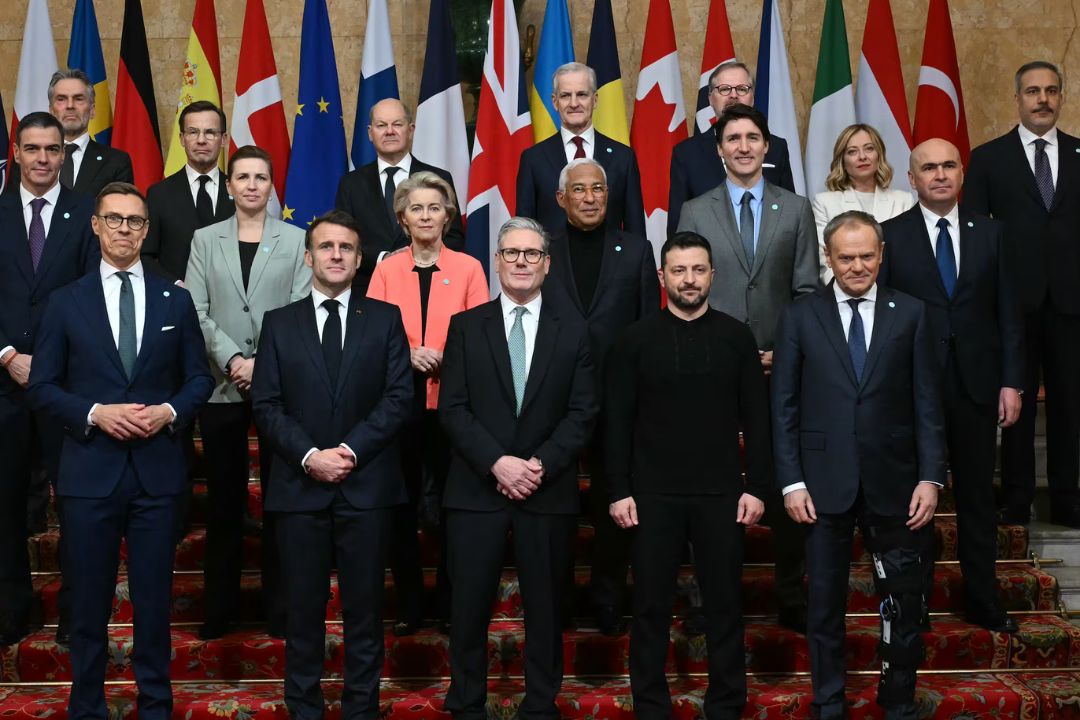
Hardly a day goes by without another “wake-up call for Europe”. Whether it’s Merz or Macron, the European Commission or national heads of government: Europe, according to the German Chancellor, must learn the language of power once again, must break away from the US and become “sovereign”. Macron is calling for a European defence force and a coordinated arms industry.
“Europe” – or more precisely, the EU – must thus increase its political, military and economic clout. Yet the wake-up call has regularly ended in a hangover. The latest EU summit reveals once again that the continent’s “unity” is in a sorry state, and not just because of Viktor Orbán.
Europe is in the midst of a deep, historic crisis. This affects above all, though not exclusively, the EU, but all the states and powers of the continent.
In the following, we shall examine the various manifestations of this crisis, as they help us to understand the deeper causes of the constant failure to achieve the self-imposed and proclaimed goals, and to grasp why the European bourgeoisie are proving incapable of uniting the continent economically and politically.
Economically
Europe’s economy is stagnating and falling behind its competitors in China and the US. This affects all the leading economies of the EU and Britain. Russia must be considered separately, but there too there are clear signs of stagnation. The shift to a war economy and the ability to withstand the extreme economic sanctions imposed by the EU and the US following the start of the war in Ukraine highlight, on the one hand, the imperialist character of Russian capitalism. On the other hand, the shift to a war economy and the financial and human costs of the war lead in the long term to economic exhaustion and decline, as evidenced by inflation, labour shortages, the overexploitation of migrant workers, and falling rates of accumulation.
Yet, in economic terms, Russia has always been a relatively weak imperialist power. The EU states, by contrast, set out at the start of the millennium to become the strongest economic power. With the euro, they established the world’s second-largest currency, which was intended to challenge the dollar in the long term. However significant the euro may be, it has long been unable to catch up with the US dollar, and this is entirely out of the question for the foreseeable future.
With the Lisbon Agenda of 2000, the European powers, led by Germany and France, openly articulated their ambitions to become a global power. According to German Chancellor at the time, Schröder, the EU was to rise to become the largest and most dynamic knowledge-based economic area. These goals have long since been shelved. For years, it has been under growing pressure from the rivalry between the US and China over the redistribution of the world, trying to hold its own somehow and find a way to at least halt this development.
The EU member states’ share of global GDP currently stands at around 17% in nominal terms (and approximately 14% in terms of purchasing power parity). By way of comparison: in 2000, it was still 29.5%. This trend is certain to continue in the coming years.
However, GDP is only one indicator of development. The EU’s share of global industrial production stands at 15–18%, depending on how certain sectors are classified. This figure is also falling and declined by 2.4% in 2024 alone.
Taking 2019 as the baseline, the industrial production of the four major imperialist states of the EU (Germany, France, Italy, Spain) in 2024 amounts to only 92.1% of the baseline figure. In the ‘rest of the EU’, this is partially offset (rising to 114.1%), reflecting a shift in production, particularly to the semi-colonies of Eastern Europe. Industrial production in the USA also contracted over the same period and stood at 98.2% of the 2019 figure in 2024. Production in China, by contrast, continued to grow massively (to 137.2%), whilst that of the ASEAN-5 countries (Indonesia, Malaysia, the Philippines, Thailand, Singapore) also rose to a lesser extent, reaching 114.1%.
Within the EU, Germany and Italy in particular have been suffering from a decline in industrial production since the war in Ukraine, a situation also linked to the composition of the sectors and the trend in energy prices. In Germany alone, for instance, approximately 266,000 industrial jobs (4.7%) have been lost without replacement since 2019.
However, the European economy is not only losing ground in the industrial sector; it is falling behind the US and China particularly in the areas of financial capital and high-tech sectors.
This makes further decline and continued stagnation almost inevitable. The problem for the powers of the European continent is that this economic basis of the crisis is inextricably linked to its political and military dimensions, and the two reinforce each other.
Politically and militarily
In global politics, the EU and its member states play only a minor role compared to the leading global powers. This is not only due to military weakness compared to the US, China or Russia, but above all to the internal contradictions within Europe itself. Russia, for its part, has managed to assert itself as a global imperialist power, even though at an enormous cost.
The full extent of the crisis facing Europe and the EU becomes clear when we consider a crucial difference compared to the US and China. Unlike these two major powers, the EU is not a state, but a confederation of imperialist powers and semi-colonies (particularly in Eastern Europe). It is an economic area with its own currency and a large single market that extends far beyond national borders. In this respect, it represents an enormous boon for the most powerful imperialist capitals, above all for Germany, which economically dominates the EU countries of Eastern Europe and reaps gigantic super-profits from them, as well as a cheap, skilled labour reserve that incurs no, or comparatively low, training costs for German capital.
The EU and the Eurozone represent an attempt to overcome, by capitalist means, the boundaries of the nation-state, which, as Trotsky aptly analysed even before the First World War, have long since become too narrow for the further development of capitalism. Yet Europe is a continent of (former) great and colonial powers, all of which lay claim to leadership or at least assert that they stand ‘on an equal footing’ at the top. These conflicts were already evident when the European Community (EC), the forerunner of today’s EU, was founded, but they were also kept in check by the fact that the EC was primarily an economic entity and, secondly, that the US also played a hegemonic role in Western Europe.
The more the EU is faced with the question of moving forward, the more pressing the question of leadership becomes – not only within the EU, but also in relation to other European powers, particularly Russia and Britain. And since capitalist unification inevitably raises the question of leadership amongst them, Europe comes up against the self-interest of the established nation states on the continent. However, this is not happening in an isolated, geographical space, but against the background of the global conflict between the US and China, which in turn are exerting an open, and in the case of the US, very aggressive influence on the EU (and of course Russia is doing the same, just as the US and EU powers have been expanding eastwards since the end of the Cold War).
In recent years, however, the EU powers have been steadily losing ground not only economically, but also politically and strategically. French imperialism, for instance, has lost influence in Africa massively and has been forced to withdraw from a number of its former colonies. Once the weaknesses of the Russian war machine became apparent in 2022, the EU powers attempted, together with the US, to use Russia’s war with Ukraine as an opportunity to severely weaken Russia as an imperialist power and effectively exclude it from the world market through a sanctions regime unprecedented against an imperialist state since the Second World War. However, this failed (which in turn reflected a shift and transformation in the global economy).
With Donald Trump’s inauguration, the situation has once again deteriorated drastically. Even before that, the EU powers found it difficult to develop an independent and unified position on major global political conflicts. But until then, the US had fulfilled this role within the framework of the transatlantic partnership. Under Biden (and before that under Obama), it was possible to pretend that one had participated on an ‘equal footing’ in all matters. The EU and the major European powers were thus able to indulge in the illusion of being an equal partner, a quasi-world power. Trump’s first presidency was glossed over as a one-off ‘slip-up’. His second term shattered another daydream of the European imperialist leaders.
In recent years, these differences have become even more pronounced. This applies to Palestine, Ukraine, the conclusion of major trade agreements such as Mercosur, key issues of European economic and industrial policy, the question of migration policy and internal borders, as well as relations with the US, Trump’s ‘Peace Council’, the stance on Maduro’s kidnapping, the blockade of Cuba, and the war against Iran.
The Trump administrations – a real turning point
Before Trump, the EU powers and the EU were treated ‘respectfully’ by the US as equals, as quasi-superpowers. Under Trump, only the US, China and, with reservations, Russia are regarded as superpowers. The EU and the EU powers are not.
This weakens the position of European countries on the world political stage. A “world power” that is not recognised as an equal by others is not an equal either. Rather, it must prove this through actions, through economic, political and military unity and power.
Added to this is the fact that Trump, Vance and the entire US administration view the EU as a hostile entity, seeking to combat and weaken or even destroy the greatest economic achievements of the Western European imperialist powers.
Consequently, the US administration and the MAGA movement are also taking an offensive stance in support of the right in Europe, be it for right-wing governments such as Orbán’s in Hungary or Meloni’s in Italy, who presents herself as a ‘mediator’, or for the right in Germany, France and Britain. Even if it is unclear whether Orbán will be voted out in Hungary, this struggle is effectively taking place in all European countries, with one of the next major showdowns set to occur in the French presidential elections.
The US’s aim is not necessarily a break with (Western) Europe. But it is about establishing a clear order in the ‘Western Hemisphere’: the US determines this sphere of influence, just as China and Russia have theirs. Hence, the threat to annex Greenland is more than symbolic; it sums up the situation, so to speak. Even if the immediate annexationist ambitions are currently off the table, this conflict can – indeed, will – resurface. Whilst most EU states sent only purely symbolic forces to Greenland at the start of the year, the Scandinavian states have placed substantial contingents on standby. The trade and economic conflicts over import tariffs, in which the EU was forced to make massive concessions, are far from resolved.
In the ‘National Security Strategy’ of November 2025, the Trump administration clearly sets out its objectives regarding Europe/the EU.
– Ending the war in Ukraine to stabilise Europe.
– Empowering Europe to stand on its own two feet, which in plain terms means a massive rearmament programme.
– Cultivating resistance to the current course in European nations (and the rise in support for ‘patriotic parties’ shows that this is possible).
– Building “healthy”, white nations in Europe.
Taken together, all this constitutes a political declaration of war on the existing governments in Germany, France, Britain, Spain and the European Commission. And it also constitutes a declaration of war on European capitals, whose privileged access to and dominance of European markets is also under attack. At the same time, the US has fundamentally altered its relationship with Russia – see the war in Ukraine. Added to this is the fact that the sanctions against Russia now affect the EU states more than the other way round, having proved economically to be a shot in the foot. Whilst the EU constantly invokes “solidarity with Ukraine”, in reality it plays a secondary role in US mediation between Ukraine and Russia. This need not remain the case, but at present the US is banking on a new division of spheres of influence with Russia (with the US, of course, gaining far more), and hopes to free itself somewhat from the growing dependence on China. To this end, it is prepared to respect Putin’s core strategic interests in Ukraine and Eastern Europe.
“Europe’s” response?
The EU member states and the EU as a whole have no unified response or even strategy to this – unless one considers regular ‘wake-up calls’ to be such a thing. However, this must not blind us to the real changes that the EU and its leading powers have embarked upon in order to regain ground in the redistribution of the world. Even if there is no unified strategy within the European bourgeoisie on how to respond to the challenges posed by Trumpism and China, as well as Russia, there are nevertheless some commonalities among all the dominant factions of the ruling classes and the political establishment in the EU.
1. Re-armament and militarisation across Europe
At the NATO summit in June 2025, it was agreed that all European states would increase military spending to 5% of GDP by 2035, with 3.5% relating to military expenditure in the strict sense (defence budget, arms deliveries) and 1.5% to infrastructure. Some states, such as Poland, have already achieved this target and are continuing to rearm. Germany will also achieve this well before 2035 and has effectively abolished all restrictions on funding within the defence budget. Even if the decisions were ostensibly made under pressure from the US, these targets have long been in line with the interests of major factions of national capital and imperialist states, but were easier to sell as a ‘response’ to the alleged global threat posed by Russia, the US and China. In reality, it boils down to this: if the EU or individual powers wish to play a central role in global politics, they must possess massive military capabilities. This applies to conventional weapons, but it will also apply to nuclear armament. Sooner or later, Germany will also take the initiative to produce its own nuclear weapons (an extension of the French nuclear umbrella is ultimately only seen as a stopgap solution).
This rearmament serves not only military and geostrategic objectives. It is also intended to act as an economic stimulus package. Naturally, the various arms manufacturers stand to benefit first and foremost, but at the same time ‘civilian’ companies such as car manufacturers are also getting involved in order to make up for lost sales.
2. Attacks on the working class, racial discrimination, attacks on environmental and social standards
However, rearmament and economic upheavals must be paid for. They go hand in hand with a massive increase in debt, which in turn must be paid for by the working class as well as by sections of the middle classes and the petty bourgeoisie.
Immigrants and the populations in the semi-colonial parts of the EU (as well as in marginalised regions within the core states) are particularly affected. It affects socially oppressed groups, women, LGBTIAQ people, young people and pensioners generally even harder than the average. But competition, the restructuring of European capital and the crisis will also hit the ‘privileged’ sections of the working class hard – and at the same time, the means of social cushioning are dwindling.
Furthermore, environmental and social standards in the EU have been and continue to be under massive attack.
In every country, the attacks on wage earning masses go hand in hand with a deliberate policy of division, which massively exacerbates the already existing backward mindset and lack of solidarity following years of defeats and losses. The achievements of social movements, campaigns against ‘gender madness’ and, above all, racism are part of the standard repertoire not only of right-wing populist and far-right parties, but also of the Conservatives. The Liberals, Greens and Social Democrats waver between feigned opposition and effectively aiding and abetting the attacks.
3. Racism and Nationalism
This applies above all to racism and nationalism. Whether as a ‘united’ EU bloc or as an ‘independent’ nation-state. In any case, the glue of nationalism and racism is needed to drive forward rearmament and internal mobilisation against external enemies. Anyone who wants to turn Europe or Germany into a world power cannot do without this; at best, it can be whitewashed as ‘social-chauvinist’, ‘social partnership’, ‘green’ and ‘democratic’. Ironically, this phenomenon is by no means confined to the states of the EU. In Russia, it has ultimately progressed even further.
4. Shift in the balance of power within the EU
Racism and nationalism go hand in hand with a shift in political majorities within the EU. Until a few years ago, the dominant political bloc consisted of an alliance of conservatives, social democrats, liberals and Greens. With the rise of the right, but also due to military requirements and the intensified struggle over the redivision of the world, the leading bloc has shifted. Parts of the right, led by Meloni and Fratelli d’Italia, have been incorporated and are now treated by the bourgeois mainstream in the EU as more radical conservatives. This is currently strengthening not only the right, but above all the European conservatives, who are able to manoeuvre between the right and the social democrats, liberals and Greens. Attempts are being made to make a section of the right-wing ‘respectable’, including at the national level. The basic conditions for this integration are simple: adherence to the EU and the abandonment of all attempts to leave the EU or the euro; rejection of all social-demagogic aspirations and support for cuts and deregulation in favour of capital.
However, all this does not yet amount to a common strategy for deepening the capitalist unity of Europe and forming a more powerful imperialist bloc. That would ultimately require the undermining of the rights of the weaker nation states within the EU and the resolution of the question of leadership among the imperialist powers – and there is no sign of such a resolution.
Therefore, in the coming period, the EU states will carry on as before: vacillating between appeals for European unity, making Europe strong and ‘sovereign’, and appeasement towards Trump. Whilst, from the standpoint of a capitalist union, overcoming national particularism would actually be necessary, we will witness renationalisation at various levels, above all on the ideological front. Since there is no real European nationalism, existing nationalisms – and thus, inevitably, their contradictions – must be resorted to for national invocation and to obscure class antagonism.
Even if we can expect some vacillation in the short term and the existence of the EU and the Eurozone is not immediately threatened – not least because even extremely nationalist governments such as Hungary know that without the EU they would face economic ruin – this does not hold true in the medium and long term.
The current situation will, in fact, lead to the EU falling further behind the US and China, and indeed, on an economic level, losing out even to emerging semi-colonies such as India. Therefore, the situation could change decisively if, for example, one of the major European bourgeoisies were to seek a path outside the EU or attempt to pursue the path of a ‘core Europe’, i.e. effectively a split within the bloc.
Overall, however, this makes one thing clear: the capitalist class has no answer to the continent’s fundamental problems; it is incapable of uniting and developing Europe. Only the working class can resolve this – not through a utopian return to small-state politics, but by fighting for a United Socialist States of Europe.
Endnote
In the first part, we examined key elements of the crisis in Europe and, above all, in the EU states. In the next part, we will look at the situation of the working class and the labour movement.)