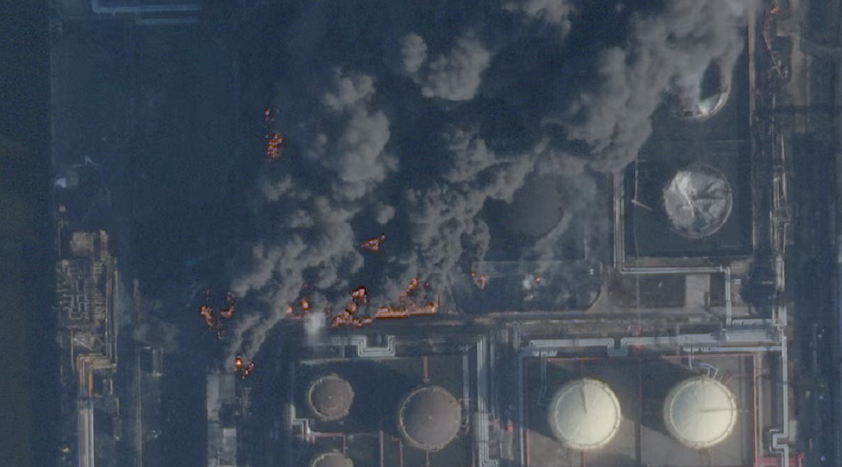
Within the framework of the war initiated by the Russian invasion, Ukraine has launched its biggest offensive of the year against oil infrastructures, in response to Russian attacks. In Eastern Europe, the global energy crisis provoked by the imperialist-Zionist aggression against Iran is also deepening.
By Oleg Vernik – Ukrainian Socialist League (LSU)
Ukrainian response to Russian aggression
The second full-scale war unleashed by the Russian invader in our country, since February 2022, has been steadily escalating, with attacks on civilian and energy infrastructure. Since the beginning of the conflict the aggressor army has used missiles and drones to destroy Ukrainian power grids, cities and ports, causing civilian deaths and economic devastation.
As Putin projected a war of a few days, he did not succeed in four years, and is trying to break the resistance both on the combat fronts and in the rear. It was again evidenced during the harshest of the last winter that is leaving – temperatures averaged -15º C – when the bombings favored the destruction of energy production so that there is neither heat nor light. And again, it has failed because we did not give up.
In recent days, Russia intensified its offensive: with the launching of nearly 1,000 drones in just one day, it has been one of the largest air strikes we have endured, mourning casualties and suffering damage in several regions.
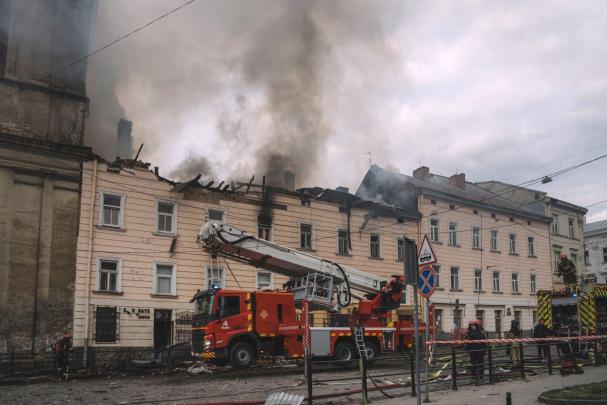
Russian drone attack on the historical center of Lviv.
In response, between the night of Tuesday, March 24 and the morning of Wednesday, March 25, the Ukrainian military executed a massive drone offensive over Russian territory. The attack hit the port of Ust-Luga, one of Russia’s main oil export hubs in the Baltic Sea.
The Russian Defense Ministry claimed to have intercepted hundreds of drones – nearly 389 in a single night – but had to acknowledge that there were hits on key infrastructure.
One of the most important blows
This attack represents one of Ukraine’s most significant blows against the Russian war economy in 2026. It is not just a military action, but a strategic operation aimed at weakening the Kremlin’s hydrocarbon export capacity.
The Baltic ports are essential to sustain Russian state revenues, especially in a context of international sanctions. Ukraine had already been developing this strategy: in 2025 it attacked facilities in Primorsk and even oil tankers on international routes, seeking to disrupt the so-called “shadow fleet” that allows Russia to evade sanctions. Now it is also allowed by Trump, who suspended restrictions on Russian exports in an attempt to alleviate the energy and economic disaster caused by the imperialist-Zionist aggression against Iran in the Persian Gulf.
The novelty of the Ukrainian response lies in its scale, territorial depth and precision. Striking Ust-Luga implies taking the war to more than a thousand kilometers from the front, directly affecting the logistical heart of Russian imperialism. The action is a concrete and symbolic blow for the aggressors that moralizes the Ukrainian resistance.
Imperialist wars generate deaths, destruction and crises.
The consequences are manifold. For Russia, these attacks mean an increase in the cost of exports, greater logistical risks and pressure on its main source of income: oil. For our country, they imply the demonstration of strategic offensive capabilities, in the context of an enormous disparity of forces, and also the risk of suffering more intense reprisals, particularly on the civilian population.
Globally, the impact is even greater. The war in Ukraine is intertwined with the new war in the Middle East starting in 2026, which directly affects energy production in Iran. With simultaneous conflicts in two key regions of the world’s energy supply, the result is further instability in oil and gas prices, straining the global economy.
The wars initiated in Eastern Europe by Russian imperialism and in the Middle East by U.S. imperialism and its Zionist gendarme, cause destruction, deaths and become a structural factor of international capitalist crisis.
Other aspects to highlight
This attack, as is being seen in the Persian Gulf, also confirms the growing centrality of drones in modern warfare and that Ukraine has developed a technological capability that allows it to strike in depth, replicating and even surpassing in some respects the Russian strategy, despite the overwhelming superiority of its military and war logistics; beyond the fact that the US and NATO only provide weapons to Ukraine to defend itself, not to defeat Russia or strike on strategic targets.
The geographical spread of the attacks – from the Baltic to the Mediterranean – shows that the war has taken on an increasingly broad, unpredictable character, affecting key infrastructure and the global economy.
We continue to resist
We continue to resist on the combat fronts and in the rear, we do it for our lives, sovereignty and territorial integrity. We have the right to do so with all the means at our disposal, for that reason, we need claims and solidarity mobilizations all over the world, as proposed by the International Socialist League (ISL) that we integrate with the Ukrainian Socialist League (USL).
We resist without giving political support to the liberal and anti-worker government of Zelenski or to the NATO powers, which seek to capitalize the conflict for their own geopolitical interests. The solution will not come from the powers, but from the independent action of the peoples and workers against the war and the system that engenders it, as well as from the construction of a consistent left force in our country.