Peter Solenberger
In his three runs for president, Donald Trump promised the US ruling class tax cuts, deregulation, and “smaller government.” Not a smaller military or fewer police, of course, but cuts in health, education, welfare, and other government services benefitting workers.
He promised more aggressive use of economic and military power to advance US imperial interests — without being constrained by international agreements or alliances, and without dragging the country into “forever wars” or attempts at nation-building.
He promised to draw workers into his “Make America Great Again” (MAGA) show, deflecting their anger away from capitalism.
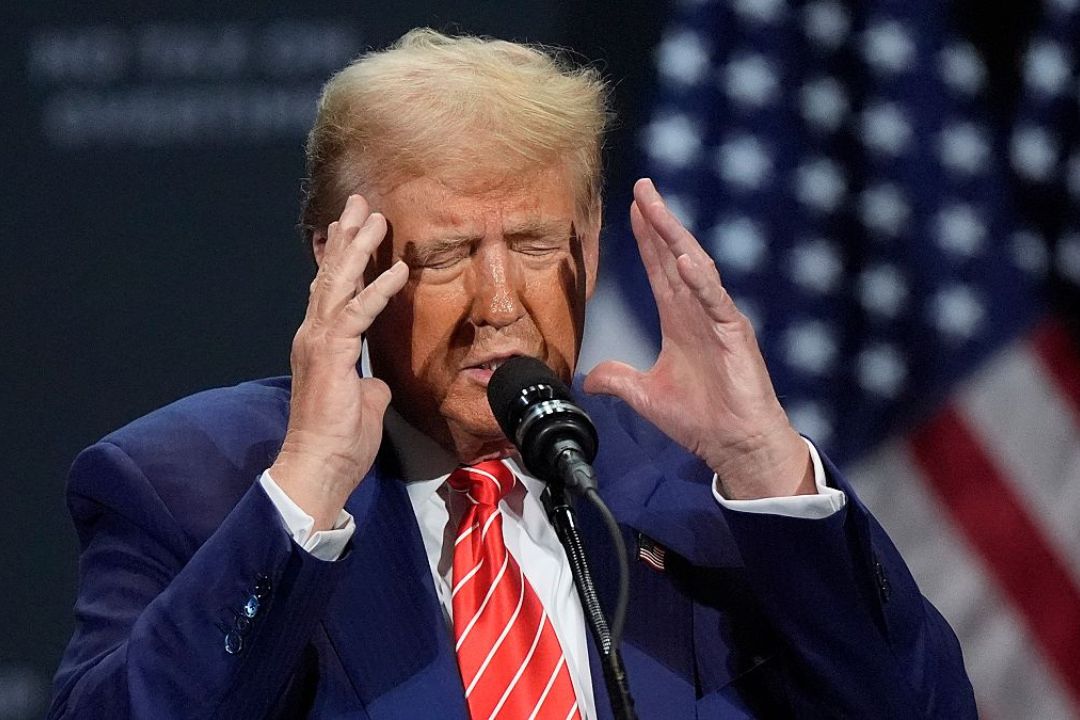
Trump has only a tenuous grasp on reality. Mentally and emotionally, he’s a two-year-old. He has the delusion that he — and US imperialism — have the power to do what he wills.
Some big capitalists share Trump’s delusion. Most are skeptical, but willing to let him try. With their money, their media, and their government and military connections, they can restrain or replace him, if he creates too many problems or provokes too much resistance. They can always call on their other team, the Democrats, to take the field.
Trump has delivered on his promises to the capitalists to cut taxes, deregulate, build up the military and police, and reduce — from the capitalist standpoint — “wasteful” government expenditures. He has repudiated international agreements and insulted allies. He has further disentangled the US economy from China’s.
But he has not made America great. He has not restored US imperial power. Again and again he has run up against his limits and been thrown back by reality and resistance.
The empire maneuvers
In other articles, I’ve discussed Trump’s domestic and economic policies. See “Dissecting Trump’s ugly, evil bill” and “US economy: Capitalists party, workers struggle” . Here I’ll focus on his international policies.
Internationally, the big problem for the ruling class is that US imperialism has lost the dominance it had in the postwar period and again for twenty years after the collapse of the Soviet Union in 1991.
The Great Recession of 2007-2009 showed not just the crisis of overaccumulation of the world capitalist economy, but also US imperialism’s diminished stature. With the 2014 Russian invasion of Ukraine and annexation of Crimea, the rising imperialist bloc of Russia and China began openly challenging the established bloc of the US, Europe, Japan, and their allies.
The Obama administration sought to assert US power in concert with its allies. It tried to isolate China economically, rejected Russia’s protests over NATO expansion, initiated a trillion-dollar program to modernize US nuclear weapons, supplied arms to Israel, intervened in the Libyan civil war, handing the country over to Islamist warlords, surged the Afghanistan war, and assassinated Osama bin Laden on Pakistani soil.
The first Trump administration proclaimed “America first,” withdrew from the Paris Agreement on climate change, abandoned the Trans-Pacific Partnership (TPP), imposed tariffs on Chinese goods, demanded that NATO and other allies spend more on their militaries, and negotiated an end to the Afghanistan war. It continued to aid Israel and to sell arms around the world, but it was more isolationist than the Obama administration.
The Biden administration proclaimed “America is back,” worked to restore relations with allies and a US presence in the United Nations and other international bodies, and adopted an industrial policy centered on subsidies to disentangle the US and Chinese economies. It continued to arm Israel and, with the Russian invasion in February 2022, began providing massive military aid to Ukraine.
These maneuvers strengthened US imperialism relative to the other established imperialist powers, began disentangling the US and Chinese economies, and confronted the Russia-China bloc. But they didn’t restore US dominance.
Trump tries for a new world order
In a 1997 book, The Grand Chessboard: American Primacy and Its Geostrategic Imperatives, Jimmy Carter’s National Security Advisor Zbigniew Brzezinski wrote that “the three grand imperatives of imperial geostrategy” are “to prevent collusion and maintain security dependence among the vassals, to keep tributaries pliant and protected, and to keep the barbarians from coming together.” Gilbert Achcar quotes Brzezinski’s words in his 2003 book, The New Cold War: The United States, Russia and China from Kosovo to Ukraine.
By “vassals,” Brzezinski meant Europe, Japan, and the other imperialist allies of the US. By “tributaries,” he meant the semicolonial countries dependent on and subservient to US imperialism. By “barbarians,” he meant Russia and China.
US imperialism lost control of the third imperative in the 2010s, when Russia and China allied and began challenging US-NATO hegemony.
In the first months of his second term, Trump tried to rearrange the grand chessboard by splitting Russia from China. No longer willing to finance a war Ukraine couldn’t win, Trump and Congress effectively ended US aid. The US continued to sell arms to Ukraine on the condition that Europe pay for them. Trump proposed ending the war with a ceasefire in place and no NATO membership for Ukraine.
If Trump had offered restoration of the Russian Empire, including Central Asia, the Caucasus, Ukraine, Poland, the Baltic countries, and Finland, he could have split Russia from China. But Trump couldn’t offer that, and a ceasefire in place in Ukraine wasn’t enough. Russia maintained its alliance with China, demanded the rest of Donetsk as a condition for a ceasefire, and continued to pummel Ukraine.
The failure of Trump’s Russia maneuver forced US imperialism to turn back to its traditional allies. The disagreement over Ukraine was settled by the arrangement to have the US sell arms for which Europe paid. The vassals complained, colluded, and increased their arms spending, but they couldn’t break their military and economic dependency on the US.
Trump under water
Trump and the Republicans won the November 2024 election on the issues of the economy and immigration. More than a third of eligible voters stayed home. Of those who went to the polls, 49.8% voted for Trump, and 48.3% voted for Kamala Harris.
The Trump administration has failed to deliver on his promises to workers. On the economy, the macroeconomic indicators are not bad in historical terms, but manufacturing hasn’t increased, job-creation has slowed, prices haven’t come down, and inequality continues to rise. A recession is coming, and workers feel its cold winds blowing.
The ICE raids and deportation of immigrants have not made life better for US citizens. More and more workers oppose them as unjust and inhumane and identify with the resistance of immigrant communities and their allies.
Trump is now “under water” on both the economy and immigration. By nearly a 60:40 margin, poll respondents disapprove of his policies on those issues and on his overall performance.
The Republicans currently have a 218 to 214 majority in the House of Representatives, with three vacancies. It now seems highly likely that the Democrats will win a majority of the House this fall, as they did in 2018, and the presidency and the Senate in 2028, as they did in 2020.
Trump would like to declare himself president for life and ban the Democratic Party, as well as all political organizations to its left. But the US ruling class doesn’t want that.
As Lenin wrote in The State and Revolution (https://www.marxists.org/archive/lenin/works/1917/staterev/ch01.htm), “A democratic republic is the best possible political shell for capitalism,” since it maximizes compliance and minimizes the need for repression and the risk of working-class revolt or a runaway military and bureaucracy.
Palestine, Venezuela, and Iran
The Trump administration continues the bipartisan policy of aiding and arming Israel, despite its genocide in Gaza and ethnic cleansing of the West Bank. Trump’s innovation is to openly urge Israel to “finish the job” quickly, as the “optics” of genocide are bad.
The governments of Saudi Arabia, the Gulf states, Egypt, and Turkey want to expand diplomatic and commercial relations with Israel, but popular support for Palestine forces them to hold back while the genocide continues.
The US and the Venezuelan government headed by Nicolás Maduro negotiated a deal under which the US would lift sanctions, and Venezuela would return to the US economic fold. The sticking point was Maduro. Trump insisted that he go to demonstrate US dominance. Maduro didn’t want to go.On January 3, the US launched a military strike against Venezuela and kidnapped Maduro and his wife, Cilia Flores. The Venezuelan government, headed by former vice president and now acting president Delcy Rodríguez, protested but discouraged mass demonstrations and completed the deal with the US.
The deal ended Venezuelan oil shipments to Cuba, which had sustained it since Hugo Chávez became president of Venezuela in 1999. The Trump administration ordered Mexico not to send oil, cutting off Cuba’s other main source. The Cuban Revolution is in more peril than it has been since the 1962 missile crisis.
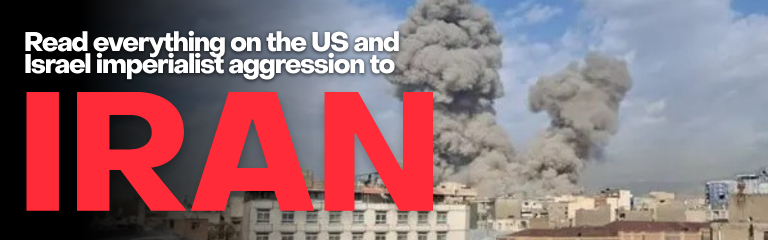
Having succeeded in Venezuela, Trump decided to try Iran. He was urged on by the governments of Israel and Saudi Arabia, which want to destroy Iran as a competitor and assert their own regional power.The US and Israel launched massive air strikes against Iran on February 28, taking out its air defenses and killing Ayatollah Ali Khamenei and other leaders. Iran retaliated by closing the Strait of Hormuz. Prices of oil, liquified natural gas (LNG), and fertilizers soared on the world market, since a fifth of the world’s oil shipments and a third of its LNG and fertilizer shipments pass through the Strait.
US imperialism found itself in the familiar and unhappy position of winning every battle and still losing the war, as it had in Vietnam, Afghanistan, and Iraq.
Trump was elected on a promise not to drag the US into “forever wars” like George W Bush’s in Afghanistan and Iraq in 2001 and 2003. But he knows that those wars saved the Bush presidency and would like to repeat Bush’s tail-wags-dog political feat.
Iran didn’t attack the US, however, there’s no patriotic wave like that after September 11, and war for regime change is unpopular. Trump is under water on the Iran war too.
Combine the strands of resistance
Trump is still very dangerous, in some ways more dangerous. As he loses his grip, he lashes out. His policies remain an option the ruling class wants to keep open.
Working-class and popular resistance to Trump today has three main strands. First, the massive “No Kings” rallies on June 14 and October 18, 2025, and March 28, 2026, and the many local actions they have spawned. Indivisible, the most prominent organization of liberal Democrats, initiated “No Kings” to protest Trump’s assault on democracy, hoping to channel dissent into votes for Democratic Party candidates. Rally participants raise immigrant rights, abortion rights, Palestine solidarity, opposition to militarism and war, and other issues the Democratic Party leadership would prefer to downplay for the elections.
Second, May Day Strong, which is organizing for “No Work, No School, No Shopping” on May 1. Many unions back May Day Strong, including the Chicago Teachers Union (CTU), the National Education Association (NEA), the American Federation of Teachers (AFT), the United Electrical, Radio & Machine Workers of America (UE), the Communications Workers of America (CWA), and the Association of Flight Attendants-CWA. National Nurses United, while avoiding explicit calls for its members to strike on May 1, is calling for informational pickets and other solidarity actions.
Third, the anti-ICE rapid response networks formed in Los Angeles, Chicago, Portland, Minneapolis, and other cities to protect immigrants from arrest and deportation. The networks and the protests they ignite have forced the administration to shift from flashbang paramilitary raids to targeted arrests with the cooperation of state and local police.
Revolutionary socialists and other activists seek to combine the strands to make May Day 2026 an event approaching May Day 2006, when millions of Latinos and their allies demonstrated and struck. The “Great American Strike” and the threat of more mass action forced the Bush administration and Congress to retreat from the so-called “Border Protection, Anti-terrorism and Illegal Immigration Control Act of 2005.” The act would have criminalized aiding undocumented immigrants and, hence, tens of millions of workers with undocumented family and friends.
Looking beyond the two capitalist parties
The US ruling class hedges its bets in elections. In the 2024 election cycle, the Democrats raised $3.46 billion, while the Republicans raised $2.78 billion. Businesses and business-affiliated individuals contributed $2.13 billion to Democrats and $1.65 billion to Republicans, 61.8% of the Democratic total and 59.5% of the Republican total. The OpenSecrets website (https://www.opensecrets.org/elections-overview?cycle=2024&display=T&type=A) has the details.
In the first decades of the 21st century, the capitalists have tacked from Clinton to Bush to Obama to Trump to Biden and back to Trump. They haven’t abandoned Trump, but they’re already looking beyond him to the next Democratic Party administration.
Revolutionary socialists must work to combine the strands of resistance into mass, militant, working-class action. We must at the same time combat illusions in electing Democrats to stop Republicans. That’s not how the two-party system works.
The Democrats are the lesser evil to the Republicans. We should acknowledge that. But the trap is to see politics as just the alternation of the two capitalist parties. Workers need both mass action and a mass working-class party. Otherwise, we acquiesce to our own defeat.