The 2026 general election campaign in Peru has confirmed, once again, that the political struggle in our country is not only electoral, but profoundly social and class-based. We arrive at this April 12 with 36 candidates for president, a full expression of the crisis of the political regime in our country. It is an expression of the exhaustion of a political class that, fragmented and disconnected from the population, is incapable of offering a national project for the majority. But it also reveals something more concerning: the strengthening of a “mafia pact” that involves different candidacies and seeks to guarantee the continuity of a system that benefits the few. And in this context, electoral fragmentation is not diversity: it is a dispersion that benifits those who have always ruled: a power bloc that seeks to perpetuate its privileges.
What is at stake is not only an election, but the kind of democracy we are willing to accept. Because while the “mafia pact” is strengthened and the system continues to work for a few, the majority is trapped between right-wing options that do not represent a real way out. This democracy, as it stands, does not guarantee rights or improve the lives of the majority: it administers them. A process that is being experienced throughout Latin America, the shift towards right-wing options, as in Argentina or the advance of conservative sectors in Chile, is showing its limits: more inequality, setbacks in rights and a deepening of the social crisis. At a global level, similar phenomena show the erosion of an economic model that no longer responds to the needs of the majority.
Faced with this panorama, the conclusion is clear: anger is insufficient, because in the face of this expression of formal democracy that allows voting but not deciding, it becomes necessary to contribute to the construction of an alternative that unifies the struggles, organizes and strengthens the militancy, that not only disputes the electoral space, but the very meaning of politics, that questions the roots of this unequal economic model and confronts the structures of power and puts the dignified life of the majority at the center. To remain outside the political and electoral process and debate that is currently going on in our country does not seem to us to be an option. It is crucial to initiate agreements of struggle to deepen the debate about the alternative we need. Since for revolutionary socialists the elections are a platform of struggle, we decided to intervene by betting on strengthening an independent solution.
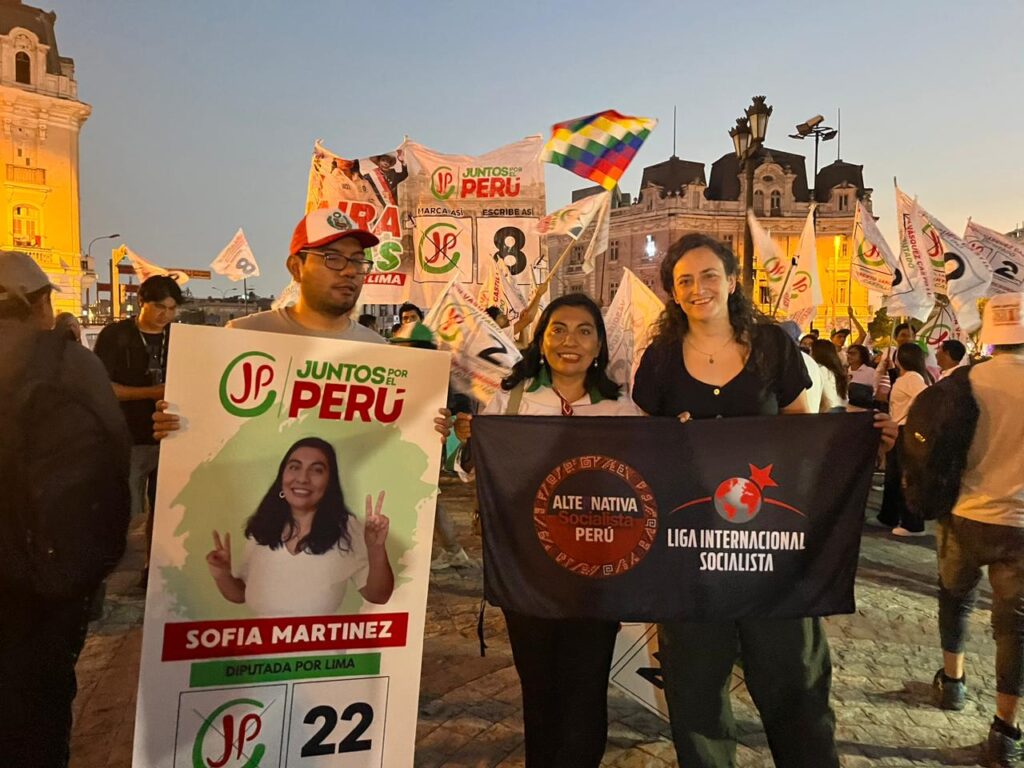
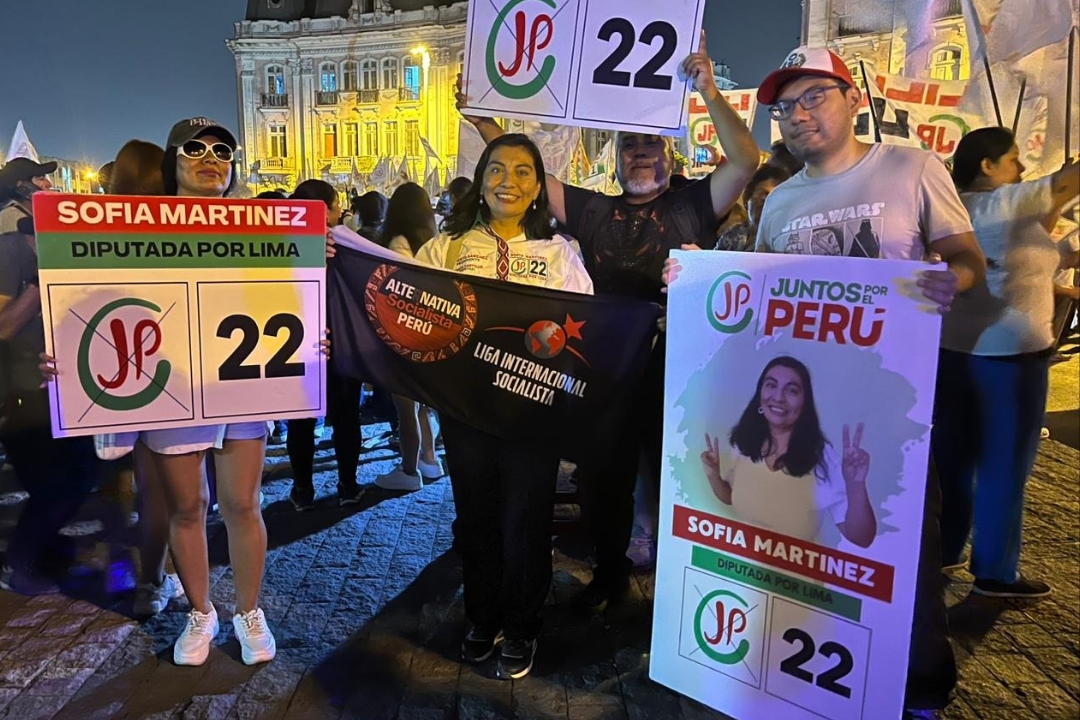
For this reason, Alternativa Socialista, ISL section in Perú, promotes the candidacy of our comrade Sofía Martínez Guerrero, candidate for the Chamber of Deputies with the number 22 for Juntos por el Perú, who represents a left that does not negotiate its principles: anti-capitalist, feminist and internationalist. A left that does not adapt to the system, but seeks to transform it.
We come from months of developing an austere campaign from below, rich in political content and programmatic clarity. Together for Peru is a leftist and socialist political space that carries the candidacy of Roberto Sanchez Palomino to the presidency. With a campaign that has raised two central banners that connect with the feelings of the people: the urgent need for a new Constitution through a Plurinational, free and sovereign Constituent Assembly, and the liberation of Pedro Castillo. These demands are not isolated, but express the rejection of an exhausted neoliberal model that has commodified fundamental rights such as education and health.
In this sense, the proposal to recover these sectors as universal rights -increasing the education budget to 10% of the GDP and the health budget to 8%- marks a clear break with the policies of state neglect. Added to this is the defense of national sovereignty through the revision of contract laws, the nationalization of strategic resources such as Camisea gas and the application of taxes on mining surpluses, indispensable measures to redistribute wealth in favor of the majority. With a political platform that vindicates the anti-imperialist struggle and places the voice of the people at the center.
In terms of popular security, the proposal has also been firm: repeal of laws that favor crime, a structural reform of the National Police and strengthening of investigations to effectively confront extortion and organized crime. All this accompanied by a demand deeply felt by the people: justice for the victims of state repression, especially the so-called “martyrs of the south”, with investigation, reparation and punishment of those responsible.
Thus, from every corner of Peru a standing campaign has been developing, under the slogan “only the people can save the people”, a network of solidarity that transcends electoral issues and aims at building power from below. The calculations of the right wing have failed. They underestimated the strength of the people’s demand. Today, JP’s proposal overcomes the electoral hurdles and could assure his passage to a second round, opening the real possibility of not only an electoral victory, but the beginning, with a consistent and independent policy, of a process of profound transformation in Peru.
We thus ratify a clear conclusion: beyond the immediate result, the people have begun to reorganize themselves and to challenge power. And on this path, the slogan remains in force and stronger than ever: only the people save the people.
Alternativa Socialista Perú will continue, before and after the elections, to fight and call for the construction of a socialist, anti-capitalist, anti-imperialist alternative that from an independent and class proposal calls for the unification of forces for a solution in which those who have never governed, the workers and the people, will govern.