By Daniella Fernández Realin
At the beginning of 2026, Donald Trump’s Administration deepened its offensive against Cuba with the imposition of tariffs on any country attempting to supply oil to the island. The measure, justified under the premise that the island’s government represents an “unusual and extraordinary threat” to U.S. national security, aggravated an energy crisis and placed the country on the brink of collapse.
This is not an isolated event, but the continuity of a policy sustained for more than six decades. The economic, commercial and financial blockade has structurally conditioned Cuba’s development and, far from affecting the ruling elite, it has had and continues to have a direct impact on the material living conditions of the population. It is not an instrument of democratization, but a mechanism of collective punishment.
In this context of suffocation, on March 13, 2026, President Miguel Díaz-Canel Bermúdez confirmed what was already suspected: Havana and Washington were in “dialogue”. Even from the United States, Cuban-American congressman Mario Díaz-Balart assured that there were high-level conversations with Raúl Castro’s entourage, in similar terms to those held by the Trump administration with Nicolás Maduro’s close circle.
Less than 24 hours earlier, the Cuban government had announced the release of 51 people following the mediation of the Vatican. Although the category of “political prisoners” was never used, activists and human rights organizations maintain that some of them are part of the group of more than one thousand prisoners of conscience who, on repeated occasions, have been used as bargaining chips in negotiations with Washington.
Cuba arrives at this scenario under double pressure: the external aggression of U.S. imperialism and the internal limitations of an increasingly closed model, administered by a bureaucracy that has restricted popular participation.
Cuba for everyone but Cubans
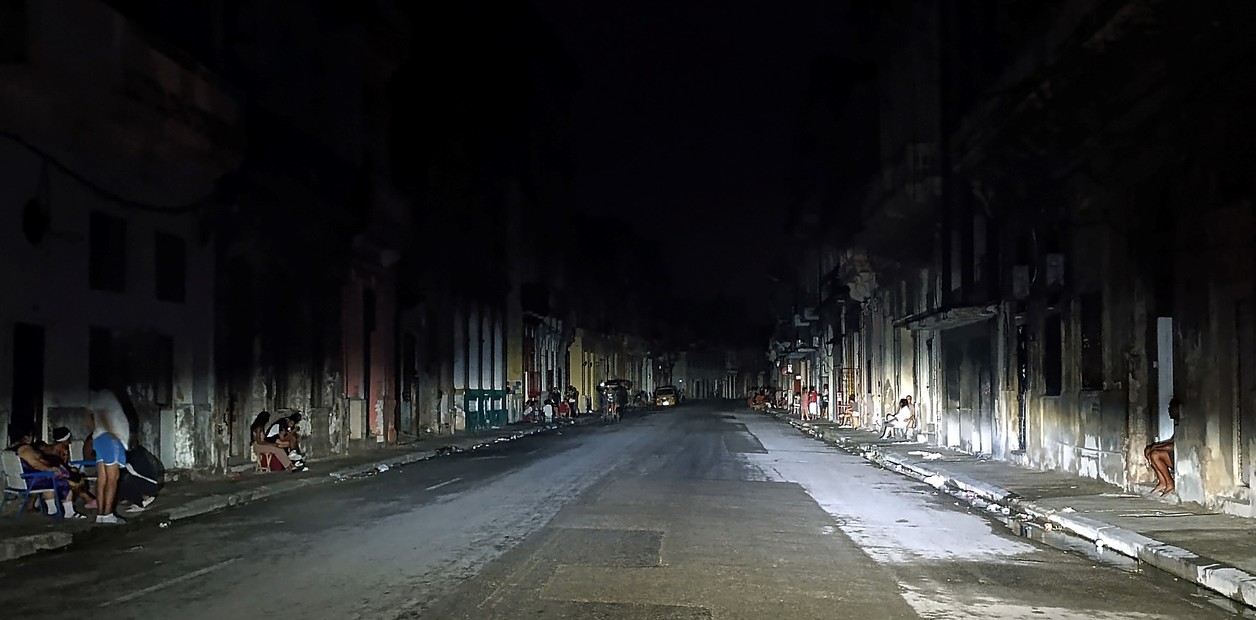
In an almost total shortage of crude oil and without the capacity to cover a daily demand of 100,000 barrels, blackouts in Cuba reach up to 20 continuous hours -with two national blackouts in less than 15 days and a total of 7 in less than 18 months-. An almost total paralysis of the economy and severe effects on the most basic services: health, education and food.
The response of the Cuban government has been to apply austerity measures that recall the Special Period: a call for self-sufficiency and openning the door to foreign investments in the private sector, even from a diaspora historically stigmatized by the official discourse itself.
In statements to NBC News, Oscar Pérez-Oliva Fraga, Minister of Foreign Trade and great-nephew of Fidel Castro, said that the Cuban government was open to “maintaining a fluid commercial relationship with U.S. companies”.
The willingness to negotiate with Washington is not new. In 2016, during the so-called “thaw period,” U.S. businessmen landed in droves to pump dollars into the tourism industry. Barack Obama not only flew the American flag in Havana, but watched a baseball game between the Tampa Bay Rays and the Cuban national team at the Lationamericano Stadium: to his right, his family; to the left, Raúl Castro, president of Cuba’s Council of State and Council of Ministers.
The news of new negotiations -without transparency about their terms-, therefore, aroused a mixture of expectation and indignation. In social networks a phrase was repeated: “they preferred to dialogue with the enemy rather than with the people”, reopening the wounds of July 11, 2021, when thousands of people took to the streets in an unprecedented protest that ended with more than 1,500 arrests. Among them, a significant number of minors.
“The combat order has been given,” Diaz-Canel said then.
The revolt exposed the difference between “the dictatorship of the proletariat” and the “dictatorship of a handful of politicians”. The vestiges of a Revolution emptied of content and betrayed were left in the streets. Because, together with the demand for food and medicine, the people also shouted freedom.
The light that never quite arrived
The revolutionary process of 1959 marked a before and after in the history of Cuba and in the struggle against U.S. imperialism in Latin America. The fall of Fulgencio Batista was the result of the combined action of the workers’, peasants’ and students’ movement, and found in the general strike of January 1 a turning point that consolidated the triumph. Popular mobilization was the driving force behind the first transformations: literacy campaigns, industrialization and a broad cultural development.
For the first time in the region, a revolution expropriated the landlords and the bourgeoisie, opening a process of transition to socialism just miles from the world’s leading imperialist power. Just 90 miles away, the Cuban experience became a reference for an entire generation, an impetus for anti-imperialist, anti-capitalist and socialist struggles, and a direct challenge to U.S. power.
However, that energy never translated into real workers’ control over the means of production. With the passage of time, it was absorbed by a bureaucracy that did not yield power and ended up consolidating itself as a privileged layer.
Today, that structure is expressed in conglomerates such as GAESA, under the control of the Armed Forces and without public oversight mechanisms: a network that ranges from ports to tourism and the real estate business, including the remittance network and dollar stores -notably better supplied than those operating in Cuban pesos-. Essayist and teacher Alina López Hernández defined GAESA as an oxymoron in a country that claims to be socialist.
A leadership that, in addition, has handed over strategic resources to other imperialist powers such as Russia and China, and that in 2022 approved a Penal Code that expanded the crimes punishable under the figure of “state security”, further restricting political freedoms. Most of them with the death penalty as a punitive measure.
But the role of this bureaucracy transcends the national arena. Its consolidation was linked to the Stalinist doctrine of “socialism in one country”, which implied renouncing revolutionary expansion and assuming coexistence with imperialism as a horizon. Under this logic, the Cuban state acted more as a factor of containment than as an emancipating engine. In the 1980s, it helped channel insurgent processes towards negotiated solutions in Central America. And two decades later, it influenced the Bolivarian process under the same limiting logic: giving priority to government stability over democratic radicalization and popular protagonism.
The result is a bureaucracy that ended up digging the pit of its own isolation: a power that is closed, conservative and increasingly distant from the social base it claims to represent.
Formula for resisting external interference
Cuba therefore reaches 2026 in a critical scenario, where external pressure is combined with an exhausted internal model. A multidimensional crisis, with an aging population that exceeds 20%, pensions that do not cover the basic cost of living, a deteriorated health system, a declining education system, intermittent public services, collapsed infrastructure and a process of informal dollarization that deepens inequalities.
To this must be added the persistence of political repression: human rights organizations estimate an approximate number of 1,214 persons deprived of liberty for exercising fundamental rights -a sub-registry, since the real figure is unknown and the PCC denies its existence-. All this has eroded the social confidence of the people in a bureaucratic regime -and its international campist and progressive allies- which has sacralized concepts like Revolution and Socialism, pushing a part of the working class towards an ultra-right wing which does not offer structural answers either, and 3 million people to a massive exodus.
Can those who seek to perpetuate a status quo be revolutionaries? Are those who limit political freedoms, or those who fight to expand them, the revolutionaries?
A people without self-determination – without real channels to deliberate and decide – lacks the tools to resist external interference.
In this context, a new wave of activism also emerges: a youth vanguard of the critical left that, from inside and outside the island, begins to fight for the very meaning of the Revolution. Expressions such as Socialistas en Lucha (SeL), a Marxist, anti-capitalist, internationalist and anti-authoritarian collective, promote, from an anti-imperialist perspective and in defense of social conquests, the demand for democratic rights, political pluralism, freedom of organization and protest, as well as full independence from the ruling regime.
SeL took an active role during the national student and university teachers’ strike of May 2025, in response to the government’s “tarifazo” (price hike) on internet services, which sought to restrict domestic consumption and encourage payment in dollars through recharges and remittances.
“Dissenting from Castroism from the left is a political position of great coherence,” said Raymar Aguado Hernandez, a member of the collective.
In that crack -between the criticism of internal authoritarianism and the rejection of external interference- one of the most complex struggles of the Cuban present is playing out today.
Therefore, more than ever, it is necessary to surround the Cuban people with active solidarity, without subordination to the regime or concessions to imperialism. Not an abstract solidarity, but one committed to the defense of political rights, the material conditions of life and the autonomy of those who resist inside and outside the island.
Recovering the Revolution is not a nostalgic gesture: it is an current task whose outcome will depend on the capacity of the Cuban people to once again become the subject of their own history, to reconfigure their political horizons and to fight, from below, for the very meaning of emancipation.