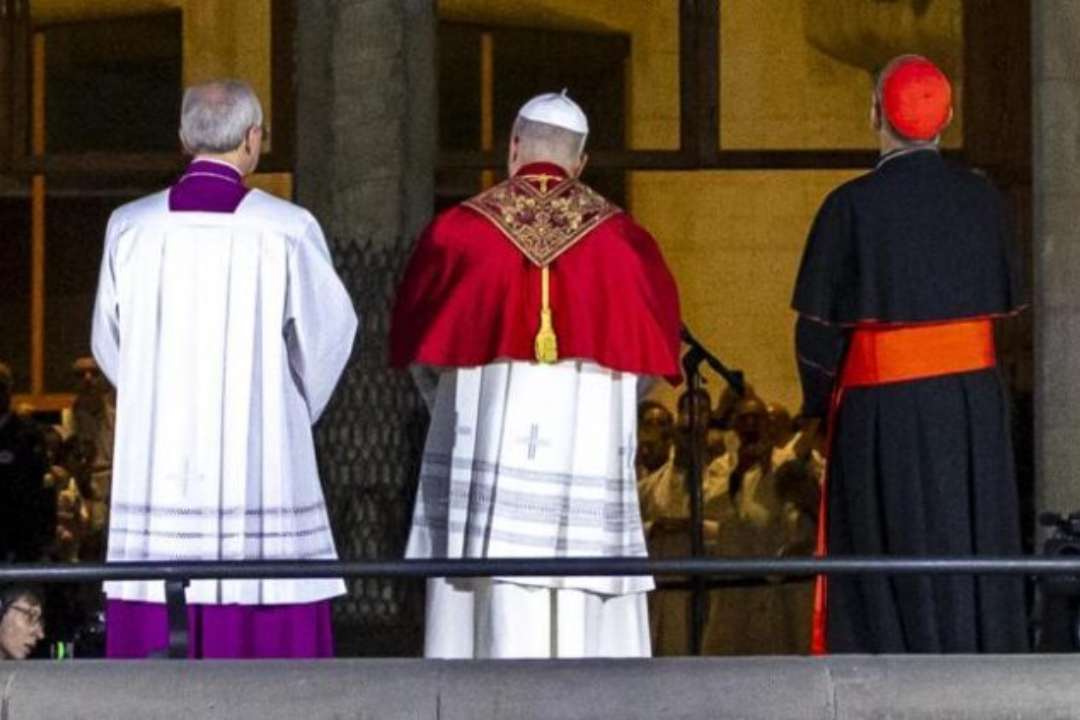
León XIV’s visit highlighted the close relationship between the Catholic Church and state institutions. Against a backdrop of growing secularization, the tour reignites the debate over privileges, abuses, complicity, and public funding, as well as the Catholic hierarchy’s opposition to major democratic and social gains.
Automatic translation made by AI.
By Gérard Florenson and Rubén Tzanoff
The Pope on a tour
Not only to see the world and mingle with ordinary people, but also because he has a mission: despite the Vatican’s opulence, it faces numerous challenges. Not only are faith and religious practice on the decline, particularly among young people and in every country (which is not incompatible with a minority—though sometimes spectacular—form of fundamentalism), but competition is fierce, especially from the most reactionary evangelical churches, whose growth is supported by Trump.
Furthermore, in its traditional strongholds in Latin America and Southern Europe, it notes with dismay that not only is secularization on the rise, but social movements are also making gains in women’s rights—including abortion—as well as in the rights of LGBTQIA+ people.
France, Spain, Portugal, and even Italy are “mission territories”—fortunately without conquerors or “warriors of Christ the King”—but rather, as in the days of the Council of Trent, when the people were invited to admire the beauty of the cathedrals built with their money and sweat, to contemplate beautiful images, to listen to liturgical music, and to obey the priests in all matters of earthly life…
Blessings and thousands of faithful gathered
The Pope inaugurates the nearly completed Sagrada Familia, and Gaudí is hailed (his fervent Catholicism in no way diminishes his talent, nor does the Baroque style make us forget his artistic marvels); there is even talk of a possible canonization.
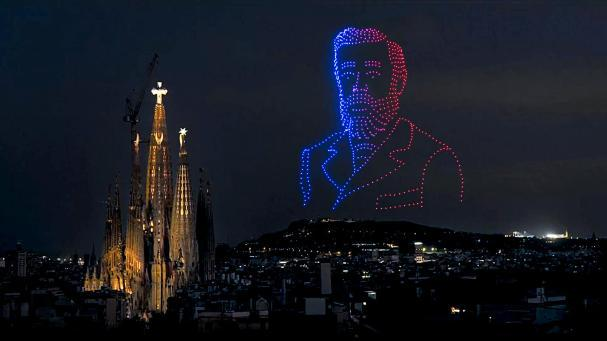
León XIV drew large crowds of the faithful in Madrid and Barcelona, with significant media coverage. The problem does not lie there, although the complacency of most journalists—who refrain from asking uncomfortable questions about the Catholic Church’s real estate holdings, its undeniable misogyny, its rejection of LGBTQ+ demands, child abuse in Spanish churches, and other reactionary stances that are never questioned, is surprising and outrageous.
The political class on its knees
But what is most scandalous is that the vast majority of the political class bowed to the Pope and that all institutions collaborated in financing this event. While France was once considered the Church’s eldest daughter, the Church remains the Spanish state’s favorite. The Concordat signed with Franco in 1953, slightly modified in 1979, still guarantees it considerable privileges and income. As expected, the right supports it, but “progressive” governments are careful not to repeal it.
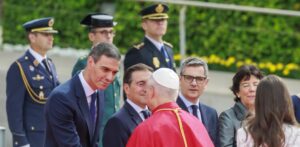
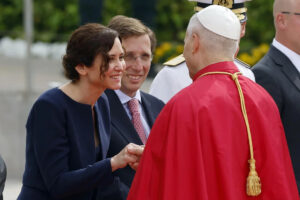
The Pope did not come to offer (in Catalan, Spanish, or Latin) the Vatican’s apology for its support of Franco’s “crusade,” nor to question the backing given by nearly the entire episcopate to the military uprising. The Catholic hierarchy’s desire to impose its particular morality on all of society remains very much alive. This has manifested itself in its opposition to civil marriage and divorce (legalized in 1931 and later abolished by Franco), to secular education… Forced to retreat at the institutional level, it still resolutely opposes—and the Pope was quick to remind us—the right to abortion, as well as same-sex marriage.
But instead of denouncing all this hypocrisy, most so-called “left-wing” politicians have redoubled their obsequiousness and enthusiastic comments, hoping that the Holy Father’s words will unsettle some voters. VOX. What a brave man and what a good Pope, who calls for brotherhood with our immigrant brothers and sisters, is open to dialogue, and does not propose reigniting the pyres to purify the world of heretics, homosexuals, and other horrors condemned by his Church!
The stance of the “Catalan nationalists” was also regrettable—they were willing to attend Mass only if it was celebrated in Catalan. What a fascinating issue, certainly more so than housing (even though the Church is a major landlord), wages, and job insecurity! The Catalan government and the Barcelona City Council (PSC) were very generous during the papal visit, paying more attention to the Church’s demands than to those of the teachers who are fighting for their rights and mobilized despite the visit and all.
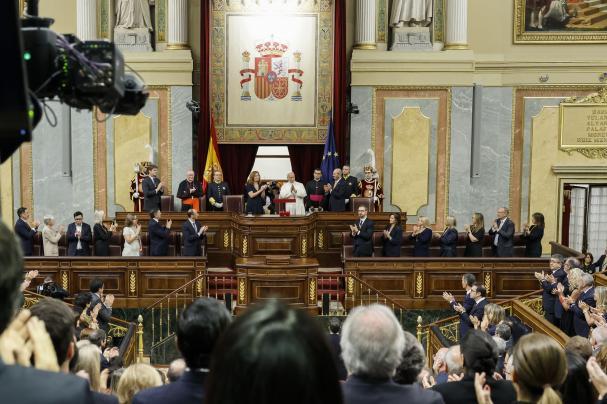
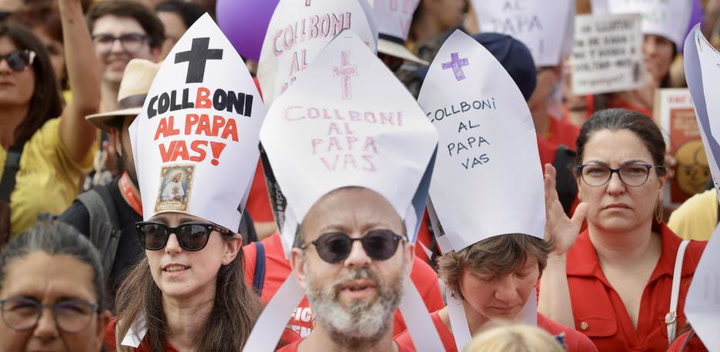
These false socialists and pseudo-Catalan nationalists have even betrayed the traditional republican program—the democratic demand for the complete separation of the state and public institutions from the churches—which requires the repeal of the Concordat and the abolition of all funding, whether overt or covert, especially for private education.
Sensitivity toward immigrants? From words to action
Pope Leo XIV’s words on the suffering of migrants, shipwrecks, and the need for integration are the bare minimum that can be said about the racist barbarity of European governments and the dramatic reality facing those desperately seeking asylum. However, the Pope avoids naming the political and institutional actors responsible for this tragedy: the governments of the European Union, the European Commission, and the states that uphold the “Fortress Europe” policy, responsible for militarizing borders, funding deportations, outsourcing expulsions, and turning the Mediterranean and the Atlantic into mass graves for thousands of human beings.
While calling for solidarity and integration, the Church maintains an abstract critique that fails to consistently challenge the root causes of the migration crisis. It does not denounce the economic plundering of Africa and other dependent countries by European multinationals, nor the role of imperialist powers in wars, indebtedness, and the destruction of entire economies that force millions to flee their homes. Words of compassion for migrants thus stand in stark contrast to the silence in the face of those who build walls, fund detention centers, and make the persecution of migrants a matter of state policy.
The outdated institutions of the system
Ultimately, the Church and the bourgeois state have historically functioned as complementary pillars of the same social order, one based on economic exploitation and gender, sexual, and social oppression. Through their institutions, laws, and mechanisms of ideological influence, they help sustain relations of domination that reproduce inequalities, discrimination, and privileges for the ruling classes. In the face of the scourges of the capitalist system, it is necessary to fight for the complete separation of church and state, the elimination of all religious interference in public life, full equality of rights for women and LGBTQIA+ people, and the construction of a society free from exploitation, oppression, and the reactionary ideologies used by the capitalist system to justify and perpetuate these forms of domination—a society that can only be a socialist one.