By Oleg Vernik, Chairman of the Independent Trade Union of Ukraine “Zakhist Pratsi– Ukrainian Socialist League
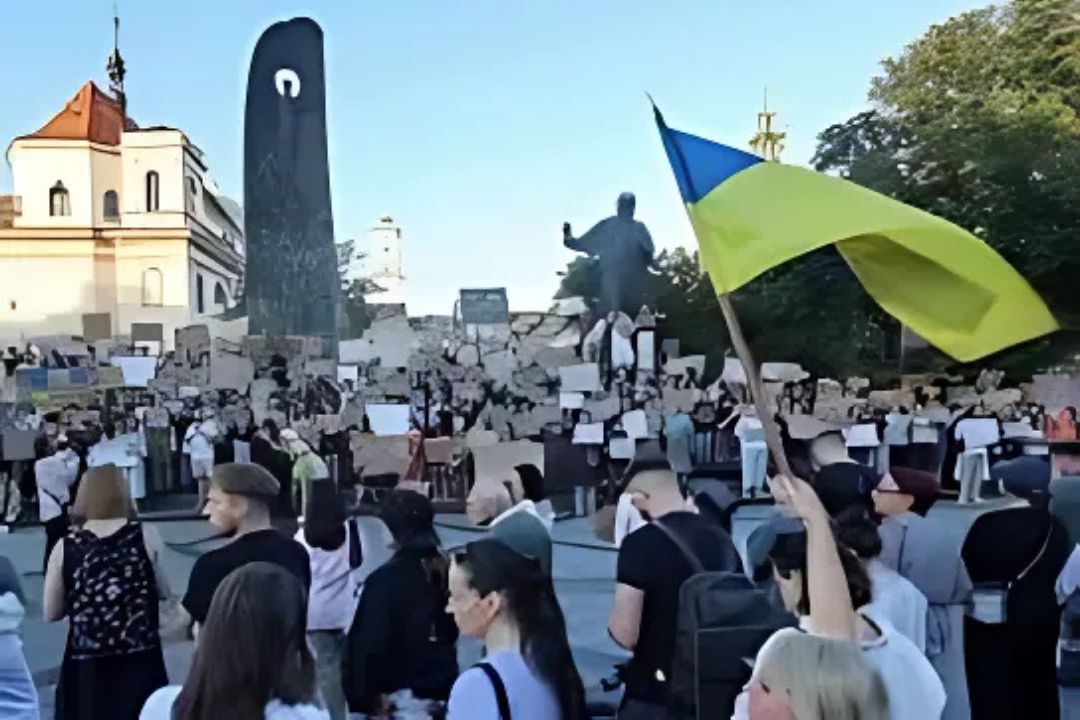
Mass protests in Ukraine began on July 22, 2025, immediately after President Volodymyr Zelensky almost instantly signed Bill No. 12414, adopted with equal speed by the Verkhovna Rada, which in practice erradicates the independence of the National Anti-Corruption Bureau of Ukraine (NABU) and the Specialized Anti-Corruption Prosecutor’s Office (SAP).
On July 23, 2025, street protests spread to numerous regional capitals of Ukraine, and a protest rally of a magnitude not seen since the Maidan of 2014 in Kiev. The heads of the NABU and the SAP publicly thanked all the people who took to the streets. More than 1,200 people gathered in Ivan Franko Square in Kiev demanding that President Zelensky veto the law. It is important to emphasize that these protests took place throughout the country despite the official ban on such demonstrations, in force since the beginning of Russia’s large-scale military invasion in 2022.
What are NABU and SAP?
The National Anti-Corruption Bureau of Ukraine (NABU) and the Specialized Anti-Corruption Prosecutor’s Office (SAP) are two extraordinary law enforcement bodies that were created in 2015 after the Maidan victory and under pressure from the Western partners of the new pro-western government of Ukraine. The IMF, World Bank, European Union and the United States directly conditioned their financial assistance to Ukraine on the creation and functioning of anti-corruption institutions, including NABU and SAP. In particular, launching NABU was a key requirement to receive assistance from the IMF and macro-financial assistance from the EU.
The NABU was given powers to independently investigate corruption crimes, identify corruption among Ukrainian senior officials and transfer cases to SAP for judicial prosecution. The particular thing about these bodies was that their management was not entirely appointed by the Ukrainian authorities: half of the commission in charge of electing their directors was appointed with the approval or recommendation of international partners, mainly international NGOs that ended up exerting a decisive influence on the priorities and orientation of these institutions.
It should be noted that the international organizations that most influenced NABU and SAP were related to the US Democratic Party and one of its main financiers, George Soros. Since 2015, these entities have been able to directly pressure the Ukrainian political elite based on their own interests. When the Ukrainian authorities tried to act independently or favor the local oligarchy, NABU and SAP responded by judicially attacking even the highest state officials. But if the Ukrainian government did not clash with the interests of its “Western partners”, the edge of the investigations blurred.
The fact that there are key organs of Ukrainian justice that are not under the direct control of the sovereign state raises many doubts. These mechanisms of ”external protection” violate the very principle of national sovereignty and the constitutional foundations of people’s power. The Ukrainian ruling class that emerged from the Maidan was forced to accept this humiliation due to its extreme dependence on financial and economic aid from the Western bloc.
However, amid an endemic corruption in the Ukrainian administration, the existence of NABU and SAP played a relatively positive role, at least as a partial curb on the officials’ appetite. They often managed to bring investigations to the end even against figures of the highest level of the Ukrainian ruling class.
During Petro Poroshenko’s presidency, it was NABU that opened high-profile corruption cases against his inner circle: the “Ukroboronprom” case (corruption in the defense industry), the sale of the company “Leninska Kuznia”, the supply of fuel to the company “Trade Commodity” and interference in the selection of judges of the Supreme Court. These cases significantly contributed to the collapse of Poroshenko’s popularity and his defeat in the 2019 elections.
Why did Zelensky decide to attack NABU and SAP?
Despite numerous attempts, neither Zelensky nor his Presidential Office (headed by Andriy Yermak) managed to bring NABU and SAP under their full control. Although they completely control the Security Service of Ukraine (SBU), the Prosecutor General’s Office and the State Investigation Bureau (DBR), they could not stop NABU’s investigations against its closest allies.
Recently, NABU detectives have opened cases against people very close to Zelensky, such as Deputy Prime Minister Oleksiy Chernyshov, who had to temporarily leave the country pending guarantees. NABU’ director Semen Kryvonos publicly denounced government interference in this investigation. An indictment was also being prepared against Timur Mindich, co-owner of the production company “Kvartal 95” and referred to by the press as “Zelensky’s money man”.
Faced with this direct threat, Zelensky chose to think ahead. As has been said, the greatest control over NABU is exercised by organizations linked to the US Democratic Party and Soros. It is likely that Zelensky would not have dared to this attack without the tacit approval of Donald Trump, due to their recent rapprochement. Trump is interested in weakening the influence of his political adversaries inside Ukraine. For decades, the Democratic Party has cultivated a network of USAID-funded organizations that have acted as ”civil society” in Ukraine.
Before the attack on NABU, the government had already launched an offensive against one of the leaders of Soros and the Democratic Party in Ukraine: Vitaliy Shabunin, president of the Anti-Corruption Action Center (CAP). The DBR, controlled by Zelensky, accused him of evasion of military service and fraud, while Shabunin denounced political persecution. The accusations do not seem unfounded, and the fact that during years of war no action has been taken against him is at least suspicious. Only now that he openly criticizes the presidential circle has the repression been unleashed.
What does Law No. 12414 consist of?
The new law transfers control from NABU and SAP to the Attorney General’s Office, implying their political subordination to the Office of the President. The most alarming provisions include:
- The Attorney General will be able to access all NABU files and refer them to other prosecutors, influence investigations, sign indictments and close cases without NABU or SAP approval;
- The Attorney General may issue mandatory written orders to the NABU detectives;
- It will have the power to close criminal proceedings against high-ranking officials (President, deputies, judges, high military commanders);
- Only the Attorney General will be able to sign indictments against senior officials, before the competence of NABU.
And, perhaps the most serious: for the first time, one of the introduced rules annuls the constitutional right to the inviolability of the home. Now a supposed “urgency to preserve evidence” will be enough for a prosecutor or investigator to enter without a court order. This is a new example of the authoritarian path taken by power, shielded by martial law.
Reaction of Ukraine’s “European partners”
Despite the relative silence of Trump and his entourage, numerous European officials strongly condemned Zelensky’s decision.
Ursula von der Leyen, president of the European Commission, expressed her concern in a conversation with Zelensky, reminding him that the rule of law and the fight against corruption are inalienable conditions for EU membership.
Marta Kos, European Commissioner for Enlargement, described the law as “a serious setback” and reiterated that the independence of the NABU and the SAP is a key criterion for accession.
Guillaume Mercier, EU spokesman, said that for now there are no plans to suspend financial aid to Ukraine, but that transparency and respect for the rule of law are essential pillars of European support.
Similar statements were heard from the European Parliament and national parliaments of the EU.
Is Zelensky backing down?
The situation got out of hand for Zelensky and Yermak. This time, even the usual propaganda device of accusing NABU and SAP of being infiltrated by Russian spies did not work, something ridiculous given their Western creation and tutelage.
On the night of July 23 and during the following day, Zelensky issued several statements seeking to calm the situation. He said to “listen to the citizenry” and not ignore social unrest. He recognized the right to demonstrate and promised to present a new bill soon to guarantee the independence of anti-corruption agencies and reduce political influence over them.
Although it is still too early to know if these words will calm the protest, it is clear that the bourgeois parliamentary opposition is trying to jump on the bandwagon. On July 23, the mobilization of Poroshenko’s party and sectors related to the opposition mayor of Kiev, Vitali Klitschko, was already noticed.
However, the majority came out to protest without following bourgeois slogans. Workers and students are fed up with corruption, brutal social inequality in the context of resistance to Russian imperialist aggression.
It is important to note that the ”fifth column” of Russian imperialism failed to use these protests to promote its interests or weaken popular resistance. The pro-Russian provocateurs were immediately isolated by the protesters themselves.
Socialist analysis and our demands for this moment
The interests of the various bourgeois factions in dispute are totally alien to us. We know well that NABU and SAP were never really independent. They are organs of the bourgeois repressive apparatus at the service of different fractions of the ruling class.
Its very existence is an expression of Ukraine’s lack of sovereignty and its peripheral status in the global imperialist system. We do not support any form of “external tutelage” by imperialist powers, be it the Russian military aggressor or the Western “partners”.
But as Ukrainian socialists, we are also not indifferent to the authoritarian drift and the attack on democratic rights. The Ukrainian people have the right to independent anti-corruption institutions under popular control. Any bourgeois democracy is preferable to a bourgeois dictatorship. This is an elementary principle of Marxist analysis. As the International Socialist League has pointed out, the banner of democratic freedoms is consistently defended today only by the left.
Our demands are clear for all workers and youth of Ukraine:
- Out with NABU and SAP! Long live the workers’ and students’ mobilization!
- Ukrainian popular masses control of NABU and SAP. Out with foreign manipulators!
- Long live workers’ and students’ control over the anti-corruption bodies!
- No to the external tutelage of Ukraine! No to the authoritarian shift of the government!
- We will not allow legitimate popular discontent to be used by Russian imperialism!
- Long live the socialist and anti-capitalist alternative!
July 24, 2025