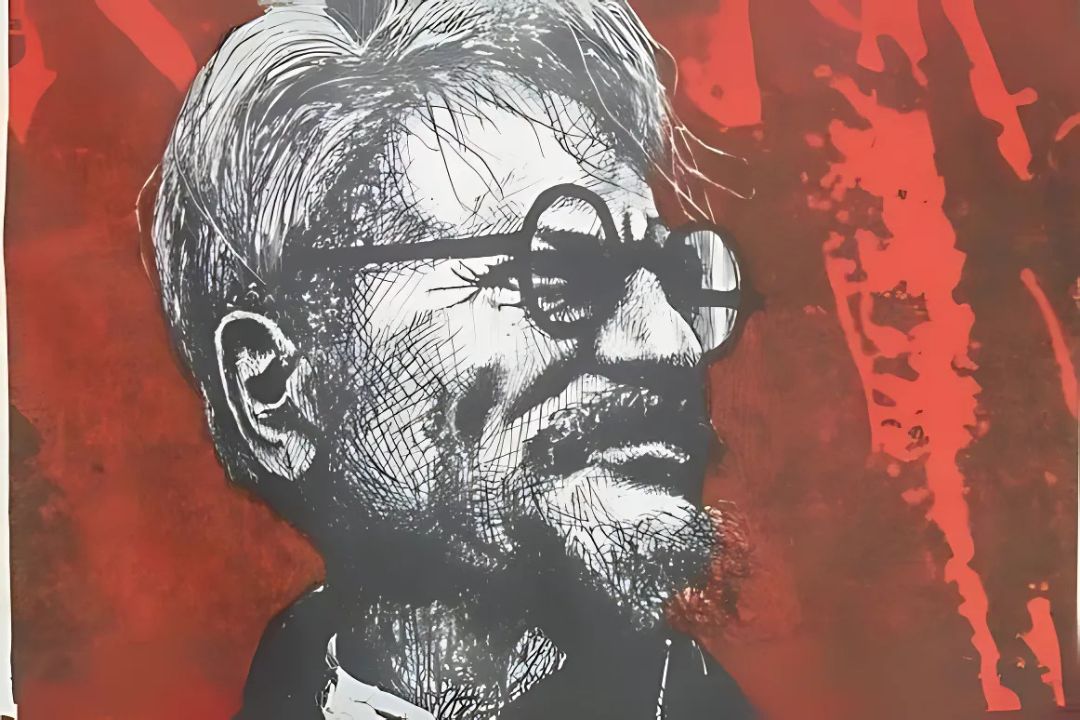
85 since Leon Trotsky´s assassination, we share the following article.
By David Morera Herrera
UNDER THE BANNER OF THE FOURTH INTERNATIONAL
Faced with the bankruptcy of the Third International, corrupted by Stalinism, Trotsky set out to accomplish what he considered the most important task of his life, the founding of a new revolutionary international organization: the Fourth International. Hard work in the midst of a profoundly adverse situation.
The map of Europe was turning black with the advance of the Nazi-fascist hordes. Inside the USSR, Stalin had consummated the physical extermination of the Left Opposition. Under these conditions, the world had plunged into the unprecedented maelstrom of destruction that was the Second World War.
Trotsky was aware that the Fourth International was born “swimming against the current”, with very scarce resources, made up of small inexperienced groups, relentlessly persecuted by imperialism and Stalinism, daring to raise the banner of revolutionary Marxism, against all odds.
Shortly before the foundation of the Fourth International, Erwin Wolf, who was Trotsky’s secretary during his stay in Norway, died in Barcelona while fighting against Franco’s troops in the Spanish Civil War. In France, other key figures were assassinated by Stalinist agents: Rudolf Klement, organizational secretary, in charge of the preparations for the founding Congress of the Fourth International, then Leon Sedov, Trotsky’s eldest son, who was in charge of the clandestine contacts inside the Soviet Union and of publishing the Bulletin of the Left Opposition in Russian. These three young comrades, who died tragically at the dawn of the constitution of the Fourth International, synthesize the drama of the epoch and the severe conditions under which it was born.
On September 3, 1938, in the town of Périgny, in the suburbs of Paris, France, a clandestine meeting founded the World Party of the Socialist Revolution, better known as the Fourth International. Trotsky was not present, because he was not allowed to leave Mexico and his life had already been seriously threatened. Twenty-one delegates representing revolutionary organizations from 11 countries were present.
The conference was held in the shadow of the recent assassinations and elected the three young martyrs, Wolf, Klement and Sedov, as honorary presidents. With Klement, many reports on the work of Trotskyist groups in various countries disappeared. For security reasons, the founding conference held only one session during the indicated date, and approved the Transitional Program, drafted by Trotsky, which in our opinion is a very valuable programmatic document for revolutionary Marxism, as a continuity and update of the Communist Manifesto of Marx and Engels.
The Transitional Program begins by indicating the crisis of revolutionary leadership of the proletariat, caused by the betrayals of social democracy and Stalinism, as the main aggravating factor of the world crisis, and assumes the resolution of this crisis as the main task of the new International.
“The charlatanism of all kinds according to which the historical conditions would not yet be ‘ripe’ for socialism are nothing but the product of ignorance or conscious deception. The objective conditions of the proletarian revolution are not only ripe but have begun to decompose. Without social revolution in the next historical period, human civilization is under threat of being swept away by a catastrophe. Everything depends on the proletariat, that is to say, on its revolutionary vanguard (…). The historical crisis of humanity is reduced to the crisis of revolutionary leadership. The economy, the state, the politics of the bourgeoisie and its international relations are completely sterilized by a social crisis. The main obstacle on the road of the transformation of the pre-revolutionary state into a revolutionary state is the opportunist character of the proletarian leadership: its petty-bourgeois cowardice before the big bourgeoisie and its treacherous association with it, even in its death throes.”
With this analysis as its starting point, the Transitional Program is a system of transitional demands to bridge the gap between the present situation and consciousness of the working masses and the tasks of the socialist revolution. Its guiding principle is to promote the independent mobilization of the working class and the oppressed, as well as the construction of the revolutionary organization that will lead them to the socialist revolution.
“In a society based on exploitation, the supreme morality is that of social revolution. All methods are valid that raise the class consciousness of the workers, their confidence in their own strength, their willingness to self-sacrifice in the struggle. Inadmissible are those methods which inculcate in the oppressed fear and submission before their oppressors, which stifle the spirit of protest and indignation or substitute the will of the masses for the will of the leaders, conviction for coercion, analysis of reality for falsification.”
TROTSKY´S ASSASSINATION
On August 20, 19140, at approximately five o’clock in the afternoon, in his home in Coyoacan, Mexico, Trotsky, at the age of sixty, Trotsky was mortally wounded by Ramon Mercader, an agent of the Stalinist secret police (GPU), recruited for the extermination of Trotskyists during the Spanish Civil War.
With Jacson Monrad’s false passport, posing as a Belgian diplomat, Mercader, since the summer of 1938, had become the lover of Sylvia Agelof, a Russian-American who served as Trotsky’s personal secretary in Mexico. Gradually, he became close to Trotsky’s family circle and befriended his bodyguards. With the ruse of asking Trotsky to review an article he had supposedly written, the assassin smashed the Russian revolutionary’s skull with a pickaxe, which he hid in his overcoat. Trotsky died one day later: August 21 at 7:25 pm.
Joe Hansen, leader of the American Socialist Workers Party (SWP), accompanied him in his final breaths. He wrote the following words, first published in October 1940 in the magazine Fourth International:
“I leaned back on the bed. It seemed that his eyes had lost those quick flashes of the energetic intelligence so characteristic of the Old Man. His eyes were fixed, as if they no longer perceived the outside world, and yet I felt that enormous will pushing away the darkness that extinguished him, refusing to yield to his enemy until he had accomplished his last task. Slowly, haltingly, he dictated, painfully choosing the words of his last message to the working class, in English, a language that was foreign to him, and on his deathbed he did not forget that his secretary did not speak Russian!
‘Please tell our friends…I am sure…of the victory…of the Fourth International…Forward.’ “
On the occasion of the assassination of Leon Trotsky, André Breton, an outstanding exponent of the surrealist movement, co-author, together with Diego Rivera and Trotsky of the “Manifesto for an Independent and Revolutionary Art”, expressed the impact of this crime in the following way:
“Many times the phrase of Lautréamont has been used in surrealism: All the water of the sea would not be enough to wash away a stain of intellectual blood; but here it is no longer necessary to put it in a figurative sense.”
The biography “Life and Death of Leon Trotsky”, written by his comrade Victor Serge, states:
“His moral rectitude was linked to an objective intelligence, but passionate, always tense towards the deep and wide, towards the creative effort and the just combat. And he was at the same time simple. It occurred to him to write in the margin of a book whose author alluded to his lust for power’: Others may have wanted power for power’s sake. I have always ignored that feeling. I have sought the collective power of intelligences and wills’.”
THE STRUGGLE CONTINUES
The assassination of Trotsky is not simply a personal revenge of Stalin, it is a coldly calculated political act. Trotsky’s death deprived the Fourth International of the only surviving leader of the generation that embodied the most valuable revolutionary experience and tradition of the century, from the struggle against the tsarist autocracy and emigration in the Marxist circles of Europe, through the Russian Revolutions of 1905 and 1917, the Red Army and the Third International, to the struggle against Stalinist degeneration and fascist barbarism.
But 80 years after his assassination, the once powerful Stalinist apparatus that tried to erase with blood and fire the memory and teachings of October of 1917 and to bury Trotsky’s name, has callapsed into rubble, while Trotsky’s figure acquires a prophetic stature before the verdict of history itself.
Since the fall of the Berlin Wall in 1989 and after a brief period of economic and political opening (known as perestroika and glasnot), in the former USSR, with Gorbachev at the head, preceded by Yeltsin, the falsley named socialist regimes of the former Soviet Union and Eastern Europe, fell one by one, before the mobilization of the working masses and the pressure of imperialism.
However, in the absence of a revolutionary leadership to channel the discontent of the working masses in those countries, the former “communist” bureaucracies, recycled in association with imperialism, opened the doors to the pillage of the nationalized economies and sealed the path of capitalist restoration. In other states such as China, Cuba and Vietnam, the totalitarian control of the bureaucracy, which still calls itself “communist”, remains intact, but it is also moving, with different rhythms, towards the restoration of capitalism and the reversion of the social conquests derived from their respective revolutions.
Thus Trotsky’s prediction is fulfilled, in its negative sense:
“Thus the regime of the USSR embodies terrible contradictions. But it remains a degenerated workers’ state. This is the social diagnosis. The political prognosis has an alternative character: either the bureaucracy, becoming more and more the organ of the world bourgeoisie in the workers’ state, will overthrow the new forms of property and plunge the country back into capitalism, or else the working class will smash the bureaucracy and open the road to socialism.”
Unfortunately, in the second post-war period, the Fourth International did not pass the test; it was not able to resolve the red thread of the crisis of humanity: the crisis of revolutionary leadership of the working class, as it proposed at its founding. The extreme weakness of the groups surviving the Second World War, their marginality, adaptation and pressures from bureaucratic and petty bourgeois movements and apparatuses, led to a growing disintegration into multiple fragments of those who claim to be heirs of the tradition of the Fourth International.
That is the fundamental reason why the Stalinist bureaucracy ended up ruining the workers’ states, which, bureaucratically degenerated, quickly entered a process of decomposition and dismantling, towards capitalist restoration. This political framework, expressing a new correlation of forces, led the workers’ and popular movement, on a world scale, from defeat to defeat, until imposing in the nineties of the twentieth century, a profound setback in its consciousness and organization, which led bourgeois ideologues to loudly proclaim the definitive and undisputed victory of the capitalist system and impose a harsh neoliberal counter-offensive throughout the world, which led to the precariousness, informalization and labor flexibility of the working class, while dismantling much of the social benefits and significantly reducing their unionization rates.
However, in spite of the retreat of the political and social subject of the socialist revolution, capitalism, due to its increasingly destructive nature, continues to incubate and deepen the irreconcilable contradictions inherent to it, and which Karl Marx masterfully revealed in his masterpiece “Capital”. The recurrent recessive tendencies of the world economy and its ephemeral recoveries, since the bursting of the real estate bubble in 2008, are accompanied by a polarization and aggravation of the political and social crisis, which has multiple manifestations. New workers and popular struggles emerge, which despite not having revolutionary leaderships, instinctively seek a way out of the growing misery, brutality and deprivation imposed by the system in different latitudes.
In one of his last works; “In Defense of Marxism”, Trotsky wrote the following words that are perfectly applicable to our time:
“(…) the fundamental task of our epoch has not changed, for the simple reason that it has not been resolved (…). Marxists do not have the least right (if disillusionment and fatigue are not considered rights) to draw the conclusion that the proletariat has squandered all its revolutionary possibilities and must renounce all its aspirations (…). Twenty-five years in the scales of history, when it comes to the most profound changes in economic and cultural systems, weigh less than an hour in the life of a human being. Of what use is the individual who, because of the setbacks suffered in an hour or a day, renounces the purpose he has set for himself on the basis of all the experience of his life?”
In the last years of his life, Trotsky had to observe the disbandment of many left-wing intellectuals, who renounced Marxism. The Nazi-fascist horror and the bitter disappointment with Stalinism, was the breeding ground for this state of mind, which ultimately led many of them to embellish and reconcile with bourgeois democracy in the imperialist metropolises. Regarding this phenomenon, he pointed out:
“It is beyond dispute that the old Bolshevik Party has worn out, has degenerated and perished. But the ruin of a given historical party which for a period rested on the Marxist doctrine, does not mean the ruin of that doctrine. The defeat of an army does not invalidate the fundamental precepts of strategy. That an artilleryman hits far from the target in no way invalidates ballistics, that is to say, the algebra of artillery. That the army of the proletariat suffers a defeat or that its party degenerates, in no way invalidates Marxism, which is the algebra of the revolution (…).
In any case, no serious revolutionary would think of using confused intellectuals, disillusioned Stalinists and disappointed skeptics as a yardstick to measure the march of history.”
Actually, in the 21st century the dilemma posed by Rosa Luxemburg: “Socialism or Barbarism”, is not only still valid, but has become even more pressing and stark. Far from the mechanicism of the Stalinist manuals and their professions of faith, there is no “deus ex machina” design that will inevitably lead humanity to something like the “socialist paradise” The road is very rough. It all depends on the dialectics of the class struggle and its results, it all depends on whether the working class and popular vanguard, consciously, can rise to become the social and political subject of its own emancipation, as it demonstrated, partially and potentially, with the Russian Revolution of October 1917.
Finally, it is necessary to emphasize that Marxism is the farthest thing from a dogma or a recipe book. Just as life and the universe are constantly transforming. Marxism is a critical and open science, at the service of the emancipation of humanity, whose theoretical body is nothing other than the systematization of the revolutionary experience of the oppressed in their titanic struggle.
Thus, the Marxism of the 21st century, of course, needs to be updated with the new phenomena that reality produces. It is essential, for example, that it be nourished by the innovative contributions of ecosocialist and socialist feminist currents, insofar as the overthrow of capitalism is inseparable from the liquidation of patriarchy and, at the same time, is combined with the increasingly alarming conflict that derives from the voracious destruction of the planetary ecosystem, imposed by the irrational profit system.
On our part, our best tribute to the work and singular example of Leon Trotsky, is to continue his long march towards opening the socialist horizon for all humanity.