Automatically translated by AI.
By: Mario Unda
Daniel Noboa begins his term of office on November 23, 2023, after early elections arising from the “death cross” decreed by his predecessor, Guillermo Lasso. A simple review of the main milestones of Noboa’s government allows to assemble, like a jigsaw puzzle, the contours that characterize it.
1. RECRUITMENT
January 2, 2024: announces a popular consultation with 11 questions, 9 of which are aimed at issues related to insecurity and violence, giving more powers to the Armed Forces, the Police and security agencies. The other two refer to submitting disputes between the State and transnational corporations to international arbitration and allowing hourly labor contracts1.
January 9, 2024: declares the existence of an “internal armed conflict” against “transnational organized crime groups” which it describes as “terrorists “2.
March 29, 2024: Noboa holds a private meeting with Trump. According to CNN, Noboa arrived with a proposal for the return of US troops to Ecuador. Meanwhile, the spokeswoman for the US National Security Council assured that Trump “is firmly committed to strengthening bilateral security cooperation and is considering expanding our combined efforts against transnational criminal organizations.
April 1, 2024: increase of VAT from 12 to 15%, justifying it on the need to finance the war against “narcoterrorism “4. The new tax affects more than 200 products of the basic food basket, and 21 of the 215 foods that make up that basket. The measure had been announced on March 16.
April 5, 2024: Noboa orders an invasion of the Mexican embassy in Quito to arrest former Vice President Jorge Glas, accused of acts of corruption during the government of Rafael Correa. Glas was in asylum in that diplomatic headquarters5.
April-May 2024: first electric crisis with outages and rationing. Noboa accuses the Minister of Energy, Andrea Arrobo, of sabotage, asks for her resignation and files a complaint against her in the Attorney General’s Office. Before the crisis broke out, several professional and labor sectors had announced the risk of power outages due to the heavy drought, while the government insisted on having everything under control. During her impeachment trial, Arrobo assured that the president was aware of the problem6.
April 21, 2024: the referendum is held. The Yes vote wins by a wide margin in the 9 questions on security; the No vote wins by a wide margin in the questions on international arbitration and labor contracting7.
May 31 – June 7, 2024: Signs letter of intent with the International Monetary Fund (IMF)8. The government commits to implement neoliberal policies, complementing them with targeted social measures.
September-October 2024: second electricity crisis, with more drastic outages and rationing, up to 14 hours a day in some provinces, lasting until December.
March 13, 2025: rupture of the trans-Ecuadorian oil pipeline in Esmeraldas. The government says it was sabotage.
May 5, 2025: Noboa visits Israel and meets with Netanyahu, to whom he said that Ecuador and Israel “have the same enemies “9.
May 24, 2025: Noboa’s new mandate begins and he undertakes an avalanche of laws, decrees and agreements.
June 10, 2025: Organic Law of National Solidarity.
June 11, 2025: Organic Law of Intelligence.
June 16, 2025: the government reopens, after five years, the mining cadastre for new concessions.
June 20: the National Assembly approves the reform to the Democracy Code that changes the Webster method for the D’Hondt method, favoring the most voted lists.
June 26, 2025: Organic Law of Public Integrity. Among the several aspects it contains are, on the one hand, the mechanisms that allow the dismissal of public workers, based on “evaluations” (in fact, the dismissals began before there was any evaluation), and, on the other hand, provisions that nullify interests and fines for late payment of debts to the SRI. The article that prevented the President’s family members from benefiting from a law of December 2024 was eliminated (with this new law, Corporación Noboa eliminated its debt)10.
July 4: Decree eliminating several ministries in the social area: for example, Environment becomes a dependency of the Ministry of Energy and Mines, Women and Human Rights becomes a dependency of the Ministry of Government.
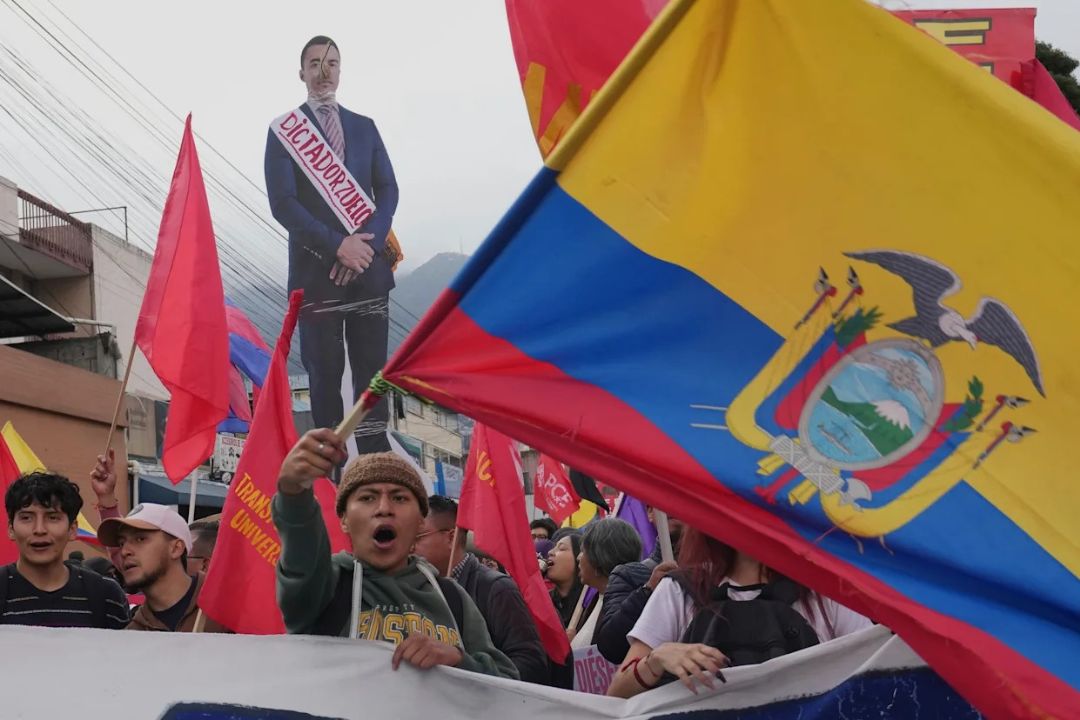
July 11: protests begin, led by the Unitary Workers Front and the Front in Defense of Health, Public Education, Decent Work, Social Security, Human Rights and Nature. In the following weeks they will carry out several mobilizations, sit-ins and events until linking up with the strike decreed by CONAIE.
July 14: regulation of the Organic Law of Intelligence.
July 15: regulation of the Organic Law of Solidarity.
July 23: regulation to the Organic Law of Public Integrity.
July 24: Decree 60 of “institutional reforms of the Executive Function”.
July 26: “Regulation of labor organizations for the exercise of the right of freedom and autonomy of labor unions” (Ministerial Agreement No. MDT2025-082, known as “Agreement 082”). This replaces Ministerial Agreement No. MDT-2024-012, which the same Minister had issued in January 2024 with the same name. The changes between one and the other are significant: adding the prohibition of immediate reelection and the requirement that the leaders must be “active workers under a relationship of dependence”.
August 4, 2025: the Constitutional Court temporarily suspends 17 articles of the Solidarity, Integrity and Intelligence laws.
August 16: the Frente Unitario de Trabajadores calls for a national mobilization for September 11.
August 27: the “Organic Law of Social Transparency” is published, for the control of NGOs and foundations.
September 12: the government decrees the increase in the price of diesel and establishes a flotation scheme with compensation bonds.
September 16: march for water in Cuenca with more than 100,000 participants.
September 17: a kidney patient dies during a protest in Ambato.
September 18: CONAIE calls for an indefinite national strike. Repression leaves three dead and numerous injured.
October 1: Law of Strengthening and Credit Sustainability, which obliges the BIESS to sell its portfolio.
October 5: Noboa announces the advance payment of the thirteenth salary before the popular consultation.
October 27: regulation to the Organic Law of Social Transparency, which prohibits organizations to “execute actions destined to paralyze mining activities”.
November 3: Noboa meets with Ecuadorian migrants in Queens and offers one thousand bonds of the Emprende program.
2. A BEGINNING LITTLE REMEMBERED
Perhaps no one remembers anymore (and maybe remembering it does not contribute much) that Daniel Noboa made his electoral campaign in 2023 defining himself as a person of the center-left.
So, in his first inauguration speech11, Noboa tried to present a totally new image: his own youthfulness, a short speech, which lasted about seven minutes, and promises to leave polarization and confrontations behind.
Beyond revenge: “those who see politics as a reality of extremes and revenge will not have popular support […]. [I feel the obligation to put my country first and break the cycle of revenge”. And, to complete, he sentenced that “The anti has a ceiling and the pro is infinite” […]: “I am not anti-nada, I am pro-Ecuador”.
He also boasted of the diversity of his ministers: “Few cabinets in history have been as diverse as this one. We have never had the participation of so many women or young people”. Accordingly, he offered “an Ecuador that includes everyone”.
Promises and purposes: “I believe in a State whose first objective is to reduce violence and make progress a custom”. How to face violence: “To fight violence we have to attack unemployment”, and he announced that, for this purpose, “we will send urgent reforms”.
To solve Ecuador’s problems, he said, “the old political schemes” must be discarded and we must work together “to put an end to the common enemy: violence and misery”.
Two other facts marked this first phase of Noboa’s government. On the one hand, the conformation of his ministerial cabinet, which shows an attempt to establish a government of oligarchic unity, but with new faces and the participation of new generations; they represent families from diverse economic sectors, at least not the largest ones (except for their own family groups)12.
On the other hand, the establishment of a parliamentary alliance between ADN (Acción Democrática Nacional), the Partido Socialcristiano (PSC) and Revolución Ciudadana, which shared the dignities of the Assembly and the leadership of the parliamentary commissions. The political agreement followed and completed the social alliance.
But the situation changed drastically at the beginning of the new year, under the pretext of violence generated by drug trafficking, which was spiraling out of control and which the population identified as its main concern. In 2021, Ecuador had a homicide rate of 13.7 per 100,000 inhabitants, and in 2022 it jumped to 25.9. In 2023 it was already 49 per 100,000 inhabitants13, including the murder of a candidate for the presidency of the republic, mayors and councilors. Although in 2024 it dropped to 39, robberies, kidnappings and “vacunas” (extortions) increased: Ecuador had become the most violent country in Latin America14.
Guayas accounted for 46% of homicides, followed by Manabí (12.34%) and Los Ríos (11.59%). Guayaquil, the main canton of Guayas province, accounted for 27.87% of all homicides registered in the country, four times more than Durán and seven times more than Manta, which were in second and third place. The population, frightened and helpless, clamored for the protection of strong governments and heavy-handed measures.
Thus, when Noboa decreed a state of internal war against terrorist groups and transnational organized crime, he received the approval of the population and his acceptance grew notably. Even more so because the declaration included states of emergency, militarization and the formation of a Security Bloc that appeared as a new state institution that concentrated political and military action and, consequently, as the real axis of the government.
States of emergency became the form of democracy under Noboa: from then on, all the time, even in electoral periods, at least part of the country -and sometimes the entire national territory- fell under his aegis.
The president has established a strong relationship with the military and the police, whose penetration by the drug cartels had been denounced by a former U.S. ambassador. But it is his alliance with the military (exemplified in the Security Bloc) that affirms his Bonapartist character, because it strengthens his possibilities of materially placing himself above his class and society as a whole.
Thus, the previous strategy of parliamentary alliances became obsolete, and Noboa precipitated his demise on April 5, with the assault on the Mexican embassy, where Jorge Glas, Correa’s former vice-president, was in asylum. Correaism passed to the opposition, but never went beyond a parliamentary opposition with little repercussions.
Since then, we have lived through the second phase of Noboism, which with the reelection after the elections of February and April 2025 has only consolidated itself. By placing himself, thanks to the recourse to the fear of violence, Noboa succeeds in making society -especially the frightened and exhausted society- place him above it. It is the first stone of the Bonapartist edifice, of a new Bonapartism, oligarchic in its social content and regressive in its political character.
3. NOTHING NEW IN ECONOMICS? TYPICAL NEOLIBERALISM AND SOMETHING ELSE
Noboa’s economic program is almost entirely contained in the Letter of Intent signed in 2024 with the International Monetary Fund15 to obtain a credit “of exceptional access”. The focus is, as usual, “mitigating Ecuador’s structural fiscal vulnerabilities and […] cementing medium-term fiscal sustainability: balancing revenues and expenditures and reducing dependence on oil, while protecting essential spending on security, the social safety net and public investment”, in the words of Kristalina Georgieva, Managing Director and President of the IMF.
The document outlines five objectives:
“(i) Strengthen fiscal sustainability by protecting vulnerable groups;
ii) Safeguard dollarization and macroeconomic stability;
iii) To rebuild liquidity reserves; iv) To strengthen financial stability and integrity;
(iv) Strengthen financial stability and integrity; and
v) Continue advancing the structural reform agenda to promote sustainable and inclusive growth.”
Fiscal sustainability would be achieved through “significant mobilization of non-oil revenues”, i.e., temporary taxes and, especially, the increase of the VAT from 12 to 15%. However, given that part of sustainability depends on temporary measures, “more sustained efforts” aimed at “high quality permanent measures on the revenue and expenditure side” will be required.
How to achieve it? There are no mysteries, because the recipe is repeated. The plan contemplates, in the first place, “the containment of spending on salaries and goods and services”. And it adds: “while protecting targeted social support and priority investment projects”.
Second, eliminate what the IMF and the government call “subsidies”. In their words: “an improvement in the non-oil primary balance of the NFPS, including subsidies, which would be concentrated at the beginning of the program and would be equivalent to 2.2% of GDP in 2024, with an additional 3.3% of GDP in the period 2025-2028, totaling 5.5% of GDP during the program period” (note that the expected amount of reduction is significantly high). And he insists: “The plan will be accompanied by an optimization of the social safety net that would be achieved by expanding the coverage of social transfers for vulnerable households”.
Then, “tax revenue mobilization” focused on “rationalizing inefficient tax expenditures” and replacing transitory measures with permanent ones, including “gradually eliminating the ISD” (tax on foreign exchange outflows). Now, if taxes are eliminated and others are forgiven, as well as fines and interest, where can the more permanent revenues come from?
Then, mobilize other revenues: eliminate the diesel subsidy; contain salary increases (“matching salary growth to inflation”); reduce expenditures, keeping only “urgent” ones. And privatizations, either by direct sale or through “greater participation of the private sector” and public-private alliances (a mechanism already instituted during the Correa administration). The sectors he is targeting are oil (for which he also plans to “increase competition in the distribution of internal fuel markets”) and electric energy (“private investment projects”).
The plan also focuses on “safeguarding financial stability”, as they observe a “margin compression” of interest rates (then, allowing them to widen again). Among other measures, “develop the domestic debt market” (finally the recent laws on IESS and BIESS).
Finally, “to strengthen the effectiveness of the anti-money laundering and counter-terrorist financing framework” (see the respective laws in the account presented at the beginning).
The next point is to “strengthen competitiveness and stimulate growth potential”. The elements to be addressed are uncertainty in policy measures, insecurity, “labor market rigidity”, “cumbersome” regulations and borrowing costs. This requires “restoring macroeconomic stability,” openness to privatization and “labor market reforms” to eliminate “rigid labor contracts, heavy separation costs” (i.e., severance payments) “and high minimum wages.” As usual, it is claimed that “increasing labor market flexibility” (i.e., making labor more precarious) will promote formal employment.
But beyond these half-ideological and half-cynical statements, the document cannot fail to recognize “the adverse impact” of such policies, with the consequent “social discontent”, with a possible “high” impact, together with the risk of a “new political deadlock”.
He then recommends “policies to protect the poor and most vulnerable” (the aforementioned cash transfers) and… propaganda (“continue to interact with the general public and explain the advantages of the reform program”). Thus, traditional neoliberalism is combined with social policies or, rather, with political actions that are not only focused, but punctual and temporary, but widely extended.
4. The political character (1): concentration of power, control of all State functions, authoritarianism and alliance with the Armed Forces.
From the very first moment, even before the great turning point of January 2025, Noboa undertook his task of concentrating all power. The first step seemed to be just an anecdotal whim: to exile the vice-president of his first term. As soon as he was installed in the presidency, he devised a diplomatic exile for Veronica Abad, sending her to Israel as a “collaborator for peace”. Then followed (through the Prosecutor’s Office) a trial of Veronica Abad’s son, accused of influence peddling and imprisoned in the most dangerous prison in the country. In the meantime, he appointed two vice presidents to replace her. Finally, Abad was removed de facto by an administrative act of the Ministry of Labor, which accused her of abandoning the workplace. There was no control body to notice the irregularities.
But that was only the beginning. The campaign for reelection was a showcase of how the president circumvented legal norms16. Even the very prudent OAS Observer Mission could not avoid pointing out “certain conditions of inequity observed in the contest”. The Mission said it “observed with concern that the electoral process was marked by conditions of inequity during the campaign, as well as by indications of the improper use of public resources and of the state apparatus for proselytizing purposes”.
Among other things, he himself decided which days he would ask for licenses to campaign, alleging ambiguity of the norm; the ministers were handing out electric stoves in the middle of the electoral period; he put in place bonds with a precise duration to cover the weeks prior to the voting. But neither the Assembly, nor the National Electoral Council, nor the Contentious Electoral Tribunal, nor the Constitutional Court did anything significant to put things in order: the subordination of all the powers and institutions of the State to the will of the Executive was sealed and evidenced.
Of course, when any institution did not completely bend to his will, Noboa resorted to threats, delegitimization and harassment of its members (as in the case of the Constitutional Court).
This control of the State is complemented with the control of the press: in addition to the public media that are in his hands, he has the approval of a large part of the traditional press, either on his own initiative or by means of advertising. And recently, a substitute Assemblyman of ADN bought two important media with presence in radio and social networks17; the great disproportion between the amount paid and the assets declared by the legislator is just another anecdote of the period.
The pressures include smear campaigns (such as those against Expreso) and signal closures, as seen during the protests of September and October 2025, affecting indigenous and community media.
And this is the second stone of the Bonapartist edifice: the president, who was already placed above society, is also placed above the State.
5. THE POLITICAL CHARACTER (2): RELATIONS WITH THE VARIOUS SECTORS OF THE RULING CLASSES AND WITH THE NEW GLOBAL GEOPOLITICS
The government of oligarchic unity was short-lived, and the president asserted his control over the state; however, he did not achieve total agreement from the bourgeoisie.
As he strengthened his project -and as he used the State to carry out actions or enact laws that directly favored the companies of his family group-, some sectors began to distance themselves. This became visible in the treatment that the formal press has given to his government, as some of his decisions deserved criticism, even quite strong(Primicias, Ecuavisa, Teleamazonas). Expreso is a particular case, due to the confrontation initiated by the government (the SRI accuses him of tax fraud in the distribution of newspapers), but before that, some of his editorials already had a questioning tone, and he usually publishes in-depth articles that refute official narratives.
In the political sphere, the government maintains the initiative and controls alone the leadership of the National Assembly. The remaining parties of the ruling classes, including the Social Christian Party and the most recent groupings, are strongly weakened. Revolucion Ciudadana generally maintains an opposition discourse, although its initiatives have not been successful. On the contrary, although the initial agreements ended with the assault to the Mexican embassy, it has had no inconvenience in agreeing with the ruling party in the reform to the Code of Democracy to overrepresent the political groups that obtain more votes.
The PSC has also distanced itself from the initial agreement with Noboa, and intermittently opposes or criticizes some of his measures. This is reducing the broad class base, and the government places itself not only above society, but above its own class. Evidently, unity is produced around two issues: neoliberal measures and the repression of social protests.
Just as it placed itself above society, it has also placed itself above its own class, planting the third stone of its Bonapartist project. Nevertheless, it has not ceased to represent, in a certain way, the interests of the ruling class as a whole. For this reason, and because of the ideological and cultural configuration of the oligarchy, its various fractions decisively support the government when it comes to the aggravation of the class conflict, as occurred during the last days of popular protest.
As Ecuador is a dependent country, the relationship with the disputes over the hegemony of global capitalism acquires great importance. Even at the time of the signing of the Letter of Intent with the IMF, there was talk of the need to sign as many free trade agreements as possible, and the IMF document praised the agreement with China.
But the scenarios were drastically modified after Trump’s election to the US presidency and the offensive undertaken by him to modify the global order for the benefit of US interests. Similarly, the commercial and diplomatic language that dominated previously has soon been replaced by a warlike rhetoric.
In these conditions, Latin American rulers -especially those on the right of the political spectrum- have very quickly adopted the role of subordinate pieces to Northern imperialism and its geopolitical advances. The proposal to reopen military bases of foreign powers in Ecuadorian territory, openly pointing to the United States and Israel, falls within this framework. The island of Baltra, the former base of Manta and Salinas have been pointed out at various times by Noboa as potential locations for such bases.
6. THE POLITICAL CHARACTER (3): RELATIONS WITH THE SUBALTERN CLASSES. CLIENTELISM IN GENERAL AND ELECTORAL CLIENTELISM.
Relations with the subordinate classes specifically contemplate two aspects. First, to stimulate and reinforce clientelist mechanisms as mediation between the rulers and the ruled. The aforementioned Letter of Intent is explicit in the need to “strengthen the social protection network”. This means expanding the coverage of direct “monetary transfers” to poor families throughout the country, to protect them “from the adverse impact of fiscal consolidation measures”.
The argument, at first sight, is to reduce poverty, but the underlying motives are not hidden: to confront the foreseeable social discontent and avert the risks of political crises. That is why the bonuses have been profusely handed out at two moments: during elections and during periods of heightened social struggles.
Election bonds were issued in the midst of campaigns and were valid for the duration of the contest. Let’s take a look at the reelection bonds, with voting scheduled for February 9 and April 13. When the country was bearing the brunt of the energy crisis, the government introduced a subsidy for the first 180 kW of consumption for all households (valid between November and December 2024 and January-March 2025). In December 2024 and January 2025, the government delivered 80,000 induction stoves free of charge; the distribution was carried out by the Ministries of Inclusion and Energy, the Electricity Corporation and the Armed Forces.
Also in December 2024, the “Youth in Action” bonus was established: US$400 per month for six months for young people between 19 and 30 years of age, in exchange for various jobs in ministries. In March 2025, “Ecuadorians in Action” was introduced: a bonus of US$400 per month for two months for people between 30 and 65 years of age. On March 26, special one-time bonuses of approximately US$500 were given to police and active military personnel. On March 27, the “Incentivo emprende” program was announced: a one-time US$ 1,000 bonus to owners of small businesses of the popular and solidarity economy affected by the severe winter season. On March 28, a new bonus was announced: a one-time payment of US$800 to benefit small and medium agricultural producers affected by disasters.
The next electoral juncture, that of the popular consultation and referendum scheduled for November 16, practically overlapped with the mobilizations of September and October. At this new moment, the government reactivated the “Incentivo emprende” to be delivered in areas affected by the strike and among migrants in the United States. In September 2025, it established the “Bono raíces”: a one-time transfer of $1,000 for poor farmers. Also in October, the “Youth in Action” program was reinstated. In October, following the increase in diesel prices, it established a compensation for transporters which, after several announcements, was set at amounts ranging from US$400 to US$1800 per month; urban transporters would have the compensation for eight months and interprovincial transporters for six months. This sector also benefited from the “chatarrization bonus” of up to US$23,000 for carriers seeking to renew their vehicles, complemented with loans at 9% per year.
The delivery of bonds practically exhausts the proposal of social policies of Noboa’s government. But these “direct transfers” were not only in money: if in the electoral campaign, hundreds of thousands of cardboard dolls with the image of Noboa were distributed, now, prior to the consultation, dolls of Daniel Noboa were given to the children of Esmeraldas, as a new Creole Ken. Pigs were also given as gifts.
The importance that the government has given to bonds – and, at the same time, the neglect in which it has left other actions and investments – is portrayed in the headline of a press release of October 31, 2025: “The Government has spent USD 120 million on public works, less than half of what it has spent on bonds “18.
7. THE POLITICAL CHARACTER (4): RELATIONS WITH THE SUBALTERN CLASSES. PERSECUTION AND REPRESSION
Clientelist mediation is the first policy of relations with the subordinate classes. The second is a combo of smear campaigns, persecution, espionage, infiltration, control and weakening of social organizations and non-governmental associations that support them; blocking of bank accounts, dismissal of workers, summons to the Public Prosecutor’s Office accused of terrorism and paralyzing public services, and press censorship19. Finally, the exercise of direct violence at times of – and not only against – social protests.
The complete menu contemplates the issuance of laws and decrees to normalize this type of state activities against the associative forms of the popular sectors and their leaders (intelligence laws, financial transparency, etc.), and the mobilization of the entire state apparatus: ministries, Armed Forces, Police, propaganda agencies, Prosecutor’s Office, SRI and Financial Analysis Unit. Such a concentrated deployment in time had never been seen before.
During September and October, the Armed Forces and Police invaded indigenous communities with excessive use of tear gas, creating an artificial fog that asphyxiated residents (and actually caused one death in Saraguro) and gunfire. Homes were raided to arrest indigenous youths. Ambulances were also blocked and hospitals were violently entered to detain injured protesters. Several detainees were arbitrarily transferred to prisons in cities where there had been deaths of prisoners. Several communities in Otavalo, Cotacachi, Calderón and Saraguro suffered these violent attacks.
The premises of the Central University were also invaded, contrary to constitutional provisions. Peaceful demonstrations and sit-ins were harassed, searched, intimidated and attacked by the police. Several demonstrations were repressed and dispersed as soon as they began their march.
Technology was also turned into a battlefield. Cities in the province of Imbabura, such as Otavalo and Cotacachi, had their internet signal cut and cellular telephony blocked. In addition, press censorship returned: radio stations Inti Pacha (Cayambe) and Ilumán (Otavalo) and TV Micc (Cotopaxi) were temporarily closed and administrative proceedings were initiated against them. The police prevented them from recording and recording the violent acts they committed and damaged reporters’ cell phones and video equipment. Several journalists -especially community journalists, photographers and cameramen- were beaten and injured by state repression. Fundamedios recorded 55 aggressions against freedom of expression during the 31 days of protests20.
Artistic events and public acts for peace organized by social collectives and religious groups were also censored, interrupted and dispersed. The group Mugre Sur suffered censorship and interruption of two concerts, one in Quito and the other in Cuenca.
Before unleashing the barrage of violence, the government also tried other mechanisms to silence the voice of protest. To prevent or discourage a demonstration of several collectives in Quito -which had announced to meet in El Arbolito park-, the government organized an artistic meeting in the same place and at the same time. Likewise, it organized marches (such as the one against the Constitutional Court in Quito or in support of Noboa in Latacunga) and counter-marches, such as the one organized in Quito to “counteract” a demonstration of the United Workers Front and other collectives. This was the “good side” of the repression. This is how the war against organized crime and drug trafficking became a war against the people.
The building of the Bonapartist project is almost complete with these two halves of the last stone.
Final thoughts
However, Noboa’s project is not completely affirmed and ready. Towards society, in order to obtain its approval in the authoritarian course, he presents himself as a protector against the violence of the narco. Towards the middle classes and small businesses, he presents himself as the peacemaker who will allow them to “go back to work”. Before the different fractions of the ruling class, he presents himself as the government that will put an end to the sequence of social protests and that will finally defeat the social movements, particularly the indigenous movement.
For that it must destroy the forms of organization and representation of the subaltern classes. The various forms of repression used are one mechanism; clientelism is another; and yet another are the attempts at division and fractioning.
The September and October mobilizations ended almost abruptly, with no clear resolution. The scenario moved to the popular consultation. We finished writing this article before the elections; the results will mark more clearly the affirmation of the Noboist project or its limits.
Quito, November 6, 2025
- National Electoral Council of Ecuador: Popular Consultation and Referendum 2024.
- “President Daniel Noboa declares the existence of an ‘internal armed conflict’ in Ecuador and orders the Army to restore order after several attacks and the takeover of a TV channel”; see: BBC Mundo.
- “Donald Trump met with Ecuador’s President Daniel Noboa at his Mar-a-Lago residence”; see: Infobae.
- “Ecuador: 15% VAT is effective as of Monday, April 1”; see: Primicias.
- “Assault on Mexican Embassy in Quito plunges Ecuador into political chaos”; see: El País.
- “The Andrea Arrobo trial, explained”; see: GK City.
- “Consultation in Ecuador: partial results show support for new security measures proposed by President Noboa in the midst of violence crisis”; see: BBC Mundo.
- IMF approves 48-month, USD 4 billion agreement with Ecuador. Also: “Download the full document of the 2024 Ecuador-IMF credit agreement”; see: Primicias.
- “Noboa tells Netanyahu that Ecuador and Israel ‘have the same enemies’”; see: FM Mundo.
- “How did Exportadora Bananera Noboa’s debt with the IRS vanish?”; see: GK City.
- Presidency of the Republic of Ecuador: President Daniel Noboa takes office (November 23, 2023).
- Mario Unda and Maritza Idrobo: “Un gobierno de unidad oligárquica”; in: Correspondencia de Prensa.
- Human Rights Watch: Ecuador. Events of 2023; in: World Report 2024 – Ecuador.
- PADF: Annual bulletin of intentional homicides in Ecuador. Statistical analysis of 2024; in: OECO-PADF.
- IMF: Ecuador. Request for an Extended Fund Facility Arrangement: press release; staff report; and statement by the Executive Director for Ecuador. IMF, Country Report No. 24/146; in: Ministry of Finance of Ecuador.
- Mario Unda and Maritza Idrobo: “Ecuador – Second round and after. Unas elecciones muy poco equitativas”; in: Correspondencia de Prensa.
- Fundamedios: “Alternate Assemblyman of ADN buys La Posta and Radio Centro”; in: Fundamedios.
- “El gasto público en obra cayó mientras aumentó el gasto en bonos durante el gobierno de Noboa”; in: Primicias.
- Correspondencia de Prensa: “Ecuador – Urgente: cacería de brujas contra dirigentes y activistas de los movimientos sociales”; in: Press Correspondence.
- Fundamedios: State repression marked the national strike: 55 aggressions against freedom of expression (November 5, 2025); in: Fundamedios.