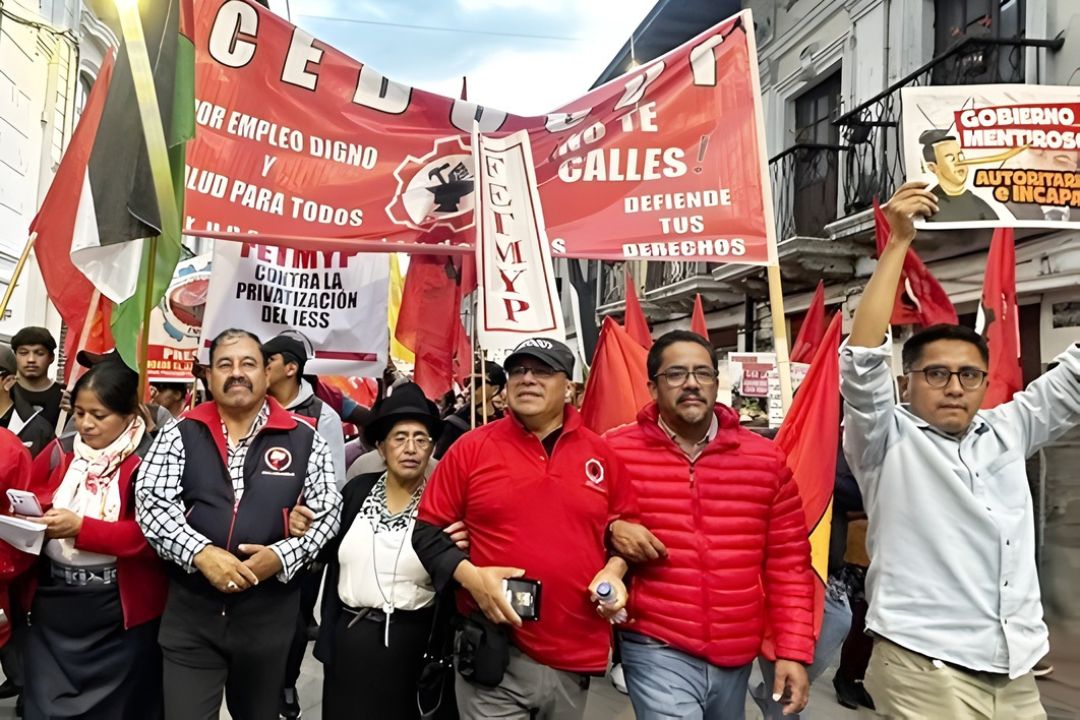
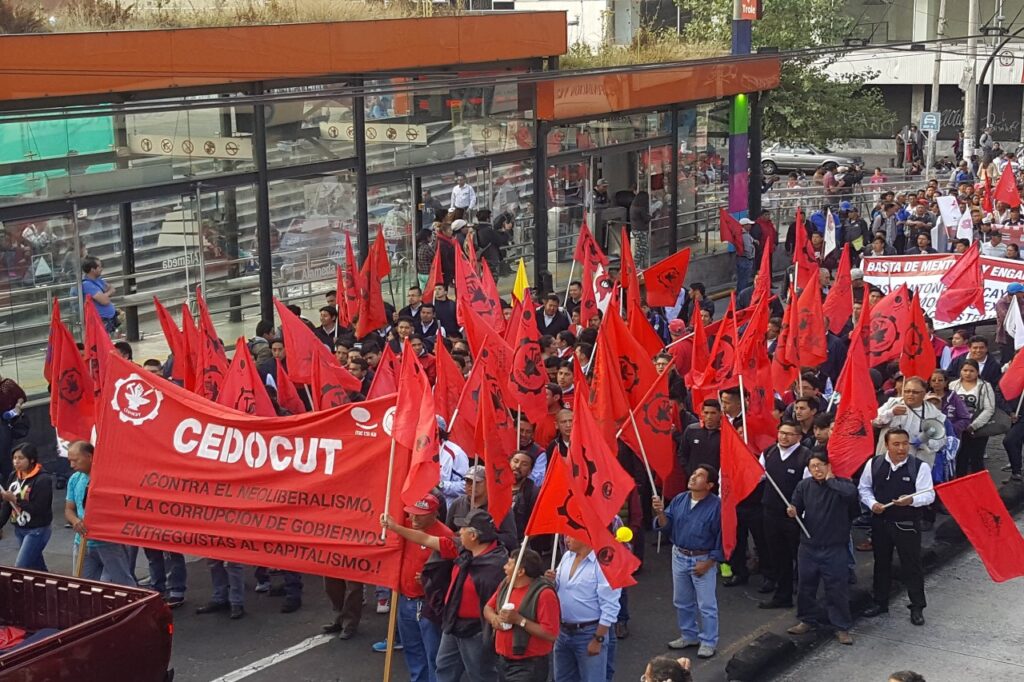
Edwin Bedoya is president of the Confederación Ecuatoriana de Organizaciones Clasistas Unitarias de Trabajadores (CEDOCUT) and president of the Frente Unitario de Trabajadores (FUT), which groups together six trade union centers and is a rotating presidency, held every two years by each of the centers.
Could you tell us briefly about President Noboa’s project?
More than that of a president, it is the project of the Ecuadorian right wing and it is a project that is linked to the recipes of the International Monetary Fund. It is the model that is prevailing in the world, with which the Fund conditions governments to grant loans. All governments have tried to fully apply the IMF project and this was rejected by the social organizations and the Ecuadorian people.
How did Noboa come to be?
During the pandemic, governments such as Moreno’s first and then Lasso’s, tried to apply the IMF’s prescriptions. Moreno paid the foreign debt during the pandemic and began the reduction of the State apparatus -which was one of the demands of the IMF- and of the labor contracts. He also applied a “Humanitarian Law” where he practically eliminated workers’ rights, said he was going to sustain employment, but ended up with a reduction of public sector workers and layoffs without liquidations.
Then came Lasso, with greater institutional deterioration, and corruption and drug trafficking mafias appeared, already inserted in many state agencies, such as the Courts of Justice, the Police and the military.
The attack on freedoms and rights and the persecution of trade union organizations is deepening, in order to weaken them and thus also collective bargaining in the public sector.
Lasso was governing in a scenario of great rejection, so much so that he was forced to activate the cross death[1] and did not finish his term. And it is in this transition where Noboa is elected, he arrived with a right-wing discourse, very mediatic and that managed to penetrate in the majority of young people.
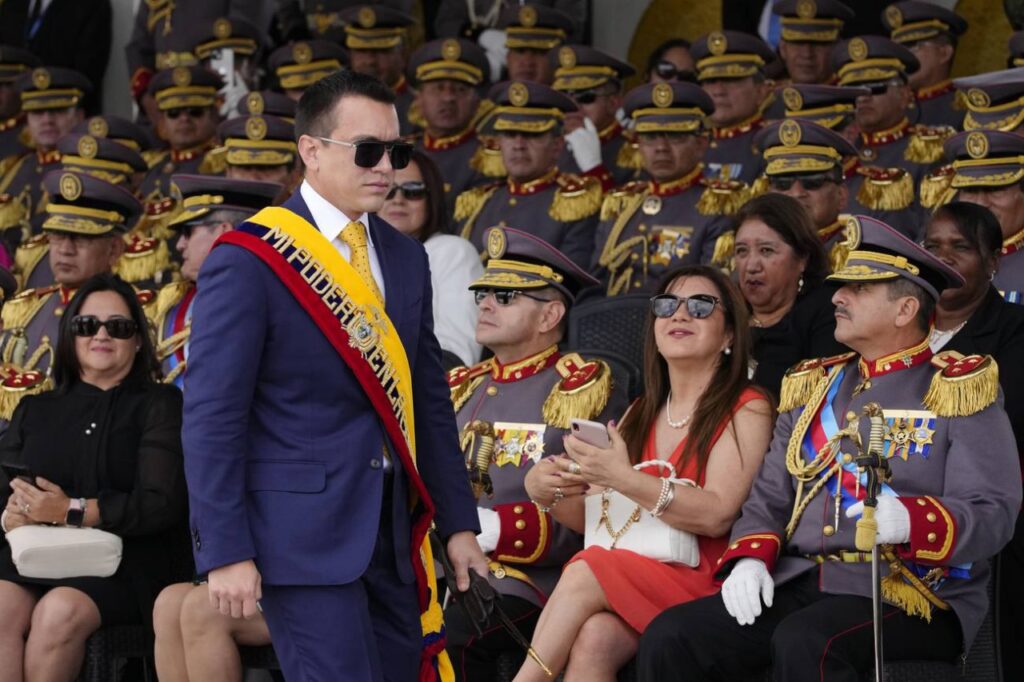
How were Noboa’s two years in power?
Since Noboa took office, there was no interlocutor or approach with social organizations and he put together a cabinet with people linked to his companies, to control strategic areas such as oil, energy, mining and industry.
Since then, a political project begins that is strengthening the IMF’s prescriptions and also something that we have mentioned since CEDOCUT, which is the monopoly of the management of the State through the companies linked to the Noboa Group. Which is the main group of the economic elite and has business everywhere: mining, oil, energy, health, public procurement, food, agribusiness and they are also the largest exporters of bananas in the world. So, what they are interested in is to consolidate their line of business and create an industrial monopoly.
In April of this year, Noboa and his ADN party won the presidency and since then he has deepened the same scheme. He achieved a majority in a Congress with a strong presence of Revolución Ciudadana (Correístas) and with the independents and the left of Pachakutik very weakened. In this framework, Noboa managed to introduce many laws as “urgent economic” but which meant the deterioration of freedoms, the attack on freedom of association in the public sector, the dismissal of more than 7000 civil servants from the public sector, the reduction of social investment in health and education.
And in addition, the Intelligence Act…
Yes, it is the most macabre of all, because it means the control of the institutions, of the Police, of the Armed Forces to be able to pursue, not drug trafficking, but social leaders and to be able to quell protests.
We succeeded in demanding all the laws and we have triumphed in two laws, that of integrity and that of solidarity. We still lack the Intelligence Law, which generated an attack by Noboa on the Constitutional Court, to pressure it to reject it. The government organized two marches and initiated a conflict with the Constitutional Court, telling them that if they did not think like them, they were allies of the terrorists or were terrorists.
From there comes this narrative of linking social organizations – or whoever is against the government – with drug trafficking mafias. And this is beginning to sink in with part of the population, since the government is taking advantage of some of the precedents of Correism to attack union organizations, putting us in the same bag, trying to discredit any attempt at social struggle and starting the persecution of union leaders and the freedoms of union organization.
Ministerial Agreements such as 082 are created, which limits and monitors the State’s control over the unions and the danger begins that the Ministry of Labor will declare us insolvent or take away our legal status, in violation of Convention 87 on freedom of association and Convention 98 on collective bargaining.
In this context, in September, the price of diesel was raised from U$S 1.80 to U$S 2.52 with a decree of law…
How did the government react to the national strike?
To manage the narrative, the government bought media outlets and began a smear campaign linking social and union organizations to drug trafficking.
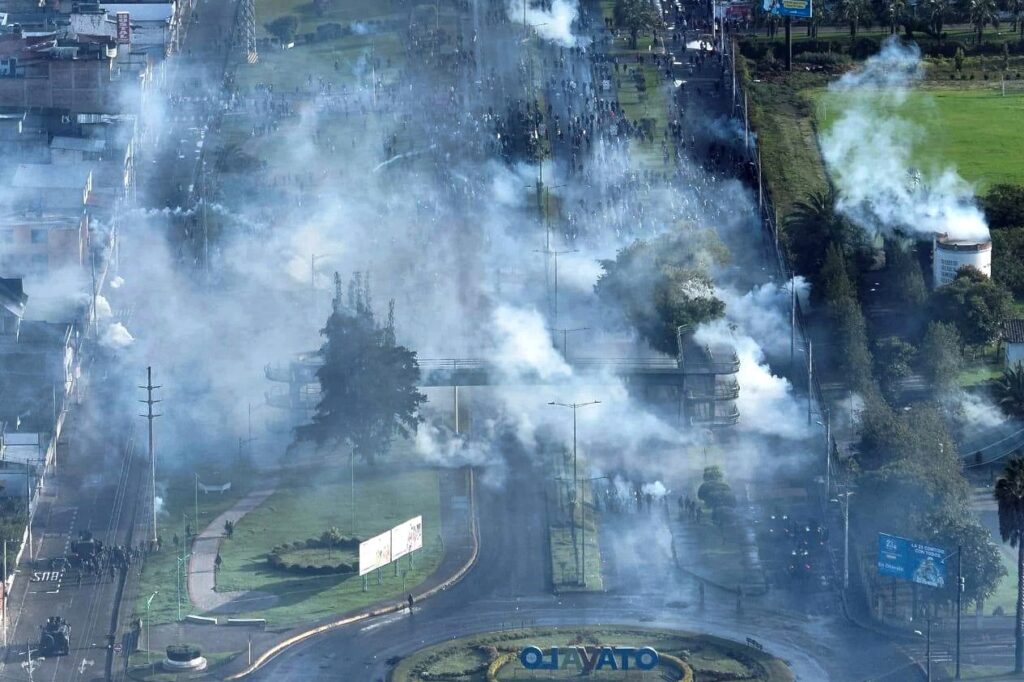
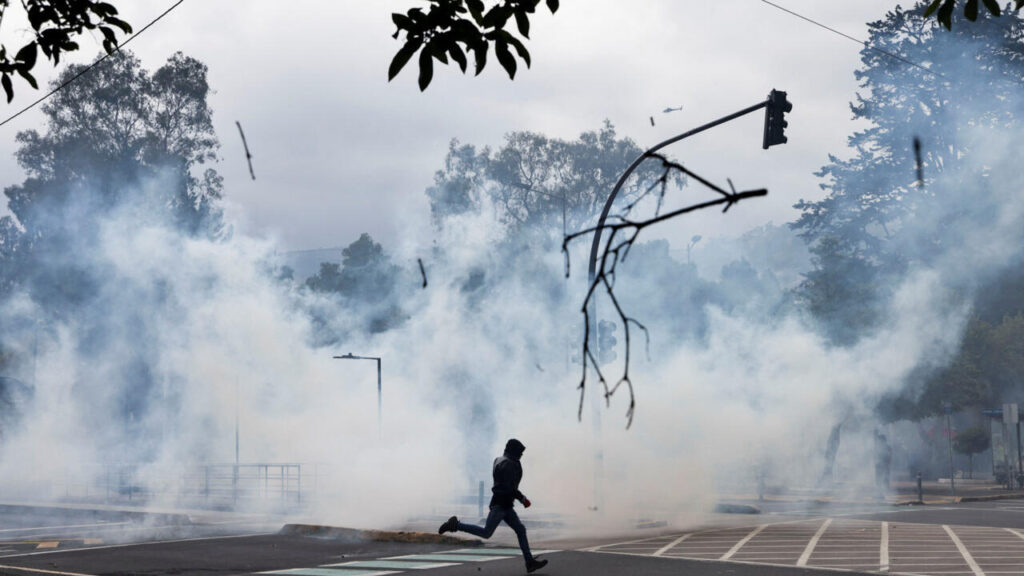
The CONAIE strike takes place in the province of Imbabura, in Otavalo, where there is a large indigenous population. There there is a merciless, dehumanized attack, all human rights are violated, the military enters and bombs the houses. In Quito and other provinces it happens in the same way.
At that time, a process of prosecution and tax investigation began for all the protagonists of the last marches: from the Water March of September 16 in Cuenca, where more than 100,000 people mobilized, to the union movement, which also arrested and investigated us for “attempted paralysis of public services”. Other comrades who have only U$S 180 in their accounts, for example, are being investigated for illicit enrichment. It is a persecution, they invent anything. And this generates a process of fear in the population and in the organizations.
Unlike other strikes, this one involved the army, right?
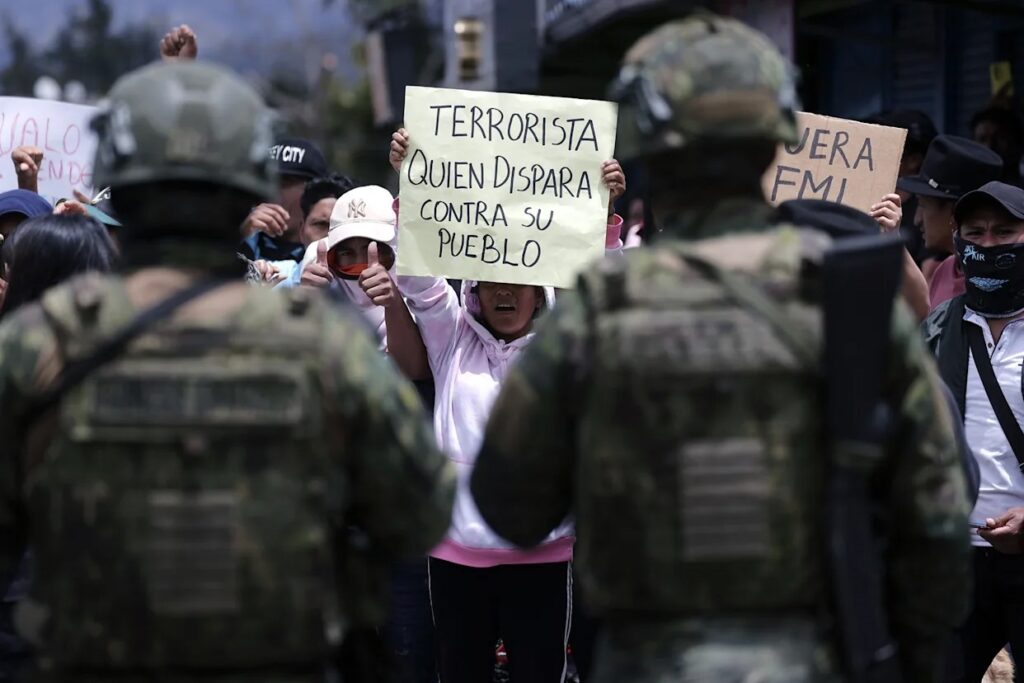
Yes, and with the entry of the military they begin to use a tactic of war against the Ecuadorian population, against the social organizations and this generates more fear. But the government does not understand that the indigenous movement has a different worldview and instead of being intimidated, the comrades are generating more anger against the repression. That is why the strike lasted a month, even with the internal weaknesses that it could have.
The government tried to victimize itself by inventing things like that they had attacked the president to assassinate him or that they wanted to poison him, all to cover up the three deaths of indigenous comrades. In addition, there are 12 indigenous people imprisoned accused of being terrorists, for whom they are asking for 30 years in prison, something that has not been asked of any criminal in the country.
How did they organize themselves to confront the repression?
We are in the logic of resisting, we have asked for international solidarity, we have moved with Human Rights to pressure the government to dialogue.
We formed caravans to be able to bring aid, but we could not enter because of the Army surveillance, but also because of the distrust of the communities to let anyone enter, because it turns out that the government made a “humanitarian convoy”, but in the trucks they were carrying bombs and that was what generated the attack on the president’s caravan. Noboa took advantage of this to victimize himself and start a racist, apartheid and ethnocide attack against the indigenous comrades. And that is what also inflamed the social struggle in these communities.
On the other hand, crime rates, homicides and hired killings have increased in the cities, because all the police and the military are focused on repressing demonstrations and persecuting leaders. That is why we are in the process of meeting with the organizations.
And now the Popular Consultation is coming…
Yes, we are close. The popular consultation is yet another addition of the government with which it intends to strengthen its policy linked to the recipes of the International Monetary Fund. The Letter of Intent of the IMF is a “copy paste” of the laws that Noboa is issuing: the reduction of the State apparatus, the elimination of liberties and rights, foreign military bases, International Arbitration and work for hours, which they already lost in the previous consultation. And yet, they intend to hold a Constituent Assembly in order to eliminate many of the gains we achieved in the 2008 Constitution. They want a neoliberal style Constitution, managed by the IMF and with the support of the United States.
The government’s strategy is to threaten repression by the Armed Forces and the Police in order to win this Popular Consultation, which will take place on November 16 and which we hope the Ecuadorian people will reject.
But it does not stop there, because despite the fact that it already lost the consultation the previous time, it began to manage with decrees, all linked to a neoliberal model and to make conditions more precarious.
The Popular Consultation also serves Noboa to cover up many investigations that the prosecutor appointed by the government has just filed against him. Investigations for conflicts of interest, for the management of his family’s mining companies, links with drug trafficking for drugs hidden in the banana boxes and others.
In previous strikes there was a lot of unity between the indigenous and union movements, how was this expressed in the last strike?
In CONAIE they had a very conflictive congress and they did not come out in a unitary process, this was expressed in the fact that the strike did not have the same dimension as in previous years, in which it took place in a process of coordination between the United Workers Front and the CONAIE Government Council. The meetings were held between the Governing Council of CONAIE and the Executive Committees of the trade union centers, which strengthened the FUT and also the social sectors of all the cities.
We are also coming from a process of weakening of the trade union movement due to the massive layoffs in the public sector, where most of the trade unions are located, which makes the context of the strike a little different at this moment. But the mobilizations are going to continue because there is social discontent and because the crisis of the diesel increase is going to generate that all the basic necessities will start to rise.
How would the diesel hike impact the current social situation?
At the moment, the basic food basket is at US$ 800 and the basic salary at US$ 470, we are almost 50% short of the basic food basket. And with the increase in the price of fuel, which is one of the products used in 60% of the production chain, it will reach approximately US$ 900.
To get an idea of our purchasing power, it should be noted that currently only 35% of the economically active population, which is about 8 million, receive less than a basic salary.
Health is deteriorated and there is no investment, hospitals are abandoned and there is a privatization process in the health and education areas. Here there is free education up to the higher education level, but there are already announcements that they want to eliminate this together with the right of access to services.
The cost of health services, water, electrification, etc., is also rising. And this is beginning to generate an increase in the cost and a decrease in purchasing power. We have 40% poverty, 15% multidimensional poverty, people living on one dollar a day. This shows us the dimension of the deterioration of the standard of living of Ecuadorians that could come with the increase of diesel and the policies they want to implement.
That is why the struggle will continue beyond the lifting of the strike. Because the deterioration in the quality of life will force people to demonstrate.
What was the experience of the working class with the supposedly progressive government of Rafael Correa?
First, I do not believe in progressivism, I come from the left and I consider myself a socialist. I believe that there is only one Marxism and only one socialism. And many are wrong, because the 2008 Constitution was not built by Correa, it was built by the organizations, even in a dispute on some issues where we, the workers, lost. Because they eliminated from the Constitution the right to unionize in the public sector. And from it also come the laws that begin to persecute the trade union organizations, there begins the criminalization of social protest, the attack on the peasant comrades who fought against mining companies, etc. And it is these laws that the governments of the day have used to make union leaders precarious and persecute them. In other words, we do not say that Correa is entirely to blame, but nothing of what Correa left against rights was changed by Revolución Ciudadana, the party that was created at that time, and it is with those laws that they have been persecuting us.
And that is what we, the organizations, criticize Correism. And there is a deterioration in Revolución Ciudadana, we know it. The strategy of force has increased, which is the same force used by Correa. In 2015, for example, there were already important mobilizations against Correa and the laws he advocated and currently we see that the right wing strengthened those laws and strengthened them in his favor. When he led the country, there was zero rapprochement with social organizations, he split them and as a result of this splitting is that we are living what we are living until now.
There is a group that is trying to recompose and we hope that the unitary and self-critical process will go beyond the internal programs of each of these organizations.
What would you say to workers in Argentina who face policies very similar to Noboa’s?
Who is worse, Milei’s government or Noboa’s? I believe that beyond the social, political, philosophical analysis, it is also convenient to make a psychological analysis of what is happening with society, because you cannot explain why many of our fellow workers have voted for the right. And I think it is something that also happened to the Argentine comrades.
What I would say is that we must strengthen the process of unity beyond the agendas that each organization may have. There has to be a collective agenda, I believe that we have more things in common than differences and that is what we should strengthen, a single objective to fight for. The objective has to lead the struggle and not the people. So, it seems to me that this is the moment for international solidarity, even regional solidarity, that we should strengthen it and discuss it as a regional strategy from the trade union organizations to have a single strategy to confront the neo-liberal model and the International Monetary Fund.
Do you see any political solution to resolve this situation in favor of the workers and the people?
Well, I see it as very complicated. It is a complex path, but not impossible. Complex because the left is very divided. Individual leadership is outweighing collective leadership. That is what does not allow for a unitary process, I see a slow progress. The issue of unity is a problem in this reality, but they say that sometimes you have to hit bottom to react. So, it seems to me that this is going to happen here and I am sure that we are going to find ourselves to get up.
The progress of unity in Ecuador is slow. The persecution, control, repression and subjugation of the government with the Armed Forces, the judicialization of protest weakens us and frightens us a little. But it is the path we have and we have to strengthen ourselves.
How is your legal situation?
There are two of us from CEDOCUT who are being prosecuted for attempting to paralyze public services. I am one of them and the other one is the vice-president of the Cuenca’s central, as a result of the Water March. The Prosecutor’s Office will look for arguments to be able to accuse us of terrorism or link us to drug trafficking. This has already happened with other leaders who have been in this line. I have to go to the Prosecutor’s Office to defend myself and then the Prosecutor’s Office will see what they are accusing me of. The proof is a video where in a press conference I call for resistance.
I have already received the solidarity of many comrades and I thank them. It seems to me that it is important to put pressure on the Government from trade union, international and social human rights organizations. We have to put pressure. I was just talking about the situation of the comrades from Belarus who are in the same situation. That is to say, the situation of persecution and the attack on the trade union movement through force is worldwide. So, somehow this motivates you because you know that you are not the only one. We know that they are attacking us because we are right, because we have rights, because we are somehow convinced that solidarity and unity will bear the necessary fruits and that is what we aspire to.
Interviewed by: Marcelo Maceira – MST Argentina
[1] Article 148 gives the president the power to dissolve the National Assembly, but only at the price of giving the electorate the opportunity to recall the president. The mechanism requires that a special election be held after the dissolution, in which a new president and vice president and a new National Assembly are elected.