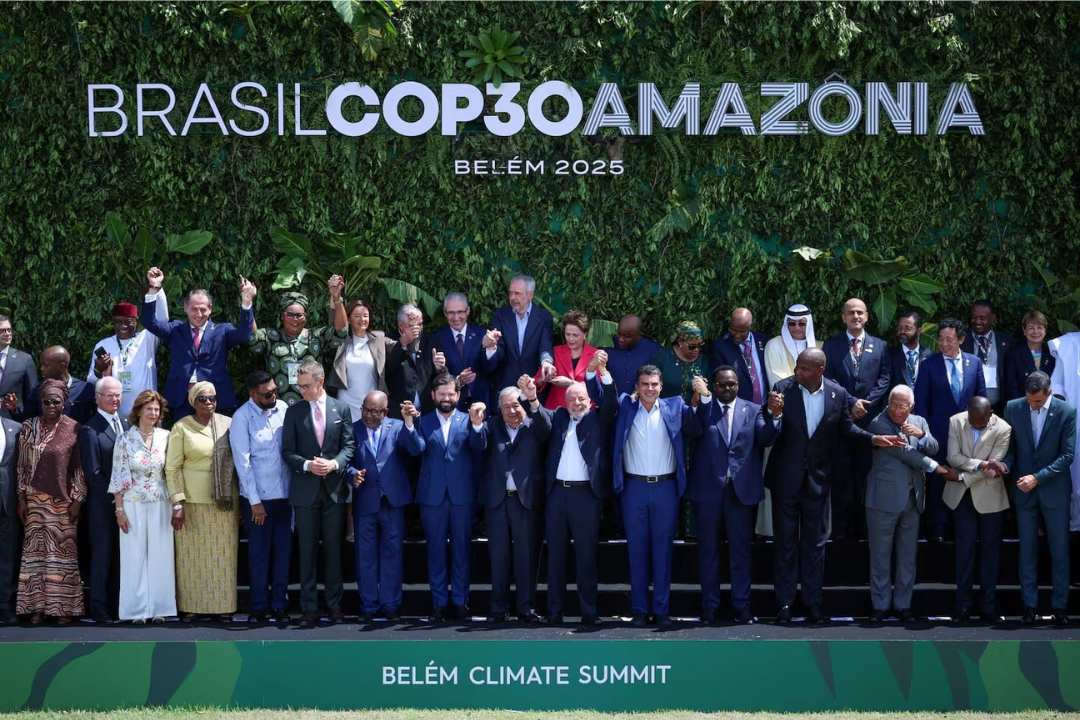
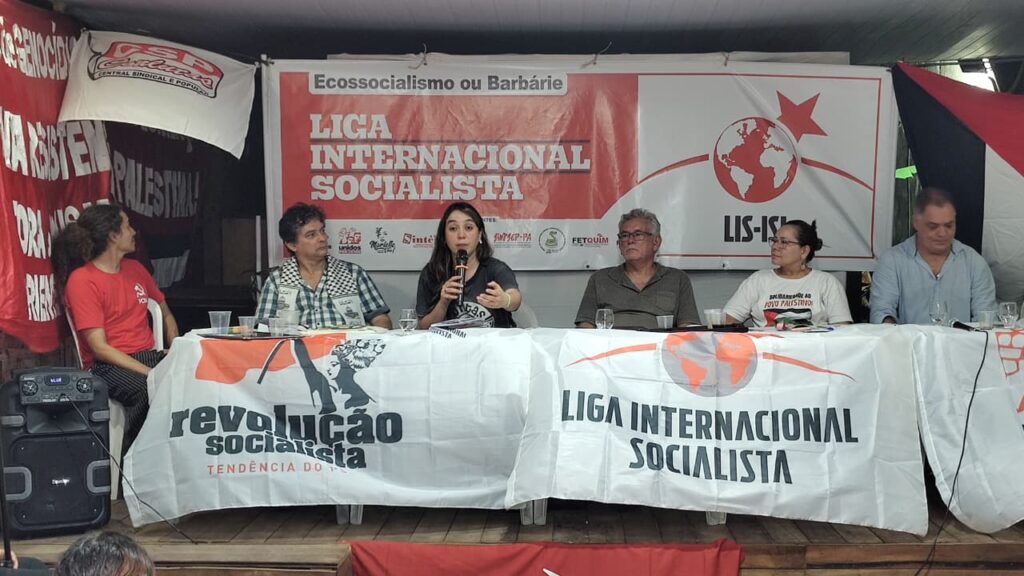
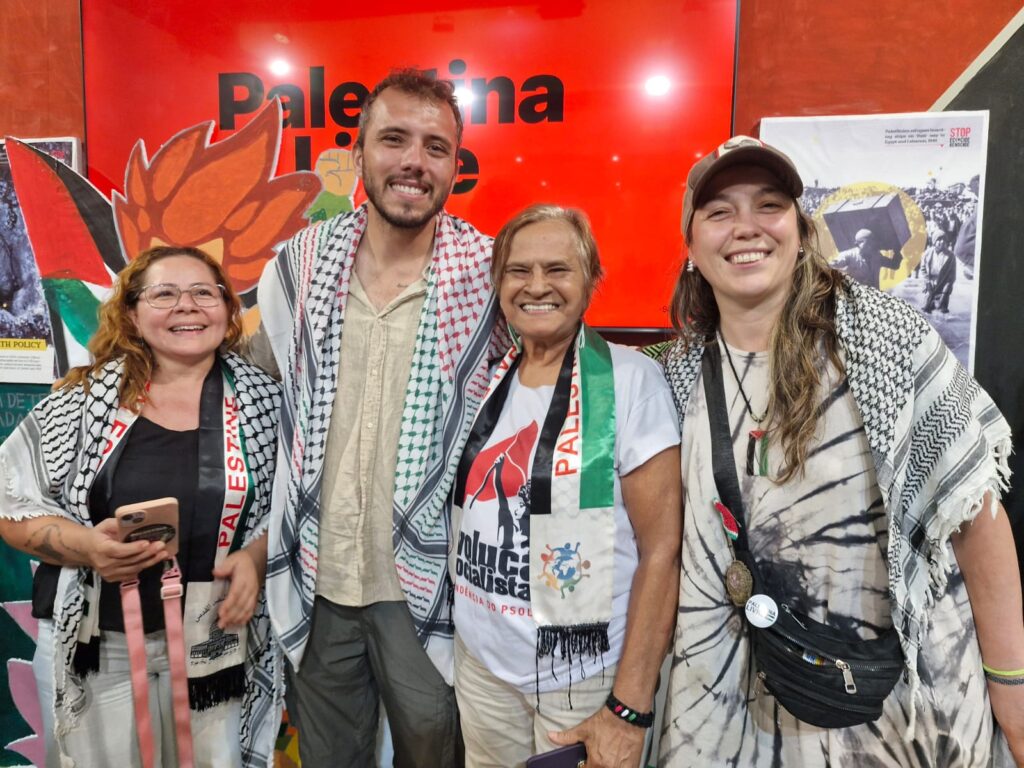
From Revolução Socialista – section of the LIS in Brazil – and the MST/Red Ecosocialista – section of the LIS in Argentina – we participated in Belém in the Peoples’ Counter-Summit and COP30. For two weeks we debated with indigenous communities, environmental organizations and social movements, and organized a series of talks with activists and professionals.
By: Jessi Gentile, MST-Red Ecosocialista

This article synthesizes the main conclusions of that intervention, tracing a bridge between Rio 92 and Belém 2025: 33 years that show the simultaneous exhaustion of climate diplomacy and of the progressivism that promises to manage it. And today, in the face of climate collapse, it is necessary to build an alternative capable of disputing the future.
When Brazil hosted the Earth Summit in 1992, the world was undergoing an immediate reordering after the fall of the Soviet bloc. The United States was emerging as the undisputed hegemonic power, capitalism was proclaiming itself without rivals and the global neoliberal offensive was advancing: privatizations, unrestricted openness, permanent indebtedness, deindustrialization and, in Latin America, a brutal reprimarization that consolidated extractivism as a model.
It was in this framework that the United Nations Framework Convention on Climate Change and Agenda 21 were born: an architecture designed to manage the environmental costs of capitalism without questioning its logic of accumulation. Rio 92 was an early attempt to politically domesticate a growing social concern without altering the destructive metabolism of capital.
But towards the end of the 1990s that order began to fracture. The popular uprisings in Venezuela, Bolivia, Ecuador and the Argentine rebellion of 2001, together with the alterglobalization movement that erupted in Seattle, Genoa and Porto Alegre, set the stage for a global questioning of neoliberalism. The COPs of Kyoto, Copenhagen and Cancun confirmed the failure of the system to halt the ecological crisis that it was itself deepening.
In 2015, the Paris Agreement and the 2030 Agenda attempted to restore legitimacy. But it was – and still is – voluntary, weak and functional to capital. Under the banner of the “green transition”, a new extractivism based on lithium, copper, rare earths, hydrogen, carbon markets and the financialization of nature expanded.
At the same time, an unprecedented political event emerged: the youth climate rebellion, symbolized by Greta Thunberg and the Fridays for Future movement, as well as the founding of our environmental movement, the Ecosocialist Network. What in the 2000s had been alter-globalization now became an intergenerational global mobilization that once again questioned the legitimacy of the COPs and put at the center the idea that the problem is systemic.
2025: a world profoundly more serious than in 1992
Thirty-three years after the first Summit in Brazil, COP30 returns to the same country, but in a radically transformed scenario:
–Accelerated climate crisis: temperature records, mass extinction, collapse of ecosystems.
–Global rise of the denialist ultra-right, which combines hatred, militarism and defense of fossil capital.
–Relative declineof U.S.imperialism, rise of China and fragmentation of multilateralism.
–International warand turmoil: Ukraine, Gaza, tensions in the Pacific, real risk of conflict between powers.
-New green extractivism, lithium, hydrogen, rare earths, territorial expansion of capital in the name of energy transition.
Reactivation of social struggles: youth, indigenous, feminist, anti-racist, workers.
The world that receives COP30 is, therefore, more unstable, more violent and more unequal than that of 1992. It is no longer just an environmental crisis: it is a multiple civilizational crisis.
COP30: no antifossil roadmap, no financing, no real agreement.
Belém 2025 confirmed the obvious: the COP is incapable of producing real agreements.
There was no roadmap for moving away from fossil fuels, no progress on climate finance and all reference to the “phase-out” was erased. Between fires, evacuations and an infrastructure with its own environmental impact, the summit showed its symbolic breakdown.
The COP does not fail because of “lack of political will”.
It fails because global capitalism can no longer agree on anything structural.
Each power competes for minerals, energy, maritime routes and strategic territories: it is a world in permanent disorder, with no room for common pacts.
Lula, the PT and the limits of progressivism: when green discourse hides the continuity of extractivism
In the official narrative, Lula and the PT represent the polar opposite of the ultra-right. Democracy versus authoritarianism, environmentalism versus denialism, inclusion versus devastation. But when one looks at the real map of policies, investments and strategic decisions, this distance shrinks.
And what appears – with uncomfortable clarity – is a profound continuity in the logic of territorial appropriation, extractive expansion and subordination to corporate interests.
Brazilian progressivism is presented as the civilizing actor to stop neo-fascism. But in terms of territory, budget and country model, both share a common framework: the Amazon as a sacrifice zone, workers and indigenous peoples as an adjustment variable and climate as geopolitical marketing.
Some do it by shouting. Others, with a friendly speech.
But the material result is alarmingly similar.
The green illusion of Lula
Lula arrived at COP30 proclaiming “climate leadership”, but the heart of his environmental policy beats to the rhythm of classic extractivism.
- IIRSA: a gigantic infrastructure of highways, waterways, dams and ports at the service of agribusiness, mining and trade with China.
- Privatization of the Tapajós: conversion of one of the most biodiverse rivers into a logistic corridor for Cargill and Bunge.
- Militarization of Belém and the Amazon: police armoring to neutralize protests while the Munduruku community stormed the official plenary.
- TFFF Project: financialization of the rainforest through carbon credits and markets, an “Amazonia S.A.” managed by technocrats and foundations.
- Equatorial Margin and oil: Lula advocates expanding exploitation to “finance the transition”, while Brazil joins OPEC as an observer and spends billions on fossil subsidies.
- Agribusiness: Lula opened R$ 4.17 billion in credits under the Safra 2024-2025 Plan, allocating most of it to medium and large producers at subsidized rates, while family farming received a much smaller portion through Pronaf. Although agribusiness is presented as the engine of the Brazilian economy, its strong state support contrasts with the fatal social and environmental impacts it brings.
The etapist formula that repeats history
Lulismo defends a thesis that we in Latin America are all too familiar with:
First extract, then distribute.
First oil, then energy transition.
Agribusiness first, then social justice.
In this version of progressivism, extractivism would be the “necessary evil” to finance the good. The problem is that this initial stage never ends.
Historical experience is conclusive: every meter that is opened to extractivism consolidates interests, destroys territories and generates structural dependence. The supposed transition is always for tomorrow.
Progressivism’s blind spot: its dependence on green capitalism
The difference between Lula and the ultra-right is evident at the democratic level. But on climate, territorial and productive issues, there are deep points of solidarity.
The right wing denies climate change to legitimize plunder.
Progressivism recognizes climate change but uses this rhetoric to modernize the same old extractive model.
Lulismo is not Bolsonaro but neither is it the alternative to Bolsonaro.
This is its historical limit: it cannot break with extractivism because it is the axis of its economic project.
And by not breaking away, it enables the ultra-right to re-enter with greater force, fed by social frustration and environmental destruction that progressivism does not want to reverse.
From alterglobalism to counter-summit 2025: Hardt, Negri and the historical limit of “multitudinism”.
The Belém Counter-Summit is not born from scratch: it is heir to the alter-globalization cycle that erupted in the late 1990s against neoliberal globalization. Those struggles – Seattle, Genoa, Porto Alegre – were influenced by Michael Hardt and Toni Negri’s reading of global capitalism. In their Empire-Multitude-Commonwealth trilogy, they argued that the world was no longer dominated by old national imperialisms, but by a polycentric Empire, crisscrossed by global networks of power.
If capital was decentralized, they said, resistance should also be decentralized: a horizontal multitude, without hierarchies or addresses, connected by networks, capable of overflowing the States.
This idea expressed the real strength of the global movements of the 1990s and 2000s, but its limits reappear clearly today in Belém:
1. The State did not disappear: it was strengthened
Far from weakening, the States strengthened their borders, armies, surveillance and territorial control. The “Empire” did not replace the States: it made them more authoritarian.
2. Lack of power strategy left a political vacuum.
The crowd could resist, block a summit or paralyze a forum, but it could not answer the decisive question: who governs?
That vacuum was filled:
- nationalist right wing,
- and progressive governments that ended up administering extractivism.
3. There was moral internationalism, not political internationalism
The alterglobalization was global in its protests, but not in its strategy.
The struggles were connected, but the political leadership remained fragmented.
4. Plurality without a common horizon weakened the action.
Diversity was an enormous cultural power, but without a unified project it could not become a force capable of simultaneously confronting corporations, powers and extractivist states.
Counter-Summit today: powerful, but limited
The Peoples’ Summit in Belém recovers this tradition: territoriality, diversity, indigenous, feminist and youth movements. It strongly denounces fossil capitalism, environmental racism and North American imperialism.
But its radicalism coexists with two strategic silences:
- It does not mention China, a central player in Amazonian extractivism and the new green imperialism.
- It does not question the Lula government, the main responsible for the advance of IIRSA, Tapajós, the Equatorial Margin and the TFFF.
Criticism is thus concentrated on the Global North, while the South, which reproduces the plundering, remains out of focus. This is no coincidence: the Counter-Summit coexists with NGOs financed by the State and sectors aligned with Lulismo that still see the BRICS as an “alternative”.
A historical pattern is thus repeated: just as alterglobalism avoided criticizing states because it considered them secondary, the Counter-Summit avoids criticizing progressive governments because of political alignment.
In both cases, criticism becomes incomplete, those responsible are diluted and autonomous internationalism is weakened.
A key difference with the 2000s: today there is no time for ambiguity.
At the beginning of the century, alterglobalization could experiment with new forms of organization.
Not today.
We are facing an accelerated climatic collapse with points of no return.
Strategic ambiguity is not a theoretical fault: it is a political limit that prevents us from confronting:
- traditional imperialisms,
- the new emerging imperialisms,
- and progressive governments that reproduce extractivism in the name of energy transition.
Thirty years later, the lesson is clear: itis not enough to denounce global capitalism without confronting those who manage it in each territory.
It is not enough to blame the North if the South also plunders.
Diversity is not enough if there is no strategy.
The Counter-Summit denounces, resists and makes visible.
But it does not yet offer a way to dispute power in the face of the disorder of fossil capitalism.
The COP is no longer useful; progressivism is not enough; the counter-summit has no strategy. We have to build something else.
Belém 2025 makes one thing clear: the conflict over the future is structural. The dividing line has never been so clear.
On one side are the fossil corporations, extractive capitals, imperialisms and governments subordinated to the business lobby. A minority bourgeoisie, powerful and willing to sacrifice lives and territories for its privileges.
On the other, the immense social majority: workers, youth, indigenous peoples, women, migrants, impoverished communities.

It is not a “cultural” clash: it is a material antagonism between those who sustain life and those who plunder it.
The global bourgeoisie has already demonstrated that it will not change under social pressure, nor by scientific evidence, nor in the face of planetary collapse. It is not “lack of political will”: their interests are incompatible with a dignified life on Earth. That is why there is no common agenda with them.
There are rebellions, and there will be more: explosions, climate strikes, territorial mobilizations. But without organization, this energy is dispersed.
History is clear: revolutions are not proclaimed, they are organized. They require leadership, strategy and a subject capable of transforming the material bases of society.

That subject is the working class, not as an identity but as a position in the social metabolism. Because of its place in the production and reproduction of life, it is the only force, in alliance with indigenous peoples and oppressed sectors, capable of reorganizing the energy, food, urban and industrial system at its roots. That is why the elites try to divide it with partial identities, fragmented discourses or false “green” transitions that leave economic power intact.
The strategic task of this epoch is to give horizon and program to the social energy emerging from below. This is where the LIS is located: an internationalist project that seeks to articulate dispersed struggles and regroup the vanguard, transform indignation into political force, turn resistance into political alternative and give the working class what it still lacks: organization, strategy and perspective of power.
Rio 92 opened the cycle of neoliberal illusions.
Belém 2025 marks its collapse.
What is coming – and what we have to build – is political organization capable of applying the emergency brake before fossil capitalism drags us towards barbarism.