During the pre-congress, we presented our members with a series of analytical and programmatic texts for debate, including an assessment of the current world situation and the main events in the class struggle. Here, we will summarize in 10 points what we consider the most important features and what our response should be.
1. Since 2008, the crisis of capitalism and its devastating consequences for humanity and nature have deepened. The constant decline in workers’ living standards and the attack on the social and democratic rights of peoples are combined with an unprecedented advance in environmental destruction. Racism, sexism, homophobia, and attacks on migrants are on the rise. Wars, pandemics, genocides, and sectarian disputes have returned. The far right, repression, and militarization are being promoted from the halls of power in several countries. These are the only solutions offered to us by the bourgeoisie and imperialism. If we don’t stop them as soon as possible, they will lead us to barbarism and then to extinction. Only the workers, in the lead of a national, regional, and global revolution against this rotten system, with a program that leads us to socialism, can prevent this outcome. Socialism or Barbarism and the regroupment of revolutionaries are our banners of struggle and organization.
2. We are entering a new global stage or period. The 2008 crisis disrupted everything. It forced imperialist states to go into debt, bail out large corporations, and launch an economic counterrevolution against the masses to try to recover the multinationals’ losses. The pandemic, the result of an increasingly predatory production model and disinvestment in public services, deepened the systemic decline years later.
Resistance was not long in coming. Since the end of the first decade of the new century, rebellions, major struggles, and mobilizations have been taking place in different parts of the world. Various broad anti-capitalist formations also emerged, aiming to reform capitalism without overthrowing it. For this very reason, they failed, opening the door to the right-wing counter-offensive underway today.
The capitalist restoration in Russia and China did not end in their semi-colonization by Western imperialism, which saw its crisis deepen. The transformation of these states into imperialist powers initiated a struggle for hegemony between a declining American imperialism and a rising China. The world and the phenomena we are witnessing cannot be understood without a clear grasp of the depth of the changes that have taken place over the last 15 or 20 years.
3. With the new Trump presidency, American imperialism has deployed a series of initiatives to reassert its role as the world’s primary policeman and to strengthen itself against China. Aware that the agreements and institutions that emerged after World War II and after the fall of the Soviet Union had become useless to prevent its deterioration, it overturned the established order and terminated the pacts and agreements of the postwar era and the liberal globalization of the 1990s. The United States intends to build a new world order based on specific agreements between the major powers, while simultaneously deepening the trade and tariff war against its competitors, disputing territories, defunding its former partners in Europe, and launching an offensive against the peoples and workers of the world, including in its own country, to make them pay for its adventures and the ongoing crisis.
The current condition of US imperialism resembles a beast that has lost its senses under circumstances rapidly slipping out of its control. Donald Trump personifies this entire phenomenon. In periods when their dominance is unchallenged, major imperialist societies do not usually elevate such volatile, corrupt, egoistic, and unreliable figures to leadership positions. The private enrichment of parasitic US capitalists, and control of mineral resources for new technology projects, clearly play a central role in Trump’s plans and deals. Therefore, Trump’s very rise is itself a clear political expression of the system’s deep crisis. Driven by the pressure of events—and often by his own personality—his policies resemble a “hit-and-trial” approach rather than any long-term or coherent plan.
4. During his first term, from 2016 to 2020, Trump did not have the support of the majority of the bourgeoisie. He reached the White House by capitalizing on the crisis of the traditional parties and the capitulation of Sanders and the DSA. He faced massive mobilizations and opposition from the establishment, failed to implement much of his program, lost his reelection bid, and was tried and convicted of several crimes. But he built a radicalized, reactionary social base that he continued to consolidate after losing the presidency. This base, along with the continued decline of the traditional parties during Biden’s disastrous term and the rise of the far right globally during those same four years, allowed Trump to secure the support of the Republican Party and a significant sector of the bourgeoisie for the 2024 elections. The collapse of Biden’s reelection bid and Harris’s improvised campaign left the bourgeoisie without an alternative project. Once Trump won the election, they lent him their active or passive support. This support is also based on a conclusion that the bourgeoisie as a whole has been reaching: they need to significantly increase exploitation and capture a larger share of global surplus value to overcome the crisis that began in 2008. And to bring about the structural changes necessary for this, the central institutions of the old imperialist capitalist system are useless to them. Neither formal democracy nor traditional political structures are effective, which is why they are betting on the growth of the far right and even encouraging neo-fascist formations.
5. Since taking office in January 2025, Trump has launched an open war against workers and social and democratic rights in the US. He is particularly targeting immigrants, LGBTQ+ people, and women. He seeks to increase the exploitation of all workers, the super-exploitation of immigrants, fuel divisions within the working class, and consolidate a reactionary social base with a sector of white workers. To impose this, he seeks to modify the political regime in an authoritarian and repressive way (bonapartism). He governs by decree, disregards the decisions of Congress and the Courts, and attempts to normalize the use of the armed forces in internal repression. He mobilized the National Guard and the Marines against the rebellion in Los Angeles and then in Washington, D.C., under the pretext of fighting crime. The rebellion against ICE in Los Angeles halted the offensive of migrant abductions at workplaces after days of clashes with law enforcement, and the massive May Day and No Kings mobilizations demonstrate the emergence of a resistance movement of millions of people. There has also been a radicalization of segments of young people and workers, many of whom identify as socialists, which explains phenomena like that of Zohran Mamdani in New York.
6. On the international stage, the project spearheaded by Trump seeks to reverse the decline of American imperial power by imposing the full weight of the military and economic superiority it still maintains. To this end, it broke the country’s historic alliances with the EU, Canada, Mexico, Australia, and Japan to pursue more direct negotiations with China and Russia at the expense of the rest of the world. He abandoned the multilateral strategy spearheaded and driven by the United States over many decades and distanced himself from the institutions and alliances of that order, such as NATO, the WTO, the WHO, the UN, etc., replacing them with a unilateral and aggressive approach. At the same time, he promotes a protectionist nationalism, which in turn fuels his social base with patriotic, racist, and anti-immigrant ideas.
He launched a protectionist trade policy, imposing import tariffs on nearly 70 countries, allies and rivals alike. He seeks to impose US superiority over allied, subordinate, and rival countries so that the US bourgeoisie can capture a larger share of global surplus value. He also seeks to pressure the bourgeoisie itself to repatriate industrial production and surplus value generation.
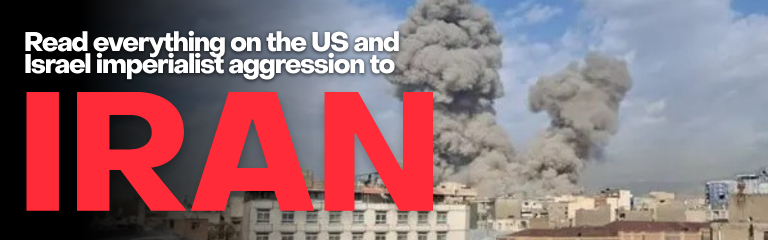
The results so far have been contradictory. He wanted to begin his term with a show of force, promising to end the conflicts in Ukraine and Gaza in a few days, but a year later, both conflicts remain unresolved. He resumed nuclear negotiations with Iran, but Israel sabotaged the attempt with its attack. The tariffs have been equally contradictory. Some countries accepted trade agreements more favorable to the US, but the most important ones, from Brazil, Mexico, and the EU to China, forced Trump to renegotiate or imposed retaliatory tariffs, leading to the announcement and suspension of tariffs time and again. The result has been rising inflation in the country and economic losses in various sectors.
7. A polarized world. While the capitalist offensive against the masses intensifies, on the other side, the resistance of workers and peoples grows, with strikes, massive mobilizations, and rebellions. For several years now, this polarization has defined the international situation. However, this polarization is asymmetrical in relation to political representation. While the reactionary pole finds a clear political expression in the rise of the far right, which has been amplified by Trump, the rebellions and struggles we are witnessing are unfolding spontaneously, without the workers’ movement playing a decisive role, without organization or a revolutionary leadership to represent them. This reflects the backwardness of working class consciousness, which stems from decades of Stalinist, social-democratic and bourgeois nationalist leaderships that instilled the syphilis of class collaboration in the workers’ movement. At the beginning of the century and during the first years of the great crisis, there was a leftward shift, primarily in the Americas and Europe, which catapulted new nationalist and radical reformist movements such as Chavismo, Syriza, Podemos, Kirchnerism, etc. Their defections, a result of their programmatic and class limitations, partly explain the subsequent rise of the far right. Currently, the rise in struggle combined with the weakness of revolutionary forces is once again reactivating this type of formation in some countries. We need to discuss each case individually to determine how to intervene. Only in Argentina has the revolutionary left, with its long tradition in the country, managed to transform itself into a pole through the FITU (Workers’ Left Front). But the class struggle, the radicalization of women, sectors of youth, and working class activists offer us great opportunities to advance in building our parties, if we are bold in applying our tactics without losing our principles and strategies or falling into sterile dogmatism. At the same time, we must prioritize building our youth movement, which is on the rise globally, as it is the sector where it is fastest possible to train cadres who will energize our parties and allow us to engage more effectively with the workers’ movement.
8. Our congress takes place in a global conjuncture that, in the face of the capitalist and reactionary offensive, sees important mass struggles developing. The most important development has been the enormous international mobilization in support of the Palestinian people. It has been decades since we have seen such a strong global internationalist movement. Millions have taken to the streets in the United States, various European countries,[1] Australia, the Middle East, Asia, and other countries around the world. General strikes have been held, as in Italy, and actions like the Sumud Flotilla have been closely followed by large segments of the population. The pact that Trump forced between Israel and Hamas has had as one of its objectives the dismantling of this enormous process, which has weakened its Middle Eastern enclave in the eyes of global public opinion. It remains to be seen whether he will succeed, although it is clear that he has confused segments of the mass movement.
Unfortunately, due to the role of campism and various sectors of the left that caved in to the pressure of Stalinism and Russian imperialism, a large-scale independent mobilization in support of the Ukrainian people and against the Russian invasion and NATO’s ambitions was not achieved. Only a minority of revolutionaries have maintained a principled policy, and this has allowed us to advance in regrouping with other sectors and strengthening the ISL.
In recent months, young people in several countries have taken to the streets, causing genuine social upheavals. This new generation, which some call Generation Z, shows that millions of young people are rebelling against poverty, job insecurity, authoritarianism, and the lack of opportunities for advancement offered by capitalism in this decaying stage.
We have seen major confrontations against governments in Ecuador, Panama, Peru, and other significant struggles in Latin America. Uprisings in Morocco, Madagascar, Tanzania, Kenya, Burkina Faso, Niger, and the rest of the Sahel. Rebellions in Nepal, Bangladesh, Indonesia, Kashmir, and other regions of Asia. And a growing mobilization in the United States against Trump’s anti-worker and authoritarian measures.
9. A key tactic for confronting the far right and austerity measures is the United Front. To confront capital’s offensive against the working class and the people, we must strongly deploy the call for a united front among left-wing organizations and urge bureaucratic and reformist leaderships to mobilize against every measure taken by various bourgeois governments that curtails democratic and social rights. This tactic has two objectives: first, to strengthen mobilization, and second, to expose the bureaucratic, petty-bourgeois, and reformist leaderships to workers and activists. In struggles, or whenever strong response is needed, we must combat the sectarian tendencies of organizations or sectors within the vanguard that refuse or boycott the possibility of carrying out united actions, as well as those who confuse the united front with political unity and yield to bureaucratic or centrist leaderships. Our groups and parties must be the champions of calling for unity in the streets while simultaneously maintaining criticism of our circumstantial allies and explaining our political and organizational positions in a way that is understandable to the majority of workers without them appearing divisive.
Positive examples of a United Front include the one being carried out in the US by Socialist Horizon with other currents, which has served to strengthen the defense of Tom and discuss participation in certain events of the class struggle. Another example is the policy implemented by the MST in Argentina to guarantee the victory of the historic strike at Garrahan Hospital. And at the international level, the push for mobilization in support of Palestine, where all sections of the LIS have played an important role.
10. Regroupment of revolutionaries. In the political arena, with the objective of advancing the construction of revolutionary leadership, our primary policy must be the ongoing exploration aimed at regrouping the currently dispersed revolutionary forces, which represent a fundamental asset that we cannot afford to squander. The objective is to build strong, vanguard revolutionary parties and a new international. The ISL is merely an embryo of what we aspire to build. Of course, this is not simply about regrouping for the sake of regrouping. Our proposal is to unite based on agreements regarding the policies to be followed in the main events of the class struggle and a shared analysis of the global situation. This, along with a sound method for addressing nuances and differences, while recognizing that regroupment involves working among comrades and organizations from diverse traditions, is fundamental. To advance this process, we will put all the work produced at this Third Congress and a call to open the debate with all those who understand the need to join forces to confront barbarism and fight for a different world that paves the way to socialism.
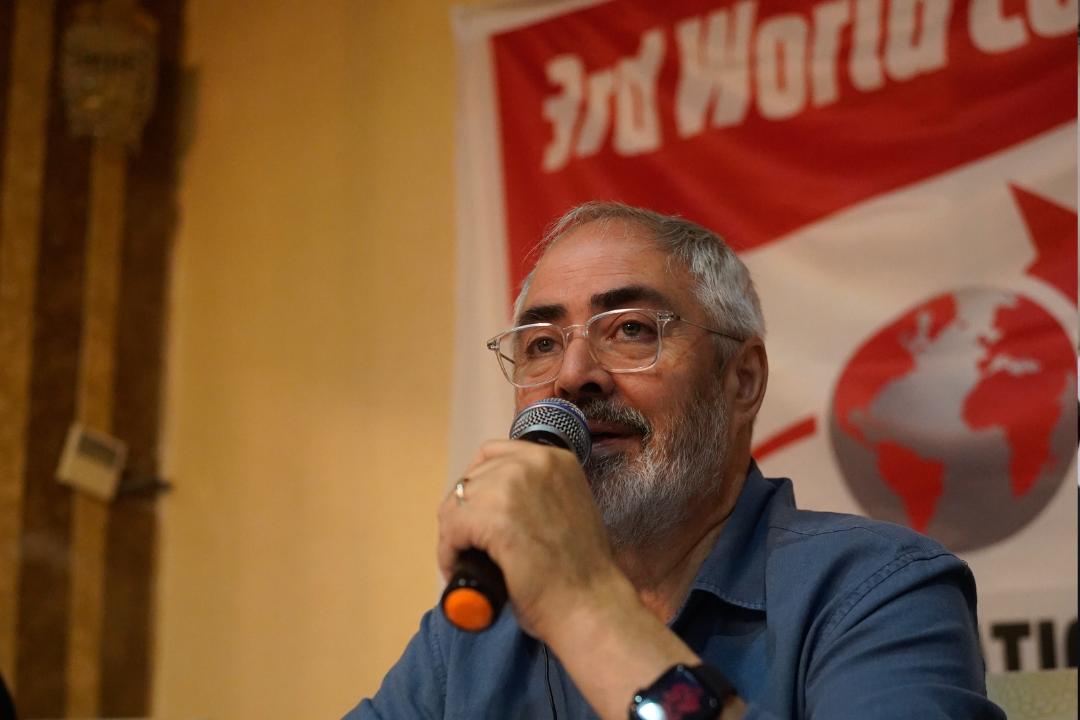
Adopted by the III World Congress of the ISL
[1] https://drive.google.com/file/d/1Bp_GAYBKdRnR–ZQ2LvweCPJi7eGkwuw/view?usp=drivesdk