Protests and confrontations in different countries give continuity to the crisis with farmers in the European imperialist bloc. Emergency measures and a fundamental solution are required.
Automatic translation made by AI.
By Gérard Florenson
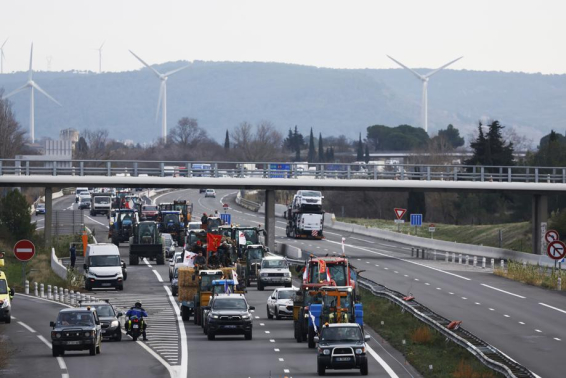
The mobilization of farmers against the catastrophic management of lumpy skin disease in cattle forced the French government to extend vaccination and to reverse the policy of systematically slaughtering entire herds as soon as the disease was detected in a single animal. Macron could have done without this crisis, which shows that farmers’ anger is far from calming down, especially since the FNSEA, which stayed out of the demonstrations, was therefore unable to help calm tempers as it did in previous mobilizations. This time, not only did no one ask for permission to block the roads, but it was the two rival unions, the Coordinadora Rural and the Confederación Campesina, who successfully mobilized jointly the small and medium farmers, whom the government’s decisions and their forced imposition by the police were putting in a catastrophic situation, ruining years of work.
The confrontations with the police were at times violent, but in addition to the fact that peasant demonstrations tend to be boisterous, the police had clear orders to use force. This convergence between a progressive union and a reactionary one, influenced by the extreme right, may have been surprising, but it is important to understand that both have something in common that distinguishes them from the FNSEA: they are not controlled by large agribusiness groups, groups completely indifferent to the fate of small and medium producers as long as the disease does not affect the larger farms. Ultimately, the government’s methods, if they could lead to greater concentration and downward pressure on producer prices, would not displease them. But while the FNSEA leadership stood aside, this was not the universal choice of its rank and file, particularly the often heavily indebted young farmers who joined forces with other unions. Plunged into a new crisis, Macron and his minority government, with many other concerns, had to make concessions after demonstrating their incompetence. The peasant mobilization helped to limit the damage.
The Mercosur agreement in question
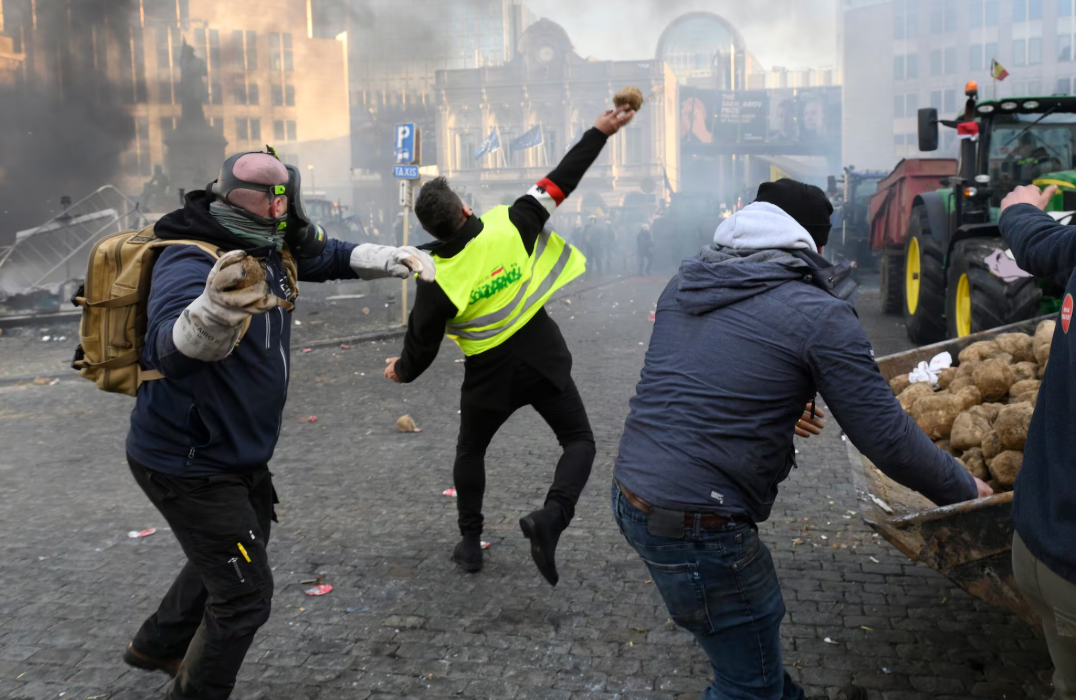
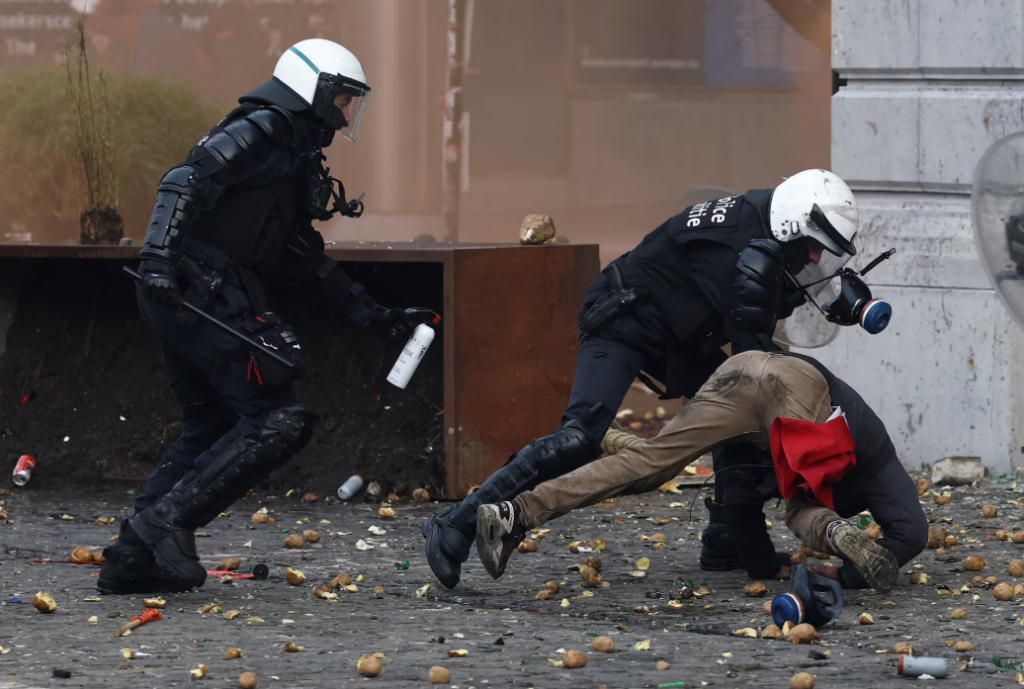
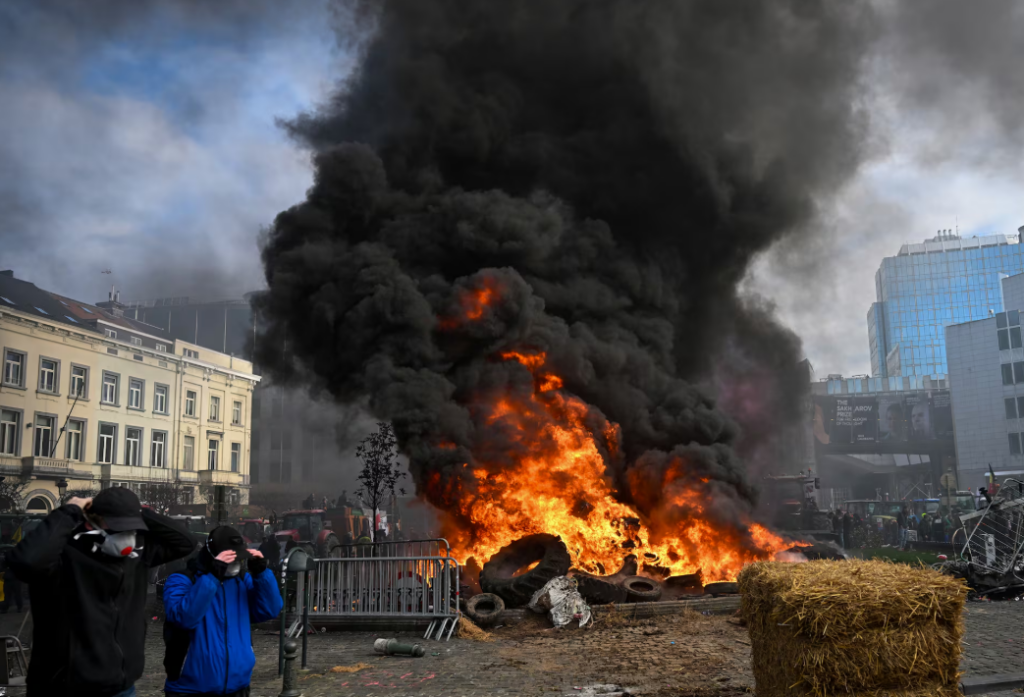
The trade agreement with Mercosur is back in the spotlight, and on the eve of its ratification. The crisis with the farmers was also clearly expressed in Brussels, Belgium, in the vicinity of the European Parliament and Luxembourg Square. On Thursday, December 18, Belgian farmers blocked the city center with their tractors, set fire to tires and carried out other actions to express their rejection of the trade agreement between the EU and Mercosur and the new budget proposal of the Community Executive, which proposes a cut in regional and agricultural aid. There were violent confrontations and police charges for several hours, with one person seriously injured as a result of the repression.
In France, Macron has declared his opposition to signing the agreement. This puts him in an awkward position, since, with the exception of Italy, all other European governments support it. Perhaps this is simply a stance aimed at avoiding an increase in peasant mobilizations, in which this time the FNSEA would be involved, just a few months before the municipal elections. Presumably, a legally admissible initiative on the part of the European institutions would allow Macron to exonerate himself. Whether this would curb the protests is another question, but they would no longer be directed against his government, which would have tried in vain to defend “French agriculture”.
Thus, the agricultural issue dominates European opposition to the EU-Mercosur agreements. Even in most of the countries whose governments are in favor of ratification, many farmers feel that they are being sacrificed to the benefit of large industrial and financial groups, which would be the only ones to benefit from the free trade agreement. The fact that Lula and the Brazilian government insist on a quick signature reinforces these concerns: tomorrow, old Europe will be flooded with cheap agricultural products, competitive because they do not meet any sanitary, environmental or, even less, social standards.
Great producers, great privileged
It should be noted that these arguments against “unfair competition” are not limited to agreements with MERCOSUR countries. They are often used to denounce imports from Morocco, but also within the European Union itself, for example in France against Spanish products. In fact, if the agreements are implemented, free trade will create winners and losers on both sides of the Atlantic. In Europe, the large industrial and service groups will find new markets that will allow them to be less dependent on Trump’s tariff whims; and, of course, the demands of “competitiveness” will increase concentration, with the elimination of the less efficient, as nation-states must help their capitalists by reducing taxes and “restrictions”.
The small textile factory that barely survives in some European province will no longer sell…. The small farmer in Brazil or Paraguay will see no benefit; he will be sacrificed for the sake of productivity, since only the larger farms, often owned by financial groups, will be able to increase production and exports. Therefore, also on this front, there will be concentration and the elimination of the “too small”. From the perspective of European food manufacturers, it is the cost of raw materials that matters most, not the country where it is produced. Moreover, some have taken the initiative. For several years now, DOUX, the leading French chicken producer, has been moving part of its production to Brazil to be competitive in Middle Eastern markets. If the agreements are successful, it will be able to sell its Brazilian-produced chicken in France! Small Brazilian farmers will not be enriched by this.
Free trade” and protectionism, two policies of the same capitalism
Denouncing free trade and its harmful effects should not lead to advocating protectionism or a united front with our capitalists, who are just as exploitative and predatory as those in other countries. In fact, both globally and within each nation, capitalists simultaneously compete with each other and work together to curtail social and environmental legislation. Moreover, chauvinism quickly manifests itself when the qualities of “our products” are contrasted with the mediocrity of those of our neighbors, and when environmentalism, real or alleged, becomes a mere sales pitch. We support the union of small farmers around the world to fight and defeat those who exploit, oppress and sometimes murder them to steal their land. And these oppressors are the same ones who crush all workers.
Confronting fascist groups
But not all those who want to defend their right to live from their work are aware of this reality. When the demonstrating members of the Coordinadora Rural demand that they be allowed to work and that their anger is directed against the environmentalists, they do not see that it is Lactalis and other private or fake dairy groups that prevent them from making a living from their work, or if they do see it, they do not know how to confront them. This is a dangerous situation that could lead to widespread use of violent action by fascist groups. There are numerous historical examples of how the petty bourgeoisie, including sections of the desperate peasantry, provided militiamen against the workers’ movement. The fact that some are mobilizing alongside the “progressives” of the Confédération Paysanne (Peasant Confederation), and that, therefore, even limited common objectives prevail over ideological differences, should be an opportunity for dialogue, explanation and attention to the real problems and the necessary solutions.
An emergency program is needed as part of a fundamental solution
The depth of the crisis demands the elaboration of an emergency program, inseparable from a perspective of structural transformation. Such a program should include, as a minimum, the implementation of a guaranteed income, the establishment of minimum prices that effectively cover production costs and ensure a living wage and maximums to prevent price abuses, as well as the immediate improvement of the working and living conditions of workers in the sector. To this must be added a moratorium and comprehensive restructuring of operating debts, together with the strengthening of universal social protection and access to free, quality and fully accessible public services for the most needy. These measures cannot remain in the realm of institutional promises: they can only be conquered through mobilization and independent organization together with the working class, articulated in a common program that unifies the central demands of the different exploited and oppressed sectors.
The systemic crisis that began in 2008 has increased social inequality and further concentrated wealth in the hands of a privileged minority. Capitalism demonstrates once again its historical incapacity to resolve the contradictions between the city and the countryside, as well as to guarantee dignified living conditions for the majorities. The anarchy of production and distribution, subjected to the criteria of profit and not to social needs, aggravates poverty and reproduces structural inequalities. Therefore, beyond the governments in office and the actors of the moment, the solution can only come from the hand of a government of the workers, supported by the expropriation of big capital, land and factories, the democratic planning of the economy and the construction of a socialist system.