A new wave of mobilisations is shaking Tehran and dozens of Iranian cities against the rising cost of living, the collapse of the currency and growing misery, once again confronting the repression of the ayatollahs’ regime. Meanwhile, US imperialism has once again threatened Iran, seeking to capitalise on the crisis. This rebellion can only advance in a progressive way through the independent mobilisation of the working class and the Iranian people, with democratic bodies and the construction of a revolutionary, socialist and internationalist alternative.
Wave of protests
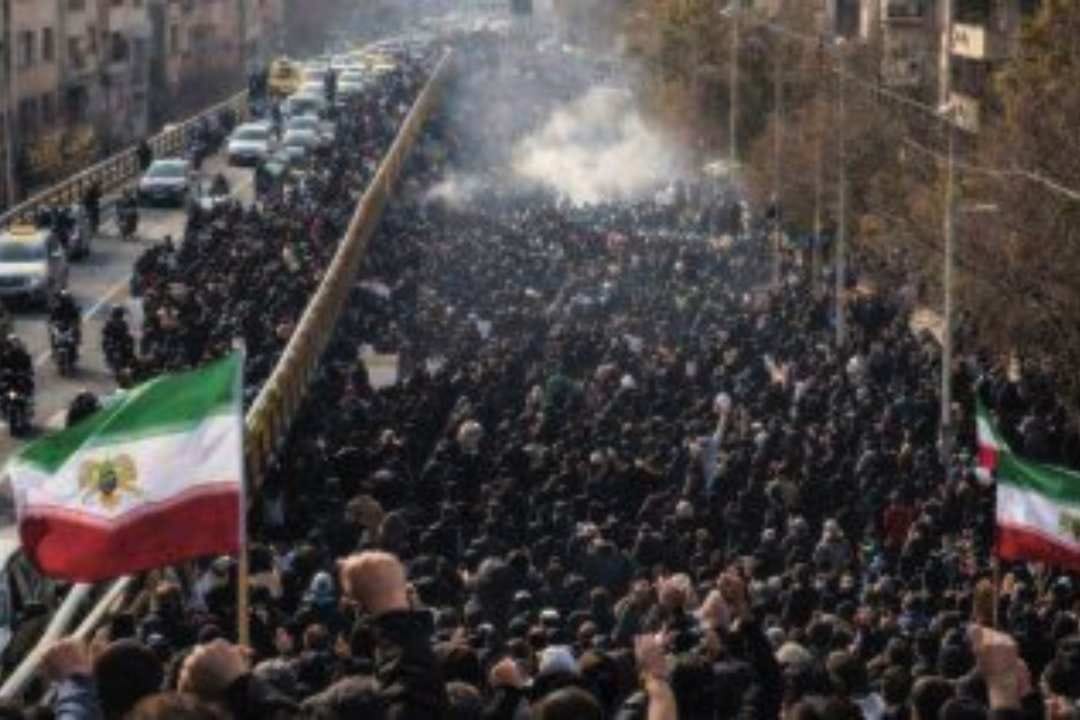
Thousands of Iranians — workers, students and shopkeepers — took to the streets in late December in Tehran and, rapidly did so across almost the entire country, in cities such as Shiraz, Mashhad, Tabriz, Karaj, Qazvin and Isfahan, among others. The explosive collapse of the national currency and hyperinflation acted as a trigger. It has destroyed the purchasing power of working-class families — one US dollar now exchanges for more than 1.4 million rials — making food and basic services unbearably expensive.
The protests began as a reaction to the deterioration of living standards and quickly incorporated rejection of the reactionary and theocratic regime, with slogans against Supreme Leader Ayatollah Ali Khamenei and political demands. The mobilisations continued until Monday, 5 January, for the eighth consecutive day.
Repressive response and growing regional instability
As it has always done, the fundamentalist regime has responded with repression. The security forces, including the Basij and the Revolutionary Guard, have caused the deaths of more than 20 people, dozens of people were injured and nearly 1,000 have been arrested. The Supreme Leader has accused “external enemies” of exploiting economic discontent and has called to “put them in their place,” while official media has reinforced this perspective to justify institutional violence. This situation further destabilises the Middle East, already convulsed by the genocide carried out by the State of Israel against the Palestinian people and the trap agreement signed between Netanyahu and Trump.
Trump’s aggressions and renewed threats
Iran has suffered economic sanctions that were reimposed after the US withdrawal from the nuclear deal in 2018, which contributed to the current economic devastation. It has also endured military attacks, including bombings by the US and Israel in 2025. Now Trump is once again threatening the country with new interventions if the regime uses violence against the demonstrators. Trump is a boundless cynic: while presenting himself as a “pacifist,” he repressed fighters for Palestine in the US, bombed Venezuela, and kidnapped President Nicolas Maduro and his wife. The real objective of Trumpist rhetoric is to lay the groundwork to justify possible future interference.
A derailed revolution
The Iranian Revolution of 1979 was carried out through strikes and independent mobilisations of millions of workers, peasants, poor urban sectors and youth, from which bodies of self-organisation, self-defence and grassroots coordination were created, such as workers’ councils (Shoras), strike committees, factory committees and neighbourhood committees. The strength of the revolution succeeded in overthrowing the dictatorship of the last Shah of Persia (Iran), Mohammad Reza Pahlavi, who was a cornerstone of US imperialism in the Middle East.
The working class played a decisive role —especially through general strikes and control over strategic sectors such as oil— but it lacked a revolutionary leadership capable of disputing power. The Shiite clergy, led by Khomeini, dismantled the nascent bodies of dual power, repressed the left and dominated the process by relying on its social and religious influence.
A reactionary regime challenged by popular struggles
The ayatollahs established a bourgeois, theocratic, reactionary and counterrevolutionary regime domestically, with a policy that over time alternated between partial confrontations and agreements with US imperialism. Beyond limited and pre-announced attacks on Israel, the Iranian regime has not developed consistent and decisive support for the Palestinian people during the genocide carried out by Zionism; rather, it has acted according to its own regional interests.
The demands of different social sectors and the repression of 2025–2026 are not a “bolt from the blue.” Over the past fifteen years, with greater or lesser intensity, there have been protests linked to the Arab Spring (2011–2012) and for political and social rights (from 2017 to the present). Just to quote one example, in 2022 a massive uprising swept across Iran following the killing of Mahsa Amini while in custody, becoming a cry against religious oppression and inequality.
Solidarity with the struggles and for a revolutionary and socialist way forward
The tasks of the unfinished 1979 revolution are combined with the current ones, driven by the injustices of theocratic capitalism, the regime’s authoritarianism and imperialist-Zionist aggressions. Therefore:
• We express our solidarity with the protests for social rights, against poverty, inequality and the deterioration of living standards, and in defence of democratic rights denied through oppression and repression.
• We demand an end to repression, punishment for the material and political perpetrators of the killings of those who have fought for their rights, and the release of political prisoners.
• We support initiatives that promote the self-organisation and self-defence of the working people, independently of restorationist, pro-Zionist and pro-imperialist forces.
• We reject any interference by foreign powers, starting with Trump and his Zionist allies, who only seek to instrumentalise the struggle of the Iranian people for their own geopolitical objectives.
• The demands for economic justice, democratic freedoms and human dignity can only succeed if they are articulated from below, defeating the regime that has exploited and oppressed generations of Iranian workers, and if they also distance themselves from the interests of other imperialisms, such as those of China and Russia.
• The most important task is the construction of a strong, consistent left alternative, organised around the objective of socialist revolution in Iran and throughout the Middle East —to sweep away monarchic, fundamentalist, pro-imperialist and Zionist governments and ensure that those who have never governed do so: the workers and the people, with a system without exploiters or oppressed, with full social and democratic rights, a socialist system.
International Secretariat