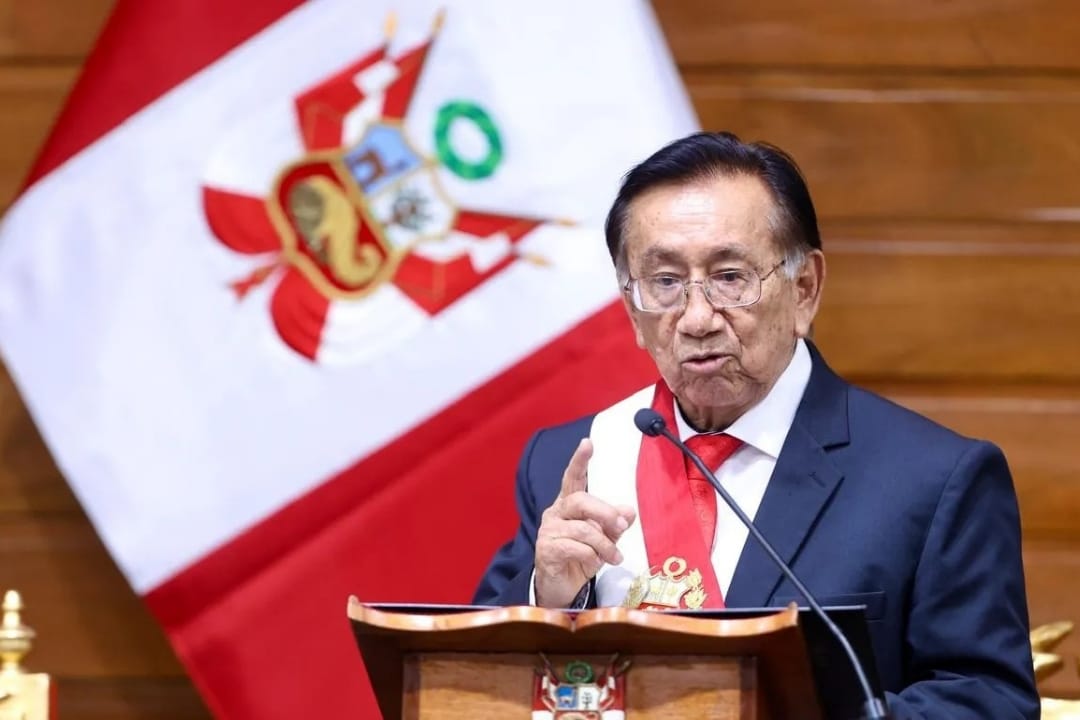
José María Balcázar Zelada, 83 years old, assumes the Presidency of the Republic in a context of profound institutional instability. With his appointment, the country is on the way to having nine presidents in ten years, a fact that in itself expresses the chronic crisis of the Peruvian political system.
The election follows the dismissal of José Jerí by the Congress, in the midst of public accusations of questionable meetings with businessmen linked to Chinese capital and accusations about the incorporation of people close to his entourage to the government administration. The parliamentary process was marked by failed votes, cross accusations and a climate of evident fragmentation. Finally, in the second ballot, Balcázar obtained 60 votes against 46 for the list headed by María del Carmen Alva.
The new president will hold office only until July 28, when he must hand over the presidential sash to the person elected on April 12. It is, therefore, a transitional presidency, whose main function will be to administer the electoral process and guarantee institutional continuity in a context of growing delegitimization.
The scenario prior to the vote evidenced the narrow margin of options available. Of the 130 current parliamentarians, 57 are running for the Senate, 29 for the Chamber of Deputies and two for the Andean Parliament, which significantly reduced the number of congressmen qualified to assume an eventual interim presidency. Most of those eligible to run also have very low levels of public approval. Balcázar’s election cannot be read, therefore, as the result of a consistent political project, but rather as an expression of the limits and contradictions of the Parliament itself.
In this context, it is illustrative to observe the media treatment. While the previous appointment was presented in neutral terms – “new president”-, on this occasion numerous headlines immediately appeal to the label of “extreme left”. This discursive construction is not innocent: it is part of a broader strategy aimed at creating a climate of fear of any reference to the left, even when the fundamental decisions of the transitional government are aimed at preserving the continuity of the current economic model. The recourse to the phantom of “radicalization” thus operates as a disciplining mechanism in the public debate.
At the same time, the figure of Balcázar has a controversial background, including ethical and professional questions that have been widely pointed out. In a country with high rates of gender-based violence and persistent impunity for sexual crimes, the appointment of authorities with this type of background brings back to the center the concern for the security, dignity and rights of women and dissidents. The institutional crisis is not abstract: it has a direct impact on concrete bodies and lives.
Beyond the names, the dynamic of changes confirms a constant: the Parliament acts as administrator of the continuity of a political and economic order based on the 1993 Constitution and on a neoliberal orientation that prioritizes the interests of financial capital and international organizations over social needs. The accelerated succession of presidents does not express a process of deep democratization, but rather the difficulty of the regime to stabilize itself without altering its structural bases.
The upcoming elections will take place in a climate of distrust towards traditional institutions and parties. In this framework, from Alternativa Socialista Perú we maintain that these changes of names do not modify the character of the current model and therefore we promote an alternative that proposes to articulate feminist, popular, rural and cultural struggles in an anti-capitalist perspective. In this sense, we accompany and support the candidacy of Sofia Martinez within Juntos Por el Peru, understanding this space as a tribune from which to strengthen an independent voice of the workers and popular sectors both in Parliament and in the streets. Sofia is running with the number 22 for the Chamber of Deputies, betting on the collectivity of the feminist, anti-capitalist and internationalist struggle that characterizes us as a movement.
The current political crisis will not find a solution in new parliamentary rearrangements. It requires opening a fundamental debate on the nature of the State and the economic model. For this reason, we propose the need to convene a free and sovereign Constituent Assembly, arising from below and supported by social mobilization, which will allow us to democratically discuss a new institutional framework. The parliamentary participation of socialists only makes sense if it is accompanied by popular organization and active intervention in the streets, where historically fundamental rights have been won.
Faced with a regime that shows signs of exhaustion, it is essential that those of us who claim to be anti-capitalists advance in the construction of an alternative capable of disputing real power, not just managing its crisis.
Alternativa Socialista Perú – International Socialist League