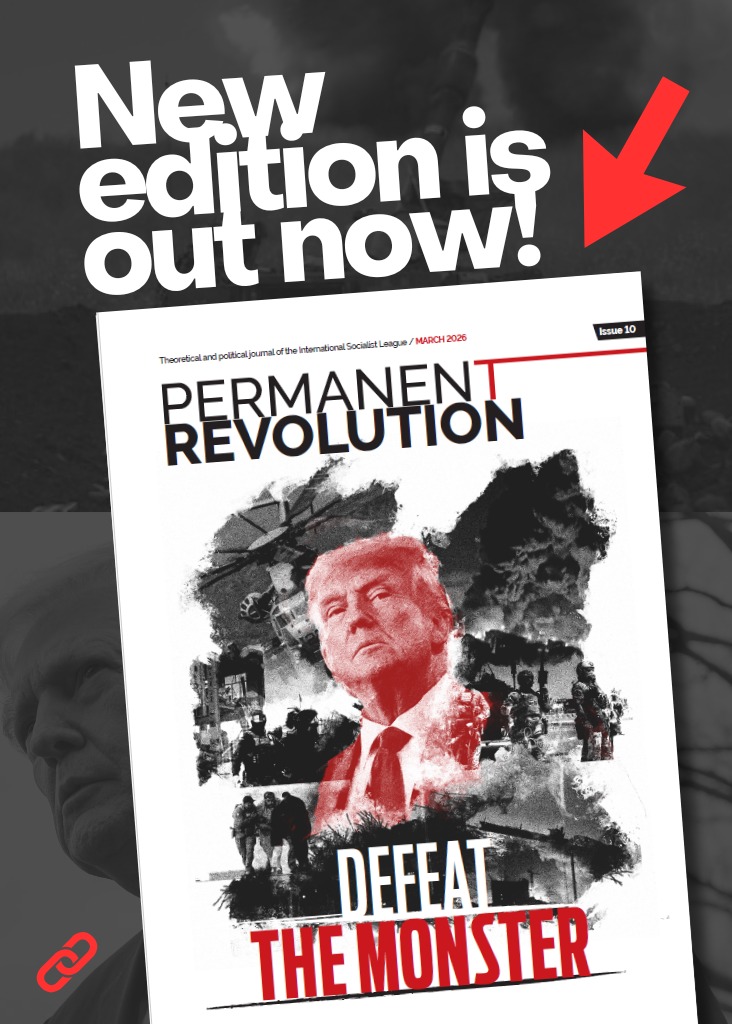
By Socialist Horizon
The rupture of the rules-based order
After decades of seeing US global hegemony decline and China grow as an imperialist competitor, the US ruling class has decided to back Trump´s gamble of replacing the world order established after World War II with direct imperialist imposition, competition and negotiation between major powers.
They mean to deploy the full weight of the military and economic superiority the US still maintains to recover lost ground. The administration abandoned the historic alliances and the multilateral strategy and institutions that the US led over decades. NATO, the WTO, the WHO, the UN, have been replaced with unilateral imposition. Free trade agreements have been replaced with aggressive tariffs on allies and rivals alike.
The agreement Trump sponsored with Hamas and the Zionist entity did not halt the ongoing genocide, but it did generate enough confusion to dampen the global Palestine Solidarity movement. Trump’s negotiations with Putin have not ended the war in Ukraine as he promised, but they have sidelined the European Union and established that neither the Ukrainian people or its government will have any say in how Russia and the US partition the country and its resources.
But the scope of the new foreign policy has been fully deployed and showcased this year with the recent US coup in Venezuela, the full blockade of Cuba, and the ongoing attack on Iran.
But Trump is not unstoppable. The retreat from his attempt to take over Greenland does not express a change of heart or agenda, but the actual limits of US global power. And the war unleashed against Iran will put those limits to a much higher stakes test. Iran is not Venezuela, its counterattack has struck Israel and various US bases and allies in the region. The war is extremely unpopular in the US and abroad, has already spread to Lebanon, UAE, Qatar, Kuwait, Bahrain and Arabia, and could destabilize the entire region. It is not at all certain that the outcome will succeed in helping US imperialism recover global power or become a new catastrophic setback.
War abroad, war at home
While the Trump administration’s foreign policy means to capture a larger share of global surplus value for US capitalists, its domestic policy intends to increase profits by significantly increasing the exploitation of workers in the US.
Since people have a tendency to resist getting screwed over, the MAGA project also needs to drive oppression and authoritarianism. The administration seeks a structural reactionary transformation of the political regime. This explains its unprecedented attack on free speech and democratic rights in general, its questioning of elections and the Constitution, its attempts to rule by decree, disregarding Congress and the Courts, and its intention of normalizing the use of the armed forces in internal repression.
To intensify oppression, the administration has targeted immigrants in particular for all-out attack. It has turned ICE into its paramilitary strike force, boosted it with billions of dollars, military equipment and tens of thousands of hardly trained recruits, particularly appealing to white supremacists and fascist thugs. And it has deployed it with the “surge” strategy, taken straight out of the Afghanistan and Iraq occupation manuals, terrorizing entire populations, illegally rounding up and kidnapping thousands of people off the streets and sending them to concentration camps, and assassinating dozens people in cold blood with impunity.
But the MAGA offensive did not take long to generate a resistance, and Trump’s escalation abroad and at home this January has provoked a qualitative leap in global conflict and the in the level of class struggle in the US.
Polarization and class struggle
An often underestimated aspect of the systemic capitalist crisis that erupted in 2008 is the ideological crisis. The so-called Washington Consensus that established the historical, social and moral victory of capitalism over socialism as common sense over 20 long years collapsed. All of a sudden, the common sense became that capitalism does not work. Socialism lost its stigma, it became a valid idea to consider.
The 2016 Bernie Sanders Campaign, the rise of DSA and polls showing most US youth consider socialism better than capitalism show that when millions lost faith in the establishment, more people in the US looked to the left than to the right, and many others looked to the left before turning to the right.
In fact, Trump and the far right only gained real traction after the Sanders phenomenon turned into a massive disappointment. Since then, social and political polarization has consistently grown. It is an uneven polarization, because the far right built a political expression and led a consolidated reactionary base into state power, while the left has seen millions of people radicalizing and mobilizing, but its political expressions, mainly dominated by reformist variants, have only disappointed its base with capitulations and failures.
The same period saw a rise in class struggle. Occupy, Black Lives Matter, a steady rise in strikes shifted the ideas of a layer of people to the left. The Palestine solidarity movement then radicalized a broad layer of young activists and led over a million Democratic voters to abandon that party. The absence of options to the left, with Sanders and AOC endorsing Biden, then Harris, led to Trump winning in 2025.
The first year of Trump’s second term consolidated the process of uneven polarization and radicalization. The No Kings marches showed that a majority rejects Trump and millions are willing to actively take action to stop him. Rebellions against ICE pushed the offensive back in Los Angeles and Chicago. And the shift to the left of a layer of the population was reflected in the victory of Zohran Mamdani in the New York City mayoral election.
But January changed everything
The attack on Venezuela and the murder of Renee Good by ICE agents signaled a new moment in the MAGA offensive and in the resistance. Hundreds of thousands across the country attended meetings to join rapid response networks against ICE, marking the beginning of a new national social justice movement, a broad process of self-organization and a shift to the left in the ideas of a broader segment of the working people.
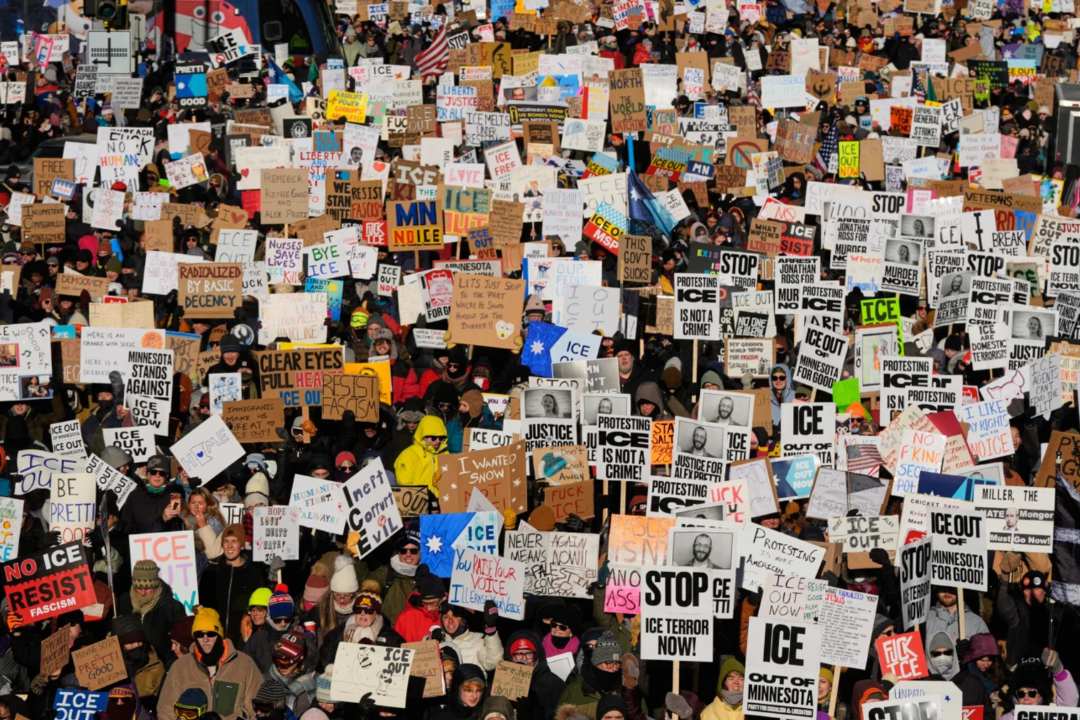
If Minneapolis was already showing signs of mass resistance, the assassination of Renee Good drove its people into full blown rebellion. A call for “no work, no school, no buying” paralyzed a significant part of the city on January 23. The cold blooded murder of Alex Pretti the next day led to 70 to 100.000 marching in the freezing cold and ICE agents being immediately relocated to the outskirts of the city.
The Democratic Party’s Minneapolis mayor and Minnesota governor stepped in to help Trump, deploying the police to demobilize the people, take down the anti-ICE check points and deputize local law enforcement agents to continue the persecution of immigrants. But Trump’s Minneapolis “surge” had to be cancelled, a political blow that should be noted.
No work, no school, no buying
It is significant that the Minneapolis rebellion adopted the methods of the working class, calling for strikes on January 23 and 30, and then organizing a workers’ assembly on February 15 to plan May Day actions.
The fact that this resonates on thousands of workers across the country speaks to the accumulated effect of events over the last decade, from Sander’s 2016 campaign and the rise of DSA to the rise in strike and union organizing, which have contributed to a not so evident accumulation, albeit partial and contradictory, of class consciousness.
Socialist Horizon and the United Left Platform participated and are working to build workers’ assemblies across the country and a national “no work, no school, no buying” strike this May Day.
Political perspectives and alternatives
Trump has advanced US imperialist power but also shown how far it reaches. He has tested the limits of the US working class and provoked a resistance which has already dealt him some blows and may take on a dynamic of its own. He has cultivated a reactionary base in a significant minority of the working class, but failed to deliver on promises that his agenda would improve their living conditions. The Epstein files are exposing him, in the eyes of all but the most reactionary, as the rapist pedophile criminal he is. Recent polls show Trump’s approval has dropped to around 39 %, with roughly 60 % disapproval.
A defeat in November’s midterm elections seems very likely and would weaken not only the MAGA agenda in the US, but also the global far right that Trump supports. At the same time, the Democratic leadership inspires so little enthusiasm that it may be incapable of doing its part to materialize a clear defeat of the Republicans. Biden maintained much of the policies of Trump’s first term. The party has done next to nothing to oppose Trump since he returned to the White House.
Even Sanders, AOC and the Squad offer no alternative but supporting whatever Democrat stands in the upcoming elections. Mamdani expresses a more radicalized base and raises more progressive positions on a number of issues, but also fails to propose any way forward.
This leaves hundreds of thousands of radicalizing people without a political project. Revolutionaries need to offer a way forward, to fight for the broadest unity of action, to organize to fight to defeat Trump and at the same time, to build a political organization of the working class that intends to do away with the capitalist system and replace it with socialism.
Socialist Horizon, ISL section of the US, along with members and ISL sympathizers in other spaces, fight for this objective. They do so from the front lines of the struggles against US imperialism, against ICE terror and the MAGA offensive, with a united front method that seeks the broadest unity in action while highlighting the necessity of fighting against the systemic causes of oppression and exploitation by joining the revolutionary socialists.
A significant aspect of this orientation is carried out through the United Left Platform, through which Socialist Horizon together with Tempest, Solidarity, Workers’ Voice, International Marxists Humanists and Speak Out Socialists act as a national force in the class struggle. And the essential aspect of the ISL’s orientation in the US is its project of revolutionary regroupment to advance the strategic objective of building a revolutionary working class party in the country and internationally.