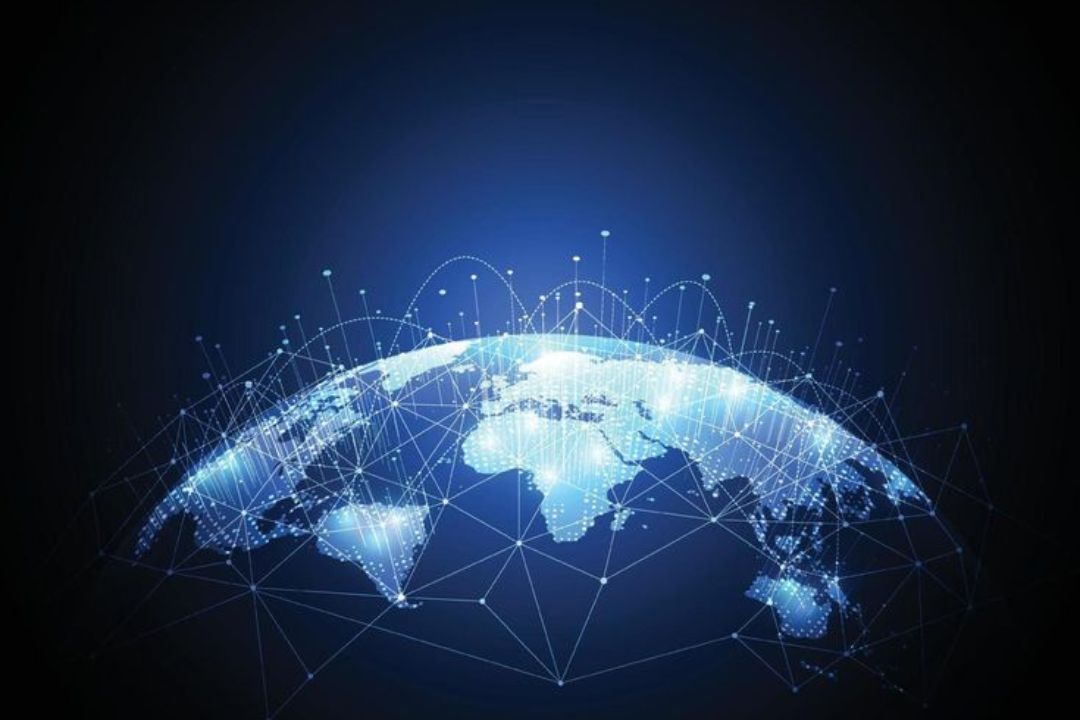
Internet cannot be understood as an ethereal cloud of information or as a neutral space of free exchange. It is, first and foremost, a material infrastructure, historically determined, built by human labor and organized under social relations of production characteristic of capitalism. The dominant discourse, which presents it as a “horizontal network” or a “global common resource”, ideologically implies the consealment of the material basis of the system and, above all, the property and power relations that run through it.
By Manuel Velasco
The materiality of the “digital world“
Behind every click are undersea wiring crossing oceans, data centers consuming colossal amounts of resources and energy, satellites, telecom towers and a global workforce subjected to intensified rates of exploitation. The internet rests on an uneven geography: lithium and coltan mines in Africa and Latin America, hardware factories in Asia, data centers in the global North. None of this is virtual. It is fixed capital in the most classic Marxist sense, the product of gigantic investments and planning that responds to the logic of profit.
The invisibilization of this infrastructure is not accidental. As in any phase of advanced capitalism, the more the final product is fetishized – the fluid user experience – the more the material conditions of its production are consealed. The platform worker, the precarious content moderator, the outsourced technician who maintains servers or the worker who extracts strategic minerals are erased from the triumphalist narrative of the “digital economy”, constituting the variable capital whose real contribution of value in the productive process is unknown.
Monopoly and centralization of capital
The development of the Internet confirms one of the fundamental laws of capitalism pointed out by Marx: the tendency towards concentration and centralization of capital. Far from democratizing the economy, the network was used by the new business sectors for the emergence of private monopolies on a planetary scale. A handful of corporations now control infrastructure, information flows, algorithms that organize visibility and, ultimately, large portions of social life.
These companies not only extract direct surplus value from their salaried labor force, but also create new forms of value appropriation. The user himself becomes a producer of value: data, habits, interactions and affections are commodified and sold. It is an everyday, naturalized expropriation that extends the classic concept of the working day to the point of watering it down to the length of the entire day.
The digital monopoly is not only economic, but also political and ideological. The platforms function as private apparatuses of hegemony: they regulate public discourse, censor or amplify content according to opaque criteria and actively collaborate with imperialist states in tasks of surveillance and social control. The alleged “freedom” of the network is thus revealed as being strictly conditioned by the interests of capital.
Internet and the capitalist state
Far from being an autonomous space vis-à-vis state power, the Internet is deeply intertwined with it. Its very origin is linked to military and strategic projects. Today, capitalist states act as guarantors of digital private property, protecting patents, data and monopolies, while using the infrastructure to reinforce mechanisms of repression and espionage.
From the Marxist point of view, there is no contradiction here: the State remains, also in the digital era, a committee for the management of the common business of the bourgeoisie. The alliance between governments and technological giants expresses a renewed form of imperialism, where the control of information and networks is as decisive as the control of territories and raw materials.
Recently, the concept of “Digital-Military-Industrial Complex (DMIC)” was elaborated to refer to the relationship of the new right-wingers at the helm of capitalist states with the military industry. It is an evolution of the traditional military-industrial complex that Dwight Eisenhower warned about in 1961, but amplified by the dominance of big techs and their symbiotic integration with the US national security apparatus. It is evident that startups are not simply companies dedicated to the manufacture of innovative technological devices for mass consumption, but are establishing themselves as fundamental pillars of imperialist power.
Algorithm in the hands of the extreme right wing
Extreme right-wing forces have turned social networks into the preferred field for the “cultural battle”, capitalizing on algorithms that reward right-wing radicalization, without traditional media limitations. Through the use of generative AI, armies of bots and the use of fake news, they have managed to inject hate speech and disinformation directly into the daily consumption of young and disillusioned sectors, transforming clicks into a solid electoral base.
In contrast, the management of the platforms has shown a restrictive face in the face of causes such as Palestine, where giants such as Meta have tightened censorship of comments in defense of the Palestinian people on networks such as Instagram or Facebook as of 2023. Through shadow banning (elimination or limitation of the scope of a certain publication), the elimination of accounts and a biased automated moderation -which even associates the Palestinian cause with terrorism-, the owners of the networks, committed to the far-right governments, have silenced critical voices and testimonies of the humanitarian crisis, evidencing an asymmetry of power where the supposed freedom of expression seems to be subordinated to the interests of Zionism and U.S. imperialism.
Emancipatory potential and limits under capitalism
Our analysis can fall neither into reactionary technophobia nor into uncritical enthusiasm. The Internet holds real potential for the international organization of the working class, for the rapid circulation of ideas and for the coordination of struggles. The strikes, rebellions and revolutionary processes of the last decades have shown that networks can be powerful tools.
But this potential constantly collides with the limits imposed by private property and monopoly control. Under capitalism, all technology tends to be subsumed by the logic of accumulation. The network is no exception. The illusion that it can be “reformed” by partial regulations or ethical appeals to corporations is a variant of digital reformism.
A socialist perspective
The socialization of the digital infrastructure, under democratic control of workers and users, is a condition for liberating the productive forces that today are chained to private profit. This implies breaking with monopolies, guaranteeing universal access and putting technological development at the service of social needs, not the market.
The Internet, like all technical conquests of capitalism, poses a contradiction: it is at the same time a product of capital and a material anticipation of a consciously organized and planned society. Resolving this contradiction is not a technical problem, but a political one. And it can only be resolved on the terrain of class struggle, on an international scale.
Ultimately, the network that today serves to monitor, exploit and commodify could become a tool for emancipation. But that will not happen by spontaneous evolution or by the good will of the digital monopolies. Either the internet remains a lever of capitalist domination, or it will be reappropriated by the working class in the framework of a socialist transformation of the state and society.