By Camilo Parada
I write these lines in a disorderly way, from the gut and inevitably crossed by emotions and my life. I apologize in advance if someone may find this text formally tedious.
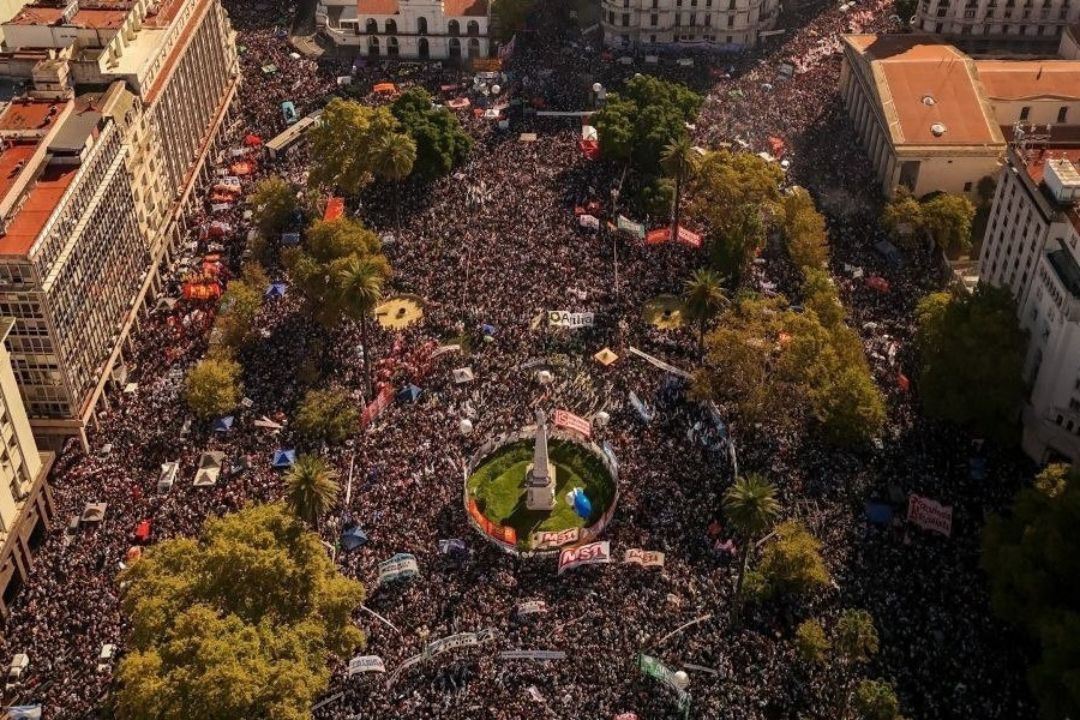
Today is the 50th anniversary of the Argentine coup, we are 53 years away from the Chilean coup. In both countries there are governments that position themselves as the great defenders of the most savage neoliberalism, in the midst of the global crisis of capitalism and a model that is failing again and again, unable to ensure, not even basic rights or the minimum conditions to be able to live. On both sides of the Andes, there are negationist government that relativize barbarism, of the crimes against humanity committed by dictatorships that are taken as a reference by both Milei and Kast.
There are many communicating vessels that cross the mountains, there are also particularities, which are worth understanding, analyzing, learning and comprehending. The main one, in my opinion, is the end of the dictatorships: in Chile, as is well known, the exit was agreed at the top, with pacts, senators for life, impunity, and dead people hidden in the closet; in Argentina, a series of social and historical events led to the end of the dictatorship, the defeat in the Malvinas War against the imperialist ravage of the United Kingdom; the deep economic and social crisis, with uncontrolled inflation and a galloping debt; but above all, the exemplary resistance and struggle of human rights organizations, Mothers, Grandmothers, left-wing parties, social movements, etc. In both countries, the dictatorships were driven by the economically dominant class, seeking to disarticulate the growing and dynamic popular mobilization and politicization of the masses, both sought a radical capitalist and neoliberal restructuring, in Chile the counterrevolution was openly, a play for capitalist restoration, transforming, in full view and patience of the twilight world of the Cold War, in the laboratory of the “Chicago Boys” praised by Thatcher, Nixon and Kissinger.
But both in Argentina and Chile the State was captured by the most reactionary fractions of the bourgeoisie and the landed oligarchy, allied with U.S. imperialist capital, nationalists, ultra-capitalists and ultra-rightists, not always coexisting in a balanced way, with internal quarrels, with the common vector of anti-communism, anti-Marxism. State violence (State terrorism) was systematically used to crush the trade union and political organizations of the working class, reversing social conquests and disciplining the labor force, that is, on both sides, what was installed was an authoritarian capitalism by means of political violence, human rights violations and the control of all powers concentrated in a civilian military leadership (in the Argentine case, also ecclesiastical).
Today, on both sides of the Andes, we are witnessing the reinstatement of authoritarian capitalist governments, after more or less long cycles of progressivism, of the renewed center-left, with the everlasting broken promises, with that eternal inability to break with the “orderly” administration according to neoliberal parameters, of the model. Yes, of the model imposed in dictatorship. I am not writing this from resentment or from easy political chicanery, but from the deepest feeling that it is necessary to talk about everything, to criticize everything, to transform everything.
The dictatorships needed to apply crimes against humanity and institutional rupture to impose the terms that the bourgeoisie required in moments of crisis, at present, the right wing does not require the armed wing of the military branches, at least at first, they reach the governments through liberal and constitutional democracies, to turn the screw again, implementing a deepening of authoritarian capitalism, opening (liberalizing) what is left of the economies, by force and at the point of decree, but above all, adjusting the working class, so that we pay for the crisis, when at the same time tax royalties are granted to the parasitic class of millionaires. In dictatorship, in Argentina, in Chile and everywhere, the worst aberrations are used to impose the new order: tortures, death flights, disappearances, stolen children, political-sexual violence, exile, executions, relegations, censorship, etc. Of our days, the legal scaffolding to repress, has been prepared with the help of the progressivisms that, were the antechamber to Milei and Kast.
In writing this, which I do not know where it goes, it is inevitable to surround me with ghosts, of all my dead, of my old José Manuel Parada, whose throat was slit by the intelligence department of Carabineros, of my maternal grandfather, kidnapped in 1976 by agents of the Joint Command, who went through the horrors of the Simon Bolivar Barracks, and that we were able to recover some pieces of bones in 2001 in the Cuesta Barriga, that is, from 1976 to 2001 he was a disappeared person; of so many comrades who were victims of these tyrannies. I also think of all the people murdered, tortured, damaged, of all the parties that suffered persecution, of the revolutionary comrades who rearticulated themselves as best they could, of the solidarity, many times hidden behind the great story, of the comrades of the PST in sister Argentina, in so many stories of torment that we share, that are important to be told and made visible, as it is important to say, to name, to vindicate, the why, the how, the where, the which, the how many, the who of the fallen, that is to say to recover the militant dimension, the world for which they fought and gave their lives. Not everything should be covered with pain, it is necessary to rescue the combative dimension and the light of a struggle that has all the sense of urgency today, 50 years after the coup in Argentina.
This present that once again blurs a border marked on the ledges, with the sorcerer’s apprentices of neoliberal capitalism, one blond, German Nazillionaire, the other greasy-haired, foaming at the mouth, both are figures of class violence. José Antonio Kast (Republican Party, Chile) and Javier Milei (La Libertad Avanza, Argentina) represent the most brutal factions of capital. Their program seeks an extreme deepening of deregulation, total labor flexibilization and repression of social protest, with a legal framework drawn by their reformist predecessors; both have bureaucratic trade union centers without independence; both are trustees of the logic of the Cold War, they play with it, although it is a fossil world; both use a discourse of hatred against “cultural Marxism”, feminism, sexual diversity and human rights organizations. They are the ideological continuity of dictatorships, although in a democratic institutional framework, there is no room for naivety in this respect.
The possibility that this has happened combines elements of the disappointment of the masses with the social-liberal project of the Latin American reformisms, with a capitalist/patriarchal restitution plan, amidst the dispute for inter-imperialist hegemony, Kast and Milei are functional to the interests of the monopolies, the financial capital and the extractivist elites, their whole policy, so openly expressed, are Trump’s lackeys. Milei and Kast reflect on the other hand, the crisis of representation of liberal democracy and the exhaustion of progressive governments that did not break with the power structure of capital.
Obviously both countries, both processes, have their own particularities, but what interests me here are the links and the social symptomatology of a global character. From this perspective, the bourgeois dictatorships and the governments of Kast and Milei are not isolated phenomena, but expressions of the organic crisis of dependent capitalism in Latin America, and projects aligned with the imperialist interests of the United States, that is to say, not only are there bridges between the projects, but there is a spatio-temporal bridge between both projects and the dictatorships. The forms change, there is no doubt (military coup vs. electoral adjustment), the class content is the same as always, with greater or lesser sophistication and makeup: to impose the conditions of exploitation that capital needs for accumulation in times of world crisis, to try to do everything possible to break the capacity of resistance of the working class, that is to say, to apply disciplining, repression, bombardment of measures to immobilize, etc. The capitalist-patriarchal-neoliberal model imposed under the dictatorships, was never overcome by the progressive governments of the 21st century (Kirchner, Bachelet, Boric, Fernandez, etc.), who administered capitalism without attacking its structural bases, that is to say, they never represented a genuine alternative, rather they were the escape valve to social pressure, not to say the emergency brake for the necessary changes.
Perhaps, in the face of the crisis of hegemony, where the ultra-right capitalizes the popular discontent that the social-liberal left is unable to channel, Marxism should propose a strategy based on the autonomy of those from below and the rupture with capital, and perhaps, on this point, Argentina has a more solid militant anti-capitalist reserve than Chile, with the experience of the Frente de Izquierda, with the accumulation that this fact means, now, seen from here and with the corresponding respect, that militant reserve will be powerful if the same Frente de Izquierda manages to go beyond the electoral framework, and transform itself into something more than an electoral front. In Chile at the moment, the situation is more adverse for the revolutionary left, fractional, very diminished, deeply sectarian, we have different and enormous tasks on both sides, but they are tasks that must be given and we must know each other on both sides, because we know that at the end of the day, this struggle is worldwide, and what better to begin by knowing, sharing experiences, of the neighboring countries, whose borders for us, are nothing more than the layout of the powerful to divide up the cake.
The way out cannot and should not be purely electoral within the liberal camp, the way out should be first of all political and social. It is necessary to overcome the current fragmentation (formal, informal, precarious, productive, reproductive, stable worker) to regroup from below, on the left, anti-capitalist, socialist, communist, of the social movements, provided they are of rupture, not in the terms of the traditional Communist or Socialist Parties and heirs of Stalinism or of the most nefarious social democracy, which only keep the echo of a historical name, but on the plane of the real signifiers. This implies recovering the revolutionary red thread, the general strike, the tradition of recovered factories in Argentina, the struggle for a decent social security in Chile, understanding that no concession within capitalism is sustainable, that there is no way out administering the model without disarming it to build the conditions for a government of the workers.
Come on, let us be honest in these moments of total decadence of the system, both the dictatorships and the current ultra-right governments have been driven by imperialist interests, Trump has stated it openly. The socialist solution in Argentina and Chile cannot be nationally isolated, we must federate the struggles that respond to the same interests. Experience shows that the governments of Latin American socioliberal reformism, which so much admire the European frenteamplista experiences, cannot resolve the structural crisis because they respect the limits of capital and the international institutions of the system, such as the IMF. The way out implies building an anti-capitalist and ecosocialist alternative that expropriates the big fortunes, socializes the strategic sectors (mining, energy, food), creates democratic mechanisms to decide what, how, how much and for what purpose it is produced, with parameters of labor rights and ecological balance and breaks with the chains of dependence on imperialism. If there is one thing that those of us who do not accept the fait accompli of capitalist dystopia know, it is that no right, no conquest, falls from the sky, on the contrary, it is achieved with struggle, with organization, with the working class and the masses.
The Argentine dictatorship was a terror machine that undoubtedly leaves scars, Kast and Milei use the ballot boxes, social networks, threats, corruption and repression, so that the crisis is paid by those of us at the bottom. It is essential then to break with that logic, to stop thinking that it is the only possible world, because the world needs, for life to be worth living in its most advanced expression, that we organize, live, think, and materialize other ways of organizing ourselves, of power, where the majorities decide everything, about production, distribution and the destiny of the common goods, that which, with foam on the corners of their lips, Milei and Kast call resources for foreign investment.
While the national bourgeoisies unify, having clarity in their position within the class struggle, while they regroup with their butcher institutionalism in the chambers of commerce, in the private banks, in the IMF and in the Armed Forces, the anti-capitalist left, runs the danger of sectarianism and self-proclamation. The defeat of the 1970s was not only due to the monopoly of arms in the hands of the right wing, to the brutality of the enemy, to the concentration of capital, to its Yankee surrender to Yankee imperialism, in part yes, but also to the inability to build a united front of all the exploited against reaction, to the alliances of social democracy with the bourgeoisie, to the sectarianism of our camp. It is fundamental to learn and apprehend from our history, from our own paths, not by scourge, but as a way of tactical fine-tuning, by responsibility and also by real will of power.
On this path, the bet for the international regroupment of the revolutionaries, as a strategic process through which the revolutionary forces of the left (socialists, communists, anti-capitalists, anti-authoritarians, internationalists, ecosocialists, class feminists, anti-system dissidents, etc.) overcome historical fragmentation, which only serves the enemy and its machine of dispossession, so that we are able to build a collective political subject to dispute hegemony against capital and its ultraleft expressions.) let us overcome the historical fragmentation, which only serves the enemy and its machine of dispossession, so that we are able to build a collective political subject to dispute the hegemony against capital and its decadent and authoritarian ultra-right expressions. We are not going to artificially erase the theoretical differences nor the interpretations and characterizations of crucial moments, it is about building political, strategic-tactical unity in action based on fundamental agreements, of sculpting with our hands and in a generous way a regrouping that is a true alternative, on the basis of an autonomous class unity, clear alliances with our own program, political independence and capacity to fight, both against the right wing and the governments that betray the popular interests.
The regroupment of anti-capitalist revolutionaries, revolutionary socialists, anti-bureaucratic communists, Marxists, ecosocialists, feminists of ’99, dissidents, Trotskyists and anti-authoritarians is, in the current context, a historical necessity, which must be known and recognized, accepting that there are diverse traditions and that none by itself is the beacon of world revolution. We speak of the minimum condition for the working class and the oppressed peoples of Chile, Argentina and Latin America to be able to face with possibilities of success an enemy that (as in the 70’s) is unified to pass the steamroller, the chainsaw and whatever, so that we pay for the crisis. Let’s be responsible, let’s not give them that pleasure. That place and the engine of this need, in my opinion, reside at this moment in the International Socialist League, but it is a call that all the revolutionary leaderships should be working together.
Tomorrow is always today, for them desaparecides, the fight goes on because we have a beautiful world to create.