Ali Hammoud
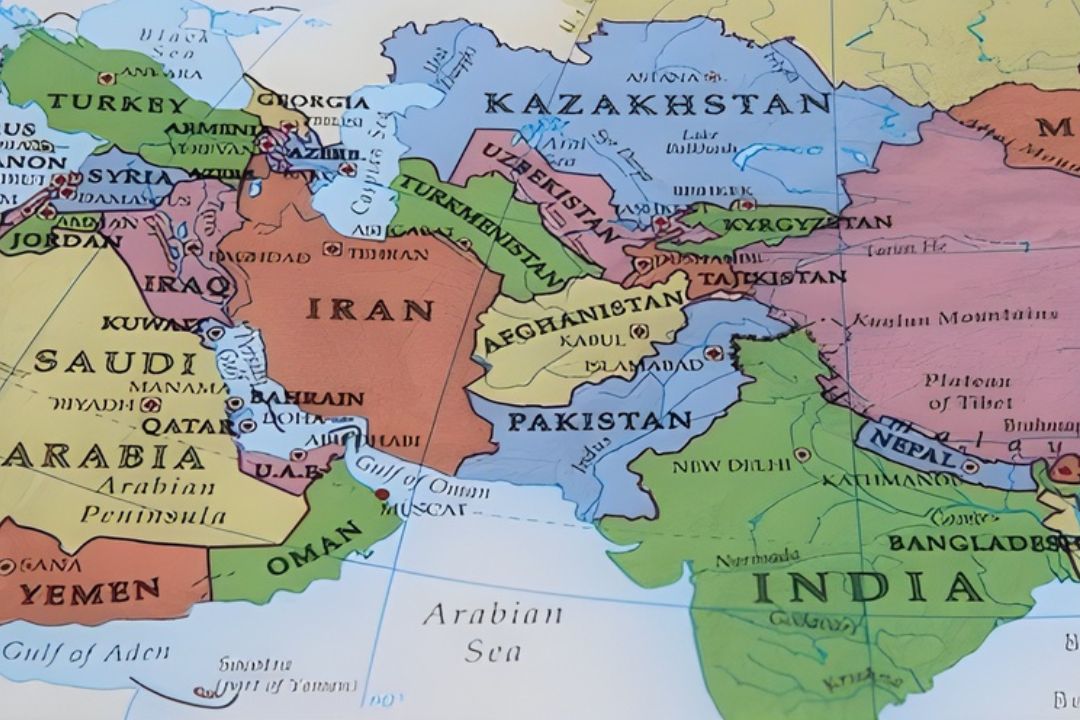
The question of liberation in our region can no longer be reduced to the boundaries of the nation-state, nor even to a narrow nationalist framework, however historically legitimate. The region stretching from the Arab Mashreq to Pakistan, through Persia, Anatolia and the land of the Kurdish people, is not simply a mosaic of peoples, but a unique historical space that was subjected to systematic dismantling over a century of wars and colonial interventions.
The historical exploitation of the geography of the Ottoman state, its contradictions and sharing agreements – such as Sykes-Picot – constituted an early model for dividing this geography into entities at odds with each other, whose contradictions are managed in terms of perpetuating domination. However, subsequent military interventions, the redrawing of borders and the ignition of national and sectarian conflicts further deepened this dismantling, to the point that the peoples of the region today live within isolated political islands, despite their profound economic, social and historical interconnectedness.
The constituent elements of liberation movements – political consciousness, revolutionary organization, popular base and clear program – are still necessary, but they are insufficient if they remain enclosed within narrow national frameworks. Dependence in our region is not local, but structural and cross-border, and so must be the project of liberation.
This reality is linked to the region’s position within the world capitalist system, where its economies are integrated as dependent peripheries that fulfill a specific function: exporting raw materials and importing value added. This unequal integration not only generates a development gap, but also reproduces internal class relations, where local bourgeoisies linked to the center emerge, acting as intermediaries to recycle dependence instead of breaking it.
Hence, the nation-state often becomes a framework for managing this dependency, not a tool for overcoming it, which forces liberation movements to transcend their borders, not only in a geographical sense, but also in a structural one.
The alternative to fragmentation is not forced dissolution, but the construction of an integration space based on:
∙ Gradual economic unity that frees resources from external domination and redistributes them equitably.
∙ Social integration that recognizes the diversity of identities and establishes relationships founded on mutual respect.
∙ Political coordination that limits internal conflicts and strengthens collective decision-making capacity.
This space is not built through decisions from above, but through the accumulation of common struggles and the convergence of the interests of the popular classes in the different countries of the region, in confrontation with the economic structures that link them to the global center.
From nationalism to the internationalist horizon
Limiting liberation movements to a single national framework, despite their historical role, is no longer sufficient to confront the contemporary system of domination. Global capitalism, with its military and financial tools, operates across borders, which requires liberation movements to rise to the same level of conflict.
Here the socialist and internationalist dimension emerges, not as a theoretical slogan, but as a practical necessity. The question is no longer only one of political independence, but of liberation from a world economic system that reproduces dependence, poverty and inequality, and that keeps this region in its place as a reservoir of resources and a scenario of conflict.
The wars that the region has gone through in recent decades are nothing more than tools to reproduce domination; the pattern repeats itself: destruction of productive structures, dismantling of States and deepening of internal divisions.
The events of October 7 and the wider war unleashed on Gaza and the region constituted a new turning point: the conflict is no longer confined to a local framework, but opens up to wider regional possibilities. This war revealed once again the direct role of the imperialist powers, whether through military support, repositioning in the region or management of escalations. In this sense, these wars should not be understood as isolated events, but as part of a continuous process of reconfiguration of the region according to the interests of domination and Israel.
What our region needs is not simply scattered resistance movements, but a comprehensive historical project that reconfigures relations among its peoples, breaks the logic of borders as instruments of separation and transforms them into bridges of communication.
Liberation, in this sense, is a long process that goes beyond overthrowing regimes or ending occupations: it targets the deep structure that governs the economy, politics and culture. It is a project that can only succeed if it is:
Cross-border: Not only in the sense of coordination between movements in different countries, but through the construction of common struggle and economic structures that go beyond the nation-state itself. This implies creating organizational, trade union and political networks that extend across geography, so that any aggression against a people in one place becomes a common cause for all the peoples of the region, and that borders cease to be instruments of separation and become lines of contact for struggle and material integration.
Plurinational in identities: Recognizing that this region is not a single national bloc, but a space rich in diversity of nationalities – Arabs, Kurds, Persians, Turks…- and cultures. This diversity is not managed with a logic of domination or exclusion, but through a liberating formula that guarantees equal rights and builds a unity based on common will, not on coercion. Unity here is not the negation of difference, but its democratic organization within a joint project.
Socialist in its essence: Because any liberation that does not touch the economic structure will remain formal. Socialism here means dismantling dependency relations, exercising control over resources and building a productive economy oriented to the needs of the people, not the demands of the world market. It also means empowering the working class and popular sectors to be the real basis of power, not mere fuel for conflict.
Internationalist in its horizon: This project, although rooted in the reality of the region, does not close in on itself, but recognizes itself as part of a global struggle against imperialism and capitalism. It intertwines with other liberation movements of the world and adopts a broader humanist horizon, where liberation is not the patrimony of a particular geography, but a historical path shared by the peoples.
Faced with a century of fragmentation, it is not enough to resist within the borders imposed on us: we must reimagine the region as a whole, not as a fragmented map, but as a living space capable of producing its own historical alternative.
Lebanon: laboratory of structural contradictions
Lebanon is one of the most expressive scenarios of the structural contradictions in the region, where the sectarian structure of the political system, the patterns of economic dependence on the outside world and the open conflict against the Israeli enemy are intertwined.
The Lebanese system, based on confessional sharing from its origin and consolidated after the Taif Agreement, did not produce a unified national state, but reproduced multiple centers of power, each with its regional and international extensions, which left political decision making subject to external balances as much as to internal divisions.
Economically, this structure was deepened through a rentier model based on services and the banking sector, linked to global markets and networks of local political influence, which led to the marginalization of the productive sectors and the weakening of economic independence. This path was consolidated after the civil war, when reconstruction was tied to financial policies that increased public debt and accentuated class inequality, until the total collapse Lebanon experienced in recent years due to the policies of the Central Bank and private banks. In this sense, the sectarian structure and the economic structure are inseparable: together they form an integrated system that hinders the formation of an independent national project.
In this context, the experience of the Lebanese National Resistance Front constituted one of the most relevant historical milestones, especially after the Israeli invasion of 1982. The Front was a model of national resistance that transcended confessional divisions and factions, based on a political vision that understood the conflict against the Israeli occupation as an integral national struggle, not reducible to a sectarian or partial framework. It carried out significant operations against the Israeli army forces, relying on a diverse popular support and a clandestine organizational structure. However, this experience, despite its importance, was limited in time and organizationally, in the face of regional and international transformations and the emergence of new forces that reshaped the resistance landscape in Lebanon.
On the other hand, Hezbollah emerged as the main resistance force, managing to build advanced military and organizational capabilities and to impose real deterrence equations against Israel, especially after the liberation in 2000, during the July 2006 war and in what followed. But this experience was born and developed within a specific confessional environment, with external support from the Iranian Revolutionary Guard and in a regional context sustained by the Syrian regime, which made its social and political structure rest on a defined sectarian basis.
This raises the central question: to what extent can a resistance movement with a confessional framework be transformed into a comprehensive national liberation project?
This problem does not arise as a denial of the role of resistance, but as part of the structural contradiction imposed by the confessional system itself. The system, by its nature, reproduces divisions within society and prevents the formation of a unifying national identity, which has a direct impact on any resistance project, keeping it subject to sectoral ceilings, no matter how strong its military might. This complexity is accentuated by the fact that the political division in Lebanon around the major issues – including the conflict with Israel – extends horizontally within society, crossing the confessional communities themselves, which makes the construction of political legitimacy for any resistance linked to its ability to present a comprehensive national project, not just to represent a particular sector.
From this arises the need to move from a partial resistance to a comprehensive national liberation project, which redefines the conflict as a cause of the whole society and links the confrontation of the Israeli occupation with the confrontation of the internal structures that hinder this liberation. This does not mean erasing existing experiences, but developing them by integrating them into a broader framework that overcomes confessional divisions and founds a more inclusive political and social base.
The Lebanese experience clearly reveals that the conflict with Israel cannot be separated from the conflict with one’s own internal structure. Liberation is not only a question of borders and sovereignty: it is also a question of building an economically and politically independent national state.