By: National Leadership of the MST
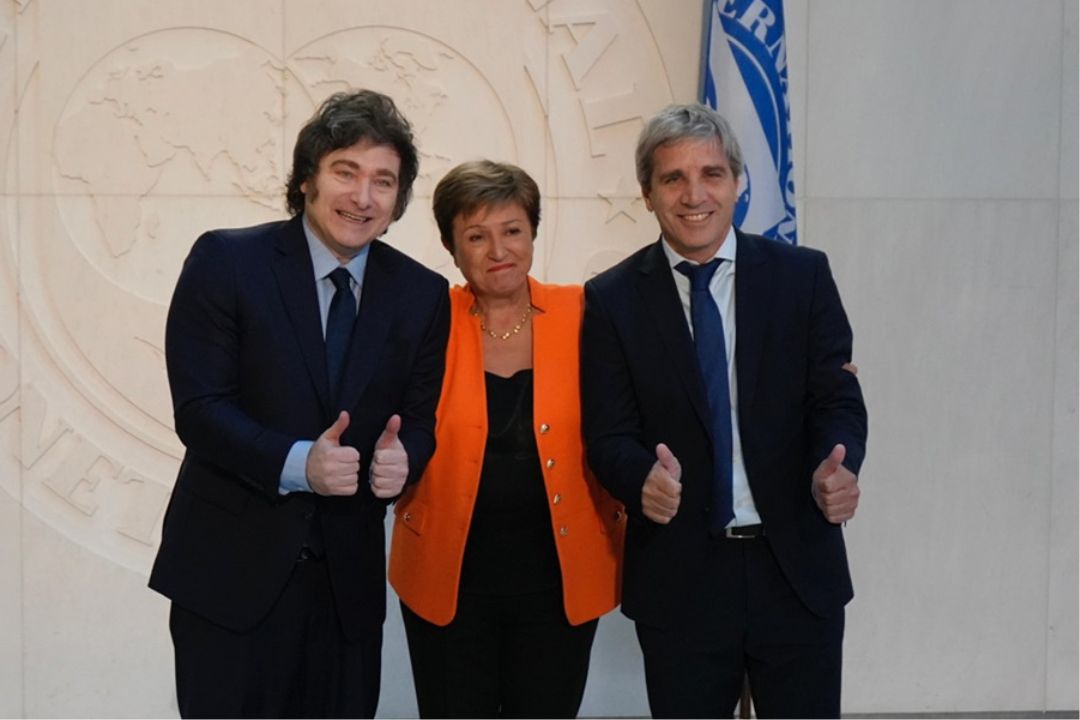
Finally, the IMF announced an agreement with the Argentine government last Friday. The agreement is for an amount of US$ 20 billion with an initial disbursement of US$ 12 billion, a review scheduled for June of this year and which logically, as with any agreement with the Fund, comes with a series of conditions that must be analyzed.
To begin with, the most important thing is that the agency imposed a devaluation of the peso through the scheme of price “bands” for the official dollar. The setting of a floor of $ 1000 and a ceiling of $ 1400 means that the official dollar, which on Friday closed at less than $ 1100, has a market margin, that is to say, of devaluation pressure to grow up to $ 1400, which means a devaluation of the national currency of around 30%.
Consequently, the relaxation of the currency restriction (and not its “elimination”, since there are still state control parameters) implies an austerity measure that will be transferred to all prices, goods and services of mass consumption, which will be felt as from tomorrow.
Inflation, which in March grew again to 3.7% (measured by INDEC), will surely take a leap again in the coming months.
In addition, the Central Bank announced measures to facilitate access to the dollar for importers and all restrictions are lifted so that large companies may remit profits (i.e., to flee dollars) to their parent companies abroad. Capitalist exporters are celebrating, since as from Friday they will be gaining 30% in pesos as a result of these measures when liquidating their dollars in the country. Importers will have lower costs in pesos due to the depreciation of the currency, and employers oriented to the domestic market will also receive a benefit, since wages will be drastically reduced as part of their production costs.
Taken as a whole, the measures imply as an immediate derivation:
● Potential devaluation in the order of 30%.
● Transfer of resources from the workers and popular sectors to the different segments of the capitalist class.
● A quality leap in the concentration of wealth in the 1% and proportionally a worsening of the misery of the majorities.
We are facing a new social plundering in favor of a neo-colonial agreement and a growth of national indebtedness for the benefit of the capitalist class of the country, imperialism and the IMF….
Milei-Caputo plan failed and now they are buying time
The government ended up begging for an agreement with the IMF because it was reaching a point of no return in economic matters, which is equivalent to saying that the Milei-Caputo plan failed. Let’s recap:
● In December 2023, the government announced a mega devaluation of 120%.
● Then, in order to keep the dollar anchored, they defined a devaluation rate lower than inflation, making access to the official dollar cheaper for speculators.
The importers achieved huge dividends by plundering the Central Bank’s reserves and at the same time the financial bicycle worked smoothly.
This logic, which was intended to be maintained without devaluation until after the elections due to the political cost of this measure, was not maintained.
It was the change of tendency of the national situation, starting with the massive action of February 1, added to the crypto-scam scandal, the setbacks of Bullrich and her protocol with the pensioners, plus the parliamentary blows and the huge rally on March 24, the national strike of March 9 and 10, unwillingly of the CGT but forceful, furthered the instability of the “markets”, which translated means capitalist distrust with the global course of the government’s plan and an unstoppable bleeding of the Central Bank’s squalid reserves. If something was missing in the combo of complications, the leap in international uncertainty as a result of Trump’s measures, with their marches and counter-marches, ended up precipitating the need to apply a new devaluation blow now, even with all its potential of derived instability.
The Milei-Caputo duo had no choice: with the disbursement of 12 billion it is betting on gaining time until after the elections, trying to avoid a bank run that would have been eventually considered if the agreement did not appear, since in order to maintain the dollar price until Friday and avoid a higher inflation rate, the government started to squander as a reserve part of the so-called bank reserves, which are nothing more than the monetary insurance of the banks’ deposits, that is to say: the savers’ money.
On the hour, the agreement with the IMF meant buying discount time.
The (not so) fine print of the subordination contract
The IMF stimulates the indebtedness of countries for an eminently political, imperialist and subjugation purpose. It is not exclusively a usurious lender: it is essentially an instrument of international financial capital, dominated by the US, to colonize the orientation of the countries.
The terms of this agreement and the strategy of the new loan are suggested in the Fund’s press release:
● Efforts will focus on strengthening labor market flexibility (…) and gradually opening up the economy.
● Improve the efficiency of the State and the discipline of public spending.
● Well-sequenced reforms of the tax, co-participation and pension systems.
● Boost the growth of the country’s vast energy and mining potential.
In short, what the IMF is demanding and Milei’s government has signed, is a road map that includes an attempt to deepen all the anti-worker and anti-popular things that have already begun, including more labor reform, more layoffs and state tightening, more tariff cuts, pension reform and appropriation of common goods with more extractivism.
Thus, once again, we are facing a de facto co-government of the Fund with the libertarian gang as a criminal association for national surrender.
Indispensable memory: eternal debt as a strategic consensus of all traditional politics
After some years of impasse, Argentina borrowed again from the Fund in 2018 and, since then, several agreements were renegotiated (Macri and Peronism included), but the leap of the huge mortgage for the country continued. The agreement that has just been signed has 10 years of extent, which added to the 7 that we have already had since 2018, are 17 years of IMF audits and social strangulation to finance capital flight and speculators’ business.
But in this, without going to the history of the debt that starts in the last genocidal dictatorship, we want to emphasize the shared complicities of all the traditional political arc in what we could call the “consensus of the eternal debt”.
A fact that could be anecdotal if it were not a recent proof of what we have pointed out: the Minister of Economy Luis Caputothanked during the announcement his economic team, which worked behind the agreement, mentioning among others Leonardo Macdur, who was Sergio Massa’s advisor and is now Argentina’s representative before the IMF.
It is true that it was Macri’s government that took a huge debt and squandered it by financing the flight as Cavallo-De la Rúa did in 2001. But it is no less true that the government of the Frente de Todos did not question the inherited debt, but validated it in Congress with an agreement managed by Martín Guzmán and that, among others, for example, the now “anti-right” candidate Leandro Santoro enthusiastically voted for.
And not only did they validate the Macrista inheritance, but also, according to Centro Cifra, under the government previous to Milei, almost 25 billion dollars were squandered by paying private debt of companies’ liabilities that requested cheap dollars from the Central Bank to face debt abroad (1).
All this happened under the government of Alberto – CFK – Massa and was not the subject of any investigation of any kind.
Let’s say it all: beyond declarative positions or inflammatory tweets, everyone pays, everyone admits submission to the Fund.
Obviously, with the sole and worthy exception of the left.
It is not enough to criticize Milei and the agreement with the IMF: it is necessary to raise the non-payment.
The payment of the debt and the conditions imposed by the IMF are incompatible with a solution for the country to overcome its structural crisis in favor of the rights of the popular majorities. The whole debt scheme, from its origin with Martínez de Hoz, passing through Alfonsín, the Austral Plan, Brady, the megacanje and the shielding with Cavallo-De La Rúa, the agreement with Macri and the present one, all constitute a huge swindle to the Argentine people. Because the debt never served to improve the life of the workers and the popular sectors, because the population was never consulted on what to do and because each government legitimized the embezzlement of the previous one by paying at the cost of austerity, backwardness and dependence or by taking even more debt.
This is a planned strangulation of our country’s economy in favor of an elite of bankers, importers and exporters who profit from this mechanism. In the meantime, the life of our people is degraded and the country is constantly plundered.
Thus, there is no more realistic way out than to put an end to this mechanism of theft.
It is then a matter of articulating a program of several simultaneous emergency measures :
● Declare unilateral moratorium on all debts with multilateral organizations and private banks.
● Promote a CONADEP of the debt: an Independent Investigation Commission based on the Olmos Case and Judge Ballesteros’ ruling in 2000 to update the illegality of the various loans (2). Subsequently, within a period of no more than 90 days, the results of this investigation should be made public without secrecy so that the people can eventually decide what to do through a binding popular consultation.
To convene an International Conference of the Peoples towards the formation of a Bloc or Front of debtor Countries willing to face non-payment before the credit organizations.
● To constitute a Foreign Exchange Fund for Economic Reactivation with those resources destined to a massive plan of public works to create real jobs on a large scale and a general increase in salaries, pensions and social programs.
● In parallel, establish the Nationalization of the Banking and Financial System to avoid the flight of foreign currency to tax havens of the big capitalists, and at the same time protect small savers. A single state bank that centralizes national resources and directs them to cheap credit for workers or middle sectors suffocated by debt.
● Also provide for the nationalization of foreign trade, abolishing the private oligopolistic control exercised today by a small group of agribusiness corporations. That the collective interest of the social majority defines what to buy and what to sell in terms of economic reconstruction in favor of the working class and the people.
Logically this alternative program to confront (and tackle) the eternal debt crisis has to be backed up with an extended process of collective debate and social mobilization in support of this orientation of independence and sovereignty.
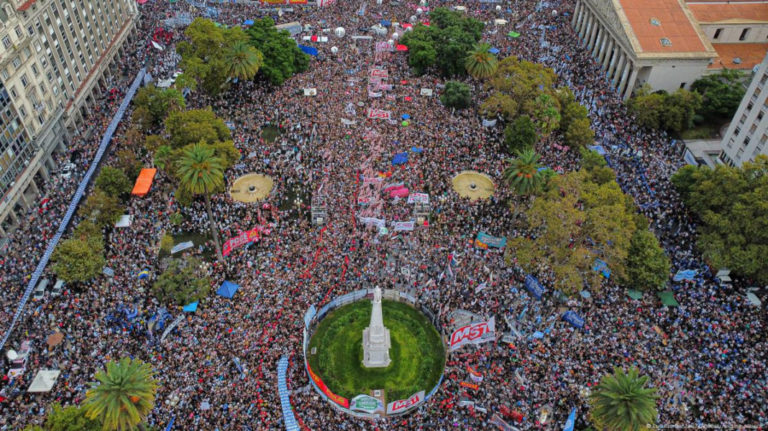
In our people there is an enormous accumulated reserve of social strength to face this challenge. In these 15 months of Milei’s government, every time that the workers’ federations (albeit at the wrong time, without organization or democratic debate and without continuity) called for a strike and mobilization, the response was overwhelming. But even without those leaderships and independently, there were also great demonstrations of force, such as on February 1, with the pensioners or on March 24.
We have no doubt that this is the perspective to emerge from the debacle to which the successive governments of the IMF and debt consensus have led us.
And finally we must understand that if the CGT or the CTA’s look the other way and continue to think like all Peronism in the distant 2027 we have to self-organize as a people from every factory or company, from every faculty or school, from every neighborhood and social collective to definitively say enough to this criminal outrage.
From the left we have the responsibility to contribute with all our strength in that direction.
Not paying is the way to go.
National Leadership of the MST
13/04/2025