Automatic translation made by AI.
By Mario Unda
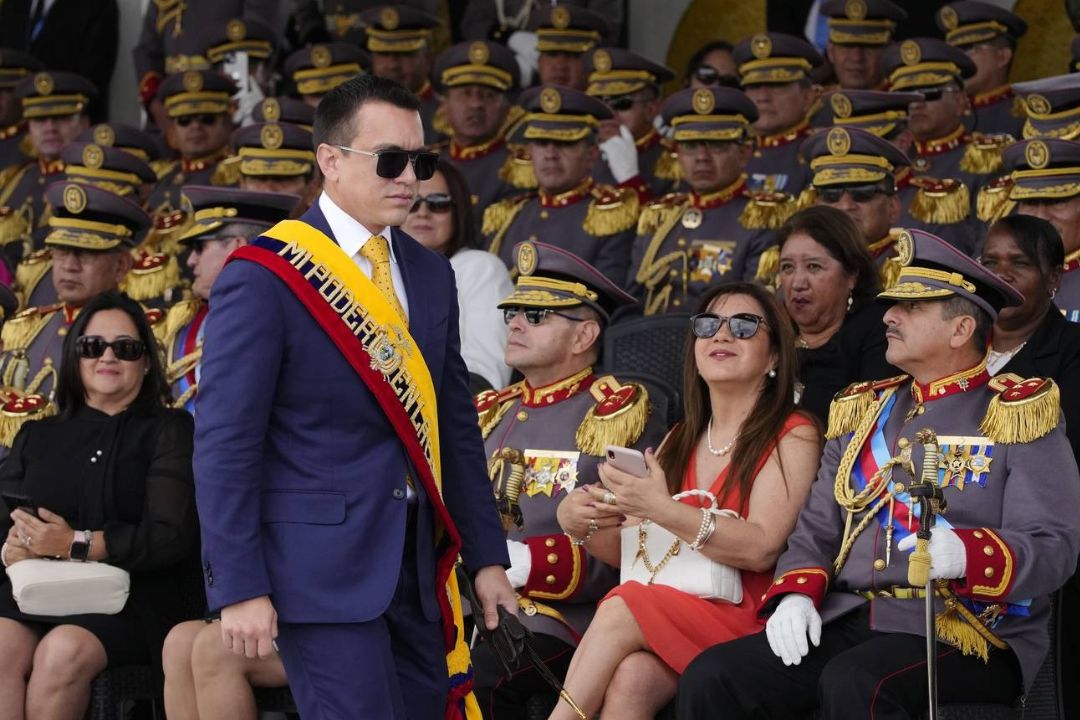
In January 2024, President Daniel Noboa declared the existence of an “internal armed conflict” and decreed a war against terrorist groups”, which at that time were groups linked to “international organized crime”: “I have ordered the armed forces to execute military operations to neutralize these groups”, he said, and identified more than 20 groups[1]. This discourse, in the face of a society frightened by the increase of violence and by the evidence of infiltration of the drug business in the armed forces, in the police and in judges and prosecutors, allowed him to increase his support among the population. In addition, by appropriating the polarization against progressivism and developing a clientelist electoral policy, she managed to triumph in the 2025 elections against the candidate of Correism.
Meanwhile, at the end of 2024 he signed a letter of intent with the International Monetary Fund, in which he offered to deepen the implementation of the neoliberal model and reinforce extractivism -and he has delivered.
On the other hand, since the beginning of his new mandate, in May 2025, he has enacted several agreements, decrees and laws, some of them trickily covered by the figure of “urgent economic projects” that seek to give legal cover to the economic model and the change of political regime.
The enactment of new states of emergency has accompanied this development, as well as the increase of 3 points in the VAT, arguing that these resources would be used to finance the “internal armed conflict”. However, official data show that violence, far from being controlled, has increased.
However, if the new laws are analyzed, a substantial modification can be observed. Until the beginning of his second term, he kept his discourse more or less unchanged, and the same was repeated in the recitals and justifications of laws such as the security law (approved in June 2025). The same month, just a few days later, the so-called “National Solidarity Law” was approved, which still claimed to focus on the fight against “organized crime groups”, but, from then on, the emphasis changed considerably.
Laws do not target “organized crime”.
The “Organic Law of Public Integrity”, which dates from the last week of June, is justified in the fight against corruption, but aims above all to generate the administrative mechanisms that make the dismissal of public workers viable, to make new jobs in the public sector and temporary contracts more precarious and to further limit the possibilities of organization of State workers.
The “Organic Law of Intelligence and Counterintelligence” and its regulations, also approved during those hurried first days of June, hardly mention “organized crime”, which only appears in one article. On the contrary, it is assured that the threats against the State vary constantly with the appearance of new actors and challenges in the political, social, economic, environmental, technological, criminal and structural spheres of the State”[2].
Further on, Articles 36 and 37 indicate that “intelligence and counterintelligence activities: are aimed at “detecting organizations, networks, groups or persons that constitute a threat or risk to the integral security of the State” or “intelligence operations”. Organizations, networks, groups, terms that are not usually used to refer to drug trafficking, but to the organizational spaces of the popular sectors. Even more so when it is made clear that these actors are “non-state agents”, without any further clarification.
The law and its regulations empower the “governing body” of intelligence and counterintelligence activities to follow and spy on social leaders and infiltrate organizations. It can also intercept communications without a warrant and monitor meetings.
Finally, Agreement 082 of the Ministry of Labor hides behind an apparent intention to enable the “exercise of the right to freedom and union autonomy”, but, in reality, its main objective is to attack union organizations. It establishes that a worker can only be a leader of his or her organization if he or she continues to work as an employee. With this, contrary to what is established in the current legislation, it is enough for the employers, public or private, to dismiss the leaders for the organization to be decapitated. But this provision is also an attack against the trade union centers, because in Ecuador, since the very beginning of the trade union movement, many organizations that are affiliated to the centers are not formed by salaried workers, but by small shopkeepers, peasants or inhabitants of working class neighborhoods.
The government and employers’ attack against workers and indigenous peoples
But the laws and agreements we have mentioned do not come alone, nor does the government’s actions remain confined to the legislative sphere, nor does it act alone: it does so in consonance with the big businessmen. In recent months, trade union organizations have denounced that a wave of layoffs has been unleashed in public and private companies, many of them against unionized leaders and workers.
But this is not something new: since the COVID 19 pandemic, with the misnamed “Humanitarian Support Law”, measures were established that attacked the stability of workers, allowed the reduction of income and attacked unionization and collective bargaining. These have been and continue to be the central points of the real program of the business associations and the right wing.
Indigenous peoples and peasant communities have also denounced the constant harassment they suffer from mining companies and the Noboa government, a solicitous defender of the interests of big capital. The axis of the conflict is found here in extractivism.
During this government, as in previous governments, oil and mining concessions continue to be granted in the territories of indigenous peoples and peasant communities; or, on the contrary, near water sources that feed various river networks that carry water to both agricultural areas and cities. Recently they have mainly affected the provinces of Bolivar and Azuay, where there have been struggles and social mobilizations.
Noboa’s government has made common cause with the mining and oil companies, sending police and military troops to conflict zones to dislodge protests. Moreover, a few days ago the president extended the state of exception to the province of Bolivar[3].
One more episode showed how the intelligence law works in practice. The Indigenous Movement of Cotopaxi denounced days ago that undercover police had made an attempt on the life of Leonidas Iza, former president of Conaie. The policemen were detained by the community, and, in the trial before the community assembly, they admitted that they were following Iza; the chats on their cell phones showed that the spying and infiltration is being carried out against several of the main popular organizations. “Leaders of the FEUE, FUT, UNE, Socialist party and others would be victims of espionage by the government”, says a journalistic note[4].
In effect, the government claims to be waging war against “organized crime groups” but, in reality, it is targeting popular movements, especially indigenous people and workers, while we have become one of the most violent countries in the world.
Quito, August 27, 2025
[1] https://www.bbc.com/mundo/articles/c3gy2zz03dpo.
[2] Organic Law of Intelligence and Counterintelligence, Article 5.
[3] https://www.primicias.ec/seguridad/presidente-noboa-estado-excepcion-cantones-bolivar-cotopaxi-103357/.
[4] https://www.radiopichincha.com/dirigentes-victimas-espionaje-gobierno/?fbclid=IwdGRzaAMcRlRjbGNrAxxF_GV4dG4DYWVtAjExAAEeZtLtuRbqspt4JcFdicQaeXvCEOicRcQab1cut-gXTCCWlmJXRyIbHFjU7CE_aem_4mu_mAiG4d-zB1jz0pqawg&sfnsn=wa.