By: Unidad Obrera y Socialista ¡UNÍOS! ! – National Leadership
https://eltrabajadorsocialista.org/
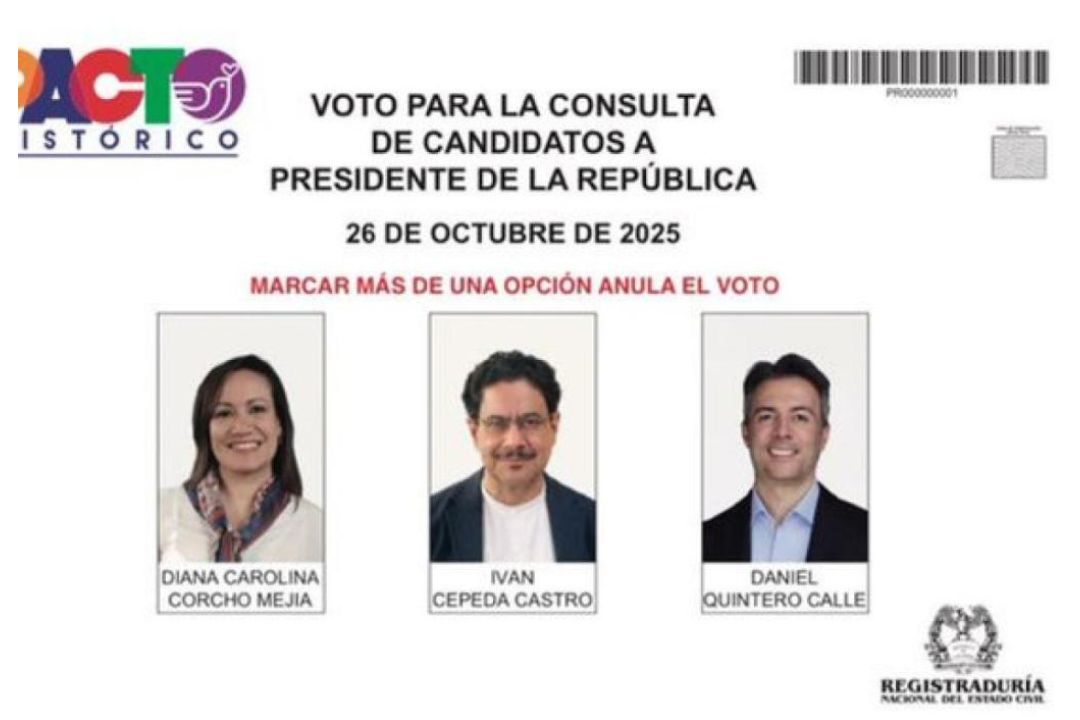
Next Sunday, the consultation of the Historical Pact will be held to choose its pre-candidate for a possible consultation with other parties on March 8, 2026, in which the presidential candidate of the so-called Broad Front will be chosen. After twists and turns, ideas and comings and goings, legal arguments left and right, confrontations with the National Electoral Council and a complex and deaf internal struggle, of the more than 10 pre-candidates that came to the arena at the beginning, only two were left for whom a vote will be cast: Iván Cepeda and Carolina Corcho. Some distracted voter may check the box of Daniel Quintero, who withdrew the previous week. It is not clear if those votes for Quintero will be counted or if his withdrawal disqualifies him from running in March 2026.
A momentous event for “democracy”?
In a loud voice, in public square and dozens of times in his X account, President Petro has tried to convince that the consultation on the 26th is one of the greatest events of the so-called “democracy” and that citizens, all of them, should go to the polls. Those who believe the story are naive.
Of course, for those who share the program, strategy and policy proposals of the Historical Pact and have actively supported Petro’s government, the issue is important, even if it has been deflated by the reduction to only two options.
However, it is not democratic at all, in the end, that political forces or movements with a different program, strategy and policies have the possibility of influencing the internal life of another organization, in this case, the Pact. Such was the situation, denounced by members of the same Pact, regarding Daniel Quintero who was pointed out as a “Trojan horse”, not recognizing him as having sufficient credentials to be a participant in this consultation.
Daniel Quintero, opportunist to the core, was pushed, promoted, catapulted to participate in this consultation by Petro himself; which shows that the strategy of the Pact, determined by Petro, continues and will continue to be the same: to ally even with the devil to continue controlling the Executive or, at least, in a coalition with other rotten fringes of traditional politics, after 2026 to continue having a slice of the government apparatus.
Risky bet
The Pact and Petro ended up making a risky bet with the consultation on the 26th. An important group of organizations that support the government, that have been part of the Pact (which still, due to legal loopholes, is not a party but an agreement of parties) decided not to be part of the consultation and go directly to the inter-party on March 8, 2026. Will these forces call their followers to vote this 26th? Will their followers spontaneously do so? The deflation of the consultation, at least regarding the presidential pre-candidate, may cause the motivation to go to the polls on the 26th to decrease substantially.
The tangles of the consultation have not only depended on the obstacles that the National Electoral Council has placed on legal grounds. In the words of Jorge Rojas, former director of Dapre and member of Colombia Humana, “It is not only the National Electoral Council. Within the parties of the Pact we gave papaya, as they say colloquially, and the CNE is doing everything to prevent this process from ending well. That is why the consultation became a problem, even for the left“(El caos en la consulta del Pacto quiebra el plan de Petro para el 26 – La Silla Vacía).
No doubt part of the initial calculation was that a massive turnout (more than 2 million voters) would mean a juicy sum of money (up to 5 billion pesos or more) to finance the 2026 parliamentary and presidential campaign. But, more importantly, a massive turnout could be valued as a referendum favorable to the government, its plans and an endorsement of its continuity. But if this does not happen, what will be the magnitude of the blow to the government, which is already at its end, if the turnout is low? The attrition, disillusionment and uncertainty that exists before the government, among many of those who supported Petro in 2022, will be greater.
Why is what is important unimportant?
What is very important for many, especially for Petro and the Historic Pact, is actually quite inconsequential. In its essence, in program and strategy, there is no difference between Iván Cepeda Castro and Carolina Corcho. Neither was there any essential difference when the range was more than a dozen or when Daniel Quintero was there. Those who tried to present themselves in no essential way differed from Petro. Petro may be louder, more boisterous, more boisterous than Iván Cepeda who appears to be colder, more calculating and reflexive; or than Carolina Corcho, who has another “style”. But in essence, in what is of fundamental interest to the workers, to the revolutionaries, the three of them -and all those who previously competed in the consultation and withdrew from it- defend the structure of capitalist society, advocating only a few changes and tweaks.
Should we, the revolutionary organizations, who raise on high another strategy, another program, who claim the struggle for another radical and completely different society, promote, participate or call to vote for any of the candidates in the referendum? We are sure that we should not. It is a disservice to the conscience of the workers to call on them to be the caboose of the proposals and policies of reformism in order to maintain its political influence.
We have raised, for decades, an electoral policy that has as its essence class independence. It means that we call on the workers to recognize themselves politically in a manner independent of both the bourgeoisie and the parties of the petty bourgeoisie. To join the consultation, becoming part of it, as the Socialist Workers Party -PST-C-[i] does, means renouncing this essential criterion of the electoral political participation of revolutionary socialism.
Revolutionary electoral participation is possible
Multiple revolutionary organizations have vindicated our political independence with respect to the current government. We do not oppose the few progressive measures that have been able to be concretized, but we have pointed out their profound limitations due to Petro’s compromises with sectors of the bourgeoisie that have acted as a straitjacket against any reform that has any radicalism. And the main obstacle has been to subordinate himself to the institutions of the authoritarian Colombian political regime, among them the anti-democratic norms of the electoral code and the parliamentary procedures, minefields for achieving social conquests.
In the next elections we have the possibility of presenting a truly revolutionary alternative. Organizations such as the Congress of the Peoples, the Independent National Popular Assembly (ANPI) and other spaces of coordination of social struggles, such as the Coordinators of Solidarity (Cosol) and the National Social and Popular Trade Union Coordinating Committee (CNSSP) could call for a National Workers’, Peasant, Youth and Popular Meeting and there democratically define an electoral formula that represents the struggles of resistance that we continue to wage every day from the factories, the mines, the fields, the native communities, the neighborhoods, schools, colleges and universities.
From that space we could demand the right to present these independent candidacies. Being faithful to the historic experience of the working class we could use the campaign to agitate for a program of real structural changes to Colombian society, a program opposed by the apex of the reformist program of the Historic Pact or the future Broad Front. A program to eliminate private property of the means of production, to put them under the control of the workers and the poor; for the revolutionary destruction of the narco-paramilitary regime with which our society is oppressed and controlled in blood and fire, and to establish a government of the workers, the poor peasants, the native communities and the popular sectors; not a government of coalition between strips of petty-bourgeois opportunist politicians and characters coming from the most rotten traditional politicking like the one presided over by Gustavo Petro. That revolutionary government must overcome the unforeseen ups and downs of a messianic caudillo and base itself on the power of the trade union, social and popular organizations, the strength of their mobilization and the general armament of the population to defeat in the streets Uribism and the ultra-right that continues assassinating social leaders and attacking social protest. In synthesis, a program and a government for the unpostponable Colombian socialist revolution.
Bogota, Medellin, October 19, 2025
[i] See his editorial For the definitive defeat of Uribism, this October 26, critical vote for Iván Cepeda – PST-Colombia