By: Alberto Giovanelli
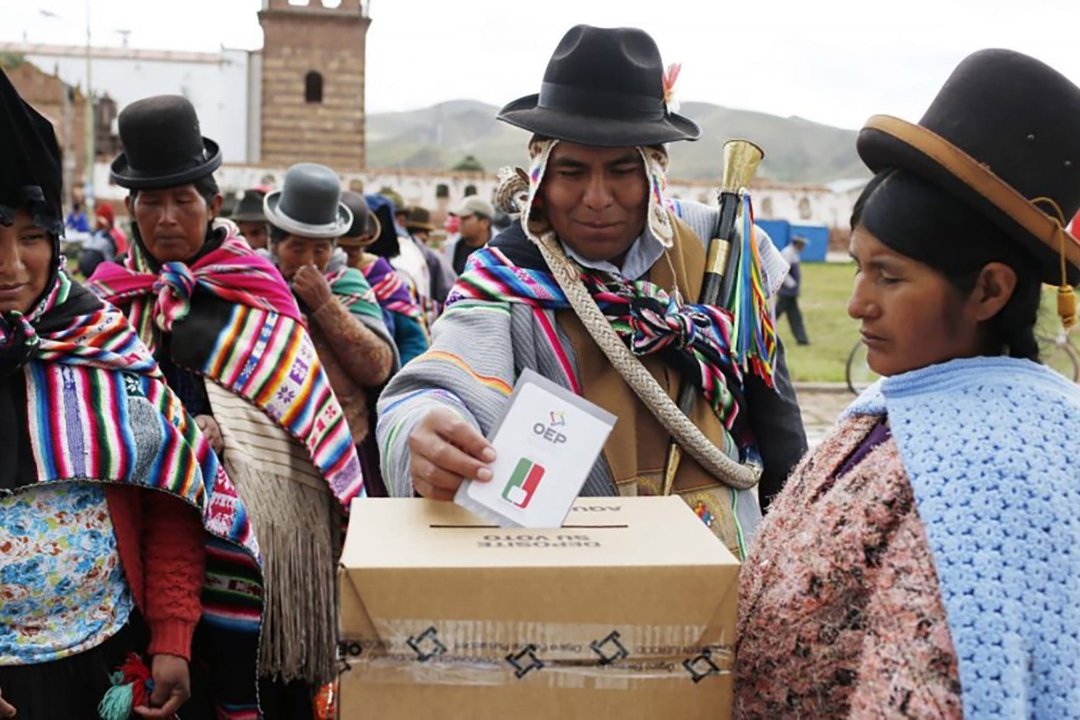
Rodrigo Paz Pereira, 57 years old and right-wing senator, was elected president of Bolivia with 54.55% of the votes, after a campaign in which he presented himself as a moderate leader close to the citizens. Son of former president Jaime Paz Zamora, his history combines political lineage, international education and a life of exile and militancy. Trained as an economist and graduate in International Relations, he obtained a master’s degree in Economic Management and presented himself throughout the campaign as an alternative to the ultra-right-wing Jorge Quiroga, and bet on a more moderate message, of proximity to the people, prioritizing dialogue and institutional reconstruction. His speech appealed to an orderly transition, capable of gathering support from different sectors, including former voters of the Movimiento al Socialismo (MAS), who were looking for a change without radical fractures.
With his election, Bolivia begins a new stage in which Paz promises national reconciliation, sustainable growth and openness to dialogue, to push through the anti-popular adjustment that he will inevitably try to implement. The election also marks the end of two decades of MAS government, led by Evo Morales, and ratifies once again that the impotence of progressivism opens the door to the right wing.
The result expresses a rejection not only to the Movimiento al Socialismo (MAS) and the government of Arce (Morales’ successor), but also to the old neoliberal figures. This rejection was expressed by promoting the figure of Captain Lara, elected vice-president, a former captain who was dismissed from the police force and discharged for denouncing cases of corruption in the high command. This gained him popular sympathy because the population is going through a moment in which the bulk of the population has a deep distrust of the judicial apparatus and the repressive apparatus of the State, such as the police and the armed forces. Lara managed to capitalize on this popular discontent not only with the government, but also with the formations of the old right wing.
In addition, the electoral campaign carried out by Paz and Lara had some particularities worth mentioning: First, the focus of their campaign was not on the adjustment promised by all the right-wing formulas in Latin America. That is to say, although evidently they had to refer to the need to reform the State, to shrink the State, etc., the truth is that in order to achieve the support of vast popular sectors, particularly in the highlands, they had to do it on the basis of promising salary increases, pension increases and the maintenance of the bonuses that were established by Evismo, the social bonuses, promises that sooner rather than later they will inexorably fail to keep due to the crisis of the Bolivian economy.Second, they made a more conservative and less renovating campaign, saying we are going to preserve this, we are going to preserve that, which we have to see what will happen if they do not comply.
Third, and this is an interesting fact, while practically all the candidates bet on social networks as a mechanism to boost the electoral campaign, Rodrigo Paz, bet on dispensing with the networks and concentrating his campaign on a territorial work, seeking agreements, talking directly with the peasant communities and the popular sectors of the altiplano.While everybody was betting on the social networks, the elected candidate bet on something that was the old way of doing politics, going to look for direct contact, man to man, person to person and try to see what agreements could be made, what promises could be made and from there she managed to conquer a great part of the electoral base of MAS. And we could add one last element to explain the triumph of Paz and Lara. One or two days before the elections, Evo Morales in a meeting of leaders of his faction in the Chapare and when faced with the doubts of several leaders to vote null, Evo, under pressure, responded by saying that if one did not want to vote null, one could vote for Captain Lara who was going to campaign against corruption, etcetera.
The elections showed the deep crisis of the political project of Evo Morales, which at the time generated many discussions, much controversy on the left. After 20 years of successive MAS governments, including in the middle a never fully clarified crisis in 2019, this crisis has arrived.
The MAS hegemony was already strongly questioned since the 2019 coup. The crisis opened with the water war and a series of national uprisings that went on for years and closed also with the street actions, in this case by the armed forces and the police in November 2019.
These events already highlighted the failure of the progressive project. That is to say, at the beginning, we are talking about two decades ago, both Álvaro García Linera, Evo Morales, and the entire staff of the Movement towards Socialism at that time, affirmed as a political objective to advance in overcoming historical defects of Bolivian society, such as the exclusion of political participation and participation in the state apparatus of large indigenous majorities, mainly Aimaras, Quechuas and Tupi-Guaraníes. Then, the project of the MAS General Staff was to advance in a series of constitutional and institutional reforms, of an inclusive democratic nature, which would allow overcoming all this, such as, for example, the structural organic racism that Bolivian society lives and has.
The year 2019 showed that all these objectives had not only not been achieved, but were far from being fulfilled. On the contrary, an increasingly authoritarian project was deepened by the Arce government, which swept away and dismantled the democratic concessions that had been established in the previous 20 years. The logic of convincing the dominant classes to show more solidarity did not work either. Both Arce and Morales based all national policy on an attempt to reach agreements and consensus with the agro-industrial mining sectors for these reforms.
The MAS crisis became even more explicit when Arce and Morales strongly confronted each other for the leadership of a party already in regression and in confrontation with numerous popular sectors. These reasons are some of those that allow us to explain the triumph of Paz and Lara, supported fundamentally by the electoral base of the MAS.
The new government faces a complicated scenario. There is an economic crisis that offers no way out within the framework of Bolivian capitalism, an inflation that is growing more and more and a situation in which the popular sectors continue to agitate. We are not talking about popular sectors that come from systematic defeats or that come from suffering great defeats, quite the contrary. We are talking about a mass movement that overcame the crisis of 2019 and it is that mass movement that is beginning to mobilize again today product of the economic crisis and the political crisis. That mass movement is the one that gave a large part of the vote to Paz and Lara. So, that is a problem, it is a contradiction that the new government will have to face because it is very difficult to carry out an adjustment plan against a social base that has just brought it to the government on the basis of electoral promises that it will not be able to fulfill.
That is why in this scenario the regroupment and organization of revolutionaries is indispensable to put up a definitive fight against Bolivian capitalism, the construction of a class, revolutionary, anti-capitalist and socialist alternative is imperative in Bolivia, and from the International Socialist League we commit our efforts behind this unpostponable objective.