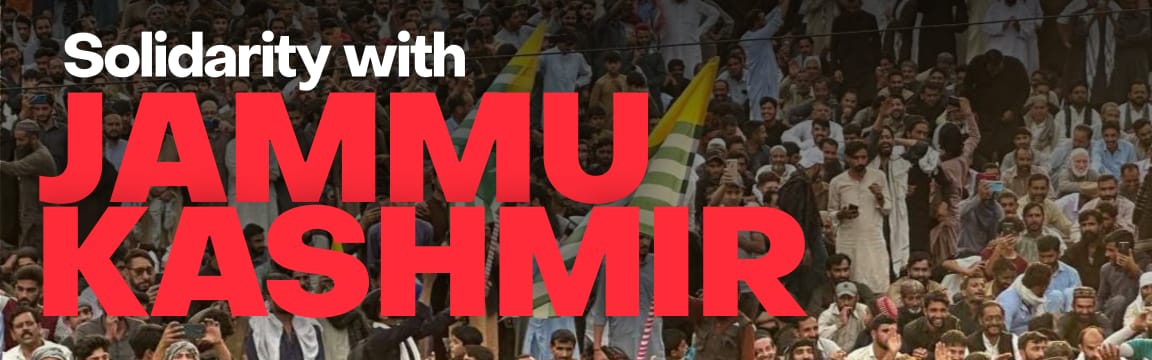
The British colonial domination over the Indian subcontinent took the form of direct rule over the territories of British India, and indirect rule over 565 princely states and feudal estates. Jammu Kashmir was one of these princely states. Its existence was established through coercive occupation of Jammu, Ladakh, Gilgit–Baltistan, Poonch, and the Kashmir Valley, as a result of an 1846 agreement (the Treaty of Amritsar) between the British Empire and its loyal Dogra dynasty.
At the time of the imperialist, religious-based partition of the subcontinent in 1947, the other princely states were gradually incorporated into the two newly created states, Pakistan and India, without consulting the will or consent of their populations. However, due to armed and popular uprisings against autocratic rule in various regions of Jammu Kashmir, and due to the expansionist ambitions of Pakistan and India, the region was divided into two parts after the first India–Pakistan war. To this day, the peoples living in Jammu Kashmir have not been granted the right to decide their own future.
At present, Pakistan and India exercise complete control over Jammu Kashmir, while China lays claim to certain areas. Internationally, the issue of Jammu Kashmir is portrayed as a territorial dispute between Pakistan and India. For more than seven decades, both states have repeatedly exploited this issue to whip up religio-nationalist war hysteria, suppress mass movements, and divert the attention of their working people from their real problems and the burning class antagonisms within their societies. But the Jammu Kashmir conflict is not a territorial dispute between Pakistan, India and China; it is fundamentally a question of the right to self-determination of nearly twenty million people belonging to five major nationalities and cultures living in Jammu Kashmir. We demand the full withdrawal of all occupying forces from Jammu Kashmir, and the granting of an unconditional and unrestricted right to self-determination—including the right to secession—to the peoples of the Kashmir Valley, Gilgit–Baltistan, Ladakh, Jammu and Pir Panjal.
A free, independent, secular, socialist Jammu Kashmir—based on a voluntary federation of all its nationalities—is the only solution that can liberate the peoples of this region from slavery and exploitation.
Adopted by the III World Congress of the ISL