By Jette Kromann – Denmark
What is the US’s main interest in owning Greenland?
While parts of the left have long mistakenly claimed that the US’s main motive for claiming Greenland was control of the country’s raw materials, this is linked to the fact that they do not consider China (and/or Russia) to be imperialists and therefore cannot see US imperialism’s motive for wanting to own Greenland as primarily motivated by rivalry with imperialist China. After the US’s brutal attack on Venezuela and threats against several countries in Latin and Central America where China is economically well established, Trump has openly declared his doctrine: the US must dominate the Western Hemisphere. Not as a more permanent division of the world’s countries and peoples between China (and Russia) and US imperial power, but as the US securing a more favorable position in a later, possible final showdown for world dominance vis-à-vis China. This has become even more relevant after Trump’s failed attempt to pull Russia away from China in the negotiations with Russia over Ukraine. Putin has proven to be unshakeable.
When the US makes claims to Greenland based on geopolitical considerations, this is nothing new. What is new is the heightened international polarization between the US and China/Russia, as well as the US president’s imperialistic, internalized personality traits. As he himself put it in a recent interview with the New York Times: “I feel that it is psychologically necessary to succeed. Ownership gives you something you can’t get if you talk about leasing or a treaty.”
Unlike Venezuela and several other Latin American countries, which are now also facing threatening aggression from the US, neither China nor Russia currently has any economic influence or presence in Greenland – not to mention a military presence. In 2019, the US pressured the other participants in the Arctic Council to prevent Chinese and Russian interests from establishing themselves in Greenland. Since then, China has focused on the Russian Arctic. With the realization of a future increase in Greenland’s national independence, this situation would certainly change. This possible prospect is another motive for the US’s demands. And with the climate crisis opening up previously frozen Arctic waters and coastal areas – the Arctic Ocean is melting – more transport routes are being opened up and potential mining areas exposed along the coasts.
Militarily, the US dominates the country without restriction and has done so continuously and unhindered since the beginning of World War II. At the same time, they have reduced their number of bases and troops in favor of military missile surveillance.
Military takeover?
Militarily, the US already has full control of Greenland. An actual military occupation would mean full takeover of the country’s state apparatus. The small imperialist Danish state is militarily a small subsidiary of US imperialism. Today, Greenland has formal self-government when it comes to local affairs. Greenland has the status of a Danish region/municipality, with a completely inadequate Danish economic contribution and without its own overall foreign policy and other state power. Of course, neither Denmark nor Greenland is in any way capable of resisting a military attack from the world’s strongest imperialist power.
European imperialism under severe pressure
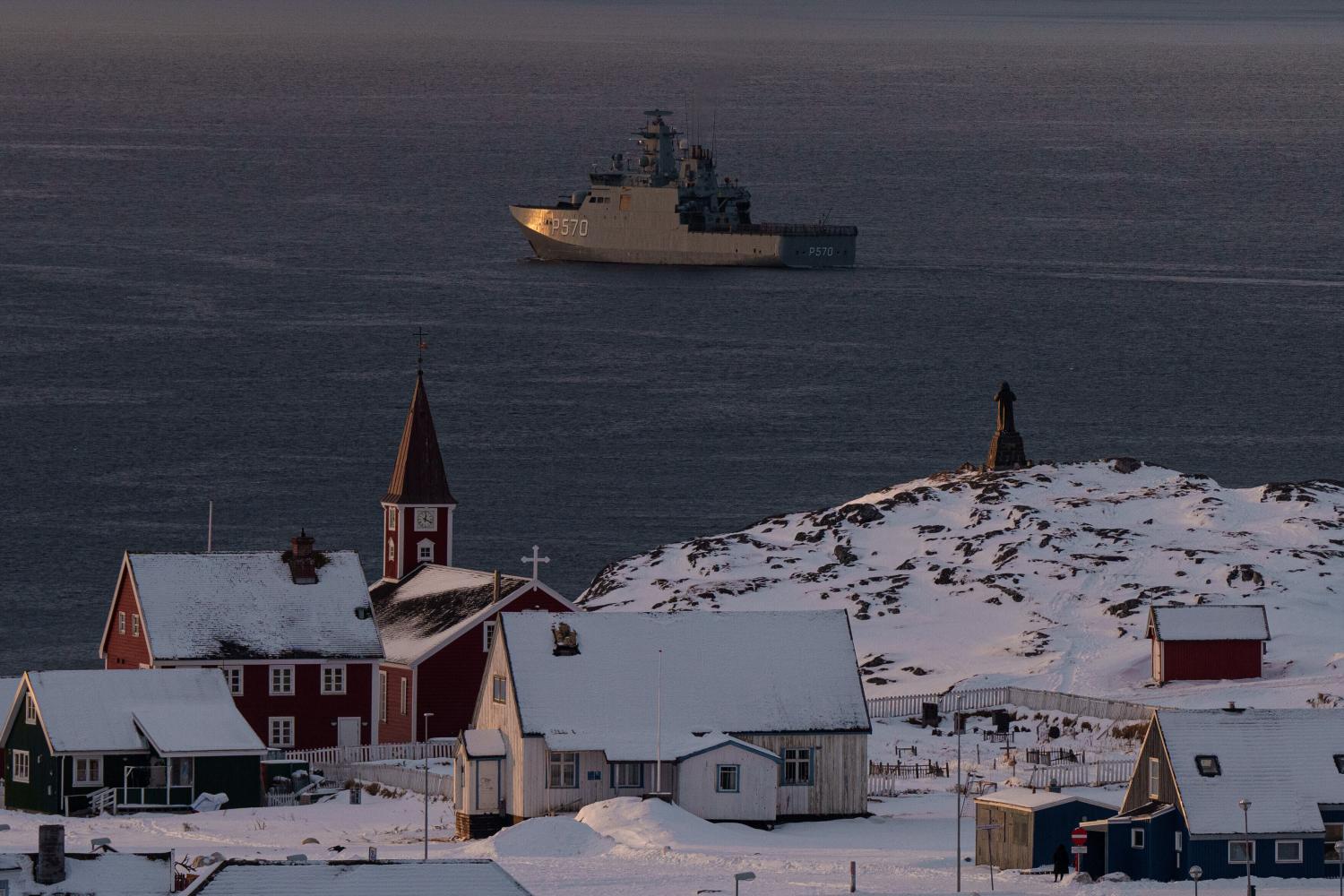
Opposing US imperialist aggression are the imperialist powers of the EU and their interests. With continued Danish imperialist colonial power over Greenland and Greenland’s own affiliation with NATO, the US demand to own Greenland becomes a direct attack on Europe’s imperialist powers/the EU and their NATO membership. The relationship between the US and the EU in NATO is already in deep crisis under US attack. A US military takeover of Greenland opens up a rift between the EU and the US over NATO. The seriousness with which European imperialist interests are considered threatened can be seen, for example, in the Swedish and French offers of troops to Greenland, and Denmark and the EU will double their investments in the coming period. The imperialist European states have feverishly expressed their support for the Danish “Rigsfællesskab” (Danish colonialism) – and Greenland. But they are powerless against the US in the crossfire between their dependence on the US and their own interests. The question is whether the US will ultimately risk the relationship between Europe and the US in NATO by militarily occupying and taking over Greenland. The question is whether an economic takeover would not be preferable.
An economic takeover?
An economic takeover would be completely without risk to NATO and could involve a mixture of direct individual economic “gifts” with a comprehensive US-owned economy. And this would be directed at an Inuit population that is in a well-founded state of opposition to the continued colonial arrogance of Denmark and which suffers from sky-high youth unemployment among young people, many of whom have no education, and an Inuit-population that suffers from widespread general poverty. The country is economically underdeveloped and deeply marked by Danish colonialism, which has hindered the necessary economic accumulation required for any country’s economic development. Currently, there is talk in the US of a possible so-called COFA agreement (Compact of Free Association) – an association agreement with modest financial support from US imperialism – and formal national self-determination – cultural dominance and massive military supremacy.
According to Google’s AI response, COFA is “…a treaty between the United States and three independent Pacific nations: Micronesia (FSM), the Marshall Islands (RMI), and Palau (ROP), which guarantees the US military access to strategic areas and gives citizens of these islands the right to live, work, and study in the US in exchange for financial support and US defense. These agreements give the US exclusive military access and give COFA citizens access to certain US programs and job opportunities.”
On January 14, 2026, a meeting was held at the foreign minister level between Denmark, Greenland, and the US without any conclusion, but with an agreement to continue meetings. Perhaps a COFA agreement or something similar will become a topic of discussion?
Crisis in relations with the Danish colonial power
The US demand comes at a time of growing desire for national self-determination. The US demand has been met with the largest protest demonstrations in Greenland’s history, and in a recent survey, over 80% expressed their opposition (Danish settlers are included in the survey). At the same time, there is a growing crisis in the relationship between Greenland and the Danish Social Democratic-led majority government. Here are just two examples of the continuation of old colonial Danish abuses against the Greenlandic Inuit population. These examples have once again shown the Greenlandic population – and now also the public in Denmark – how destructive Danish colonial policy has been and how little the Danish colonial power has fundamentally changed its colonial imperialist class character.
The first case came to light four to five years ago. Without the parents’ consent, the Danish authorities had adopted Inuit children to Danish families in Denmark, where they were deprived of their language and contact with their Inuit parents. The colonial rulers’ plan was that these children should be raised to be Danish and, as adults, should form a future Danish-oriented elite in Greenland. The few of these children who survived this brutal removal from their parents, language, and environment, now in their 70s and 80s, had to sue the Danish state to force it to provide financial compensation and an official apology. Many of these children committed suicide or became alcoholics as adults. Only a few finally received this symbolic compensation for a ruined life after a court case.
The second example of violent abuse took place over many years throughout the 1960s and 1970s. Greenland’s former Prime Minister, Múte B. Egede, describes it as genocide. Without the knowledge of young schoolgirls – some as young as 13 – about what was happening, they were ordered to the doctor to have IUDs inserted to prevent them from becoming pregnant, in order to prevent what the Danish colonial rulers considered to be unwanted population growth. This took place under the auspices of the Danish health service, with all cases being registered – 4,500 girls and very young women. Many only discovered what they had been subjected to many years later. Many were ill for years because of the large, primitive IUDs used at the time on young, frail girls and women. Often, the IUDs were only discovered when, after years of trying, they were unable to become pregnant as adults and underwent thorough examinations. Chronic illness and childlessness were the result for many. It is symptomatic of the continuing Danish imperialist arrogance that it has been necessary for these women – 143 women, now very old – to sue the Danish state in order to have their suffering recognized, receive financial compensation and an official apology.
It is obvious what suffering these abuses have caused for the individuals concerned. But there is also great social suffering, grief, and suppression of personal development and community growth when large groups of young people in very small communities are so brutally removed and sexually abused by the state.
Currently, the Danish Parliament has once again demonstrated its colonial arrogance by rejecting simultaneous interpretation from Greenlandic to Danish when the Greenlandic political representative wishes to speak Greenlandic in the Danish Parliament. This means that a large majority of the Inuit population, who do not speak or understand Danish, cannot understand what their representative is saying in the Danish Parliament. The argument in the Danish Parliament was financial—it would cost a (very modest) amount to provide simultaneous interpretation—and deeply embarrassing arrogance: “Well, we know that the person in question speaks Danish.”
The Inuit’s right and demand for national self-determination
As revolutionary socialists, we support the Inuit people’s full right to national self-determination, including a complete break with Danish colonial power. The latest ‘Landsstyre’ (local council) election in Greenland in April 2025 confirmed the massive popular desire for increased national self-determination with almost unanimous support for the demand – sooner or later. Many on the left have highlighted the country’s great natural wealth. Could this be part of the answer to an economic basis for an independent Greenland? It could be, under certain specific political conditions.
There are some special circumstances surrounding Greenland’s mineral wealth. The country’s subsoil legally belongs to the Inuit – the Greenlandic population. This means that there is no private ownership of the land. It belongs to the community. Under greater national independence, there is therefore, at least formally, every opportunity for the extraction of these resources to benefit the population. This includes both the entire population and the local population, which would inevitably suffer to some extent from the necessary encroachment on the natural environment surrounding a mine. Any local residents – if there are any – could benefit from the necessary new infrastructure in the form of ports, roads, power supply, airports, etc. The second special circumstance surrounding mining is that a political decision has been made in Greenland not to allow mining if a by-product is radioactive material, which is in fact the case for a large proportion of the raw materials. This decision was made in consideration of the irreversible damage to nature that radioactive waste will inevitably cause. This ban illustrates the indigenous Inuit people’s concern for protecting the fragile Arctic environment and is fully in line with the revolutionary socialist perspective on environmental and climate protection.
Most Inuit do not want to and cannot work underground in traditional mining, but want to maintain their freer fishing and hunting occupations. Therefore, the choice is either between the unacceptable use of fly-in, fly-out labor or the use of the most advanced robot technologies with relevant training programs for Inuit as the controlling part of the high-tech work processes. How does this relate to the political conditions for progressive exploitation of natural resources in accordance with the wishes of the indigenous Inuit people? Realizing such a policy in the interests of the population is completely incompatible with any form of imperialist power – American, Danish, Chinese, Russian, Canadian (etc.) imperialist-controlled mining would in any case only lead to the theft of resources and the destruction of people and nature. Progressive development, on the other hand, requires the control and social power of the entire Inuit population. Translated into political language, this means a socialist revolution based on the councils of workers, hunters, and fishermen—of the Inuit population and their descendants of mixed Inuit-Danish ethnicity. (All privileged people are largely Danish colonists – permanent or temporary residents).
But for the indigenous Inuit people, the struggle today is primarily about resolving the national question—to realize the right to national self-determination and to choose the best path in that direction in a situation where superior forces threaten from several sides. In countries where there has been no experience of the right to a fully-fledged national civil democratic parliament – as in Greenland – constitutional committees can be set up to prepare for the adoption of a genuine popular constitution for the nation’s new state. The Inuit people have never had this opportunity, but they can express their will by using this radically democratic expression of their collective will. Even though a population of 56,000 does not constitute the material basis for the formation of a truly independent state, this does not mean that independence cannot be achieved, for example through the right basis for a federation. This could be in cooperation with other Arctic Inuit peoples or in some other way. As the situation stands right now, the elected parliamentarians in Greenland are under a lot of pressure. One of the political parties in Greenland (with 26% of the vote) has a clear neoliberal policy and is pushing for an immediate break with Danish colonialism – and for ties with the US. So even though all the political parties agree that “only Greenlanders should decide the future of the country,” the possible formal realization of this does not in any way automatically imply real independence for the majority of the population. But what will politicians do when the US/Trump presents them with the “choice” between accepting what may appear to be generous economic offers and formal independence or military intervention? It is not the best security to leave the future of the Inuit people in the hands of a few parliamentarians who are limited in their political maneuvering.
It is quite different for the Inuit people themselves. That is, if they are not left to the unbearable pressure of individual atomization, which will inevitably divide and atomize them in a situation that absolutely requires collective solidarity. It is quite another matter if the collective people are given the opportunity to choose together the most radical bourgeois democratic course for society and their constitution. What does that mean? At no point have the Inuit people had the opportunity to decide how they want their society to be organized. How can the various sectors of society be developed in the interests of the people in an overall, coherent social plan for the benefit of people and the environment? How should economic property rights be organized when it comes to society’s resources, and how should they be developed? How can the population be guaranteed health, education, work, a secure old age, women’s and LGBTQ+ rights, good conditions for people with disabilities, and control over consumer prices? Should the population, many of whom are accustomed to using firearms for hunting, be armed and organized into a locally based national self-defense force? And, not least, how can the population ensure continued control of society after the constitution has been adopted? In the process, the constitutional committees must be able to make use of the knowledge of sympathetic experts – with a clear awareness that these experts must not be allowed to take control of the process.
How can such an organization of the entire Inuit people in constitutional committees throughout the country in all settlements be a protection against imperialist aggression? A population capable of formulating its collective social interests—a self-formulating collective – becomes self-aware and resilient in a fundamentally and completely different way than an individual, atomized population left alone, individually, to the swarm of economically based manipulations that the US will unfold in the near future through all media. An organized popular collective will also support their parliamentarily elected representatives to the extent that they agree to build on the organized strength and will of the people, and will thus politically sort these politicians for the population.
One might object: But can such popular constitutional committees really implement a radical democratic constitution under the current conditions? It is far from certain, but it is not absolutely impossible either. In any case, an organized population will be optimally equipped to resist any external pressure. Furthermore, the possibility of implementation also depends on the ripple effect that could be achieved—including on other Arctic peoples spread across a wide band of the Arctic—the United States, Canada, and Russia. In particular, it depends on whether a politically relevant leadership emerges – a revolutionary socialist Inuit leadership that fully understands the profound revolutionary significance of the national question – and does not succumb to bourgeois nationalism, and which can win the trust of the populations. The Inuit people have been subjected to violent oppression throughout their history. The Inuit have been met with a deadly, undermining racism for decades. This applies not least to the Inuit citizens who reside permanently or temporarily in Denmark. They and their interests must be sought to be included and taken care of. Like all indigenous peoples who have endured hardship, the Inuit need a popular experience that affirms their own rich abilities, collectively and individually. They need increased collective self-confidence against the onslaught of imperialism.
Such a popular experience in the form of participation in constitutional committees will – regardless of how successful or unsuccessful the outcome may be leaving an indelible mark on several generations, radically changing the consciousness of broad sections of the population, away from any defeatism and towards a belief in their own ability to bring about change through action and their own collective ability to exercise social power. From powerless oppression to self-aware potential rulers.
What tasks does this pose for revolutionary socialists in Denmark and internationally?
Revolutionary socialists recognize and support the Inuit people’s right to national self-determination, including breaking with all forms of colonialism. Revolutionaries in Denmark must first and foremost direct their criticism toward their own imperialist bourgeoisie—the Danish government and capital interests—in solidarity with Greenland. This is in contrast to Pelle Dragsted, leader of the Danish left-wing reformist party Enhedslisten, who supports his own and the EU’s imperialist bourgeoisie with proposals to send European soldiers to Greenland to deter Trump. This would be a clear inter-imperialist confrontation between the EU/the imperialist European states and the US. As revolutionary socialists, we cannot support our “own” imperialist side against US imperialism. There is an extremely dangerous risk of escalation at the international level. In this situation, the imperialist European powers have launched a joint military exercise and are planning to deploy permanent troops. So far, they have sent (symbolic) troops from Sweden, Germany, France, and England. This could pose an obstacle to Trump’s military attack. A direct military confrontation between the imperialist states of the EU and the US would trigger an almost certain break between Europe and the US in NATO. With the increased alliance between China and Russia, it is highly unlikely that the US will risk such a break with Europe and the collapse of NATO.
Revolutionaries must seize every opportunity to show solidarity with the interests of the Inuit people. In the Danish public sphere, pro-colonial forces have driven the truth into hiding in the Danish state media, as they dared to express that Denmark had profited from the historical extraction of coal in Greenland. The public lie is that the Inuit people were and are an economic burden on Danish society. Revolutionaries must seek to refute this lie with facts by, among other things – ideally in collaboration with Inuit university students – seeking to organize Marxist economists and other sympathetic academics; people who specialize in analyzing the economic and other consequences that the plundering and oppression of the colonies has for them. This is to demonstrate that the Danish state, among other things with its cryolite mining in Greenland, has robbed the country of a concrete opportunity for economic growth – original economic accumulation, resulting in economic underdevelopment – growth that instead benefited the Danish socio-economic growth. These lost values for the Greenlandic community are values that the Danish state today owes to Greenland and the Inuit people, and which the Danish colonial state must now repay. Furthermore, revolutionaries must pass on the revolutionary historical experiences of indigenous peoples’ struggle for freedom in a Marxist light as a contribution to the inspiration and political development of the new radical generation of freedom-seeking Inuit youth. Revolutionaries in Denmark must seek knowledge and political exchange with left-wing and radical Inuit in Denmark with a view to developing the core of a revolutionary socialist party in Greenland. They must bring the radical youth in Greenland into direct contact with other indigenous peoples’ revolutionary socialists and other young people for exchange and international revolutionary organization.
January 15, 2026