By Leonie Schmidt, Gruppe Arbeiter:innenmacht
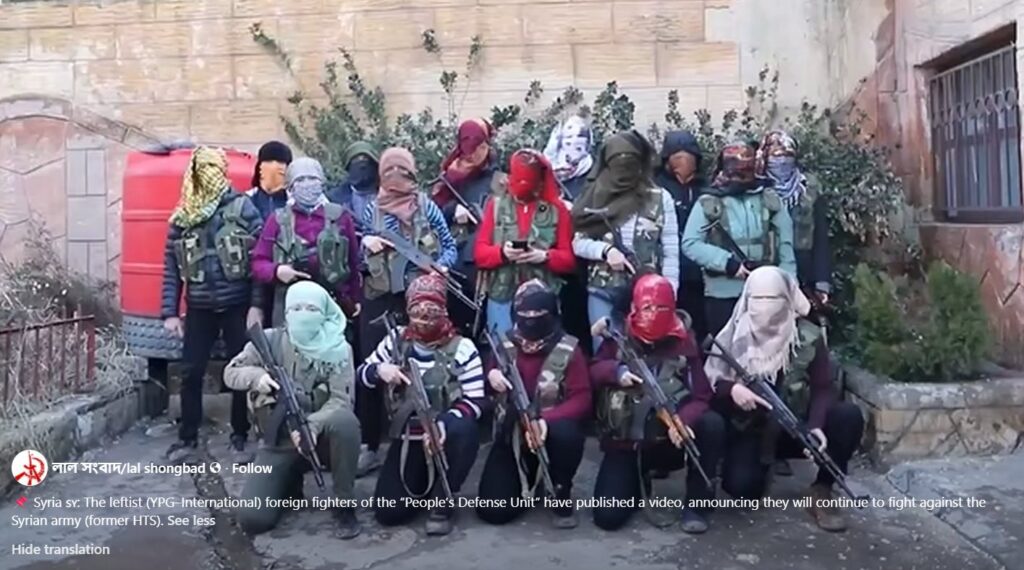
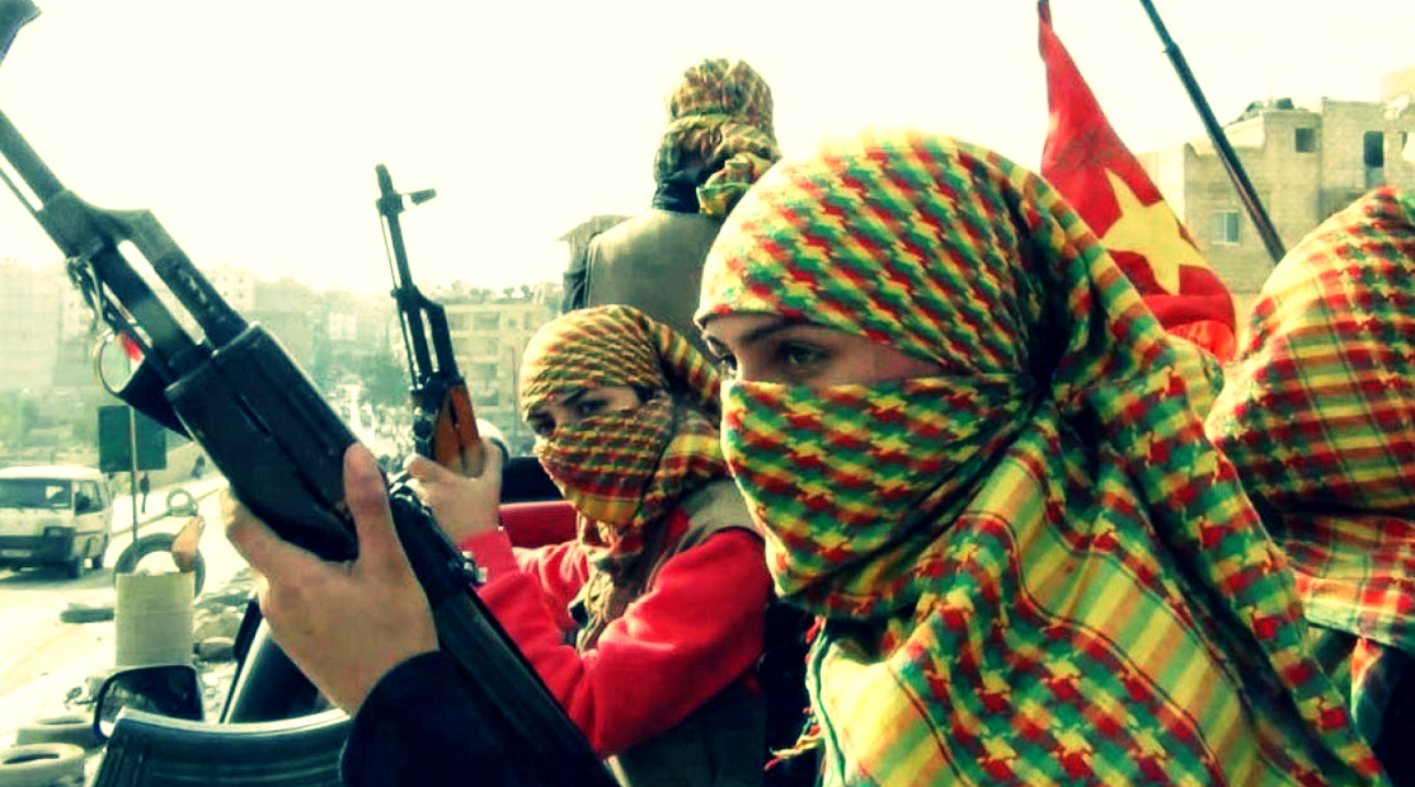
In recent days, the Syrian army has repeatedly attacked neighbourhoods and cities in Syria where Kurds live or which are even under Kurdish self-administration. These attacks began in early January when the Syrian army attacked the Kurdish neighbourhoods of Aleppo, Sheikh Maqsoud and Ashrafiye. As the attacks took place in densely populated neighbourhoods, many Kurds were injured and killed. The hospital in Sheikh Maqsoud was also hit. The attacks also led to a renewed mass expulsion of the Kurdish population from these neighbourhoods, as the Syrian army designated all Kurdish military positions within the neighbourhoods as legitimate targets.
The Syrian army was allegedly supported in its attacks by Turkey, whose proxy militias were significantly involved. It was even announced that there was an offer to send Turkish drones to enable the ground offensive. It is clear that Turkey has a significant interest in wresting democratic self-government from the Kurds in northern and eastern Syria (also known as the Autonomous Administration of North and East Syria and Western Kurdistan) and has always been determined to prevent any form of Kurdish self-government. Its role during the negotiations on the March agreement once again made its position clear. In the days that followed, the Syrian army was able to extend its offensive to Deir Hafer, Maskanah, Raqqa, Deir ez-Zor and Al-Hasakah.
Threat of disempowerment
On 18 January, the president of the Syrian transitional government, Ahmed al-Sharaa, then proposed a ceasefire that effectively disempowers the Kurdish-led SDF in Syria. The ceasefire, which had been worked out together with US envoy Tom Barrack, was ultimately accepted by the SDF. Under this agreement, the SDF is to be fully integrated into the Syrian army, a demand that has been in place since Assad’s fall and was already negotiated in the March agreement. Only a local police unit in the Kurdish areas, which is integrated into the Syrian police apparatus, will be allowed to continue to exist. Ultimately, all agreements aim at disarming the SDF and also the Kurdish self-defence units YPG and YPJ.
Furthermore, areas of Kurdish self-government, specifically Raqqa and Deir ez-Zor, are to be placed under the rule of the Syrian state and Kurdish autonomy there is to be ended. In addition, control over prisons holding IS supporters and their family members, as well as access to important infrastructure and resources, is to be handed over. Although the region has been severely damaged by the war against ISIS and progressive environmental destruction has further exacerbated the devastation, it still has considerable resources such as oil and gas fields and particularly fertile agricultural land where wheat and cotton, among other crops, are grown along the Euphrates. Another key issue is the pro-Turkish stance of US ‘mediator’ Barrack, who is accused by critics of enforcing Erdogan’s interests.
In order to appease the Kurds, al-Sharaa officially recognised Kurdish as a language in a decree issued on 16 January. According to this decree, Kurdish may now be taught as a minor subject in schools in areas where the majority of the population is Kurdish. Newroz was also declared a national holiday, although it should be noted that 21 March is also Mother’s Day, among other things, and therefore does not represent an immediate gain for the Kurds. These are crumbs that could not be smaller, although they have great symbolic significance in the context of the cultural and national oppression of Kurdish identity. This decree must also be understood as an attempt to divide the Kurdish population and the SDF, according to the motto that the transitional government would take care of Kurdish culture, which is why they would no longer need self-government or armed structures.
Al-Sharaa’s tactics
The escalation of the situation and the attacks on the democratic self-administration of northern and eastern Syria are likely to have several tactical reasons. According to some media reports, al-Sharaa is currently negotiating an agreement in Paris that would enable and legitimise the occupation of southern Syria by the Israeli army. The attack on the autonomous region serves as a perfidious distraction to conceal this betrayal.
But ultimately, this is only a secondary aspect. Al-Sharaa’s efforts stem from Syrian nationalism itself, which also underpins the Islamist government and rejects the right to self-determination of oppressed nations. At best, the new regime feels compelled to make tactical and merely temporary concessions to the Kurds.
Secondly, they are also closely linked to the change in imperialist power relations. The US, which once supported the Kurdish-led SDF militarily as ground troops in the fight against ISIS, has been turning its back on Kurdish-led structures for some time now. Since IS has been defeated, at least militarily, and Kurdish self-government was of no interest to the US anyway – quite the contrary, in fact – its attitude has shifted accordingly. The democratic achievements of Rojava are of no importance to the US, nor is a decentralised state that is not in its strategic interest. On the contrary, they want a pro-Western vassal government in Syria through which they can indirectly control the country. Accordingly, the US is now positioning itself alongside the transitional government, as this will enable it to more effectively enforce the country’s dependence within its own sphere of influence.
And it is not only the US; the international community is also becoming increasingly sympathetic towards the Syrian government. Al-Sharaa has already announced a state visit to Berlin. With this backing, it is easier to attack supposed opponents of a ‘stable’ Syrian state. The aim is to open Syria to foreign capital after Assad’s fall and to push ahead with neo-liberalisation.
This also means that al-Sharaa stands for a centralised state in which power is concentrated in his hands. The ongoing social and economic crisis and the internal contradictions between different factions in the government on which al-Sharaa relies virtually necessitate a Bonapartist regime that, on top of that, depends for better or worse on the United States, other Western imperialisms and regional powers such as Turkey, Saudi Arabia and Qatar. Any form of self-government or federalist structure, as demanded by the SDF and PYD, stands in opposition to this and, whether intentionally or not, counteracts al-Sharaa’s Bonapartism. The argument that such structures would call into question the newly emerging state and deter foreign investors is therefore used repeatedly by the regime as a justification for suppressing democratic achievements – especially against the backdrop of efforts to attract Turkey, Qatar and Saudi Arabia as investors.
The extensive resources controlled by the Kurdish self-administration, which gave it power beyond the barrel of a gun, are particularly relevant to the Syrian army. Al-Sharaa criticised the fact that the Kurds control ‘a large area comprising about 25 per cent of Syria, covering 50,000 square kilometres and providing food, water and energy’. The military attacks are intended to intimidate the Kurds and force them to submit to the plans of the transitional government and give up the self-determination of the Kurdish people.
Defending the Kurds’ right to self-determination
We strongly oppose the Syrian army’s attacks on the Kurdish population and regions that have been under mainly Kurdish self-administration for almost a decade. Like any oppressed people, they have the right to national self-determination. It is unacceptable that the comparatively ‘progressive’ structures and the right to self-defence should be undermined in this way! These attacks are not only terrible, they are also de facto a betrayal: in March 2025, the agreement between the SDF and al-Sharaa promised to build a ‘democratic, pluralistic, decentralised’ state. Even that was a defeat for the Kurdish people, as it already provided for the integration of Kurdish civil administrative institutions or structures, and thus the achievements that the SDF had made over the years, into the transitional government.
No imperialist power can be relied upon to defend the rights of oppressed nations – neither in Kurdistan nor in Ukraine, let alone in Palestine. Only the class-conscious working class, which, in the words of Karl Marx and Rosa Luxemburg, has no fatherland but the International, can support their rights to the end. It is in the interests of all Syrian workers to stand up now for equal rights for all, and above all to defend the rights and democratic achievements of the Kurdish population.
Revolutionary class politics also means fighting consistently for democratic rights such as the right to national self-determination for the Kurdish people (including the right to establish their own state, if they so wish). Wage earners have already demonstrated their courage and tenacity in establishing independent trade unions and workers’ committees, as well as in resisting job cuts and factory closures. Now they must show the same steadfastness in the struggle for democratic rights.
Only by clearly standing up for the rights of all oppressed people, such as national and religious minorities and women, can they build a real alternative to nationalism, Islamism and imperialism.
A key focus and a means of uniting the struggle around unresolved democratic issues must be the demand for elections to a fully sovereign constituent assembly, comprising delegates from urban and rural workers and also including the various ethnic and religious groups that make up Syria. It is essential that delegates be elected at assemblies in neighbourhoods, universities, factories and schools in order to wrest control of such elections from the hands of the current transitional government.
The workers and democratic revolutionary forces must play a decisive role in convening these elections and protecting them from coercion by forces acting on behalf of the government or the former regime. The delegates to a constituent assembly must be eligible for election and removal by their constituents. At the same time, we must also be aware that such an assembly would not be the end point of the struggle, but only an arena for it. Only a workers’ government based on councils and its own armed militias, which would include many fighters from the Kurdish movement, but also the remaining democratic forces in Syria, can offer a solution.
Only through the expropriation of Syrian and foreign big capital can the foundations be laid for a democratic planned economy that carries out reconstruction in the interests of the population and links it to the struggle for a socialist revolution throughout the region. Revolutionaries should fight to link the most important democratic and socialist demands in a programme of permanent revolution for Syria and the entire region.
Syria, which has a history of socialist and communist organisations dating back to the 1920s, but which was horribly distorted by Stalinism and where these organisations were crushed under the Assad dynasty, needs the building of a revolutionary workers’ party to lead this struggle.
– Hands off Rojava!
– Stop the attacks on the Democratic Self-Administration of North and East Syria and Rojava! Solidarity with the Kurdish people and victory to the fighters!
– For the right to national self-determination, including the right to self-defence and the arming of the population!
– Immediate withdrawal of Syrian army groups from Kurdish areas! Withdrawal of all foreign troops from Syria!
– Reversal of the restrictions imposed by the ceasefire deal! Resources such as oil and agricultural land under the control of workers and the oppressed!