Originally published at PuntoRojo
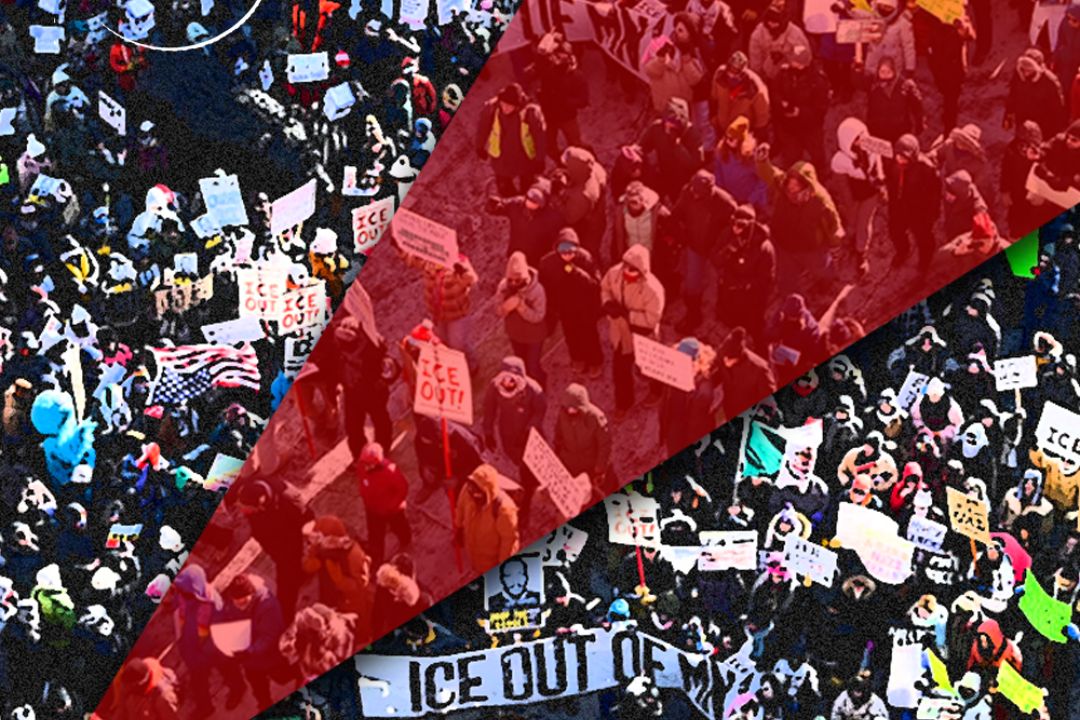
The mobilization in Minneapolis against ICE has become the largest and most intensive local struggle since the civil rights movement. Moreover, it has adopted a manifestly working-class character. The city will host a Workers’ Assembly this February 15 to plan mass strikes on May Day.
The large January 23 protests and work and school stayaways and walkouts in Minneapolis following the ICE murder of Reneé Good, and the subsequent mass protest following the ICE execution of Alex Pretti marked a transition from a protest-based anti-Trump resistance into a wider social justice movement in which working people are taking a central role.
The implicit goal of unleashing state terror on the people to quash opposition only reinforced the resolve of the resistors and has drawn even more people into the fight. Hundreds of thousands across the country jumped into action and organization, building local efforts to resist and oppose ICE. Most spectacularly, thousands of youth self-organized walkouts from schools in protest of ICE in nearly every corner of the country, marking the emergence of a new social justice movement taking on a mass character.
A strike by any other name
A significant and positive aspect of the Minneapolis movement is that it has taken up the methods of the working class. The January 23 action was called and built as a “mass strike”. Despite not involving the biggest unions or shutting down industrial production, it did paralyze much of the city’s activity and it highlighted the power workers have in their potential to shut down the system, sparking a broad discussion about the possibility of building a similar “mass strike” at a national level.
The result of the combined actions have effectively pushed back on the offensive, leading the administration to have to change the tactics and command of the ICE occupation, and ultimately declare an end to “Operation Metro Surge” and begin the withdrawal of ICE and Border Patrol from Minnesota.
While this is undoubtedly an achievement of the struggle, it is by no means a decisive defeat for the Trump regime and ICE—who will readjust their strategy and tactics to continue attacks. ICE deportation and violence will continue, as this is the lead method of the Trump regime for carrying out his war on immigrants, the political left, and the whole working class to impose his model of authoritarian capitalism.
Our side is also continuing to learn how to organize ourselves, and to develop our own strategies and tactics to continue the fight until the defeat of the regime, and the complete dismantling of its ICE shock troops. The next step in this struggle is to build on the January 23rd call for “no work, no school, no shopping” and build from the bottom up for mass strike actions on May Day 2026.
Make May Day a mass strike day (again)
Socialist Horizon is committed to joining this effort and helping build May Day actions that will include strikes, school stayaways, boycotts and protests and strengthen labor, social movements and the left. It is an opportunity to revive and build on the tradition of May Day protests in the U.S., which began for the struggle for the eight-hour day in 1886. Most recently, more than three million immigrant workers led and participated in the massive “Day Without an Immigrant” strikes of May Day 2006.
The May Day actions will build on the January 23 “mass strike” in Minneapolis. The local movement is now reinforced by the May Day Strong coalition of labor, faith, community and nonprofit organizations that have put strike action at the center of the discussion. The February 15 Workers’ Assembly meeting in Minneapolis aims to take that struggle forward. There will be many other local and national protests to build for May Day, including the next No Kings action on March 28.
Nationally, prominent politicians such as Chicago Mayor Brandon Johnson and labor leaders such as Association of Flight Attendants President Sara Nelson publicly supported a May Day strike in planning calls involving thousands of people across the U.S. This provides a critical opportunity for activists, socialists and the left to amplify this call, getting their own organizations to commit to action. However, we should be clear that union officials and politicians are responding from grassroots pressures from below— and will not actually follow through unless pushed from below and forced to.
Democratic officials such as Minnesota Gov. Tim Walz and Minneapolis Mayor Jacob Frey have called on the Trump administration to withdraw ICE. But despite the Democrats’ lawsuits and press conferences, they began bending to Trump’s crackdown.
After Gov. Walz met with Trump’s man in Minneapolis, Tom Homan, the White House “border czar” praised “unprecedented collaboration” with county sheriffs to hand over jailed immigrants to ICE. The Hennepin County Sheriff’s Department, which patrols the area around the Whipple Federal Building that serves as ICE headquarters, has provided daily protection for ICE convoys, arresting 42 protesters on February 7 alone.
Minneapolis police began dismantling the anti-ICE checkpoints set up by working people to protect their immigrant neighbors. No one should forget that after Renee Good was killed, Walz gave a speech that called on Minnesotans to take out their phones to video ICE. Alex Pretti did so—and was executed on the street. The governor activated the Minnesota National Guard, not to protect protesters, but to support the county sheriffs and help protect the Whipple building.
But the crackdown on Minneapolis and democratic rights goes far beyond ICE’s street terror. The arrest of civil rights attorney Nekima Levy Armstrong and journalist Don Lemon on federal charges for participating in a local protest is aimed at intimidating protesters and activists in Minneapolis and across the U.S. A federal judge has blessed the ICE occupation of the city, with no end in sight. U.S. Attorney General Pam Bondi declared that ICE will only withdraw if Minnesota hands over its social assistance and voter registration data, part of Trump’s efforts to “nationalize” elections in order to steal them.
Strategies for building the movement
While U.S. union officials usually steer close to the Democrats, the groundswell in Minneapolis and beyond is driving them towards action. Left-leaning unions in the May Day Strong coalition are allied with NGOs like the Women’s March and groups like 5051 and the No Kings efforts, amplifying the effort beyond the ranks of organized labor to include non-union workplaces and student groups as well as established community organizations and new ones that have sprung up to counter ICE.
There will be many discussions and debates about how best to build the movement. While the backing from some prominent Democrats opens the way to mass participation, such figures will most likely oppose efforts for workplace shutdowns, stayaways and strikes. For their part, union leaders will come under tremendous pressure from employers and the state to block any serious May Day strike action, including court injunctions with crippling fines and threats to arrest union leaders.
Only the organization of the most radicalized and determined rank-and-file workers and activists into a considerable nationwide force within the movement can hope to move the struggle forward and become strong enough to defeat ICE and challenge the Trump administration’s power. Within that process, we must also organize the most militant sections of the emerging movements into revolutionary organization to oppose and challenge the capitalist system itself, as capitalism is the generator of the crises and class war now being waged upon in most brutal form of Trumpism and ICE terror and occupation.
Socialist Horizon believes the best way towards a mass strike on May Day is through organizing committees in schools, workplaces, and neighborhoods, holding education sessions for May Day while building, joining, and strengthening anti-ICE networks in the day-to-day movement leading to it.
Another trajectory is through the creation of workers assemblies like the one taking place this Sunday in Minneapolis. Both organized and unorganized workers need to put the fight against ICE and Trump authoritarianism at the center of their agendas to build the widest possible unity. We also believe that the May Day 2006 national mass mobilization in support of immigrant rights is a model for our next step. That day of action brought together workers, students, and community organizations in a coordinated national campaign built from below. Minneapolis has helped create the conditions and the example to follow for similar national mobilization. That day of action brought together workers, students, and community organizations in a coordinated national campaign built from below.
Building workers power from below will also be necessary to counter the efforts by Democrats who will try to hold the movement back, as well as to advance in building the independent political organizations of the working class.
We join others on the socialist left to bring to this activism an internationalist perspective. We do so by being in solidarity with people who have crossed a border in search of a way to survive, work, and make a living, but also in opposition to U.S military adventures and imperialism abroad. The crackdown on Palestinians and the U.S. support for Israel’s genocide in Gaza under the Biden administration has set the stage for Trump’s still more aggressive militarism against Venezuela, Iran, and many others.
May Day has been an international labor and socialist tradition for more than a century, even during decades when it was nearly forgotten in the country where it originated. The anti-ICE struggles of 2026 show the urgent need to revive May Day in the US and build a movement capable of meeting the challenges ahead.