By Haris Qadeer
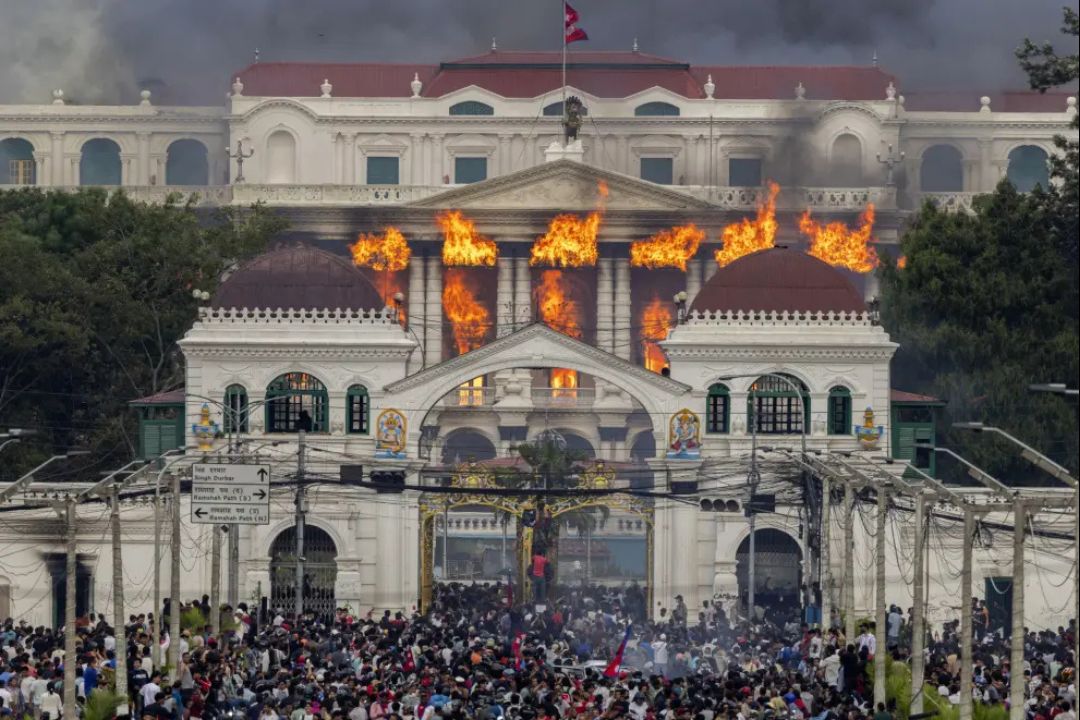
Following the overthrow of the government in September last year as a result of the “Gen Z” uprising in Nepal—a South Asian country situated between China and northern India—general elections were held in March this year. The Rastriya Swatantra Party (RSP), which gained significant momentum from this uprising, secured a majority and formed the government. The former mayor of Kathmandu assumed office as prime minister and, on March 28, announced a 100-day roadmap. This roadmap and the government’s initial actions have drawn international criticism.
Amid social deterioration and deep economic and political crises, the new government faces numerous challenges. At the same time, a fundamental question arises: does its agenda include any structural transformation of the existing system, or is it merely planning to reinforce a crisis-ridden capitalist system through populist rhetoric in a more rigid form?
Election results
In the general elections held on March 5, 2026, the RSP secured 182 out of 275 seats in the House of Representatives, achieving a two-thirds majority. This marks the first time since the abolition of the monarchy in 2008 that any party has achieved such a decisive mandate. Previously, coalition governments dominated, resulting in 14 governments over 17 years.
The Nepali Congress—considered pro-India—emerged as the second-largest party with 38 seats. The Nepali Communist Party secured 17 seats, while the Communist Party of Nepal (UML), often viewed as closer to China, won 25 seats.
Formation and rise of the RSP
The RSP was founded in July 2022 under the leadership of well-known television anchor Rabi Lamichhane, who gained popularity through programs exposing corruption, misgovernance, and malpractice. After forming his party, he became Deputy Prime Minister and Interior Minister in December 2022 but was disqualified within a month due to holding U.S. citizenship.
Subsequently, he himself faced charges of financial corruption amounting to over 48 crore rupees, along with pending cooperative fraud cases.
During the September Gen Z protests, the popularity of Lamichhane’s anti-corruption activism, along with songs by rapper and former Kathmandu mayor Balen Shah, surged dramatically. A large segment of youth and the urban middle class involved in the movement adopted the RSP as their political platform.
In December 2025, Lamichhane and Balen Shah formed an alliance: Lamichhane became party leader, while Shah was nominated as prime ministerial candidate. Campaigning under the slogan of a ‘new Nepal, the party succeeded in forming a government composed largely of new faces.
Political and ideological orientation of the new government
The Gen Z movement emerged primarily as an anti–status quo movement. Participants—mainly urban middle-class youth—recognized the failure of the existing system but attributed it largely to corruption, nepotism, poor governance, and weak rule of law rather than systemic contradictions.
The new leadership similarly lacks a structural critique of the system and offers no coherent alternative. The RSP presents itself as a centrist, reformist, anti-corruption force, distancing itself from traditional left-right politics.
Its agenda includes:
•eliminating corruption
•technology-driven governance
•bureaucratic reform
•improved public services
•promoting private investment
•strengthening law enforcement
In essence, it proposes to resolve the crisis of capitalism through “good governance” rather than systemic change. Notably absent are: any critique of corporate capital, military-related corruption, and a stance on IMF-driven economic policies.
The 100-day government roadmap
The roadmap includes reforms in governance, digitalization, transparency in appointments, anti-corruption campaigns, investigations into major cases, asset scrutiny, employment programs, investment initiatives, and improvements in infrastructure and urban services.
A key measure is the formation of a high-level committee to investigate former rulers and recover allegedly looted wealth—closely resembling narratives previously advanced by Imran Khan in Pakistan. Incidentally, Imran Khan has ended up in jail on similar allegations!
Another major step is the proposed ban on trade unions and student unions, justified on the grounds that their political affiliations hinder governance. In effect, this targets organized labor resistance to neoliberal policies such as downsizing and austerity.
Student unions are to be replaced with “non-political” student councils, likely aligned with the ruling party. This risks suppressing ideological debate, grassroots leadership development, and independent student politics—ultimately fostering authoritarian tendencies.
Arrests, repression, and protests
Former Prime Minister K.P. Sharma Oli has been arrested for alleged responsibility in 76 deaths during the Gen Z uprising, provoking strong reactions.
Over 460 individuals have been arrested on corruption charges. Measures to silence critical media have also begun. On April 9, a YouTuber was arrested for criticizing Prime Minister Balen Shah, triggering protests that forced the government to release him.
Opposition crackdowns and restrictions on unions have sparked both domestic and international criticism, with further protests likely.
Economic and social crisis
Nepal, with a population of around 30 million, relies heavily on remittances, tourism, and agriculture. Its GNI is approximately $49 billion, with per capita income around $1,650.
Economic structure:
• Services: 55%
• Agriculture: 22%
• Industry: 11%
Remittances account for around 25% of GDP.
Since 2022, Nepal has been under an IMF program, and the new government has shown no intention of deviating from its neoliberal framework.
Other structural issues include money laundering—linked to cooperatives, corporations, the political elite, and the bureaucracy—the country’s presence on the FATF grey list, and military corruption in procurement, logistics, engineering, and related sectors.
Budget constraints limit spending on human development. Rural infrastructure remains weak, inequality is severe, and youth unemployment is high. Many workers migrate to the Middle East under harsh conditions, and the current geopolitical instability threatens these jobs, while millions more are eager to move abroad.
Infrastructure deficits—roads, electricity, water, and logistics—remain severe and cannot be resolved within the existing system.
The politics of Balen Shah
As mayor, Balen Shah was criticized for heavy-handed governance, including demolition drives against informal settlements. As prime minister, similar tendencies persist under the banner of “rule of law.”
Anti-corruption campaigns lack transparency and risk becoming tools of political victimization—common in many developing countries. Corruption is portrayed not as systemic but as a problem of individuals.
Systemic change?
A new leadership has certainly emerged, but the dream of systemic transformation in Nepal remains unfulfilled. This leadership, which has built its narrative around anti-corruption, has in fact sought to obscure underlying class contradictions. The communist parties (or at least most of them), over the past 17 years, have failed to advance any agenda for transforming the system; instead, by pursuing reforms within it and seeking to secure their own interests, they have lapsed into opportunism and discredited themselves. The incoming leadership, too, is proceeding along a path that, rather than addressing class contradictions, unequal distribution of wealth, or ending neoliberal and anti-worker policies, seeks to continue the same system in an even harsher form.
Ultimately, not a single fundamental problem can be resolved without abolishing the capitalist system, repudiating imperialist debt, placing the means of production under the democratic control of the working class, and restructuring the economy on socialist foundations through planned development.
Nepal’s workers and youth have carried out three major popular uprisings between 1991 and 2025. Yet each time, only the form of government has changed. Whether it was the transition from monarchy to political party rule, or the complete abolition of the monarchy and the establishment of so-called democratic governments, popular aspirations have repeatedly been betrayed. The gradualism, two-stagism and accommodation with the existing system by ideologically and politically bankrupt “communist” leaderships have also alienated a large section of Nepali youth from politics.
However, the character of the new government may itself pave the way for another mass uprising. Sooner or later, Nepal’s workers, students, and unemployed and impoverished youth will once again take to the streets. Only through the revolutionary overthrow of a capitalism mired in belatedness and crisis—incapable of playing any progressive role—can the path be opened toward the genuine construction of a new Nepali society.