By Marco Ferrando (PCL-Italy) and Jaqueline Singh (GAM1-Germany)
Editorial note
The largest flotilla in history is on its way; however, we all know that the ships alone will not be enough: what matters is how big and determined the solidarity mobilization on land becomes. That is precisely our task: to build, broaden and strengthen this movement across national borders. The Italian trade unions made their position clear during the previous mission: if the flotilla is attacked, we will defend it; and this led to massive protests and a general strike.
Thus, the genocide in Gaza became a unifying issue for leftist, revolutionary and trade union activists, as well as organizations that even managed to mobilize beyond their own circles and carry out a general strike. This shows that the question of a free Palestine is more than a local war or an anti-colonial struggle.
Our comrades of the Partito Comunista dei Laboratori (PCL) have been active for years in solidarity work and also participated in the above-mentioned strike. In this article they report on the developments, the opportunities and the main demands worth fighting for. We should build on these experiences and put them to international use. In Europe in particular, this is a key experience that we must develop. Not only in support of the flotilla, but in the joint struggle for a free Palestine.
The rise of the masses
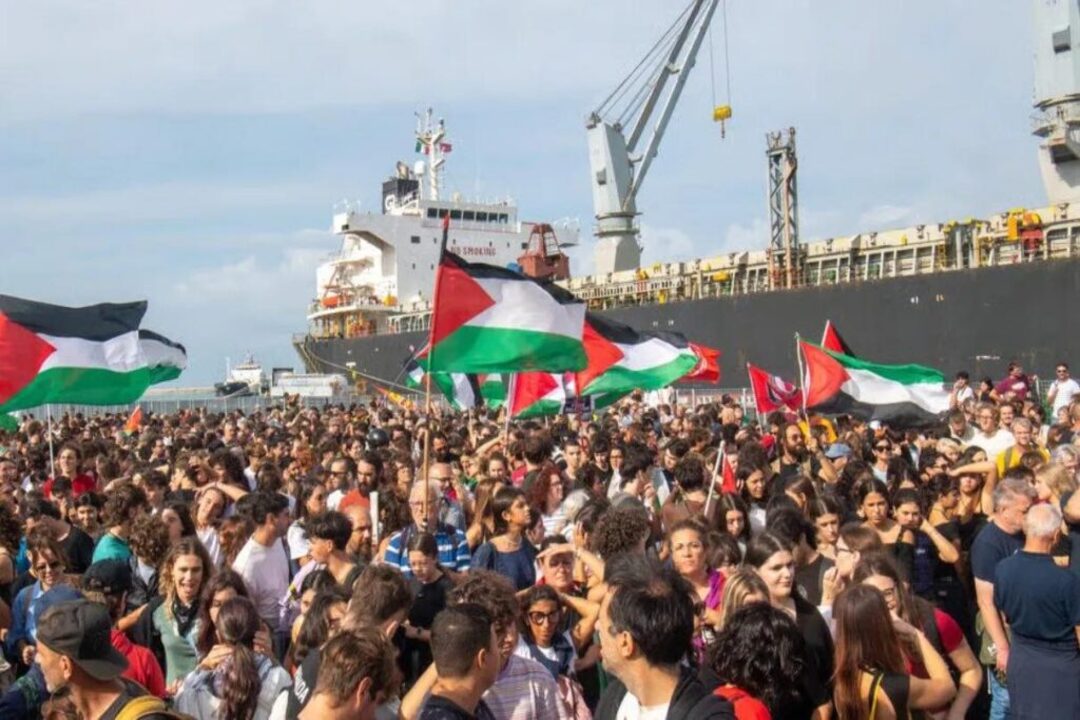
In Rome, police authorities expected 8,000 demonstrators; in the end there were more than 20,000. In Milan, Turin, Naples and Bologna, the number of participants also exceeded all forecasts. In all, on September 22, hundreds of thousands took to the streets in dozens of cities, driven by an exceptionally high turnout, especially of young and very young people, high school and university students, who flooded streets and squares with a spirit of radical struggle.
Pressure on the streets erupted into direct mass actions: vigils, occupations and blockades of railway stations, highways and port facilities. The Palestinian flag flew everywhere throughout the day. In some cases, the police attacked and made arrests. However, in most cases – despite draconian laws – they were unable to prevent the blockades or to counter them effectively. Even the bourgeois press had to report countless cases in which motorists, passers-by and neighbors showed solidarity with the demonstrations and blockades.
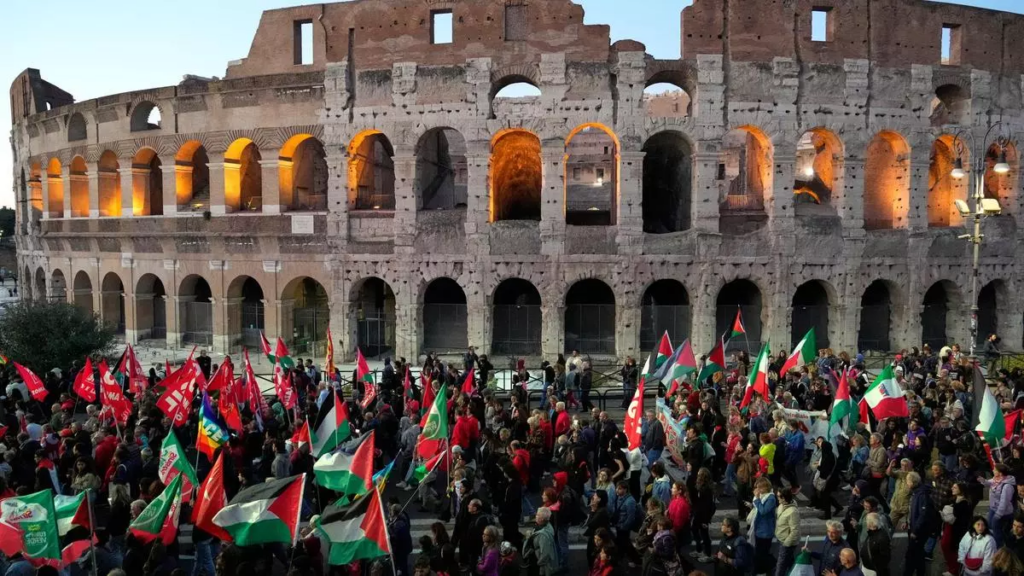
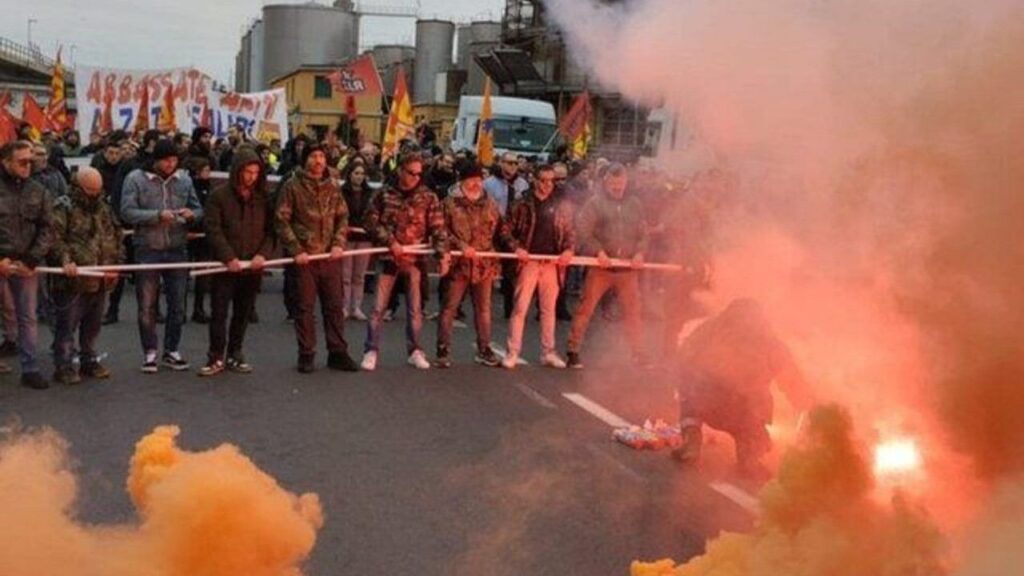
This dynamic arose from the call for a national general strike by three militant rank-and-file unions (Unione Sindacale di Base, Confederazione Unitaria di Base, Sindacato Generale di Base), small organizations with very limited support among the workers, but whose call had an impact far beyond their actual size. These forms of action are not new in the Italian tradition. What was new on September 22 was the combination of these forms of action with massive public support and the breadth of the mobilization, which led to the call for a second general strike on October 3, for the first time by all the left-wing unions, large and small.
How did this sudden escalation come about, and what are the revolutionaries to learn?
Starting point and turns of the movement
The resurgence of the movement is particularly remarkable given that, during the previous two years, it had shown tenacity with weekly demonstrations in several cities, especially in Milan. However, it remained limited to a circle of revolutionaries, predominantly students. This is not due to state repression against the pro-Palestinian movement, which so far has been less than in other countries such as Germany or the United Kingdom. Rather, the passivity of the masses is explained by the deep crisis of the political left in Italy, the result of defeats suffered for more than ten years. However, in the second half of September 2025 there was a change of course.
The Global Sumud Flotilla mission generated a strong sense of solidarity and identification in broad sectors of the population. This was reinforced in the face of threats from the Zionist government and the refusal of the Italian government to grant protection to the mission. The change was first manifested in Genoa with a spontaneous mass mobilization at the flotilla’s departure, which brought 20,000 people into the streets, accompanied by an initiative of dock workers who publicly announced a strike.
The Autonomous Collective of Port Workers (CALP) of Genoa, although small, achieved an impact far greater than its size, also due to the strong historical tradition of trade unionism and worker activism in the city. The general expansion of this turn came on September 22 with the general strike called by three grassroots unions. Although small, they managed to organize 80 demonstrations with massive participation, especially by young people.
Controversy in the background: trade unions in Italy
The number of participating workers was generally modest. The CGIL (Confederazione Generale Italiana del Lavoro) bureaucracy openly sabotaged the strike, fearing its success. They called for parallel initiatives to defuse participation. The main Italian unions are CGIL, CISL (Confederazione Italiana Sindacati Lavoratori) and UIL (Unione Italiana del Lavoro). CGIL is historically left-wing; CISL has a Catholic character; UIL occupies an intermediate position. The grassroots unions USB (Unione Sindacale di Base), SGB (Sindacato Generale di Base), SI Cobas (Sindacato Intercategoriale Cobas) and CUB (Confederazione Unitaria di Base) are numerous but minority, with about 150,000 members in total, with unequal presence according to sectors.
Policy of passivity
None of these unions poses a real strategic alternative to the bureaucracy. Concepts such as strike committees, indefinite strikes, resistance funds or factory occupations are alien to their political culture.
The political strike
Political strikes have been exceptional in Italy since the 1940s and 1950s. Current strikes are usually symbolic, brief and without real impact on the correlation of forces.
The flotilla as a catalyst
The daily attacks on the flotilla fueled the mobilizations. Striking teachers with their students and health care workers at marches reflected this momentum. September 22 generated great sympathy even among workers who did not participate. The pressure forced the CGIL to call a second general strike on October 3, this time a united one. For the first time, a real general strike for Palestine, imposed by the pressure of the masses.
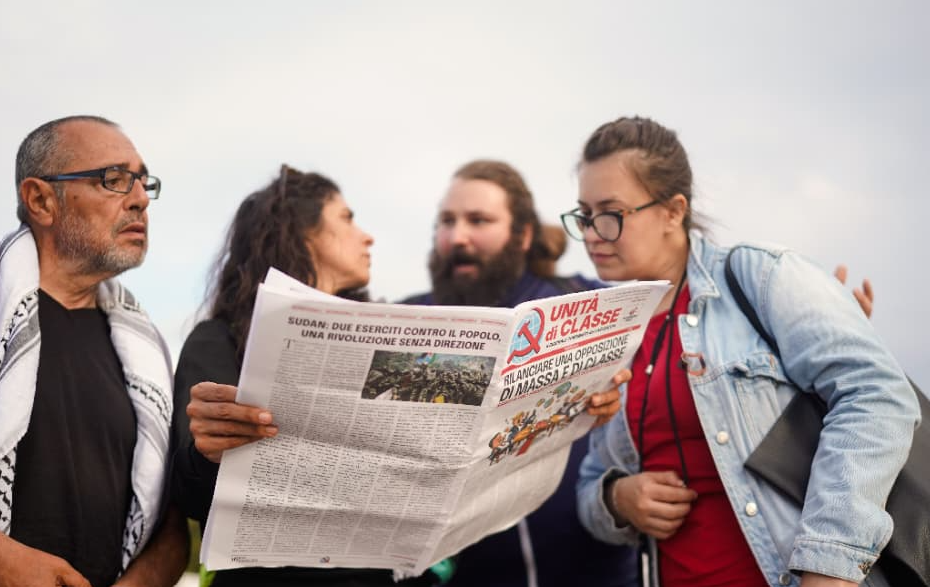
From protests to general strike
October 3 marked a leap: more than a million people in the streets. Workers from large factories were incorporated and unity with students was strengthened. However, labor participation was not in the majority and the call was rushed. Even so, the political impact was enormous. On October 4, a demonstration in Rome became the largest in almost 25 years, with massive intergenerational participation. Palestine became a unifying banner against all injustice.
Turning point and limits
Despite the radicalization, broad sectors remained passive or under reactionary influence. The turn was within the democratic left, weakening the government and its social consensus. But the so-called “Trump plan” and the discourse of the “end of the war” generated confusion and demobilization. The union leaderships fragmented unity, and the reformist left subordinated the movement to electoral calculations. The result was a rapid retreat of the movement and an increase in state repression.
Lessons to be learned
The experience has not disappeared and new mobilizations have already taken place. But it is clear: the movement alone is not enough; revolutionary organization is needed.
Evaluation of the PCL: 1. A ceasefire is not peace: the so-called Trump plan is a colonial plan that must be rejected. 2. Fight together: defend and deepen the trade union unity achieved. 3. Concrete demands: break all ties with the Zionist State. 4. Decide collectively: build democratic structures of masses. 5. Linking struggles: connecting Palestine with internal social demands. Anti-bureaucratic organization: control of strikes by the rank and file, internal democracy and recallable representatives.
Also central is the demand for a unified, secular and socialist Palestine “from the river to the sea”, integrated into a Socialist Federation of the Middle East. Together with the struggle for a unified program of the workers’ movement, a radical change in the forms of struggle and organization, and a workers’ government as the only real alternative.
1.- GAM: Gruppe ArbeiterInnenmacht
You may also be interested in: GSF26-VIII: Stopover in Sicily, Italy.