Jaqueline Katherina Singh
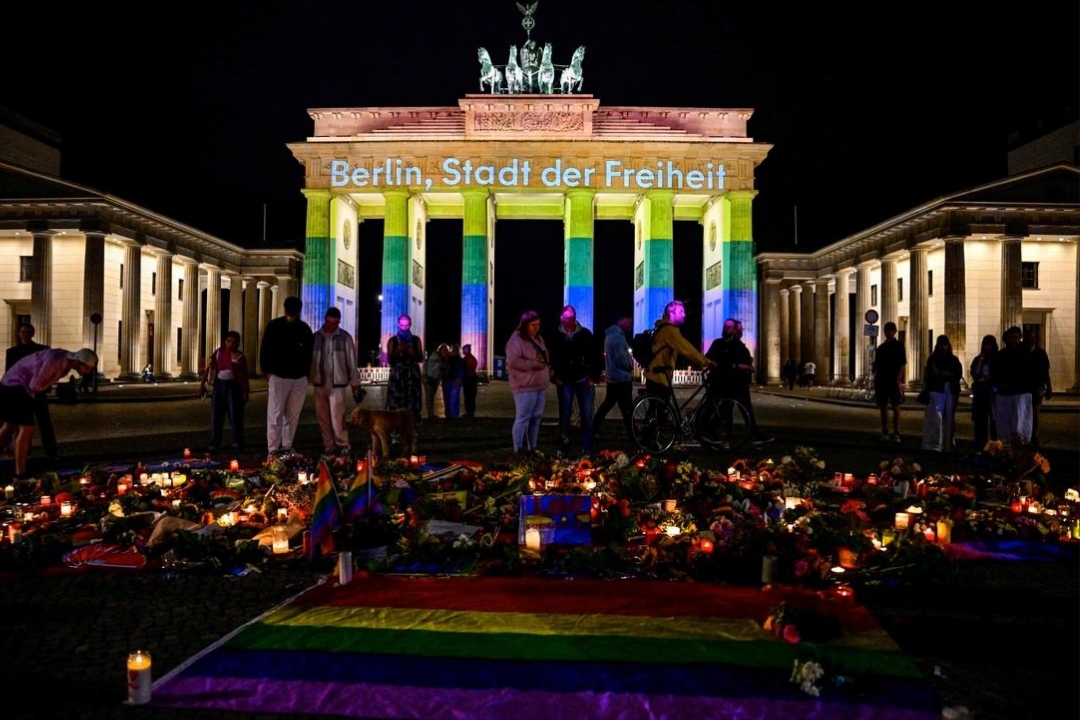
On July 25, shortly before 10 p.m., a van ploughed into one of Germany’s largest Pride parades with hundreds of thousands of participants. One woman died of her injuries at the scene. Twenty-nine other people were injured, three of them critically and eight seriously. The Pride parade was subsequently called off. What remains is shock, grief, and fear. We condemn this reactionary terrorist attack by an Islamist fundamentalist terrorist. We fully empathise with the victims, their friends and relatives.
Violence Against Queer People Is on the Rise
It is certainly painful that yet another Pride event has been attacked and people have been killed and wounded but this was not a unique event. We remember Malte C. in Münster in 2022. He stood on the sidelines of the Christopher Street Day event to protect people who were being verbally abused and threatened with anti-queer slurs. He was knocked down and died a few days later from his injuries. When I attended the Berlin CSD for the first time at age 16, it felt like coming home. The music, the colours, the people, the warmth—the feeling of safety, of simply being able to be myself. Whether loud or quiet, colourful or … Pride should be a place of fun, of belonging, of safety. But that sense of safety has long since disappeared.
The attack on a Pride event is comparable to the one on the Shisha Bar in Hanau in 2020, where 9 people were killed by a far right racist terrorist – and where a place of safety for us was deliberately destroyed. This creates a sense of powerlessness, pain, and grief. It serves as a reminder that many of us cannot be who we want to be outside of queer clubs. That we censor ourselves so as not to stand out and to avoid experiencing violence. Can I hold my partner’s hand here? Can I go home dressed like this? Can I say that I’m trans? We learn to watch ourselves. We become quieter, dress differently, look over our shoulders twice.
Anti-queer violence and hate crimes are being reported with increasing frequency in Germany. In the category of “sexual orientation”, authorities recorded 148 politically motivated crimes in 2011; by 2024, that number had risen to 1,765. The number of recorded violent crimes also rose over the long term, from 38 to 253. In addition, since 2022, crimes in the category of “gender diversity” have been recorded separately: from 417 in 2022 to 1,152 in 2024.
These figures represent only the reported cases and do not necessarily correspond one-to-one with an actual increase. Greater public awareness, changes in data collection methods, and a higher willingness to report incidents also play a role. At the same time, however, there remain a large number of unreported assaults.
At the same time, anti-queer politics are becoming increasingly socially acceptable. The AfD is inciting hatred against queer people, and trans people in particular. And Bundestag President Julia Klöckner (CDU) also decided to join the culture war by having the rainbow flag raised at the Bundestag on May 17—but explicitly not for Berlin’s CSD. Even back then, this was an ominous sign, because for several years now, it has been a trend for fascist organisations like “III. Weg” (“Third Way”) to launch counter-mobilisations, especially against smaller Pride events.
So the question—and not just since Saturday—is: How do we create places where we are actually safe?
What kind of protection?
One of my first thoughts on Saturday was: Please don’t let the perpetrator have a migrant background. Not because anti-queer violence would be any less terrible depending on who commits it. But because it’s clear what will follow: the debate about the perpetrator’s origin, religion, and immigration status—and the demand for even more police, surveillance, and isolation. The Berlin CDU has accordingly found its campaign issue—and so the sense of foreboding only grows when Federal Interior Minister Alexander Dobrindt (CSU) says at the press conference in Berlin: “Everything we see here indicates that we are dealing with an Islamist terrorist attack.” Right wing, conservative, liberal and even social democratic politicians are instrumentalising the reactionary criminal attack to single out immigrants and Muslim people as the cause and instigators of attacks on the queer community.
Our grief must not be a free pass for racism. Our fear is not an argument for deportations. And our safety must not become a pretext for more surveillance and police. Those who want queer liberation cannot build it on the disenfranchisement of others.
Queer safety cannot be pitted against the safety of others. Racism and queerphobia are different forms of systematic oppression that are inextricably linked to the capitalist system. And that also means we must take a clear stand against homonationalism and “law-and-order” politics.
The treatment met by the Internationalist Pride march—which began on June 25 at 3 p.m. at Berlin’s Gesundbrunnen—shows that the Berlin police have no qualms about attacking a demonstration with pepper spray and their fists. Protection would look different; queer lives must be defended not only when they are physically attacked. Our health, places where we can live undisturbed—none of this has been universally guaranteed so far and must be fought for:
1. We must remain visible: Awareness campaigns about queer life and sexuality in schools, universities, and workplaces—should be organised by unions and queer organisations!
2. We deserve more: Free STI testing for everyone, expansion of queer housing and health projects—for the socialisation and reorganisation of housing. No to all forms of discrimination against queer people in the workplace and in public spaces.
3. We will fight back: Pride events, clubs, youth centres, and other queer spaces must remain places where we can feel safe. To achieve this, we need democratically organised, mass self-defence against right-wing and anti-queer violence—supported by the community, unions, the left, social movements and everyone who opposes this violence.
Resistance
It pains me to say this: The rise in these attacks is happening because the social climate is becoming more hostile. Rights that have been fought for over decades cannot be taken for granted—and they can be reversed. When society shifts to the right, our visibility, our rights, and our safety once again become targets.
This is precisely where the limits of queer liberation under capitalism become apparent: We have fought to create spaces where we can live more freely. But we don’t want islands of safety in a society where we have to learn when to let go of a hand, when to speak more softly, and when it’s better not to stand out.
Saying this does not exploit the victims. For me, remembrance means more than just recalling the names of those we’ve lost. It also means fighting for those who are still here—and for a future in which no one has to learn to be afraid anymore.
We owe the dead more than just remembrance. And we owe the living more than just fear.
Let’s mourn together. But let’s not grow quieter; instead, let’s transform our anger, our grief, our powerlessness, and our pain into resistance!