Irfan Kahn
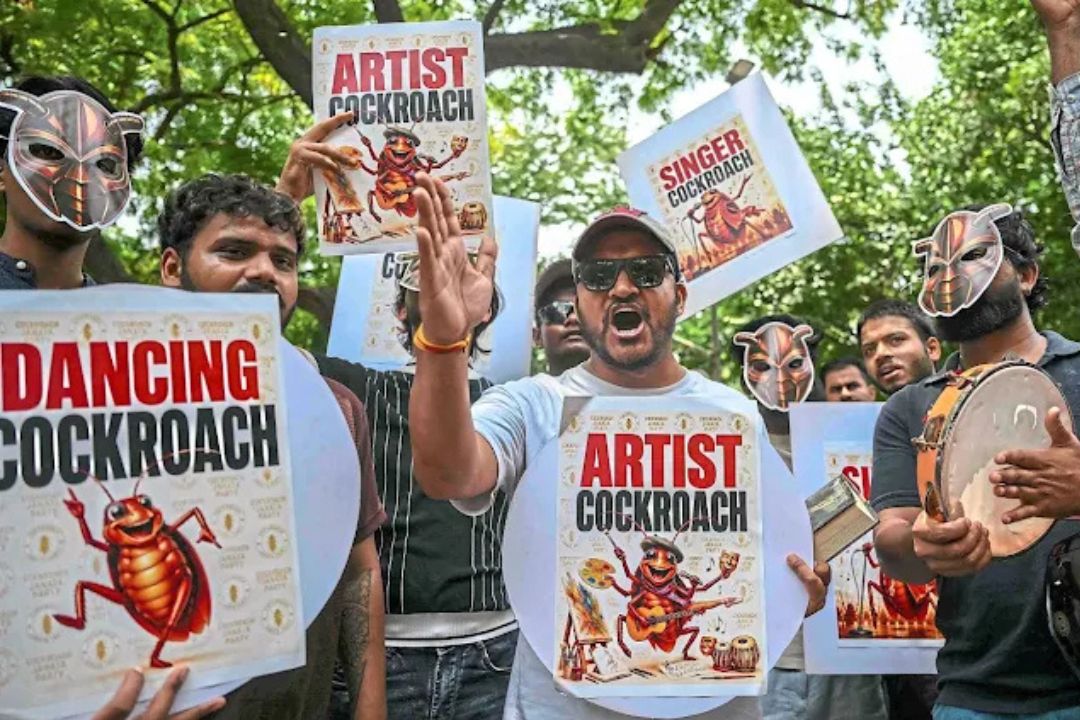
The growing unrest among India’s youth has long outgrown the confines of demands for educational reform or grievances over examination irregularities. It has developed into a profound challenge to the country’s entire social, economic and political order. Jantar Mantar in New Delhi, for decades the symbolic heart of protest politics, has once again become the epicentre of a nationwide movement of resistance. This time, however, the movement is not being led solely by the traditional student organisations. A new youth formation—the Cockroach Janata Party (Cockroach People’s Party)—has emerged as a powerful expression of popular anger, dramatically reshaping the political landscape.
The demonstrations exploded to mass proportions, after Supreme Court Chief Justice Surya Kant referred to unemployed young people as “cockroaches.” Finally on July 25, following weeks of protests, Indian Education Minister Dharmendra Pradhan resigned.
The movement showed that millions of young people had come to the conclusion that their future had been placed at the mercy of an examination system, a market economy and a state apparatus that are neither transparent nor fair, and that have little regard for their aspirations or hard work. Allegations of examination fraud, repeated paper leaks, institutional incompetence and the relentless rise in unemployment created an explosive mood among the youth. What began as protests against examination irregularities quickly evolved into a broader political movement, transforming Jantar Mantar into a national symbol of resistance against a failing system.
The Crisis of Capitalism and the Future of India’s Youth
The ruling class seeks to reduce the present crisis to questions of administrative incompetence, corruption or the mistakes of a handful of officials. In reality, however, these are only symptoms of the deepening structural crisis of Indian capitalism.
India possesses one of the largest youth populations in the world. Nearly two-thirds of its population is under the age of thirty-five, while hundreds of millions fall within the 15–29 age group. Yet capitalism has proved incapable of providing this enormous generation with secure employment, quality education or a dignified future. The cost of education continues to soar, public-sector employment is steadily shrinking, privatisation and contractual employment are expanding, while corporate capital seeks to maximise profits by keeping young workers trapped in permanent insecurity and precarious employment.
Youth unemployment remains several times higher than the national average, with educated young people bearing the brunt of the crisis. At the same time, more than ninety per cent of India’s workforce is employed in the informal sector, where stable employment, pensions, social security and even the most basic labour rights are virtually absent. Under such conditions, public examinations cease to be merely an educational milestone; for millions of young people they become a question of survival. When employment opportunities are scarce and the integrity of the examination system itself is called into question, mass anger is not an anomaly but an inevitable consequence.
The Modi Government and the Growing Alienation of Youth
When Narendra Modi came to power in 2014, he promised millions of jobs, rapid economic growth and the creation of a “New India.” More than a decade later, reality presents a very different picture. Corporate capital has been granted ever greater concessions, privatisation has accelerated, public investment in education and healthcare has remained inadequate, while unemployment, insecure work and shrinking prospects have become defining features of everyday life for millions of young people.
It would, however, be mistaken to attribute all these problems solely to the present government. Their roots lie in the very structure of Indian capitalism itself. Nevertheless, the economic and educational policies pursued by the Modi administration have undoubtedly intensified these contradictions and deepened the crisis.
The movement has also challenged one of the Modi government’s central political strategies. Over the past decade, communal polarization and religious division have repeatedly been used to divert public attention away from pressing social and economic issues. In contrast, this movement has brought employment, education, examination transparency and the future of an entire generation to the centre of political debate. Young people from different religions, castes, linguistic communities and regions have united on a common platform, demonstrating that when economic and social contradictions become sufficiently acute, broad layers of youth can rise above communal divisions and begin to organise around their shared class interests and common social aspirations.
The Rise of the Cockroach Janata Party
The struggle led by environmental activist and education reform campaigner Sonam Wangchuk also gave the movement a new political and moral impetus. By launching a hunger strike in support of the students’ demands, Wangchuk helped transform what had initially appeared to be a student issue into a broader popular cause. The government and the state apparatus assumed that removing protesters from the demonstration site or subjecting them to repression would weaken the movement. Instead, the opposite occurred. The crackdown on Wangchuk drew thousands more young people onto the streets, breathing new life into the protests and significantly expanding their social reach.
One of the movement’s most striking features was its ability to transform an insult into a badge of resistance. The Cockroach Janata Party emerged as the political expression of this defiance. It attracted thousands of young people who had previously remained outside the orbit of traditional political parties but had grown deeply frustrated with state repression, mass unemployment and the continuing examination crisis.
The emergence of this tendency is significant for several reasons. First, it gave many young people the confidence that they could forge an independent political identity rather than simply align themselves with the established parties. Second, it demonstrated how social media could be used not merely as a platform for expressing discontent, but as an effective instrument of political organisation and mobilisation. Third, it reflected the growing disillusionment of a new generation with the traditional parties of the ruling class. At the same time, however, no force that remains committed to preserving the existing capitalist order has succeeded in presenting itself as a genuine alternative.
Despite its militant rhetoric, the Cockroach Janata Party also remains confined within the limits of the existing system. Its programme has largely been restricted to demands for examination reforms, greater accountability, transparency and a change of government. While these are legitimate and important democratic demands, they do not address the fundamental contradictions of the capitalist economy that lie at the root of the present crisis.
The Resignation of a BJP Minister
The resignation of a BJP minister undoubtedly represents an important achievement for the movement, but it does not mark the end of the struggle. No lasting solution for young people or the working masses can be found within the framework of the existing system. The wave of criminal cases filed against student leaders, the arrests of activists and the continuation of state repression after the demonstrations clearly show that the struggle cannot be reduced to the resignation of a single minister or the removal of one individual from office.
The real issue is not simply one government, but the capitalist policies that the Modi administration continues to pursue in the interests of big business. For this reason, the present youth movement must develop into a broader anti-capitalist movement, linking its struggle with that of workers, peasants, women, Dalits, Adivasis, religious minorities and all other oppressed sections of society.
The Role of Left Student Organisations
Left-wing student organisations played a significant role in this movement. Their members not only participated actively in the demonstrations but also helped organise and sustain them. Particularly prominent were the Students’ Federation of India (SFI, and the All-India Students’ Association (AISA), which is affiliated to the Communist Party of India Marxist–Leninist Liberation (CPI(ML)L), together mobilising large numbers of students across the country. Among the emerging leaders of the movement, Neha Bora of AISA gained considerable prominence.
Nevertheless, the political limitations of the leadership also became apparent. Although AISA leaders sharply criticised both the Modi government and the capitalist system, their political strategy ultimately led them towards supporting Rahul Gandhi and the Congress Party, which remains a party of the Indian capitalist class committed to preserving the existing social order. According to this perspective, the fundamental problem lies primarily with the Modi government, while the implementation of the Constitution and the election of a different government are presented as sufficient solutions.
This reflects one of the central weaknesses of much of the Indian left. Rather than seeking to transform a mass movement into a struggle against the capitalist system itself, it tends to subordinate such movements to parliamentary politics and electoral alliances. In the name of defending secularism, mass struggles are repeatedly channeled behind the Congress Party. As a result, despite their courage, dedication and sacrifices, left student organisations often become prisoners of this political strategy.
The Youth Movement and the Working Class
One of the most significant features of this movement has been its ability to draw broad layers of the urban middle class into struggle. Decades of neoliberal policies have profoundly undermined the belief that education and hard work alone can secure a better future. Rising unemployment, the shrinking of public-sector employment, repeated examination scandals, privatisation and the soaring cost of education have shattered the aspirations of millions of middle-class families. Parents who had invested their life savings in their children’s education suddenly found themselves confronting the possibility that, if the examination system itself became corrupt and unreliable, all their sacrifices could be rendered meaningless. It was for this reason that the protest sites were occupied not only by students, but also by parents, teachers and other sections of the urban middle class. Their growing discontent is itself a manifestation of the broader crisis of capitalism.
The movement’s greatest strength lies in the determination, courage and political awakening of the youth. Yet its principal weakness is that its social base remains concentrated largely among students, educated young people and sections of the urban middle class. The capitalist state does not abandon its fundamental policies merely because of demonstrations or the resignation of individual ministers. Its real power lies not simply in parliament but in the economic dominance of the capitalist class and in the institutions that defend its rule—the bureaucracy, judiciary, police and the entire apparatus of state repression.
For this reason, it is imperative that the rebellion of the youth be fused with the organised power of the working class. More than half a billion workers are employed across India’s industries, construction, transport, services, agriculture and other sectors, while millions of peasants and agricultural labourers are also bearing the burden of economic crisis, privatisation and relentless corporate attacks. It is the working class that produces society’s wealth and keeps the entire economy functioning. If its organised strength is united with the struggles of the youth through strikes and mass mobilisation, it can challenge not merely a particular government but the capitalist system itself.
The experience of recent years has already demonstrated this potential. The historic farmers’ movement and the nationwide general strikes mobilised tens of millions of workers and peasants, compelling the government to retreat on major issues. The student and youth movement will realise its full revolutionary potential only when it becomes organically linked to the collective power of the working class.
A Revolutionary Socialist Strategy
Within the left, one tendency celebrates every victory of the movement as if it were the final triumph and rejects any criticism of its political limitations. In practice, this leads it into supporting bourgeois parties such as the Congress Party. Another tendency dismisses the movement altogether because its present leadership continues to place its faith in the capitalist system.
The revolutionary socialist position rejects both of these false alternatives.
This movement has already demonstrated that Narendra Modi—long portrayed as politically invincible—can be forced onto the defensive through the pressure of mass struggle. It has also shown that the Modi government will not be defeated primarily through parliamentary manoeuvres, but through organised mass action in the streets, universities, factories, fields and working-class neighbourhoods.
For that reason, the responsibility of left-wing student organisations and revolutionary socialists is not simply to follow the existing leadership of the movement. Their task is to fight within the movement for an independent class programme that links the immediate democratic demands of the youth with the broader struggle for the overthrow of capitalism.
Such a programme should advance the following central demands:
- The immediate release of all arrested students, activists and political prisoners.
- The withdrawal of all politically motivated charges and an end to state repression.
- The examination system should be placed under democratic public control rather than being outsourced to private corporations.
- A guarantee of decent employment, or unemployment benefits, for every young person when they leave the education system.
- A substantial increase in public spending on education and healthcare, together with an end to its privatisation.
- The abolition of the contract labour system, secure permanent employment and equal pay for equal work.
- The nationalisation of the major corporations, banks and key industries under the democratic control of the working class.
- The establishment of joint action committees of students, workers, peasants, women, Dalits, Adivasis and religious minorities to advance the struggle towards a nationwide general strike and the establishment of a workers’ government.
Only in this way can the Jantar Mantar movement develop beyond a campaign for examination reforms or the resignation of a single minister. It possesses the potential to become the foundation of a broad revolutionary struggle against the capitalist system itself. The challenge is to transform today’s protests into a permanent revolutionary movement. That, however, requires the construction of a revolutionary party in India capable of transforming the anger and frustration of the masses into a conscious struggle for socialist revolution.