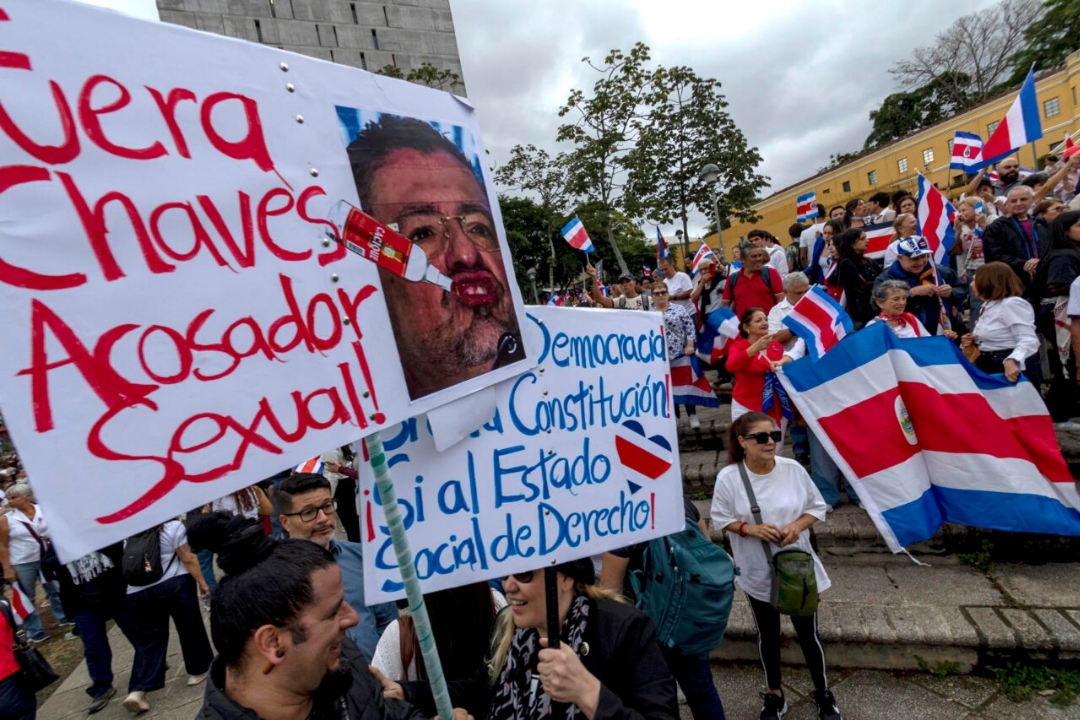
Below we are publishing an article by José René Tamariz on the conflict of powers in Costa Rica, originally published in *El Socialista Centroamericano* on August 18. Although there are some nuances or phrasings that we might express differently, we believe it is a valuable contribution to the discussion and guidance needed at this juncture. We are sharing José René’s work in order to contribute to the frank and healthy debate that we must promote within the revolutionary left so that we can make sense of the new developments arising from the authoritarian intentions of the disastrous government of Laura Fernández and Rodrigo Chaves.
By José René Tamariz
In Costa Rica, there have been repeated conflicts between the branches of government under the PLN, PUSC, and PAC administrations. However, the current conflict involving both the Rodrigo Chaves and Laura Fernández administrations is qualitatively different. The conflict between Rodrigo Chaves’s first administration and the legislative branch—which he did not control— as well as with the judicial branch and the so-called institutional framework, aimed—by leveraging his immense popularity—to discredit, undermine, and weaken those other branches and institutions, first to bypass the checks imposed on him at any given time and eventually to gain total control over them.
It is necessary and important to emphasize that, in the context of conflicts among the branches of government, the principled position of revolutionaries is not to take up the defense of one or two branches of the Republic against another. We do not defend any branch of government, much less the members of those branches. We do not defend magistrates, judges, prosecutors, or other high-ranking officials of the branches of government, since—regardless of whether they are elected or not—ultimately, they represent and defend the bourgeois system and order against the workers and the popular sectors.
An Unprecedented Conflict of Powers
During the second Chavista administration, under Fernández-Chaves, the conflict has escalated to new heights, as the Chavista movement now controls both the executive and legislative branches and is using both to attack, discredit, and eventually seize or undermine the judicial branch through various means. Because Rodrigo Chaves and the Chavista movement failed to achieve their political and electoral goal of securing 38 deputies—a qualified majority, or two-thirds—in the Legislative Assembly, through various political maneuvers and tricks, pressure has increased to control the judiciary and achieve their ultimate goal: to replace the bourgeois democratic political system with an authoritarian government or, to shift from the current weak presidential system to a strong presidential system, in which the executive branch decides and controls all branches of government and its institutions.
Initially, Rodrigo Chaves set out to win over or buy off—as he did during his first term—seven representatives from the National Liberation Party (PLN) to reach a total of 38 representatives and, by securing a majority, remove the justices and appoint his own. So far, Chaves has been unable to finalize this deal to buy off PLN deputies. Consequently, the conflict between the branches of government has deepened, and it is unclear how far it will go.
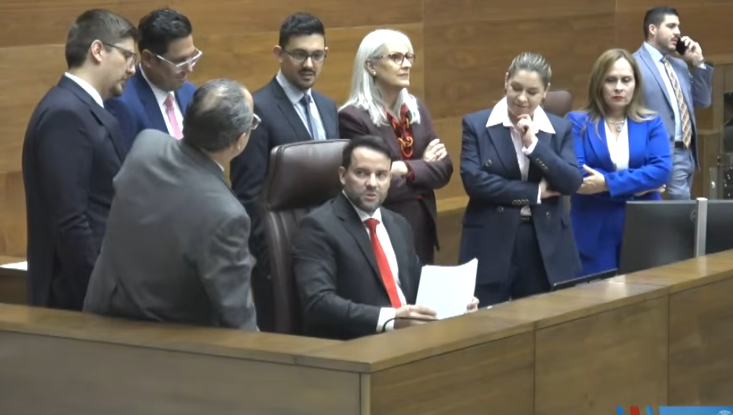
Executive and Legislative Branches vs. Constitutional Chamber
Recently, Chamber IV issued an unprecedented ruling extending the appointments of nine alternate justices of that institution as a temporary measure to prevent the body from grinding to a halt while Congress fails to elect those alternates. It is important to note that the Legislative Assembly, with a majority of pro-government representatives, has repeatedly refused to appoint these alternates because it does not approve of any of the candidates on the list submitted by the Full Court, which had resulted in the Constitutional Chamber being unable to issue rulings. This policy of the majority of pro-government legislators—to refuse to appoint the alternate justices to Chamber IV—was intended to block the functioning of that body and, thereby, effectively nullify the powers of the Constitutional Chamber.
That extension of the terms of the nine justices of the Fourth Chamber led Chavismo to publicly and vehemently denounce that the Chamber had carried out a “coup d’état” against the Legislative Assembly, which is obviously false. But Chavismo has gone much further. Deputy Nogui Acosta, head of the ruling party’s parliamentary caucus, has declared that any rulings or judgments issued by the Constitutional Chamber with the participation of the alternate justices whose terms have been extended by that institution will not be accepted or obeyed by the Legislative Assembly or the executive branch, since they consider the extension of these alternate justices’ terms by that institution to be illegal and, therefore, so too are the rulings in which those alternates participate.
On the other hand, most of the pro-government deputies filed a complaint for abuse of power against the four justices of the Constitutional Chamber who, by a majority vote, extended the appointments of the alternate justices of that body. However, there is a contradiction that must be resolved in order to address this complaint, since it requires the participation of the alternate justices from the various chambers of the judiciary—judges whom the majority of pro-Chávez lawmakers have refused to elect. But even if those alternate justices are elected in Congress, many experts maintain that the complaint has no chance of succeeding, since the rulings of the Constitutional Chamber cannot be overturned by any judicial body.
Undoubtedly, any refusal by the legislative or executive branches to recognize the rulings of the Constitutional Chamber would lead to greater confrontation among the branches of government, resulting in a serious political and institutional crisis and, eventually, a breakdown of the constitutional order. Should such a situation arise, we would be facing an unprecedented political and legal event with unpredictable consequences. To date, no ruling by the Constitutional Chamber has been disregarded, even though many politicians, labor unions, and other branches of government disagree with them; this would create a power vacuum resulting from unrecognized rulings. We will see what happens if such a situation were to arise.
The Mass Movement Takes Center Stage: The Sit-Ins in Defense of Democracy
The sit-in in defense of democracy and in support of the judiciary, held on August 6 in Democracy Square, drew a massive turnout. In addition, various sit-ins were held in different parts of the country (Cartago, Limón, San Ramón, San Carlos). Thousands of participants ended up chanting the slogan “Chaves Out!”—a demand that could increasingly become a political demand of the entire mass movement in the future. We do not agree with the defense offered at that demonstration by a sector of protesters in support of Prosecutor Carlo Díaz and other high-ranking judicial officials, since it is evident that institutions such as the Fourth Chamber have issued rulings against the economic, social, and labor gains secured through the collective bargaining agreements of many unions, as well as other questionable rulings.
It is important to note that this demonstration had a diverse social composition. Large segments of public-sector workers, groups of college students, and other sectors of the middle class participated. It is true that high-ranking officials from the judiciary and former high-ranking officials from previous administrations—such as former presidents of the Republic—took part. However, it must be made clear that this group represents an extremely small minority compared to the broad and massive participation of the masses from the middle and working classes.
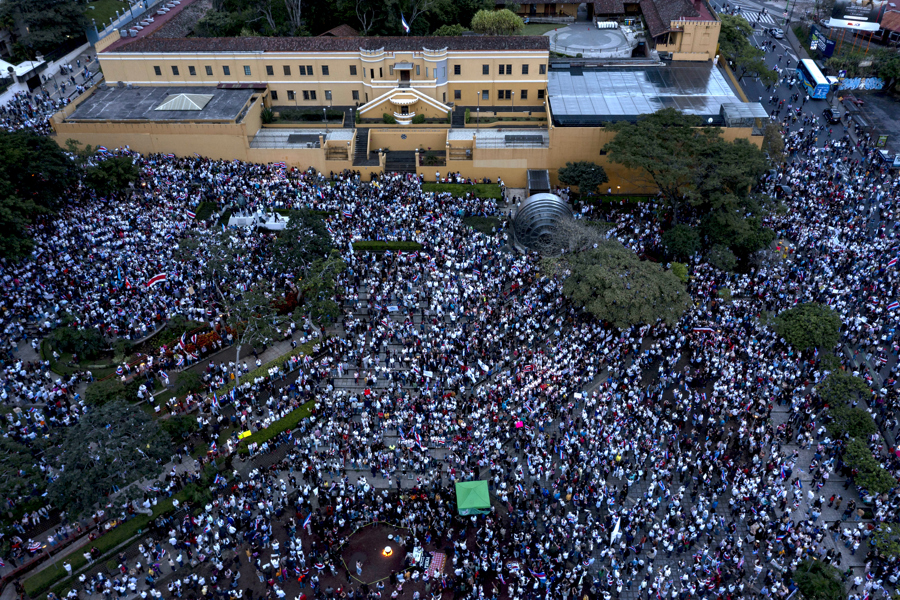
The emergence of a large segment of the mass movement in defense of democracy and in the conflict between the branches of government undoubtedly altered, for the time being, the balance of power between the opposing forces. It is important to note that Rodrigo Chaves and the Chavista movement are terrified of mass mobilization. Whenever there have been attempts at mobilization by unions and other social sectors, the Chavistas have sought to negotiate and prevent such movements from taking place. In this case, they were unable to prevent it. The Chavista movement has, for the time being, retreated in its offensive against the judiciary.
Social pressure from the August 6 protests forced Rodrigo Chaves, the Minister of Finance, to release ₡3,053 million that had been withheld from the judiciary’s budget. According to“Patricia Solano, president of the Criminal Cassation Chamber, stated on Monday that, in her view, the sit-in in defense of judicial independence and the separation of powers influenced the Ministry of Finance’s decision to reverse a budget cut it had planned for the judiciary.” (Teletica.com, August 17, 2026).
Bourgeois Democratic Illusions and the Defense of Democracy
There is currently a debate within various sectors, including left-wing groups, over whether to defend Costa Rican bourgeois democracy or to join forces with the bourgeois parties in the Legislative Assembly or reformist parties such as the Frente Amplio in defense of democracy and the independence of the judiciary.
In this debate, it is necessary and important to start from the level of consciousness of the masses. In Costa Rica, the masses harbor deep bourgeois democratic illusions about that political regime. These illusions are deeply rooted for various reasons, including participation in elections every four years; the freedom to express one’s opinion freely; formal press freedoms—even though the press is controlled by powerful economic groups; the freedom to participate in demonstrations; and other formal freedoms.
Those deep-seated bourgeois democratic prejudices among the masses cannot be broken or destroyed by words or theoretical arguments. Only the realities of the class struggle can shatter or destroy them—such as a brutal offensive by the ruling government against their standard of living, severe economic crises, attempts at Bonapartist coups, or other significant political, social, and economic events. On the other hand, it is important to note that we are clear that bourgeois democracy is a formal democracy which, in reality, serves the interests of the business owners and the wealthy who control the media; that there is, in effect, a dictatorship within private companies where union organization and freedoms are not permitted, and so on; yet despite this, the vast majority of the working masses and other social sectors are imbued with bourgeois democratic prejudices, which they can only break free from through systematic mobilization and class struggle.
Until those events occur, we must stand with the mass movement in its slow political process of breaking with those deep-seated bourgeois democratic illusions. Therefore, in this transitional stage of struggle and experience for the mass movement against the Chavista movement, we stand alongside them in defending bourgeois democracy against the danger of the establishment and imposition of an authoritarian regime that, in the style of Bukele, would end up imposing permanent states of emergency that eliminate the basic political freedoms of bourgeois democracy. In this transitional process, we must promote and drive forward—together with other willing forces—mobilizations, struggles, and other forms of resistance against the Fernández-Chaves government that will help them break with these false bourgeois democratic illusions, raising their levels of consciousness to advance the struggle against the capitalist system and its political agents—whether they be bourgeois political parties, reformists, or other types of leaders.
We must make it clear that our policy is based on class, not on political blocs. We do not side with the “democratic bloc”—composed of the bourgeois political parties (PLN, PUSC, CAC, and others) and the reformist party (FA)—against the “anti-democratic bloc” made up of the Fernández-Chaves government, the pro-government parliamentary faction, and the Sovereign People’s Party (PPSO). Our principled position is that we stand with the workers—whether in the public or private sector—as well as with students, the working class, and the middle classes in their struggle and mobilization against the Chavista government, which seeks to impose an authoritarian regime and its anti-worker and anti-popular policies.
However, this does not prevent us from forming circumstantial, temporary political alliances and unity of action with various political forces, whether bourgeois or reformist, but in order to organize the masses and drive mobilizations and the struggle against Chavista authoritarianism and its economic, fiscal, and other policies that harm workers, the popular sectors, and the middle classes.
Possible Scenarios for Conflict Among the Branches of Government
This acute conflict between the branches of government could lead to various possible political scenarios, depending on whether the conflict escalates, subsides, or the opposing forces reach a political agreement. Let’s see.
First scenario. If the conflict between the branches of government escalates to the point where the Fernández-Chaves administration, the Legislative Assembly, and the Chavista movement fail to recognize and defy the rulings of the judiciary, effectively moving toward authoritarianism, this could trigger a serious political and social crisis—a state of ungovernability—that could lead to physical confrontation between the competing social and political forces.
Second scenario. If the government and the ruling party were to undertake a process of de-escalating the conflict between the branches of government and political forces—ultimately recognizing the status quo among the branches of government—this would lead to a reduction in political and social conflict and, consequently, to a mitigation of the contradictions. This would be a process of de-escalating the conflict agreed upon in practice, without a written political agreement.
Third scenario. If, eventually, the so-called “democratic bloc” falls apart and the PLN reaches a political agreement or pact with Chavismo, in the old style of the two-party system, the conflict between the branches of government could slow down, but that would generate deep political rejection both among the rank-and-file of the Chavista movement and the PLN, which could instead spark a struggle and mobilization of the mass movement against the forces seeking a political pact. That scenario would serve the FA well because it would benefit politically by capitalizing on that political betrayal.
Since reality is more dynamic than any political forecast, it is likely that some unforeseen political development could occur. It remains to be seen how this acute conflict between the branches of government will unfold.