1. Marina, the world is watching the Plaza del Sol and the movement that keeps growing in your country. Can you tell us about the origins of this process and its structural causes?
Marina Mata. Obviously, what has happened in Spain over the past two weeks didn’t come out of the blue. There is an extraordinary amount of combustible material that has built up at the very foundations of society. All the anger over the rise of the far right, the high cost of living, precarious working conditions, miserable wages, the unbearable deterioration of public services and our neighborhoods, the tens of thousands of evictions that have taken place, and the armed robbery we suffer at the hands of landlords, vulture funds, and banks—all of this has erupted with colossal force. And working-class youth are playing a decisive role in driving the struggle forward.
The brutal eviction of Maricarmen, a neighbor over eighty years old who had been paying her rent for more than fifty years, and the police violence with which it was carried out, the contempt shown by Madrid’s pro-Trump president, Isabel Díaz Ayuso, and by the PP and Vox—servile lackeys of the oligarchy—, the fascist orgy we have endured for weeks of racist Spanish nationalism and the criminalization of migrants in Ceuta, and the deplorable attitude of this “progressive” government, incapable of implementing forceful left-wing policies to respond to the aspirations of the working class and youth, have backfired, acting as a catalyst for a fury that has left all political actors speechless.
We are facing a rebellion of a magnitude that is difficult to assess, one that directly targets capitalism and its political parties. Since the PSOE took office at La Moncloa in 2018, speculators’ dominance of the real estate market has become overwhelming. Home prices have risen by 100%, but rents in many cities have increased by more than 200%.
What does this mean? A massive transfer of workers’ labour value to financial capital, which is buying up entire blocks of apartments and taking over many social housing buildings that numerous city governments—such as Madrid’s—have handed over to them on a silver platter. Millions of young workers cannot afford a decent, affordable home, and hundreds of thousands of families are forced to endure brutal rent hikes or face eviction. More than 25,000 evictions are carried out each year in Spain, and this is happening under a “progressive government.” During the same period, real wages—adjusted for inflation—have fallen dramatically, and working conditions have worsened.
Significant segments of the middle class are getting rich through real estate speculation and the massive conversion of residential housing into tourist accommodations. It is an investment that turns a profit in just a few years, which is why international funds and banks are also betting on these high returns by mobilizing tens of billions of euros. This is leading to an unprecedented plundering of workers’ wages and the massive impoverishment of young people and broad sections of the working class, all amid a so-called “boom” in the Spanish economy.
2. It seems that the process is progressing from a lower to a higher level and that it just took a significant leap forward this weekend. Is that correct? Why?
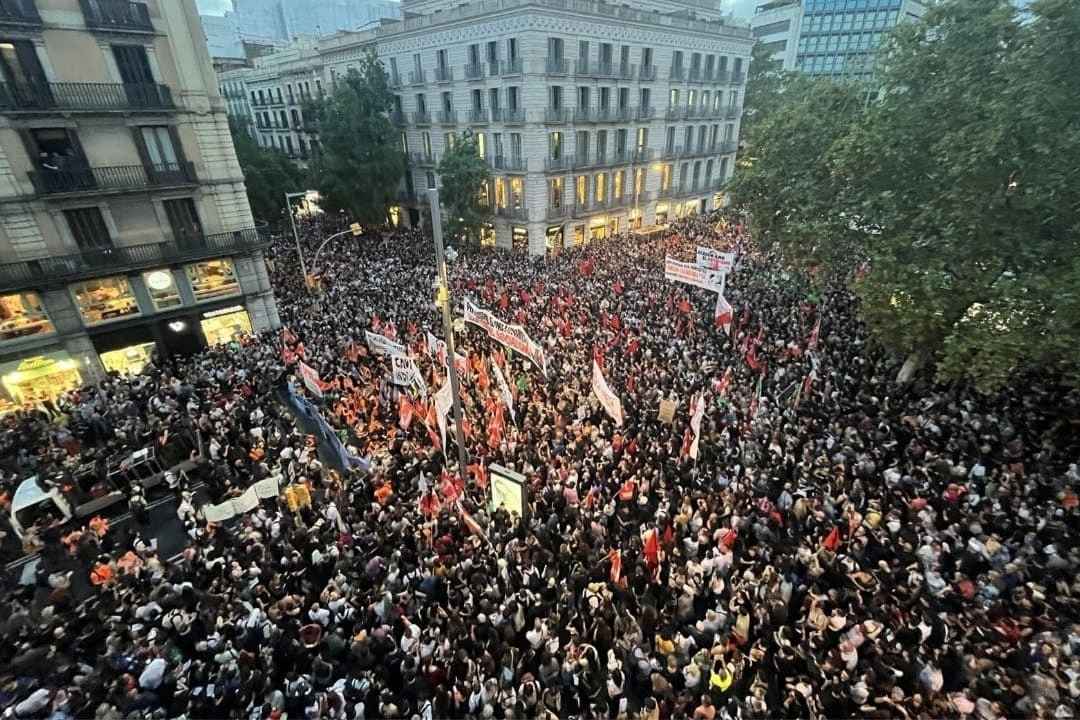
MM. That’s right. The demonstrations on Friday, October 2, and Saturday, October 3, were historic. Well over a million people took to the streets in Bilbao, Vitoria-Gasteiz, Zaragoza, Valencia, Málaga, Seville, Granada, A Coruña, Vigo, and as many as 50 other cities—not to mention the more than 200,000 who took to the streets in Barcelona on Monday, October.
In Madrid, where the demonstration exceeded all expectations. Four large processions set out from each of the city’s cardinal directions and converged on Plaza de Cibeles, in front of Madrid City Hall, in one of the largest demonstrations in living memory, with well over half a million people.
One factor that fueled the massive turnout at these demonstrations was the previous day’s vote in Congress on the two housing decrees, which were defeated by right-wing forces—the faithful guardians of their capitalist masters’ interests.
As we have explained, the decrees issued by the PSOE and Sumar are the result of our struggle and this overwhelming social upheaval, but they are woefully inadequate and have a clear objective: to try to defuse the mobilization without making even a dent in the power of the rentier class. But it’s also important to note that, for the PP, Vox, and Junts, the vote in Congress was an opportunity to inflict yet another defeat on an already severely weakened Pedro Sánchez and, above all, to throw down a gauntlet to the streets—to spit in the face of the Sol encampment, all the encampments, and the hundreds of thousands who are participating in or actively supporting the struggle for decent housing.
The right wing and the ruling class understood that the passage of even the first of the decrees—which is essentially a stopgap measure—would be seen as a victory for the movement. That’s why they had to derail it. They wanted to deal us a blow and sow discouragement, but their plan backfired.
The demonstrations showed that, far from giving up or losing heart, the movement has taken a giant step forward. The determination to maintain the encampments with the chant “We’re not leaving, we’re staying!” and the demand for a general strike to be called immediately is unanimous. The right to housing has become the central axis of the class struggle, and to win, we must shut down workplaces, schools, transportation, and all economic activity—and keep the streets occupied.
In Madrid, Izquierda Revolucionaria and the Student Union participated in the southern march, organizing a massive bloc that brought together thousands of people, the vast majority of whom were young people and workers from the most working-class neighborhoods. Of course, the call for a general strike took center stage on our banners, but we took advantage of the attention of thousands of demonstrators to raise a fundamental point of our program: the expropriation of the rentier class to create a public housing stock of millions of homes for the working class.
This is an idea that is gaining more and more traction and paving the way for the ideas of socialism—the revolutionary program of general expropriation of the means of production, the financial system, and capitalist property—to take root in the consciousness of thousands of young people and workers of all ages.
Once the Madrid demonstration was over, thousands of us returned to Sol to discuss the morning’s major events and prepare to confront the fascist rally called for on Alcalá Street, a short distance from the encampment. Several fascist groups had been threatening on social media for days to violently evict us from Sol, and finally, on Saturday, they made good on their threat and set a time: 7:00 p.m.
As we have done in recent days, at 6:00 p.m. we called an open assembly of Izquierda Revolucionaria in Sol with hundreds of activists. We briefly assessed the significance of the demonstration we had just held and emphasized the extraordinary strength we have demonstrated in just one week.
We also explained what fascism means at a time like this, marked by a deep crisis of the capitalist system and the rise of the class struggle. The assembly thus became a massive anti-fascist rally, with thousands of young people ready to erect a wall of resolve and working-class dignity against the Nazi gangs.
3. Are we witnessing the most significant mass uprising since the “Indignados” movement? What similarities and differences exist between the two movements?
MM. The balance of power has been transformed thanks to direct action and self-organization from below, driven by tens of thousands of young people and activists who have overwhelmed the bureaucratic apparatuses of the governmental, political, and union left, and who have drawn many conclusions from past struggles—especially from the great movement against Zionist genocide— as well as from the frustrating experience of these “progressive governments.”
The current struggle, led by a new generation, also represents a giant leap forward compared to the 15M movement of 2011. Anti-political prejudices have disappeared from the squares and demonstrations, which have been filled with red flags and a distinct class-based element, featuring clear anti-capitalist slogans, and which have made the expropriation of rentiers and a general strike their immediate agenda.
This is truly significant. The growth in awareness among broad sections of the youth—who are enthusiastically embracing the ideas of socialism and want to organize—is extraordinary. The mantra that change happens only in Parliament, and not in the streets, has been completely disproved over the past few days.
An attitude that is accompanied by another element that connects—and how!— with symbols that have been very present in the struggle against the genocide of the Palestinian people, in the teachers’ rebellion in Catalonia and the Valencian Community, and in the metalworkers’ strikes in Cádiz and at Airbus: the determination to fight to the end, to rely exclusively on our own strength and our capacity for organization, and to reestablish the democratic and assembly-based traditions of our class.
4. What debates are taking place within the movement and at the Sol encampment?
MM. The bold and courageous stance taken by the Tenants’ Union—standing their ground during Maricarmen’s eviction, confronting police brutality, and calling for the mobilization on Saturday the 26th—has earned them enormous support and respect among tens of thousands of people, which is an absolutely positive development.
This dynamic has been crucial in bringing to the surface—with such overwhelming force—the many contradictions stemming from years of economic prosperity for a minority and impoverishment for workers and young people, leading us, in just a few days, to face a social upheaval of this magnitude.
The fact is that we are witnessing a social upheaval—a colossal mass movement—that has forced the leadership of the major unions, CCOO and UGT, to call for a 24-hour general strike on the very same day that Sánchez dissolved Parliament and called for general elections on November 29.
As we mentioned earlier, the political upheaval we have triggered can be understood in this way.
At the Sol encampment, we’ve had intense debates, especially with those organizations that wanted to dismantle it as soon as possible and that clearly didn’t resonate with the majority sentiment.
At Izquierda Revolucionaria, we believe that when we speak of a mass movement of this magnitude—rather than a demonstration of thousands or tens of thousands—the role of the leadership is not secondary. It is crucial. Its attitude determines, to a decisive degree, whether the movement will achieve victory or lead to enormous frustration.
At the first demonstration on Saturday, the 26th, which drew more than 300,000 people, we participated with large IR processions and giant banners bearing three central slogans: “Expropriate the rentier class!”, “For decent, public, and universal housing for the working class!”, and “General strike to achieve this!”
The response to these ideas—which we set forth on thousands of sheets of paper that we distributed—was one of enthusiasm. Overwhelming enthusiasm.
What does this mean? It means that hundreds of hundreds of thousands of people—especially young people, who are the driving force behind this struggle—understand clearly that we must take drastic measures and employ methods of struggle that actively involve the working class. That we must bring the country, production, transportation, and the public sectors to a standstill… so that we can strike where it hurts the bourgeoisie the most and where we are at our strongest, because without our permission, not a single screw turns.
The idea of a general strike has captured the imagination of very broad segments of the workforce because it directly affects them: it is their sons and daughters who are being deprived of housing, who have been robbed of the chance for family independence, and thousands of families are facing unaffordable rents and the threat of eviction.
If this is the situation, a leadership that rises to the occasion must not only listen to the movement but also provide a roadmap capable of mobilizing its forces and building exceptional pressure so that the union bureaucracies are forced to break with their strategy of social peace and take the step of actually calling this strike.
For these reasons, it is very important not to adopt tactics that scatter our forces, weaken them, or divide them—especially at such a decisive moment, when our will to fight has been more than amply demonstrated.
It makes no sense to dismantle the encampment in Sol—or anywhere else—and it makes even less sense to argue that it should be dismantled so that people can “go to the neighborhoods to do grassroots work” and not “romanticize the tents.” Pitting “grassroots work” against the real strength that comes from having more than 1,350 tents in the heart of Madrid—a place where tens of thousands of young people and workers gather every day—makes absolutely no sense.
To abandon the ground we have gained—especially given that this weekend’s demonstrations were expected to draw massive crowds across the country—would have been to grant our opponents a respite and give them a lifeline.
Ultimately, the essence of these positions—which we have heard some organizations defend in recent days in Sol and at other protest camps—is a deep mistrust of the mass movement and a departure from revolutionary Marxism.
Our strategy—and our tactical slogans—have been vindicated by events. The general strike is now a reality, and the class struggle in Spain is currently at a fever pitch.
5. What is the PSOE government’s outlook in light of the decrees rejected by Parliament, and what is the most likely course of events following the call for elections?
MM. The Sánchez government has been completely taken by surprise by the scope and scale of this rebellion. It was completely at a loss, at the mercy of the far-right offensive following its regrettable stance on Ceuta, describing the events as a “violation of territorial integrity”—that is, treating them as an invasion, just as the PP and Vox have been claiming.
They tried to maneuver to gain support from the mass movement and connect with public sentiment by presenting these two decrees, which they deliberately split up to ensure support for the first one from the PNV and Junts—the nationalist right in the Basque Country and Catalonia. But as we’ve mentioned, the move backfired, and Junts ultimately voted against it.
That whole situation set the streets ablaze and led to even larger protests this past weekend, but above all, it made it clear that the current legislative session no longer made sense. With the government defeated on a crucial issue, it was time for Sánchez to capitalize on the situation and call for elections, mobilizing his electoral base with a campaign focused on the right to housing.
The pressure is so intense that the unions have also announced a general strike, and this will set the stage for an election campaign marked by mass struggle on an extraordinary scale. This is significant because it is an unprecedented scenario in Europe, in the sense that a social democratic party and the union bureaucracies have been forced to make these decisions, which—although they reflect the opportunism of their leaderships—demonstrate that it is unsustainable to maintain the social peace they have so strongly encouraged.
This opens up the possibility that the right’s victory could be thwarted—something that all the polls took for granted just a few days ago. Of course, this is not the only possibility. Class struggle manifests itself differently depending on the circumstances, and in the electoral arena, the right and the far right are highly mobilized, and all that social unrest that constitutes their base will turn out en masse to vote.
But the concern of the PP and Vox is evident. They are currently publicly claiming that the PSOE might rig the election and urging people not to vote by mail, following Trump’s model in the U.S. José María Aznar, former prime minister under the PP, has stated that the left wants a civil war.
The mobilization in the streets will, of course, translate into votes at the polls. Millions are well aware that a victory for the far right will be a declaration of war. But even if such a victory were to occur, in this context of a brutal escalation of the class struggle, the bourgeoisie will face a nightmare scenario. The strength of the working class and the youth is very much alive; there is confidence, there is determination, and there are many lessons learned from past experiences. This will not evaporate after the elections, whatever the outcome, because its roots lie in the crisis of Spanish and global capitalism. Therefore, we are preparing for momentous events that open up an extraordinary opportunity to build our forces.