Automatic translation made by AI.
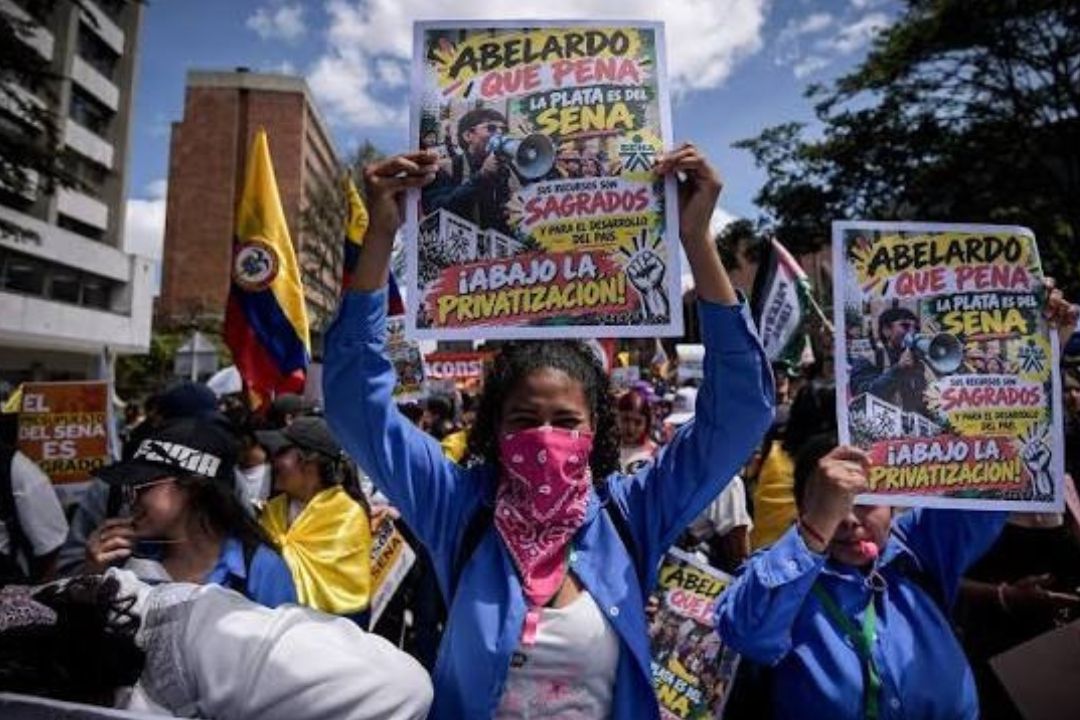
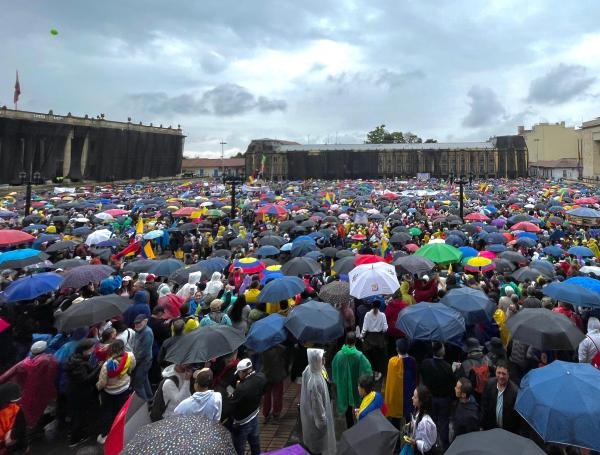
On October 14, the streets of the country’s major cities were filled with anti-government protests. The call for the mobilization had been decided at the National Meeting of Social Organizations. At that meeting—beyond the electoral ambitions of the leadership of the labor federations, the Historic Pact, or its parliamentary caucus—a broad sector of social, political, and regional leaders had expressed a preference for street mobilization and the organization of protests as preparation for a national strike. This strike has been announced for November, though no specific date has been set.
The massive turnout took everyone by surprise. First and foremost, it caught the Abelardo administration off guard, which had intended that day to unveil a decree regulating social protests with the grandiose title of “Anti-Terrorism Statute.” Many have pointed out that it is unconstitutional and denounced its aim of sowing fear among the population, which is well aware of the abuses committed by the misnamed “public forces”—the Colombian state’s aggressive repressive apparatus—against unarmed protesters. But the streets raised their voices, and it was among the government leadership that nerves were frayed. Although De la Espriella and the bourgeoisie’s mainstream media sought to downplay citizen participation, the government had to accept the resounding blow to its reputation caused by the demonstrations both nationally and internationally. For perhaps the most important point is that the protest against a government that had been in office for only two months was not aimed at economic demands or the rejection of any particular measure; it was an eminently political protest against the hardening of the regime that De la Espriella is heralding with his measures and the ongoing “cultural battle.”
Second, the organizers themselves were overwhelmed by the participation of various social sectors. October 14 brought together a diverse array of social, ethnic, gender, age, cultural, and political identities; while raising their own slogans, they knew that we are all facing the same enemy: a deeply reactionary, pro-imperialist, and pro-Zionist government that places Colombia on the map of the international far right and is now tainting the Americas with a fascist-like hue—from the U.S. under Trump to Chile under Kast—and now threatens a new electoral victory in Brazil led by Bolsonaro. Perhaps that is why, on October 14, a flag that today symbolizes international rebellion flew in every street in Colombia: the flag of the Palestinian people, who are resisting Zionist barbarism and genocide.
Third, the massive turnout at the marches also surprised the protesters themselves. The fear that had been circulating among the many groups that had been organizing the demonstrations for weeks—in the face of threats from the president and his ministers to clear the roads by force or carry out indiscriminate arrests of participants—gave way to joy and mass euphoria. Just a few days earlier, at “Rock al Parque”—the cultural event with the highest youth turnout in our country—tens of thousands of fans had chanted at the top of their lungs: “Abelardo, gonorrhea, the people won’t be silenced”; evidence that today a new generation wants and needs a different kind of society: one that is vibrant and based on solidarity, that cares for human beings and nature, rather than one that serves the destructive, exploitative, oppressive, and warmongering selfishness of big capital.
But it must be acknowledged that, to a large extent, the Historic Pact, as the main opposition party, succeeded in ensuring that the protests remained within the bounds of “civil disobedience” or “proactive opposition,” as Iván Cepeda put it at the opening of the National Gathering. That is why, in Bogotá, the main figures on stage were representatives of the bureaucratic union leadership, members of the parliamentary caucus, and former ministers from Petro’s government—not the activists in neighborhoods, villages, and rural areas who are facing unemployment, hunger, displacement, and armed conflict. Incidents—such as the one that occurred in Parque de los Periodistas—were the result of independent calls to action, in this case by the collectives that called for rejecting fracking in the exploitation of Colombia’s subsoil and the greed of mega-mining. The courage with which young people confronted police abuse in various cities is an expression of the indignation that has been pent up over the four years of Petro’s administration—an administration that sought at all costs to coexist with the most reactionary elements of the bourgeois establishment and ultimately accepted imperialism’s interventionist plans in our country and throughout Latin America, such as the coup against Venezuela.
Now we must continue with our plan of action against the De la Espriella administration. It is urgent that, from the grassroots level of labor and social organizations, we prepare for the National Strike to defeat all the regressive measures currently underway, starting with the mass layoffs in the public sector, the cuts to social spending in the 2027 budget, new borrowing from the International Monetary Fund, the handing over of our natural resources to predatory foreign corporations, Colombia’s integration into the Shield of the Americas, and the abandonment of earthquake victims to their fate. And we must also fight against the “cultural war,” such as censorship of journalists critical of the government, the work of artists, and historical memory.
We must promote local and regional gatherings where government policy is discussed, starting with the consequences of its “Anti-Terrorism Statute” and its escalation of reactionary measures; ranging from bloody military deployments and the summary execution of so-called “high-value targets” to the recent removal of political symbols from the National Museum. However, among our social demands, we must place special emphasis on plans for the reconstruction of urban and rural infrastructure and assistance for earthquake victims; in addition to an audit of the shadowy “Milagro Fund,” which is controlled by De la Espriella’s wife.
State workers, starting with public school teachers, can lead the struggle against the government by organizing a State Emergency Meeting to ratify the decision to call a national strike against mass layoffs and in support of job security for precariously employed workers. To this task we must add the demand for an adjustment to the minimum wage by 2027 that ensures a living wage.
A genuine national strike will confront not only the government but also the interests of the business associations—which will close ranks with it—as well as imperialism and its interventionist policies. Only the paralysis of the productive, distribution, and service sectors—as achieved during the social uprising—will enforce the people’s demands. In that sense, October 14 was the first warning to the government that we are ready to fight and will wage this struggle to the bitter end. But it is also a warning to the leadership of the Historic Pact: that the goal is to defeat Abelardo’s plan in the streets, not to make the mobilization conditional on negotiations or to form alliances with the bourgeoisie for electoral purposes.
On October 14, we reaffirmed Lenin’s words: “The revolution is the celebration of the oppressed and exploited.” A celebration that is spreading today in Spain, France, Germany, Italy, and Albania, where millions of young people are taking to the streets and standing up to governments that are savagely slashing social protections while increasing military budgets to drag their societies into the barbarism of war. They are our inspiration for the days ahead.
Workers’ and Socialist Unity: UNITE!
Bogotá, Medellín, October 22, 2026