A chronicle of six days in the heart of Europe on the rise.
By Lautaro Allassia
I arrived in Madrid on Thursday, November 5, with my usual suitcase and my usual suspicion: that one is always late for the important things. I was wrong. The important part was just beginning.
That morning, thousands of teachers surrounded the Regional Ministry of Education. They had been on an indefinite strike for nearly a month, and every day of the strike meant a day’s pay lost. They were demanding budget increase, decent wages, and an end to the diversion of public funds to subsidized and private schools. There were assemblies at each school and notepads with lists of picket shift schedules.
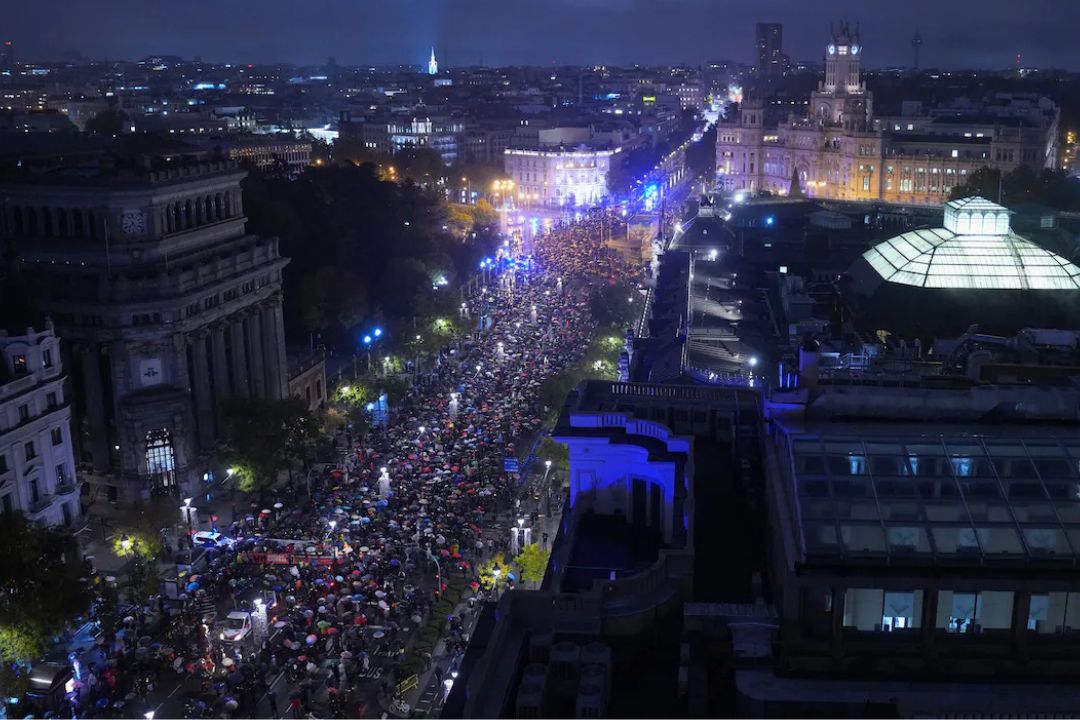
That afternoon, those teachers met with the university community. Then students, families, and neighbors joined them, swelling the crowd to 150,000 people rallying in defense of public education. They took over downtown Madrid.
An 87-year-old woman
To understand what’s happening in Spain, we have to start with a woman whom almost no one knew two months ago. Maricarmen was 87 years old and had been living in the same house for seventy years. One day, she was evicted from her home in a disproportionate police operation—the kind typically mounted against dangerous criminals. Such a massive show of force was deployed against an elderly woman that it sparked the pent-up anger of the entire society. Indeed, it was the straw that broke the camel’s back.
That’s when something snapped. Unaffordable rent, a minimum wage that doesn’t go far, and exploitative employment contracts were already the background noise for an entire generation. But Maricarmen’s image put a name and a face to what had previously been just statistics. It became clear to everyone who stands to gain from this. It’s not some inevitable fate or an abstract “market.” It’s vulture funds and real estate speculators with names, addresses, and balance sheets. And it also became clear who loses: ordinary people, who may end their days homeless after having lived their entire lives in a home.
That anger gave rise to the protest camp at Puerta del Sol, which the police eventually cleared out. But while the tents can be taken down, the streets—and above all, people’s consciences—cannot. What happened at Sol spread everywhere.
Rumors of a strike
I found out on the subway. I found out on the bus and in line at the supermarket. In Madrid, for weeks now, people have been talking about one thing and doing so out loud, without hesitation, even with strangers standing right next to them. WhatsApp voice messages played without headphones. Phone calls that end with the same phrase:
—How did the meeting go?
—So where are we setting up the picket lines in the end?
—What time is the protest?
And above all the questions, a slogan that was repeated like a greeting: On November 11, everyone goes on strike.
A general strike isn’t simply decreed. It’s prepared, and I saw it being prepared. Strike committees sprang up in the neighborhoods of major cities. The neighborhoods coordinated with one another. There were soup kitchens in the squares and informational picket lines at the entrances to workplaces, to explain to hesitant coworkers why it was worth going on strike. No one had to ask anyone for permission. That struck me as the most extraordinary thing of all.
Because it had been fourteen years—since 2012—since the leadership of Comisiones Obreras and UGT had called a general strike. No one handed this one to them on a silver platter. It was sparked by pressure from below—from the streets, from the neighborhoods, from teachers who had been fighting for weeks, and from young people who no longer accept that their future consists of a three-month contract and rent that takes up fifty percent of their salary. The union bureaucracies made their move because they had no other choice.
November 11
Today dawned with picket lines. Hundreds of workers have been blocking access to their workplaces since early morning. Reports coming in throughout the morning indicated that production had come to a halt at SEAT Martorell and Volkswagen Navarra, across entire sections of the Mercedes plant in Gasteiz, at the shipyards in Cádiz and Ferrol, at the ports, and at the petrochemical plant in Tarragona. Mercamadrid and Mercabarna, the central wholesale markets, had been at a standstill since before sunrise. The Barcelona metro was practically shut down.
There is talk of production being reduced by between 75 and 90 percent. The usual suspects will debate the numbers, each with their own agenda. What no press release can dispute is what we see: an entire country that, for one day, came to a standstill without anyone asking their boss for permission.
And the students: two million of them emptied the classrooms of thousands of high schools and colleges. There were youth demonstrations in Madrid, the Basque Country, Catalonia, Murcia, Andalusia, and Valencia. This rebellion has the face of a twenty-year-old. Young people—students and workers alike—took the lead at every gathering, at every picket line, at every assembly, and in every march. These are the very same people who were accused of having “all turned right-wing.”
The Government’s Response
The police, of course, also showed up at the picket lines. At the EMT bus depots in Entrevías, activists who simply wanted to explain to their coworkers why they were on strike were met with batons and pepper spray in their eyes. In the Basque Country, the Ertzaintza charged the picket lines, leaving dozens injured and arrested. As I finish writing this report, there are 27 people in custody across the country, and we demand their immediate release without charges.
The situation is the same as Maricarmen’s, just on a different scale. When those in power have to choose between guaranteeing the right to housing and protecting speculators’ businesses, they send in the police. The same thing happens with the “strike.”
What this means
From here, what seems vague from a distance becomes clear. This is not an isolated phenomenon. France, Portugal, Italy, Albania, and many other countries were part of the same upheaval. Europe is now one of the epicenters of a global surge in social struggles, which shatters the right wing’s claim that young people have turned toward it. And it also shows something else: the far right is not invincible.
But a strike, no matter how massive, is not enough on its own. You go home, and on Monday you have to pay the rent. The hardest part is still missing: a revolutionary leadership, rooted in workplaces and schools, capable of taking the lead in these processes and seeing them through to the end, without making deals behind the backs of those who are fighting for them. That is the task at hand, and that is what revolutionary youth everywhere are discussing.
I’m writing these lines as the afternoon is just beginning. Mass demonstrations are expected in every city, and the anger that has built up over the past few weeks will finally find its outlet in the streets. We at the International Socialist League (ISL) are an active part of everything I’ve described here, and now we’re preparing to come together, discuss, and draw conclusions. If any of this interests you, there’s a global event for ISL youth on November 14. Join us.