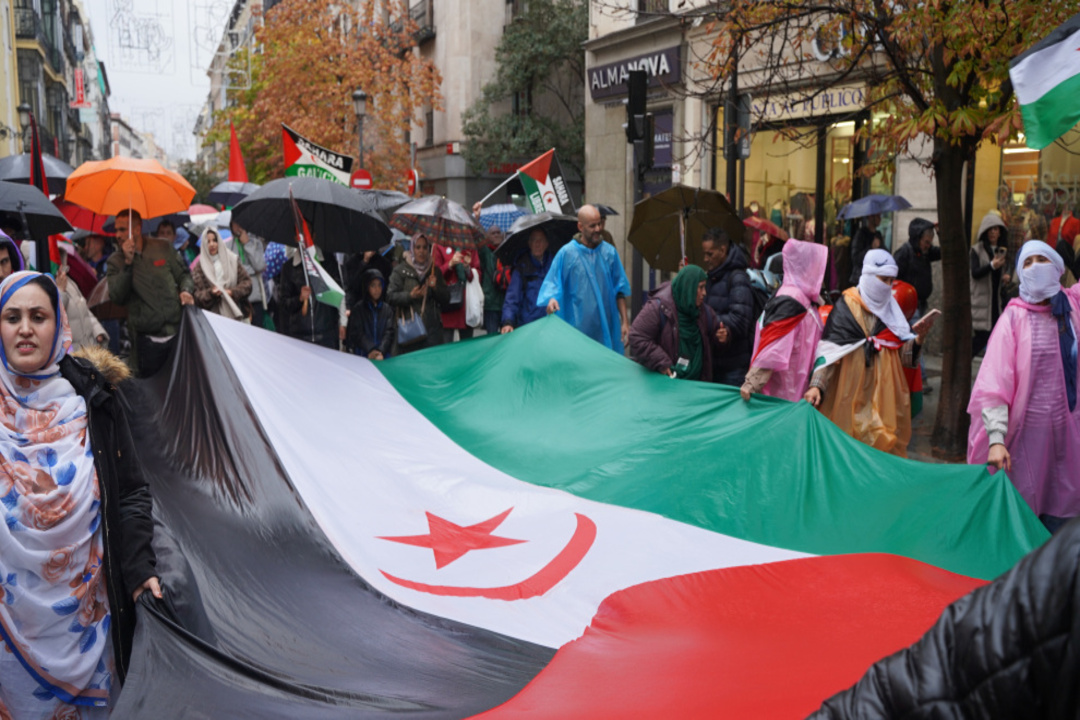
Fifty-one years after the Madrid Tripartite Agreements, the Sahrawi people continue to fight against the Moroccan occupation and for their right to self-determination. The withdrawal of MINURSO and the new threats reaffirm the need to strengthen international solidarity and defend a free Sahara.
By Flor Salgueiro
Protest in Madrid
On Saturday, November 14, marking the 51st anniversary of the Madrid Tripartite Agreements, the streets of the rainy Spanish capital once again served as the setting for a nationwide demonstration in solidarity with Western Sahara under the slogan “There is no solution without self-determination”
The Sahrawi people continue to demand the right to determine their own future, while the Spanish government still refuses to face the consequences of a decolonization process it left unfinished.
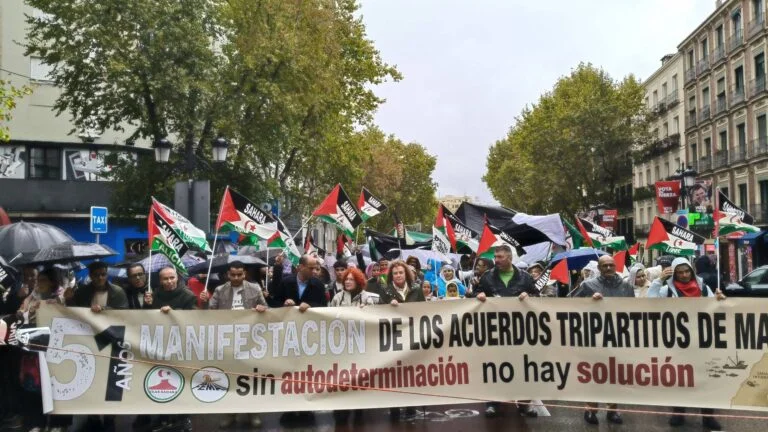
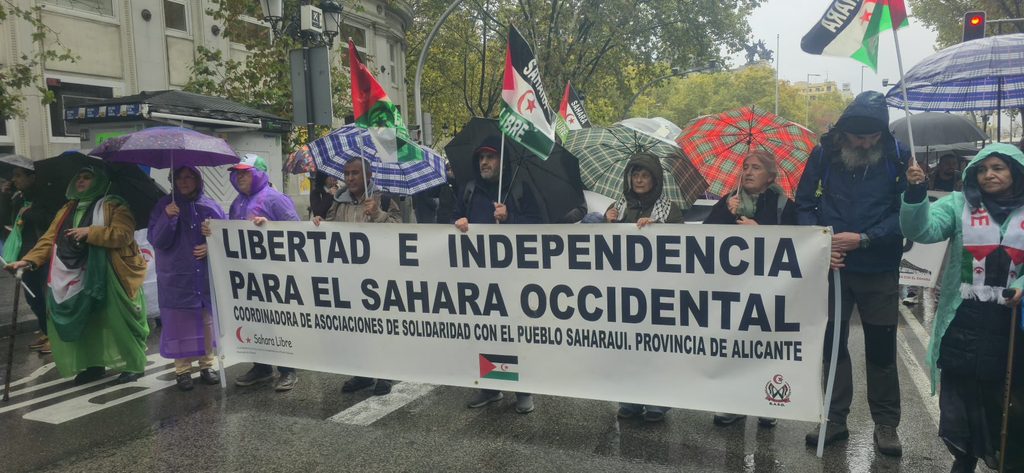
Over time, Morocco consolidated its occupation, and the Sahrawi people remained deprived of their freedom. Although more than half a century has passed, the Polisario Front, the Sahrawi people, and their youth continue to fight for freedom—both in the occupied territories and in the Tindouf camps, on the front lines, and in exile.
MINURSO, a Failed Mission
The recent vote in the UN Security Council reflected the inter-imperialist dispute over Western Sahara. The U.S. sought to impose King Mohammed VI’s autonomy plan—under Moroccan sovereignty—as the sole basis for negotiations, ruling out the possibility of independence and blocking the path to a referendum on self-determination.
Russia vetoed the draft resolution and pushed for an alternative initiative—which was also rejected—to renew the mandate of the United Nations Mission for the Referendum in Western Sahara (MINURSO) without imposing Morocco’s conditions, driven by its own strategic interests on the African continent. As a result, its mandate was not renewed, and the mission—created in 1991 to monitor the ceasefire and organize the referendum on self-determination—ceased to exist. After 35 years, it is leaving without having fulfilled the objective for which it was established and without having denounced the human rights violations, the torture of political prisoners, and the Moroccan attacks in the occupied territories. These are the reasons why the Sahrawi people had lost confidence in the mission.
You may also be interested in: “Trump and Morocco Want to Bury Self-Determination”
Growing Tension
The new situation has exacerbated the conflict between the Sahrawis and Morocco.
What Morocco will do remains to be seen. What is certain is that it will continue to push for the implementation of Mohammed VI’s autonomy plan, which is backed by the imperialists of the U.S., France, and Spain and which the UN considers the most viable solution to the conflict. Of course, we cannot rule out the possibility that the invaders will also attempt to advance militarily, taking advantage of the fact that MINURSO has withdrawn from the buffer zone established east of the Moroccan wall.
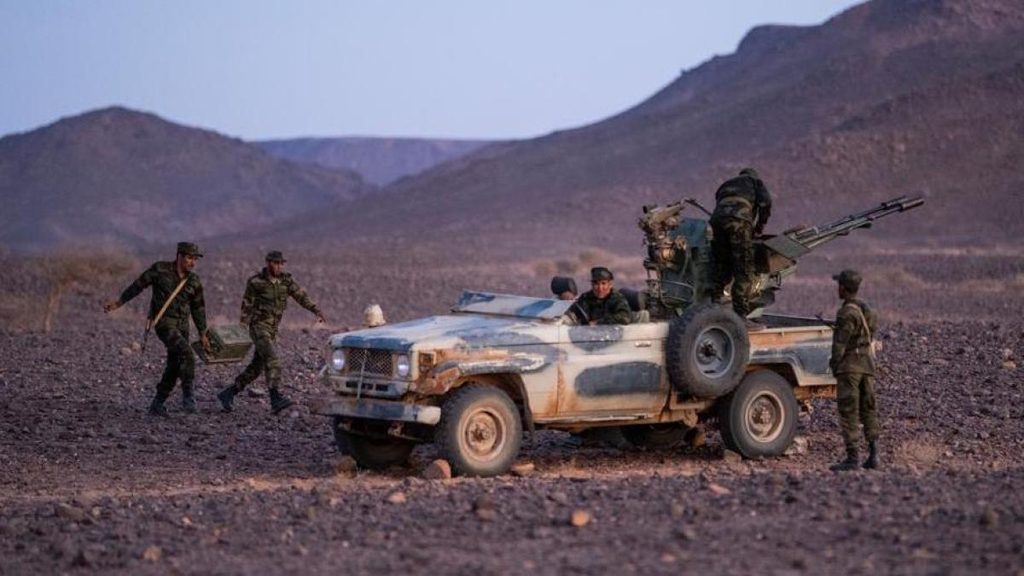
This is one of the reasons why the Polisario Front has declared a “general mobilization” against Morocco. Sidi Omar, the Sahrawi ambassador to the UN, made this clear in statements to the Blue Pass website, warning that: “If Morocco takes the risk and tries to occupy more of our territory, we will stand our ground.”
Possible referrals
A possible escalation could involve Algeria in a new and different way; Algeria is vying with Morocco for regional hegemony and has opposed the occupation of the Sahara from the outset. Furthermore, it opened its doors to the Sahrawis who were forced to flee their homes following the 1975 invasion and allowed the establishment of the five camps that still exist in Tindouf, which are home to nearly 173,000 refugees.
Another country that could become involved in some way in the event of an escalation is Mauritania, which shares a border of more than 1,500 kilometers with the Sahara.
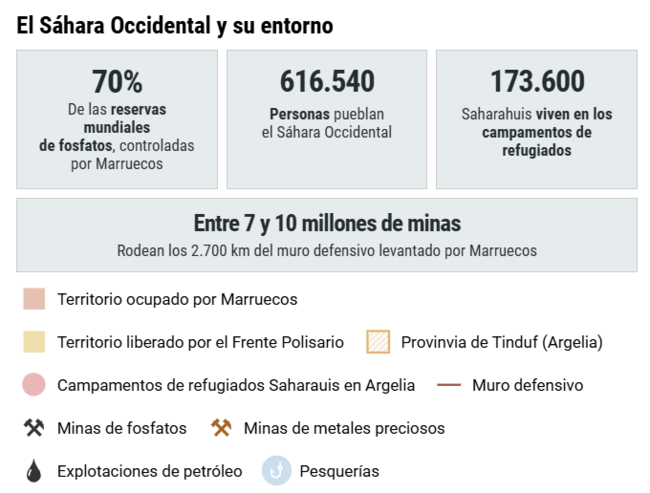
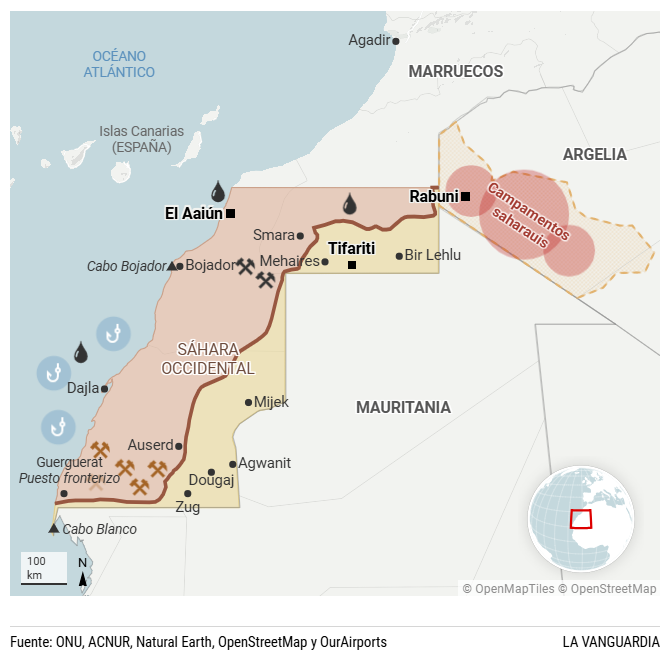
Africa is a continent where the predatory interests and influence of the imperialist powers—the United States, China, Russia, and Europe—intersect, and where the genocidal state of Israel also extends its claws through Morocco.
Therefore, an escalation between the Sahara and Morocco could turn into a broader source of conflict.
For a Free Sahara
We at the International Socialist League (ISL) will continue to defend the right of the Sahrawi people to determine their own destiny. This means demanding that the referendum on self-determination be held, free from interference by Morocco, the United States, or any other imperialist power.
We recognize the right of the Sahrawi Arab Democratic Republic (SADR) and the Polisario Front to defend themselves against Moroccan aggression by all means at their disposal. We condemn repression and human rights violations and call for the united mobilization of all African peoples and internationalist solidarity.
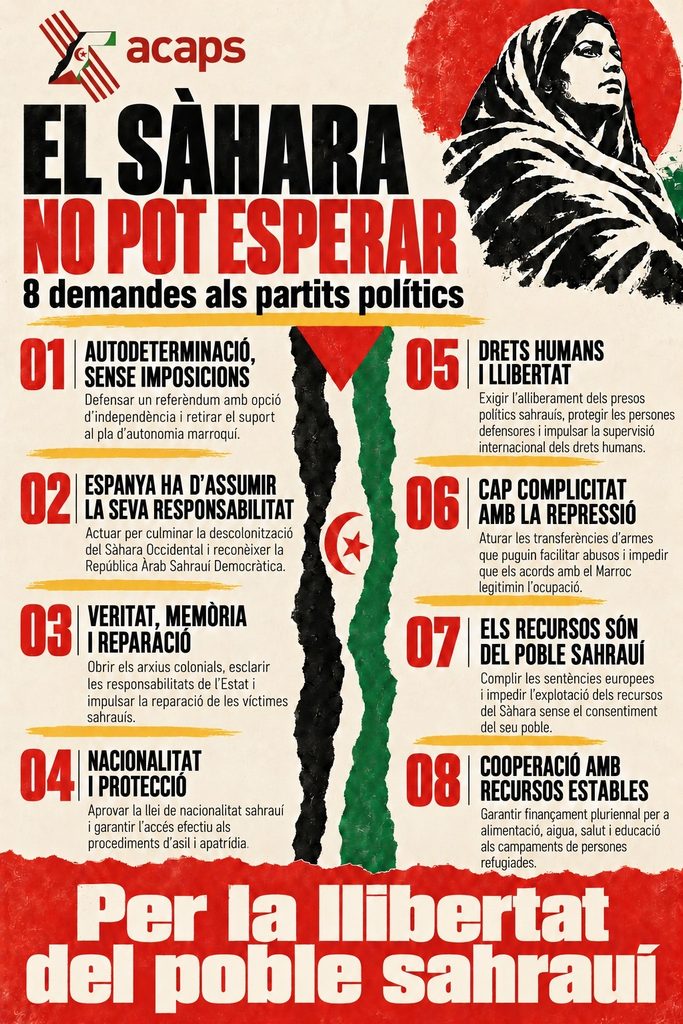
The next step in the protests will take place in Barcelona, Catalonia, on Tuesday, November 17, when the Catalan Association of Friends of the Sahrawi People (ACAPS) will hold a rally in front of the Spanish Government Delegation in Catalonia (278 Mallorca St.). There, the association will present solidarity demands ahead of the early general elections on November 29, which we at Socialism and Freedom (SOL) – Spanish State will support.