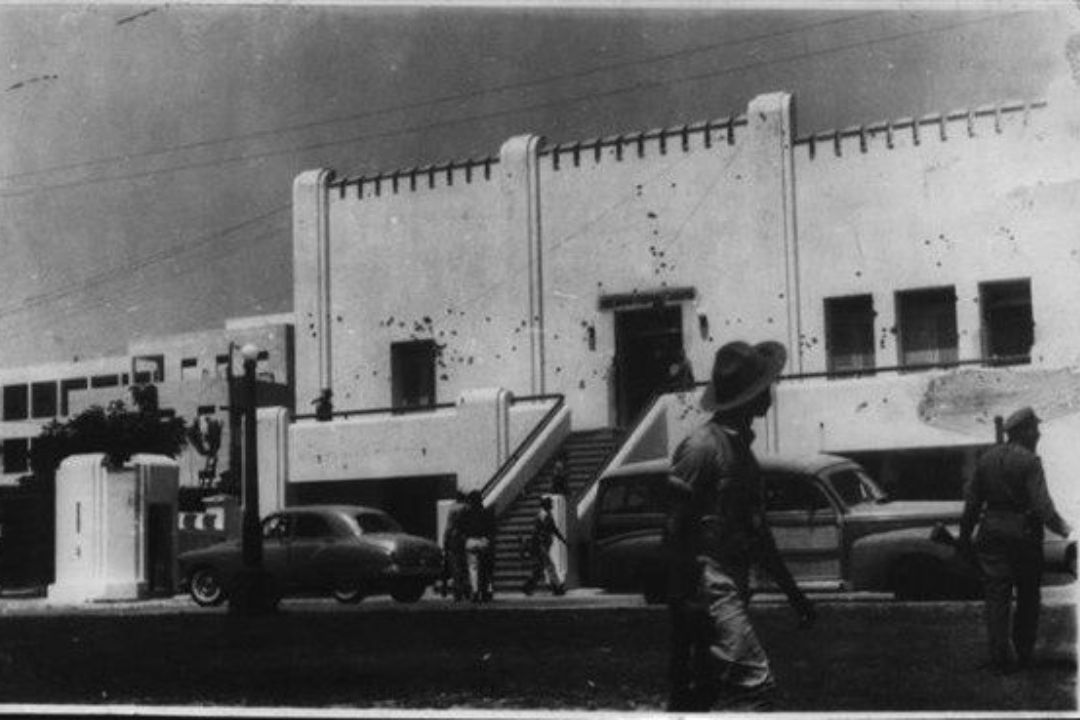
In the Cuba before the revolution, the discontent with the Batista dictatorship found an expression in the frustrated action commanded by Fidel Castro together with the youth of the Orthodox Party on July 26, 1953. The feat did not end the tyranny, but it started a path for the road to revolution, opening debates and new perspectives.
By Manuel Velasco
During the twentieth century, Central America was one of the main targets of American interventionism. The monocultures of coffee, bananas and sugar supported an agro-export economic model with great profits for landowners, entrepreneurs and poor living and working conditions for the majority sectors of the population. An imperialist enclave economy was practically constituted throughout the subregion.
Cuba in particular was the last Spanish colony to achieve independence, a process mediated by Yankee interests that, through the Platt Amendment of 1901, reserved the right to intervene in Cuba, perpetuating domination over the Caribbean country under a neocolonial model. The structure of foreign trade with strong US interference maintained the agrarian matrix, preventing any industrial development or favorable alternatives for Cuban economic independence.
The world wars allowed industrialization by import substitution in a number of peripheral countries, in Cuba it meant the possibility of taking its first steps on that path. However, it has always been a matter of relative industrialization, since the basis of the economy has never ceased to be the primary export sector.
In 1934, after the crisis of ’29, the Costigan-Jones protectionist law and the Trade Reciprocity Treaty were promoted to establish an export quota system and restrict the entry of Cuban sugar to the US market. In this way, the dependence on Cuba deepened, since from the United States it was determined how much sugar entered or not, the monoculture exploitation model was maintained without offering diversification alternatives and US economic control over the island was perpetuated. A clear example of the situation of inequality is the preferential treatment offered for 35 Cuban products, below 400 American products.
The sugar quotas and the system of tariff preferences were the pillars on which the neocolonial model was based in Cuba until 1959, the social repercussions it caused were the breeding ground for the radicalization of workers, peasants and youth.
Batista: tough and consolidated
In the 30s and 40s, the Latin American political scene was dominated by populist nationalist governments. The very dynamics of the Second World War allowed the proliferation of national bourgeoisies, starting with industrialization by substitution of imports, which took more prominence in the local economy. Governments such as that of Gentulio Vargas, Perón or Cárdenas positioned themselves as a pretended synthesis between the multiple rising classes. All of them got the popular support of the masses thanks to the granting of rights, without genuinely representing the interests of the working class. From a position of ”mediators” between the classes, they achieved a certain autonomy from foreign capital, but by the 50s their power ended up deteriorating, resulting in the definitive imposition of American monopolies over bourgeois nationalist projects.
With similarities and differences to the cases of other countries in the region, Fulgencio Batista emerged as a central figure in Cuban politics from the Revolt of the Sergeants in 1933. As a result of the Great Depression, the government of that time, led by Gerardo Machado since 1925, sought to suppress discontent and demobilize the student, workers and army sectors that were beginning to question its policy of unconditional alignment with imperialism. Gradually, the deterioration of support for his presidency ended up leaving him isolated to finally fall on August 12, 1933, pressured by a strike initiated by transport workers that later led to a general strike. A process of semi-insurrectional mobilization was initiated that put all the institutions in crisis.
As Machado’s successor, after a brief step of Alberto Herrera and Franchi for the presidency, Carlos Manuel de Céspedes y Quesada assumed. With Céspedes in power, the mobilizations and the organization of the opposition persisted. The demand for a new constitution to replace the one of 1901, where the Platt Amendment was embodied, took force.
In September 1933, the coup against President Céspedes was carried out and a Board called the Pentarquia was constituted in the Cuban government, composed of army officers and student leaders, which would later be dissolved by US pressure to leave Ramón Grau San Martín in the presidency.
Batista, who had been one of the organizers of the coup, was promoted to colonel-in-chief of the army and from there he played his cards to influence the government’s decisions. He consolidated his figure after the defeat of the general strike of 1935, where the main demand was “constitutional government without Batista”. Under the command of the army troops, he occupied factories, murdered workers and in the same context the university was closed, trade unions were outlawed and institutional guarantees were suspended.
Around 1939 Batista promoted the Democratic Socialist Coalition (CSD), backed and integrated by the Communist Party (PC) in exchange for its legalization, to participate in the elections of the Constituent Assembly. The process resulted in the Cuban constitution of 1940, where opportunistically elements such as public education, the minimum wage, universal suffrage and reforms in the agrarian property regime were incorporated, as a maneuver to gain acceptance among the popular sectors. The same year, Batista became president through elections, incorporating into his cabinet two ministers of the Popular Socialist Party (the name taken by the CP in Cuba). The political coalition headed by Batista reflected Stalinism’s following of bourgeois nationalisms (even the most reactionary ones), framed in the politics of the popular fronts, which allowed the establishment of diplomatic relations between Cuba and the USSR in 1943, during Batista’s presidency.
The search for consensus with the popular sectors and the Cuban political superstructure persisted with the promotion of a program of progressive measures such as economic diversification, regulation of the tobacco and sugar industries, social benefits for workers and extension of education in rural areas, for which the army played a central role. In the same sense, Batista ordered the distribution of state lands for families and the increase of workers’ wages. All this was possible thanks to the increase in the flow of foreign exchange obtained by the sugar and honey trade with the United States, which bought almost all of the production between 1941 and 1945.
With the post-Batista presidencies, a modernization of the traditional relations of dependence was structurally developed, by which Yankee imperialism made a series of industrial investments in the dependent countries. With the installation of some industries in 1946, tensions within the Cuban bourgeoisie were growing between the primary exporting sectors and those linked to import substitution.
The two governments of the Authentic Cuban Revolutionary Party (1944-1948 and 1948-1952) were characterized by inefficiency, corruption and violent political and trade union persecution. Meanwhile, Batista continued to hold military power.
Finally, in 1952 Batista commands the coup d’état known as the “madrugazo”. Having regained political power, he suspended the 1940 constitution, equalized his salary with that of the US president, suspended the right to strike and reinstated the death penalty. The reactionary turn was motivated by the new international economic situation that no longer yielded the same benefits for Cuba, consequently, the reduced availability of resources to grant concessions resulted in a more authoritarian change of the regime.
Take up arms
Neither Batista’s authoritarianism, nor the inconsistency of authenticity managed to provide answers to a sector of Cuban youth critical of the entire political and business class. In 1947, the political leader Eduardo Chibás founded the Cuban People’s Party (Orthodox), after his attempt to form a wing within the Authentic Party was frustrated.
Chibás’ proposal sought a break with the traditional political structure, recriminating the corruption of previous governments, taking social justice as the axis and appealing to economic independence. The slogan that was raised was “To rescue the program and the doctrine of the Cuban Revolution.” However, Chibás’ activity ended tragically with his suicide in 1951, a year before the elections to which the Orthodox Party would lead Roberto Agramonte as a presidential candidate.
The Orthodox Party’s electoral attempt was thwarted by Batista’s coup of 1952. Fidel Castro, at that time a young member of the organization, insisted on his democratic claim by filing a complaint against the dictator for violating the constitution. Without success in his attempt, it became clear that the only way to effectively change the course of history was by betting on a non-institutional way.
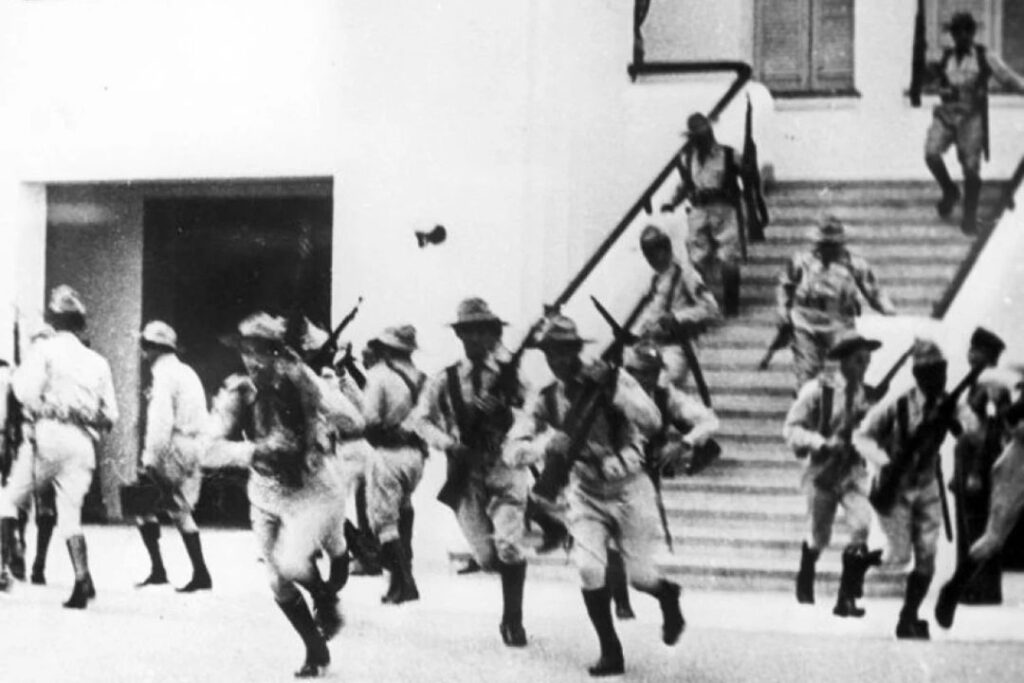
Castro’s election was due to the armed struggle, in which he entered on July 26, 1953, together with the company of 160 young members of the party founded by Chibás. The simultaneous assault of two barracks was planned, the Moncada (in the city of Santiago) and Carlos Manuel de Céspedes (in the city of Bayamo), with the aim of obtaining weapons and calling for popular mobilization to overthrow Batista. The operation was repelled by the army, the casualties exceeded half of the attackers, the rest were arrested and subsequently convicted.
The case of Fidel Castro is the best known, because before being convicted and fleeing to exile, he presents his plea “History will absolve me” where his reformist conceptions, trust in liberal democracy and a petty-bourgeois conception of the people are manifested where the working class is not assigned a particularly strategic role for the seizure of power. However, later on the very dynamics of the revolution would lead him to understand that the only way to advance his goals was by turning to a socialist program.
Fetish or revolutionary tactic?
The July 26th Movement (M-26-7), the name taken by the space led by Fidel, to which “Che” Guevara would later join, after the assault permanently lifted the use of weapons as the preferred way for the triumph of the revolution. Reviewing the history of Cuba, there were extensive experiences of mobilization led by the sectors oppressed by the neocolonial economic model. The constant frustration into which all the attempts resulted was the reason for the constant betrayal of the traditional organizations and the absence of a revolutionary leadership willing to carry out the socialist tasks with the protagonism of the working class.
Although the guerrillas finally managed to put an end to decades of imperialist domination after the revolution, vices of the inherited political system remained, such as dependence on sugar monoculture and the lack of democratization in decision-making, which favored corruption. Once again, the influence of the CP paved the way for new betrayals, making a litter of honest young revolutionaries become a bureaucracy ordered by their own privileges and detached from the needs of the people, replicating the experience of the Stalinist USSR.
In the same way, the lack of extension of the process outside the Cuban borders was a consequence, on the one hand, of the refusal of Castroism to accompany the struggle for socialism of the rest of the Latin peoples. On the other hand, Che’s correct insistence on promoting internationalism by fighting in the Congo and then Bolivia (despite the polemic with the perspective of “socialism in one country” supported by the guerrilla leadership), found its limits by mechanically extrapolating the method of rural armed struggle everywhere, without paying attention to the particular political and social contexts of each place.
Seen in perspective, it is clear that everything that the M-26-7 was able to advance did so due to the pressure below the mobilizations, breaking with all expectations in the capitalist-liberal system and the subsequent incorporation of a socialist perspective of government. By not channeling the process into a dynamic of permanent revolution, it finally ended up stagnating and retreating towards a situation of weakening in the face of Yankee imperialist power and impoverishment of the population. However, as happened on July 26, 1953, historical experience teaches us that the conclusions obtained from the initial frustrations are decisive to finally obtain the victory and to defeat the enemy once and for all.