By: David Morera Herrera
The purpose of this article is to analyze the latest developments in the acute social and political battle that persists in Panama, which has been going on for more than two months; as well as to discuss what we consider should be the most adequate revolutionary policy for the left and the Panamanian workers’, native and popular movement.
An exemplary and prolonged combat
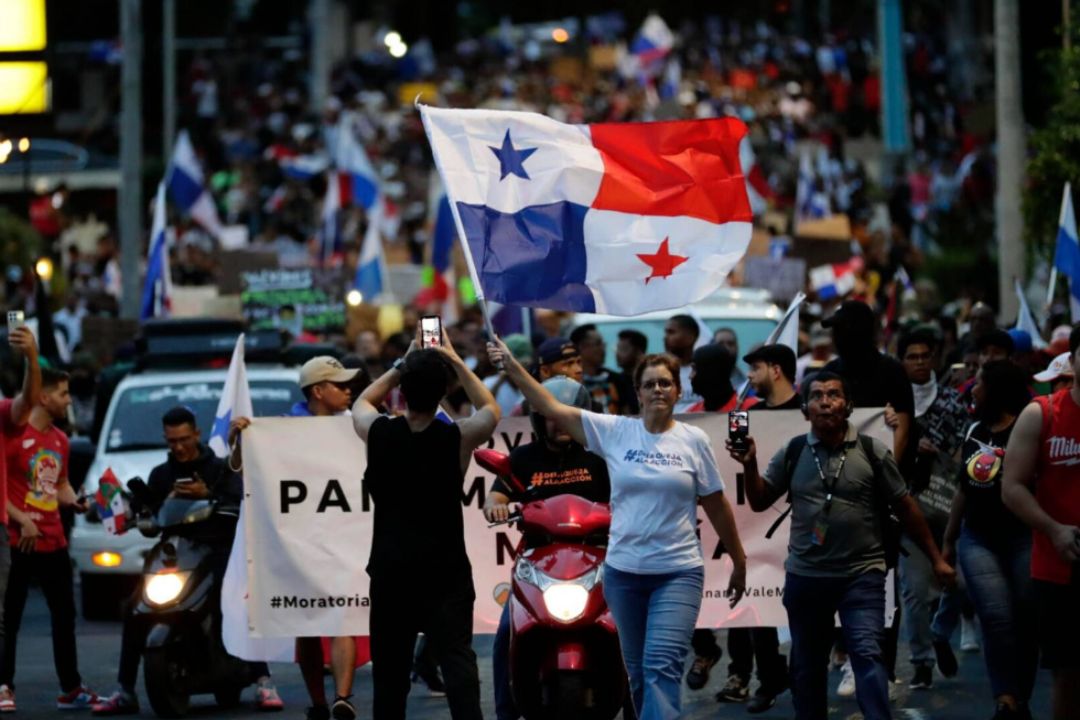
Since April 23, the public sector teachers’ unions have been on strike to demand the repeal of Law 462, a counter-reform to the pension system of the Social Security Fund. The powerful construction union (Suntracs) and the banana union Sitraibana joined in on April 28. The native peoples gradually joined the fight, closing national roads and barricades, in the context of heavy clashes with police forces. The Ngäbe peoples in Bocas del Toro, to the north, and the Emberá-Wounaan in Darién, to the south, stand out.
As comrade Alberto Giovanelli has indicated in another article, the days of struggles, although triggered by the imposition of Law 462, are combined with the rejection of the servility of the Mulino government towards Trump, by agreeing to open the U.S. presence in the Panama Canal. And not least, it is combined with the rejection of the government’s intention to reopen the copper mine in Donoso-Colón, which was closed after large demonstrations in 2023. The open-pit mining exploitation of the Canadian transnational corporation First Quantum was declared unconstitutional by the Panamanian Supreme Court, and represents a terrible ecological damage; as well as the rejection of the dams on the Indio River. Thus, environmentalist and anti-imperialist demands are combined, together with the social economic demands around the issue of pensions. In short, the masses have not stopped fighting, with ups and downs, of course, but with an impressive combativeness and persistence, to which is added an increasingly virulent repression by President Mulino.
A brutal repression
The government enters its first year and does so in an unpresentable manner. The most recent opinion polls show a broad rejection of the government’s administration by the population. A survey prior to the mobilizations, dating from January of this year, indicated that 7 out of 10 Panamanians do not trust Mulino. Today, by virtue of his repression and arrogance, the discontent is undoubtedly much greater.
Thousands displaced, hundreds injured, more than five hundred arrested without warrant, hundreds intoxicated with tear gas, missing, seriously injured and at least two dead, including a young student and a one and a half year old girl.
Added to this is the persecution and imprisonment of leaders of Suntracs, educators, banana workers and the university rector against student fighters. The wage cuts to the strikers who have been on the move for months, the freezing of the accounts of the main union Suntracs, the backbone of the workers’ movement, are taking their toll. The repression has not been in vain and today the mass movement is on the defensive, not on the offensive as it was for quite some time.
In this scenario, if the government is imposed, it would strengthen an increasingly authoritarian regime, certainly, but with feet of clay, due to the tremendous unpopularity of Mulino and what he represents as a disciple of the Martinelli mafia, former president fugitive from justice.
Repression and concerted action to demobilize
John Hooker’s June 30 statements regarding the mediation agreement between the banana union and the Ngäbe people in Bocas del Toro and the Army (which has brutally repressed them) led to the lifting of the road blockades, and to expectations of a resolution of the pension issue in parliament.
Not by chance, on July 1, under the title “Mulino is defeated in the Assembly”, El Periódico de Panamá states: “Jorge Herrera of the Panameñista party, ended up winning the presidency with 37 votes in favor, which represents an unprecedented victory against the Executive. The task to which the new president of the Assembly has committed himself is the repeal of Law 462 and to open a dialogue to reach a consensus on its reform that will safeguard the interests of the Panamanian people, and this will be done as of tomorrow. The imposition of Law 462 of the CSS is the one that has all Panamanians living in anxiety.
Immediately Saúl Méndez, general secretary of Suntracs, came out to claim victory in the social networks. Pretending that what Congressman Jorge Herrera said is a fact leads to disorient the masses. To trust in the “cave of bandits” of the parliament, or to negotiate separately each union particular concessions in the pension issue, is criminal and is the surest way to defeat.
The struggles need to be unified
The greatest shortcoming of this portentous movement lies in its leadership. In spite of the combativity of the mobilized people and in the face of the increasing violent repression by Mulino, the leadership did not orient itself to build a unitary body to plan and organize the struggle on a national scale, until it provoked a resounding defeat of Mulino. The masses have given ample proof of their strength throughout this prolonged day.
It would be a different story if only Suntracs, Sitraibana, the teachers’ unions and the native peoples’ districts had taken on the task of convening a democratic meeting to adopt a unified list of demands and a plan of struggle to triumph.
The issue of power is at stake
But, the enormous rise of the Panamanian people’s struggle is not indefinite. In life, and even more so in politics, nothing is static. So, what does not advance, goes backwards. What is striking is that the bulk of the left and the mass organizations as a whole, not even at the highest point of the mobilization, have at no time raised the slogan of Down with Mulino, nor (as we have already indicated) have the leading trade unions tried to establish organizations that unify the different sectors in struggle and that could acquire the capacity to dispute power.
Because when there are conditions for a true workers, indigenous and popular uprising, as is the case in Panama, the problem of power is raised in the program, both with regard to the regime and the government. Neither the National Liberation Movement MLN (which leads Suntracs and FER-29 in the student movement), the Polo Ciudadano, Propuesta Socialista of the UIT and the SU section of the Movement Towards Socialism MAS (linked to the Brazilian PSOL) have raised this crucial question.
In this regard, from the LIS and together with Panamanian comrades who have actively participated in the protests, we understand that it is vital to raise the slogan of power for the negative: Out with Mulino! and for the positive: Government of those from below: workers, native peoples, popular and oppressed sectors. Since the proposal for the positive is undoubtedly abstract, we are rightly asked: What workers’ and popular organizations would form such a government? Who in concrete terms would govern us if Mulino falls? Since the organizations of power of the masses themselves have not matured, we propose the original Constituent Assembly called by the organizations in struggle to re-found the country, changing the oligarchic and pro-Yankee regime.
We can accept that, in relation to the slogans of power, today in this defensive stage, they are no longer of agitation, but rather of propaganda. But it is still valid, due to Mulino’s spectacular unpopularity, and in essence it continues to be the most outstanding strategic need of the Panamanian people who have confronted him again and again in the streets. Furthermore, let us look at Mulino’s prospects, let us look at his political credibility, not only among the masses, but among the bourgeoisie itself, the change of rudder in parliament is a clear symptom of that realignment that increasingly isolates Mulino.
Broadest unity of action against repression
To make this discussion on the strategic solution in Panama does not imply at all that we have a maximalist position. The most pressing immediate need is to confront repression in all its forms. For this reason, the agreement or truce opened by Sitraibana with the support and collaboration of other popular organizations, without even asking for at least the decriminalization of all the persecuted, out of the hands of Suntracs and all types of police, administrative and judicial reprisals against those who fight, is a wet paper agreement.
With this criterion, from the LIS we invite the revolutionaries of Panama and the Central American isthmus, to assume these democratic tasks without any sectarianism, and at the same time, to continue debating and fraternally specifying the program and political orientation, in pursuit of the revolutionary regroupment.
[i] https://www.elperiodicodepanama.com/derrotan-a-mulino-en-la-asamblea/