In the Face of the Capitalist Crisis and a New World Disorder. A Program and Manifesto for the Socialist Revolution
Introduction
The world is facing a deep and systemic crisis of imperialist capitalism that threatens not only the rights of the working class, the oppressed, and the youth, but human life and the planet itself. We are witnessing profound changes. What remained standing of the old postwar world order and the capitalist globalization that followed the fall of the Berlin Wall is now collapsing. We are witnessing a reconfiguration of imperialist power, between an old imperialism in crisis and the rise of new imperialisms. This combination is generating heightened tensions and a great global disorder.
Global changes and new inter-imperialist tensions
Behind Trump’s second term as president of the United States lies a search by US imperialism for new rules of engagement that may allow it to maintain its domination, now questioned and contested by other rising imperialisms, and to recover enormous profits. This confirms that the 2008 crisis was never solved and that the US imperialist big bourgeoisie needs to try paths. With these political and economic objectives in mind, the United States proposes a new international order, leaving behind its previous alliances with European imperialism and other allies and advancing toward direct negotiations with the new emerging powers. At the same time, the US continues to deepen its dispute in all areas to reaffirm its hegemony now questioned by the rise of China and its partial and contradictory partnership with Russia.
With Trump’s second term, which has granted him unprecedented executive powers,
During Trump’s second term, has used his executives powers in an unprecedented way, such as issuing executive orders that allow him to impose regulations without following the full legislative process, or automatically repealing certain regulations unless they are reaffirmed by new legislation, economically and militarily forcing other states—both long-time adversaries and allies—to pick a side in this intensifying global confrontation, to bear the costs of the Reconstruction of American Greatness, and to display humiliating loyalty to the president.
The growing global disorder among the major powers is, in turn, giving the green light to several conflicts between regional powers and within states, in South Asia, the Middle East, and Sub-Saharan Africa. The United Nations and its multiple agencies for refugees, humanitarian aid, health, and human rights, lack resources and are unable to moderate or solve certain conflicts as they once did. Regional organizations and alliances are also weakening, collapsing, or fragmenting.
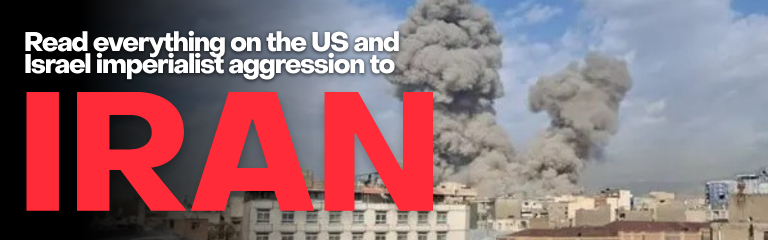
The US is forced to intervene directly in all tense regions, be it the conflict in Ukraine where it deals with Russia directly, displacing the EU from the center of negotiations, or Asia, intervening in the conflict between India and Pakistan. Even the Middle East, where it continuously intervenes through its support and financing of Israel. The US has its own plans for Gaza and seeks to weaken Iran with a powerful military fleet in the area that for the first time in years bombed Iranian bases, in order to rearrange a new negotiation. These are not isolated events. They constitute part of the new international situation we are entering.
The driving force behind these developments is the qualitative deepening of the rivalry between the old and new imperialist powers (NATO, AUKUS, and Japan versus China and Russia), along with the encouragement of conflicts among multiple regional powers. This is due to the astounding rise of China as the “workshop of the world” and the expansion of its invested capital in South Asia, Africa, among others. This has brought the United States—the world’s hegemonic power for the past 80 years—face to face with the prospect of losing its role as global banker, trade regulator, and enforcer of an order that seemed unipolar since the collapse of the Soviet Union in 1991.
With the support of the Republican Party, a considerable bourgeois sector, and another part of the economic-financial power that allows him to act that way Trump’s white supremacist MAGA movement, penetrated by outright fascists is a threat to all the exploited and socially oppressed. Trump is advancing, but he is also playing with fire in carrying out his reactionary agenda; kidnapping, imprisoning and deporting Immigrants, attacking women’s reproductive rights and those recently won by trans and non-binary people and attempting to strip people of color of civil and employment rights that were won through generations of struggle. The role of a weakened US as architect of a new world disorder is spawning further crises, financial turmoil, and the prospect of heightened tensions and confrontations.
These changes imply a reconfiguration of the imperialist world map and have a previous context with some important characteristics worth considering. On the one hand, the rise of new far-right forces that are trying to build much more authoritarian regimes in their countries to sustain their projects in the long term. Trump promotes a strong curtailing of social and democratic rights, as a foundation for his attempt to perpetuate his power through a more authoritarian regime, at the service of his imperialist project, and to revive the profitability and hegemony of US capital. The process is accompanied by populist and far-right street movements, the rise of reactionary and irrational ideologies, conspiracy theories and the exploitation of religious, racial and national prejudices.
These new far-right forces are a byproduct of the failure of the political regimes of capitalist democracy that preceded them. The failure of these regimes and their traditional parties gave rise to massive discontent. At first, this gave way to a search toward the left in various countries and continents, but the subsequent failure of reformist and possibilist projects deepened a general skepticism. Therefore, a search for rightwing solutions was opened. Trump, Meloni, Modi, Orban, Milei, the growing German far-right, Bolsonaro who is trying to return, among others, are the material result of this. These expressions act in direct association with the colonialist and genocidal State of Israel.
Another central element that marks this moment of change is the strong social and political polarization that has been developing over the years and this attempt to create a new international configuration has only intensified. In fact, what we are seeing is an advance of the far-right, combined with strong responses of class struggle, including within the US, a global process of solidarity with Palestine and significant social struggles on different continents. All of which expresses the need for a working-class leadership to forge an alternative path. The series of popular uprisings, strikes and mobilizations taking place are opportunities with great potential to break from the prevailing system. When they are halted or defeated, the main weakness of the subjective factor is manifested, the absence of a structured organization armed with the strategy, tactics and program, capable of leading the working class and its allies to the seizure of power.
The global economic crisis, far from being an independent process, constitutes the material basis of this social and political polarisation, and today manifests itself in new forms and more acute contradictions. Demand falls, bankruptcies and unemployment rise, state budgets are overloaded by massive debts and deficits increase. This, in a dichotomic framework, in which the economic growth of China and countries such as India or Indonesia and some other former colonies or deformed workers’ states continues at a high level. On the contrary, in the old imperialist economies demand falls. All of this is now compounded by a massive increase in military rearmament programs. Trump’s new policies will only deepen the unfolding recession crisis. Inflation is eroding the value of wages, public healthcare, education and welfare. Multinational corporations rely on millions of precarious workers as a reserve army, exploiting them when profits rise, discarding them when recession or stagnation hits. Driven by the logic of competition, they relocate and outsource factories, banks, and offices to extract greater profit. Massive job losses were already set in motion after the pandemic and are being exacerbated by wars and sanctions.
Furthermore, artificial intelligence (AI) and robotics threaten a massive labor replacement to increase productivity, although their long-term effect will be to reduce the rate of profit and deepen the system’s crisis. Employers dream of reducing labor costs by cutting the size of their workforces, not the hours they work. AI threatens the jobs of administrative, office, and service workers on a massive scale.
The working class has learned over two centuries that purely defensive opposition to the introduction of new technologies is futile. But also that these technologies are not neutral instruments: they embody the social relations of capital production. Therefore, the response of workers cannot be limited to using them to reduce the working day, but must aspire to transform, readapt or overcome them, and, when they hinder human development or destroy life, eliminate them. Technology can help humanity gain greater control over production and our interaction with the natural world. In a planned economy based on social ownership, AI and robotics would be a powerful tool for the emancipation of labor, allowing it to become more creative and expanding the realms that human intelligence can reach.
The current world situation features a scenario of increasingly critical regional wars, which, though not amounting to a third world war scenario, at least leaves that possibility open in the perspective of the world to come. While the United States does not retreat from its international military position, China increases its military investment and advanced technology for that purpose. European imperialism is also going through a strong militarization process and is developing new war strategies, in the face of the threat posed to Western Europe by Russia with its great military power.
Europe’s contradictions and weaknesses have only deepened as the war in Ukraine drags on and as Trump’s new policy of massive tariffs and defunding military aid escalates. Europe remains the weakest link in the Western imperialist chain and the continent where the working-class movements are most politically seasoned—and where the leaderships are most experienced at betraying them.
There is war drum rhetoric in the South China Sea, a tariff war between the U.S. and China that also affects Europe, and the redrawing of borders and agreements between powers over the heads of the peoples, as we are seeing in Ukraine. Meanwhile Israel is intensifying its colonization of the West Bank and East Jerusalem, and the genocide in Gaza—now with the U.S. aiming to become directly involved in these territories. Israel’s Western allies—whether social democrats, liberals, or conservatives—attempt to silence the solidarity movement with Palestine, but fail to do so. Netanyahu’s is in crisis, but as evidenced by its attack on Iran, Netanyahu attempts to flee forward to hold on to power, generating more and more crises in the Middle East.
Being in the midst of a deep change, there are elements that will develop in the future and open possibilities of new social and political events and phenomena. We do not consider things are easy in our vision of the world situation, precisely because we understand the changes and dangers that humanity faces in this new context of strong inter-imperialist dispute. Neither are we pessimistic. There are also strong processes of social polarization, class struggle and political opportunities for the revolutionary left.
On the basis of this general situation, which once again poses the alternative of socialism or barbarism, understanding the current world requires relating it to the main events that preceded this change, and to the particular situation of certain continents and processes.
From the crisis of 2008 to the present
After the great crisis and recession of 2008 came a contradictory recovery, sustained by historically low interest rates. This was followed by years of stagnation for the old imperialist economies, which gave way to a global surge in inflation, resulting in a rising cost of living that causes hardships for the working class and famines around the world. The economic disruption of global production and trade chains caused by the pandemic, the costs of sanctions and rearmament programs triggered by the war in Ukraine, and the accelerating consequences of climate change are interconnected crises that place humanity in the midst of a perfect storm—driven by the decaying imperialist capitalist system and the current world disorder.
The causes of the systemic capitalist crisis do not lie in a shortage or inability to produce what humanity needs. Factories, labor power, the means of production, logistics, and communication exist in abundance, as do scientific and technological means. The social means for global planning exist in multinational corporations and giant banks, but they are divided by private property and driven by self-destructive competition. The essential cause of the crisis of the system lies in the massive over-accumulation of capital, as it can no longer extract enough profits from production, at the same or greater rate as during the boom phase of globalization.
Hence, the “recovery” following the last recession faded and gave way to stagnation across broad sectors of the global economy. The solution dictated by neoliberal and monetarist theory—privatizations, increase in the intensity of the exploitation of both labor and nature, a massive destruction of capital to restore profit rates, etc.—comes at enormous cost to the workers. The response must be to fight back, to resist shutdowns and mass unemployment. This raises the need to place production under workers’ control and the power of the state in the hands of the working class. And this can only be done through revolution, by destroying the capitalist class’s state power—not through reformism.
The phase of so-called globalisation represented an expansion and reorganisation of capitalist accumulation on a global scale, characterised by growing asymmetrical interdependence between the main centres and peripheries of the system, under the hegemonic leadership of the United States and its international financial institutions. Rather than a process of balanced integration, it was the form taken by imperialism in its globalised phase. It was based on a benign symbiosis between the U.S. and the EU with China, as both a market for advanced technology and the new workshop of the world. However, in the current period of imperialist capitalism’s greatest decline, a rapidly growing new capitalist power like China has become a new imperialism.
Against all imperialisms and in dispute with campism
China’s willingness to ascend into the exclusive club of imperialist powers became evident after 2008, when it played an essential role in pulling the global economy out of the Great Recession and investing in different regions. This led to increased rivalry and conflict between old and new powers. Russia’s ability to escape subordination to the U.S., on the other hand, was based more on the profit from its abundant natural resources than on industrial growth. Economically, Russia is no match for China. But it still is a military giant—second only to the United States. This has allowed Putin to act as a significant player in the Middle East, Africa, and—through the war in Ukraine—a dominant one in his regional sphere of influence. Although they are advancing in different ways, China as the second world power and Russia as its on-and-off partner, are part of one of the imperialist poles that dispute mainly with the United States in the current situation.
As internationalists, we must not be dragged into any of the imperialist camps in dispute, nor side with any of them. The U.S. and NATO are not the only imperialist powers, and China and Russia are not anti-imperialist. Nor are their allies such as Iran or Venezuela, among others, progressive regimes. On the contrary, they are reactionary and we oppose them. In the old imperialist countries like North America and Europe, the ruling classes have manipulated the legitimate outrage of the masses over Russia’s atrocities in Ukraine, China’s internal oppression of Uighurs and Tibetans, and the crushing of democratic rights in Hong Kong, or the repression and persecutions in Venezuela, Nicaragua and Cuba by the respective regimes, to justify their Cold Wars and rearmament drives. Their claims to be defending democracy against autocracy grow more transparently false each day. Trump’s second term and his far-right agenda serves as a perfect example. Today, only revolutionary socialists stand in genuine defense of democratic rights.
Meanwhile, Moscow and Beijing woo governments of semicolonial countries across Asia, Africa, and Latin America by denouncing Western hypocrisy, its economic exploitation, the IMF’s brutal austerity packages, its invasions and occupations, and its economic blockades (as in Cuba, Venezuela, Iran, and North Korea). We value and support those who engage in legitimate resistance against the depredations of any imperialist power, or denounce their authoritarian and repressive policies, while we expose the real motives of their supposed allies. In doing so, we uphold the independence of the working class and its opposition to imperialism from both East and West.
We can support Ukraine’s struggle for self-defense, or that of peoples threatened or oppressed by Beijing, without giving any support to the war preparations and arms races launched by NATO powers—let alone their direct military interventions. In the face of imperialist wars, we maintain a revolutionary defeatist position: through class struggle, we aim to defeat their war agendas, prepare revolutionary forces, and lay the groundwork for social revolution and the overthrow of our own ruling classes. In the semicolonial world, we take a defensist position, while maintaining a strict political opposition and independence from the bourgeois leaderships of those struggles. We oppose every imperialist plan and the economic and political objectives of each of these imperialist powers in dispute. As socialists, we intervene from an independent position and in favor of the peoples against all imperialist interference. Our perspective is that of permanent revolution: the fight to bring the working class to the leadership of a legitimate war and to open the path toward social revolution.
Europe
The two dominant economies of the EU, Germany and France, have unsuccessfully tried to increase the bloc’s independence from the U.S. and to establish Europe as a global competitor to Chinese and American capital. A series of shifts in international dynamics years earlier—the bloc’s loss of the UK, the U.S.’s closest ally, the fostering of closer ties with Eurasia through oil and gas trade, and China’s Belt and Road Initiative—seemed to favor a somewhat more independent role for European imperialism. But the war in Ukraine first, and Trump’s new policy in his second term, restored U.S. dominance over the continent and dealt a blow to the plans of Paris and Berlin.
The EU remains one of the three major capitalist blocs. Although European capitalism’s productive forces long ago outgrew the national borders of its member states, the prolonged crisis afflicting the Union shows that the European capitalists are incapable of carrying out the task of unifying the continent.
The EU—its Treaties, its Commission, its Central Bank and its currency—is a coercive apparatus for the exploitation of the periphery by its imperialist core. It imposes savage austerity on the southern European states to protect imperialist financiers, provides material and diplomatic support for U.S. imperialist adventures, and manages its affairs through NATO and Fortress Europe. This imperialist architecture cannot be reformed to answer to social needs: we oppose its entire political, economic, and social scaffolding—its Parliament, Central Bank, Council, and Court of Justice. It is a structure that must be abolished through a socialist revolution culminating in a Socialist United States of Europe. One that advances on the basis of socialization and planning, in a way that develops the countries of the continent.
However, we have always rejected the illusion that the road to unification on a higher, democratic and socialist basis necessarily lies in dismantling large-scale political or economic units to restore their constituent parts. On the contrary, we seek to socialize and plan them in a way that contributes to advancing humanity. Socialism requires production on a continental and global scale. The perspective of socialism in a single country is even more reactionary today than when Stalin first affirmed it. The task of unifying Europe—recognized as necessary over a century ago in the wake of two world wars—falls on the shoulders of the working class if a third world war is to be avoided. The means to achieve it is revolution on a European scale.
The Semi-Colonial world
In the Global South, the illusion that the more advanced semi-colonial countries were following a Chinese-style path to development was dealt a mortal blow. At the height of globalization, they were considered “emerging markets” destined for sustained growth: the Asian Tigers, the BRICS, Mexico, Indonesia, Nigeria, and Turkey. The G20 was born out of this optimism in 2003. But aside from China and Russia, none of these countries managed to completely escape imperialist domination.
Resistance to the reimposition of even harsher authoritarian regimes in Algeria, Sudan and Rojava often saw the working class play a prominent, though not decisive, role; in no case were the regimes overthrown. Across sub-Saharan Africa, the United Kingdom, despite its own issues, has maintained spheres of influence over its former colonies, with varying domineering degrees. France, by contrast, has lost ground in Niger and other countries in the region, where there are semi-insurrections against its domination. There are also repeated mobilization processes in countries like Kenya. Now we are facing the emergence of a new nationalist phenomenon with the rise of Captain Ibrahim Traoré in Burkina Faso gaining growing sympathy in Africa. At the same time, Russia’s military and China’s economic influence is growing.
In Latin America, economies battered by inflation, unemployment, and debt constraints—combined with intense mobilizations—in the 21st century led to challenges from progressive-reformist forces that replaced right-wing governments. But in every case they turned out to be a disappointment by implementing austerity, paving the way for new rightwing and far-right forces to emerge, as in Brazil and Argentina. The continent is now marked by intense political and social polarization, a mix of right-wing and progressive governments, and waves of social unrest against austerity and repression.
China has managed to exploit semi-colonial discontent with the Western-dominated imperialist order through its so-called “debt diplomacy,” offering usurious loans without conditions. But swapping one imperialist usurer for another does not shield countries from the ravages of international markets, nor does it stop the new creditor from enforcing property rights over its investments. This will remain in force in the midst of the new disorders of the world and its inter-imperialist disputes.
Climate Catastrophe
The unchecked degradation of the environment, the exhaustion of common goods, and the emission of greenhouse gases heating the planet have reached the threshold of a decisive tipping point, posing a mortal threat to natural life and human civilization. The rise in extreme weather events—floods, wildfires, famines, and droughts of unprecedented intensity— alongside the accelerated melting of polar ice caps and glaciers, are clear signs that climate change is entering a deadly and unpredictable phase.
Global warming is the immediate threat, but not the only one. The acidification and pollution of the oceans, the overload and disruption of nutrient cycles, the depletion of aquifers, the destruction of biodiversity, and the accumulation of toxic chemicals in the environment and food chains all represent existential dangers to humanity.
The solutions to stop and reverse the looming disaster are clear—yet the world powers refuse to act. Trump has just finished the withdrawal of the U.S. from the Paris Agreements limiting emissions, deepening an already dire problem; every climate accord marks the refusal of the main polluters and their rivals to endanger corporate profits.
Capitalism is destroying life. It is a global system of environmental imperialism. Its foundation is the concentration of capital and the oppression of semicolonial countries through control over critical technologies and the export of capital. The exploitation of semicolonial countries by imperialist powers intensifies regardless of ecological or social consequences; the socio-ecological costs of capitalist production that are offloaded onto the semi-colonies. Monopolistic corporations in agribusiness, mining, and energy work hand in hand with local governments to suppress popular protests. In the imperialist centers, the predatory and unsustainable exploitation of the Global South is concealed behind cynical marketing for “sustainable” production and “fair” trade—propaganda in the service of corporate giants like Monsanto, Glencore, and Unilever.
While intervention and modification of nature to meet human needs are necessary and will continue under socialism, it is capitalism, driven by its desire for accumulation, that destroys it. The insatiable desire for profit, the exploitation of people and the planet, makes capitalist ‘development’ incompatible with the progress of human civilization.
Struggles and Leadership
From the 2008 crisis to the present, various phenomena of struggle have been developing. At the beginning, a wave of revolutions across North Africa and the Middle East took place, with workers’ strikes playing a decisive role in overthrowing long-standing dictators, even if those revolutions ended up failing, with power falling to Islamist or military forces. In the same period, mass protests, square occupations, and strikes against austerity erupted across Europe, particularly in Spain and France, and previously in Greece with a process of general strikes and huge mobilizations. The Syriza government, elected on a platform opposing the Troika’s demands and supported by the impressive mandate of the ‘Oxi’ referendum, capitulated and imposed the required austerity.
The defeats of the social movements, disappointments, betrayals, the crushing of the Arab Spring under the winter of counterrevolutionary dictatorships, civil wars, and the pandemic a few years later —which forced quarantines and sharpened recession— caused conjunctural moments of reflux in class struggle and stimulated the rise of the right.
Signs of renewed workers’ resistance and new openings quickly began to emerge. A wave of strikes and unionization campaigns took place in the United States. In Great Britain there were workers’ strikes as had not been seen in decades, along with strikes and mobilizations against the attack on the pension system in France. There were strong processes of struggle in Chile, Colombia, Ecuador, Peru, Haiti and Argentina, among other countries. With popular actions, strong student participation and in some cases strikes of the labor movement. During that period thousands of South African workers took to the streets to demand a basic income, a living wage and a limit on fuel prices and interest rates. There was a popular uprising against the government in Lebanon as well as against Lukashenko’s electoral fraud in Belarus. In India, millions of public sector workers were laid off or threatened with dismissal, triggering a series of annual Bharat Bandh strikes — the largest in human history in terms of the number of people involved. Thousands of labor struggles take place in China every year in industrial zones.
In 2025, new expressions of class struggle and social polarization are surfacing across countries and continents. Mobilizations of millions against Trump are emerging, a Palestine solidarity movement and revolutionary scenes are developing in countries as dissimilar as Panama and Kenya and strong strikes have taken place in central countries. Without an alternative leadership to the reformist, centrist parties and the union bureaucracies, opportunities can be squandered and the counterrevolution can prevail.
Political intervention in every struggle is essential— strengthening political leaderships based on class struggle and committed to the defeat of the capitalists, rather than negotiation and compromise within the limits they impose. Class independence, militant action, and grassroots democracy are crucial. They lay the foundation for building revolutionary parties and a new international. We fight against the policy of reaching agreements with bourgeois parties.
For a long time, social democratic, labor, and communist parties served the capitalists as alternative parties of government in the imperialist states of Europe. These parties share a common layer of privileged professional bureaucrats and parliamentarians who collaborate with capitalism and serve the ruling class, whether in government or opposition, frustrating their rank-and-file. In Europe and Asia, for the last 20 years, these parties adopted the neoliberal, pro-market policies demanded by the capitalist class, that is austerity, privatization, and wage attacks. With the capitalist restoration in the former USSR, Eastern Europe, and China, Stalinist Communist Parties around the world shifted further to the right.
In the 2010s, new reformist formations emerged. Sectors of the left, led by the United Secretariat, saw in the rise of Broad Parties encompassing both revolutionary and reformist currents as confirmation of their rejection of the Leninist party model. It is correct to engage with broad leftwing formations—even to join them where they represent a break by large numbers of workers and youth from liberalism, right-wing social democracy, or populism. But they are tactical interventions of a limited duration, which is why in all these cases we intervene with political and organizational independence, and critically with a revolutionary policy.
In Latin America, the governments and movements invoking 21st Century Socialism suffered an involution process and gradually shifted to the right. The most striking shift came from Chávez’s successor, Nicolás Maduro, who degenerated into a repressive, authoritarian Bonapartist regime. The failure of these projects—and others like Kirchnerism in Argentina — faced much harsher conditions due to the global economic crisis they had no room to meet urgent social needs and were unwilling to take anticapitalist measures, expropriating a sector of the bourgeoisie, or multinational corporations. Thus failing and paving the way for the emergence of new far-right forces, including the reactionary victories of Jair Bolsonaro in 2018 and Javier Milei in 2023. The same applies to Lula’s current presidency in Brazil, which despite the rhetoric, defends the interests of Brazilian capital and faces opposition from Bolsonaro’s base—more openly far-right, pro-fascist, and better armed than Trump’s.
Older Latin American regimes led by reformist left or Stalinist forces—like those in Cuba, Nicaragua, and Venezuela progressively consolidated highly repressive and authoritarian regimes, rather than establishing workers’ and peasants’ democracy or implementing genuine anti-imperialist policies that could have propelled a continental revolution. We are left-wing opponents of all those regimes and at the same time oppose any imperialist intervention against them.
In Africa, military coups and Bonapartist presidencies, Islamist insurgencies, and terrorism have compounded the suffering caused by imperialist exploitation and environmental degradation under the weight of exploitation by Western corporations and banks, tied to debt burdens and IMF/World Bank-imposed “reforms.” Liberation movements rapidly descended into corruption and repression by the new elites. In response, masses of people in several countries have begun to rise up against this new offensive. In the midst of the crisis, a new nationalist political project broke out in Burkina Faso, which expresses the growing discontent and to which we respond with demanding policies from an independent, anti-capitalist and socialist position.
It arises on a global scale, as the need for a new revolutionary International, a successor to those of the past that can learn from both their failures and successes. It is urgent to bring revolutionary organizations together, internationally and in each country, and layers of popular, young and working fighters, with a revolutionary program—of global reach and providing answers to the question of power—a strategic solution to the crisis of the capitalist system.
A Program of Transitional Demands
The programs of workers’ parties have long been divided between a minimum program of gradual reforms—reforms that capitalists can easily reverse as long as they hold state power—and a maximum program for socialism, presented as a distant utopia disconnected from the current struggles and demands of the working class.
The program of a new revolutionary international stands in stark opposition to these failed models. It advances transitional demands—integrated and connected slogans and methods of struggle that respond to the capitalist offensive. At the same time, it sets forth the necessary means to overthrow the bourgeois regime, establish workers’ power, and implement a socialist plan of production. Our program addresses vital social, economic, political and immediate democratic demands.
Just as Karl Kautsky, the “Father of Marxism” of the Second International, rejected the October Revolution—with its destruction of the armed and bureaucratic machinery of the bourgeois state and its replacement by workers’ councils or soviets—today’s neo-Kautskyists reject any strategy for revolution, at least in countries that have already achieved parliamentary democracy or could do so through unstable and limited democratic reforms. We, supporters of the program of Lenin and Trotsky, while never for a moment rejecting a militant struggle to wrest economic, social, and political concessions from the capitalists and their state, will never spread the illusion that capitalists will relinquish the means of production to parliamentary majorities or to the laws they might pass to expropriate them because the bourgeois state is an apparatus at the service of the ruling class and, as such, cannot be used to achieve revolutionary goals.
The idea that socialism can be achieved peacefully through gradual reform and negotiation is a utopian illusion. The socialist program challenges the core “rights” of the capitalist class: the right to own the means of production, the right to exploit the workers, the right to prioritize profit over people, the right to accumulate wealth at the expense of the poor. The right to destroy the planet and rob future generations of any hope.
A new international must put forward demands and organizational forms that meet the immediate needs of workers while also preparing them to seize and wield power. Our program advances the demand for workers’ control over production, extended across other spheres of society—from factories, offices, transportation systems, and retail chains, to banks and financial institutions.
The struggle to win and impose these demands on the employers requires new forms of organization that go beyond the limits of trade unionism and parliamentary politics. At every level of struggle, decisions must be made democratically in mass assemblies of those involved.
Workers fighting austerity and cutbacks may raise such demands in response to specific attacks. But the socialist goal of the program will only be realized when these demands are fought for as a unified, interconnected system for the transformation of society. The full transitional program is a strategy for working-class power. Our demands are not passive appeals to governments or employers—they are fighting demands that escalate until the working class overthrows and expropriates the capitalist class.
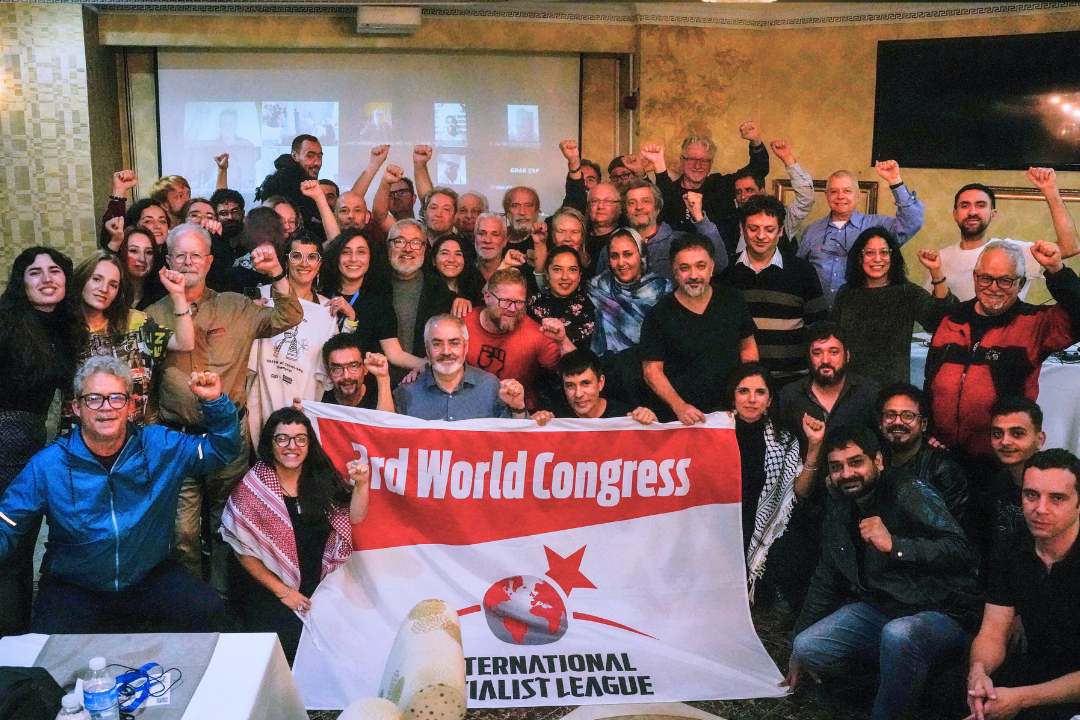
We publish this program as a contribution to fostering the rapprochement of revolutionary forces, tied to proposals for joint actions and campaigns, alongside a serious discussion on the program a new revolutionary International requires. It is a proposal for debate with all those who understand the need to build a new International and, therefore, the regrouping of revolutionaries, which the ISL promotes as a central task together with all the forces that are converging in this Third World Congress.
Against the Capitalist Offensive
In the face of employers’ attacks on living standards, our policy is the workers’ united front: the common action of all forces of the working class, within each country and across borders and continents. The broadest possible unity in action—always with political independence.
Living wage, Jobs for All, and Workers’ Control
• Against inflation that erodes workers’ wages, we fight for a sliding scale of wages—automatic raises that match the cost of living. Price monitoring committees, composed of delegates elected in workplaces, workers’ organizations, working-class neighborhoods, and organizations of women, consumers, small producers, and small traders, must maintain an index of real living costs.
• In countries facing hyperinflation, a sliding scale of income and price monitoring committees will not be enough. The distribution of essential goods and access to food requires direct intervention: workers’ committees must take control of food supply chains in direct coordination with agricultural producers and local communities.
• We fight for a national minimum wage set by workers’ committees that guarantees a dignified life. Pensions must be indexed to inflation and guaranteed by the state. A universal unemployment benefit must be provided to all jobless workers until they obtain decent employment.
• Against closures and layoffs, we fight with strikes and occupations. Cut hours, not jobs. For a sliding scale of working hours, reduced workdays, and the redistribution of available work—without cuts in wages or working conditions.
• Against governments and employers that invoke bankruptcy, efficiency, and productivity to justify job cuts: opening of all their financial books and the investigation by elected delegates of the workers of their accounts, databases, and financial, tax, and management data.
• Companies that carry out layoffs, relocate production, violate minimum wage laws, health and safety standards, environmental regulations, or evade taxes must be nationalized without compensation, with production placed under workers’ control and management.
• We call for a program of socially useful work to improve public services—healthcare, education, housing, transportation, and the environment—under the control of workers and their communities.
• No to outsourcing and offshoring. Instead of pitting workers from different countries against one another for the same jobs, we must build international coordination among workers in the same companies and industries to fight for equal pay. Collective agreements and legal rights must apply equally to workers employed by subcontractors.
• For secure employment: we oppose all forms of informal and precarious work. We demand guaranteed-hour contracts. Wages and working conditions must be governed by collective agreements overseen by unions and workers’ representatives.
• We fight against work intensification driven by speed-ups and “efficiency campaigns” that only serve to boost profits while endangering our health and our lives.
• Against “co-management,” “public-private partnership,” “social partnership,” and all other forms of class collaboration in which unions help implement the bosses’ agenda, we fight for workers’ control. For the right to veto management decisions regarding employment, production, and the introduction and application of new technologies.
For Universal Public Services and Social Security
The wave of “reforms” to public services are nothing but austerity programs aimed at offloading the costs of declining services onto the working class. Vital services and resources— from water and energy to healthcare and education—paid for over generations through taxes and labor of the working and middle classes, are being handed over at bargain prices so capitalists can exploit them for profit. Billionaires want to profit from our childhood, old age, and health—and have the audacity to demand cuts to welfare and pensions in the name of “self-reliance” and reducing a “culture of dependency.”
In the face of this brazen looting of public assets by private speculators, we demand:
• No more cuts, no more privatization. Nationalization without compensation of essential infrastructure: water, energy, transport, and communications. End all public-private partnerships and cancel all private management contracts for public services.
• Nationalize and expand the best education, healthcare, and social care systems to reach the billions of people who currently lack any access. Education, healthcare, and social care must be provided free at the point of service, under the democratic control of workers and users.
• Retirement age must be lowered, not raised. Pensions must be increased to a livable minimum and extended to universal coverage. Private pension schemes must be nationalized and merged into a single public pension guaranteed by the state.
• Free public services are essential in order to guarantee a minimum standard of living and equal access to healthcare, education, and social security for the working class. But public ownership is not socialism. Nationalized companies and services still purchase from capitalists, compensate former owners, compete with privately owned firms, use capitalist management methods, and operate under the constant threat of cuts and re-privatization. They cannot escape the straitjacket of the market system. Workers must distinguish capitalist nationalization from true socialization and expropriation by the working class—used to dispossess the capitalists. Only through this process can the highest quality services be planned and delivered to abolish need and establish equality.
Organizations of workers and users must defend the interests of the working class against the owners, opposing bailouts that save bankrupt capitalists. We must socialize assets—not losses. Nationalization under the control of workers and users is necessary to prevent governments from absorbing losses and re-privatizing profitable or supposedly loss-making assets.
Expropriate the Fortunes of the Rich
Under capitalism, a minuscule minority lives in obscene luxury while billions live in poverty and destitution. The investment decisions of this parasitic elite can plunge entire countries into crisis. Below the billionaires, hundreds of thousands of millionaires live lavishly off our labor, while nearly a billion people go hungry and thousands of children die every day from malnutrition.
This parasitic class denounces any attempt to tax or redistribute its wealth. It hides its money in tax havens, manipulates accounts to conceal profits and citizenship and residency to avoid taxes. They want the working class to bear the brunt of the tax burden—raising indirect taxes on basic goods like fuel and food while slashing taxes on corporations and wealth.
The wealth of the capitalists—of financiers and industrialists—comes from the labor of workers, farmers, and the poor. That is why we say:
Fund a massive expansion of public services and anti-poverty programs by expropriating the private fortunes of the rich. Abolish all indirect taxes and eliminate tax evasion by shutting down tax havens and nationalizing the big accounting firms.
Impose permanent wealth tax and on the owners of banks, corporations, and major landholdings.
For a Working-Class Plan of Production and International Development
Instead of a patchwork of public and private ownerships tied together only by the anarchy of the market, meeting the needs of humanity and nature requires a democratic and global plan of production. The world’s resources—including human labor—must be allocated according to people’s needs and their capacities in production, distribution and service provision. Only by replacing the anarchy of the market with the conscious planning of a globally socialized economy can production serve collective well-being instead of private accumulation. As revolutionary socialists, we link the struggle to expropriate key industries to the need to expropriate the capitalist class as a whole. As Trotsky said, the statization of the banks will produce these favorable results only if the state power itself passes completely from the hands of the exploiters into the hands of the toilers.
Just as global monopolies plan production and distribution on an international scale, but do so for private profit and in an antagonistic manner, so too will a socialist society plan production on a global scale for social needs, freeing that same collective organisation from the shackles of capital and ultimately making it conscious and cooperative. Socialist planning means nationalizing, directing and developing the economy through a democratically controlled plan of producers and consumers—not the rule of a privileged bureaucracy like the one that arose after the degeneration of the world’s first workers’ state, and which was later replicated in other states after 1945. The existence of a global economy demands international planning; the so-called “theory” of socialism in one country is a delusion. Socialist planning is international and replaces capitalist trade with the global exchange of products, resources, and labor to raise the level of social development across countries and peoples. An internationally planned economy is the central tool not only for abolishing poverty and inequality but also for reversing climate catastrophe.
The only international planning system capitalism has produced is a set of financial institutions dominated by imperialist powers: the IMF, WTO, and World Bank. Their fraudulent claim of easing the debt of semicolonial countries in the name of development was exposed by the deepening crisis in those countries and the mass mobilizations of the anti-capitalist movement from Seattle in 1999 to Genoa in 2001 (and most recently in countries like Egypt and Sri Lanka). The social uprisings that followed in various dependent countries, and the development of different global and regional social forums from 2002 to 2006— although convened by reformist leaderships—drew significant participation from activists and helped raise awareness of the shared interests and struggles of workers, youth, peasants, and native peoples from both the Global North and South.
The empty promises of the globalization institutions to create a “new paradigm” imploded with the 2008 crisis. As development goals were abandoned and aid budgets slashed, the NGOs that had pinned their hopes on the reform or collapse of these instruments of exploitation began to disappear from the political stage. As austerity programs advanced, the IMF and its accomplices went back on the offensive. What is needed now is to build new movements rooted in the working class and peasantry, free of illusions in the institutions of the “liberal world order,” in NGOs, state “aid” programs, or billionaire-backed charities. We fight for a program based on the destruction of imperialist institutions, the expropriation of banks and corporations under workers’ control, and the redistribution of land to those who work on it.
• For the total and unconditional cancellation of the debt of all semi-colonial countries. For mass mobilization against debt payment, investigation of fraudulent debts, and unity in struggle among the peoples of debtor nations. Measures must be taken to compel the imperialist powers to compensate the semi-colonial world for the plunder of its human and natural wealth. Ownership 10 and control of multinational operations must pass to the workers who produce their wealth.
• End protectionist barriers against goods from the Global South. Abolish NAFTA, the EU’s Common Agricultural Policy, and other protectionist weapons of the imperialist states. We support the right of semicolonial countries to defend their markets from cheap imports from imperialist countries.
• Abolish the IMF, WTO, World Bank, and all Special Economic Zones.
• Nationalize stock markets. Expropriate major industries without compensation, under workers’ control. Nationalize and merge the banks into single public banks under workers’ control.
Against Militarism and War
The emergence of two new major imperialist powers that could potentially form a strategic military bloc between themselves to challenge the dominance of the U.S. and its allies represents a change in the conditions facing the working class. At the same time, we are witnessing the change in U.S. policy towards European imperialism and the abandonment of the entire framework of political agreements between them from past decades, as the U.S. now acts directly against the new Chinese and Russian imperialisms, evidenced by the current wars and tensions. It also seeks to use its military and economic pressure to force them into negotiations and agreements on its own terms.
Social democracy and laborism supported the “democratic” imperialisms against the “authoritarian” regimes of Russia and China, considering the “West” to be a progressive force they must support, whether in government or opposition. Now, with the United States abandoning its “democratic and humane face” and primarily the protection of Europe against Russia, these forces are disoriented and rushing to arm themselves. The left wing of these parties opposed colonial and semicolonial wars and repression, supported the non-aligned countries during the Cold War, and also participated in pacifist and anti-imperialist movements.
Stalinist communist parties not only supported the bureaucracy of degenerated workers’ states against the imperialist powers, but also justified and defended Stalinist dictatorships over the working class and their brutal repressions (Hungary, Czechoslovakia, Poland, Tiananmen). They also supported anti-imperialist movements and liberation wars like those in Vietnam and Cuba, always from their disastrous policy of trying to manipulate and halt those processes. Although the undeniable restoration of capitalism in Russia has meant that not all Communist parties support Putin, the same cannot be said about China. Those who still view Stalinism as the main current of socialism and communism consider the U.S./NATO as “the” imperialist force par excellence and see anyone who opposes them as a lesser evil.
When tensions develop between China and Russia on one side and the West on the other, the Stalinist and socialist left tends to support the former, or at least not oppose them, while the dominant social democratic and labor traditions support the latter. The only revolutionary position is to be independent from both rival imperialist camps, following the position towards all imperialisms adopted by Lenin during World War I and reiterated by Trotsky during World War II. For them, the difference in political regimes (democracy/autocracy) was not decisive. What mattered was their common class character as plunderers of smaller nations, which were or were going to become their colonies or semi-colonies.
The working class must always defend these oppressed nations, regardless of the character of their political regimes. The goal is not only to weaken the imperialist rulers both within and outside the country but to help the working class in the countries attacked or oppressed by imperialist powers to lead the national liberation struggle and take power, with the strategy of permanent revolution. In contrast, in wars between imperialist powers, the position of revolutionaries remains that “the main enemy is at home” and that in all reactionary wars, we fight for the defeat of those waging them, a defeat that is achieved by turning their war into a civil war and revolution.
In the current conditions of intense inter-imperialist conflict, it is likely that any semicolonial resistance to an imperialist oppressor will be exploited by its imperialist rivals. As long as such intervention remains a subordinate factor, it does not alter the character of the war. The international working class must support the oppressed nation—regardless of the character of its leadership or the regime under attack—while also denouncing all imperialist interference.
As was seen in the case of the war for Ukraine, it can become the center of disputes over control of the region and the redivision of the world. Despite NATO’s official non-participation in the war, the inter-imperialist conflict between Russia and the Western powers has become an important factor in this war, with Western imperialists imposing economic sanctions on Russia and arming and training Ukraine, although far less than what is necessary to defeat Russia.
The war for Ukraine has taken on a combined character. On one side is the new Cold War between the Western imperialist powers and Russia (and its sponsor China), being fought on Ukrainian territory. But this does not mean that the self-defense of the Ukrainian people, even if led by a reactionary, pro-Western bourgeois government, has become a subordinate factor. For this reason, the working class must recognize the right of Ukrainians to resist the Russian invasion and equip themselves with the necessary means to do so. At the same time, we do not offer any political support to the nationalist, pro-Western government of Zelensky. We condemn his ambition to join NATO or subordinate his economy to the EU and now to the U.S., and we stand for the right to self-determination for Crimea and Donbas. Therefore, we also reject the negotiations between the U.S. and Russia, which go against the interests of the Ukrainian people.
In Russia, we raise the policy of revolutionary defeatism, fighting to turn Putin’s reactionary war into a class war to overthrow his regime. In NATO countries, we oppose any Western intervention and the war goals of NATO, its sanctions, rearmament, and expansion to countries that were previously neutral. We oppose the growing political interventionism of the U.S. in this war, the militarization of all of Europe, Russian expansionism, and any policy that overrides the national rights of Ukraine and is part of the confrontation between the Western imperialist bloc and Russian and Chinese imperialism. This beginning of a new Cold War could bring humanity closer to a third world war, which could be the last. The same principles would apply if China were to invade Taiwan. Xi Jinping and the bipartisan forces in the U.S. Congress are heading in that direction. It is vital to fight to prevent the working class movements and anti-imperialist forces worldwide from joining any imperialist side.
The arms race and the growing deployment of assault forces, military bases, and fleets worldwide, as an expression of antagonisms in a series of indirect wars, can be fought only if there exists a movement of millions of people with the will to go all the way and expel the warmongers from power. A movement with revolutionary leadership, which must be international and become an International.
If the working class allows, without opposition, the rulers to impose sanctions that provoke hunger and inflation, and launch new arms races that consume resources meant for work, health, education, and climate disaster prevention, our fate will be to become their victims and be incited against one another. “The working class,” as Karl Marx wrote in 1864 in the founding declaration of the First International, “has the duty to master themselves the mysteries of international politics; to watch the diplomatic acts of their respective governments; to counteract them, if necessary, by all means in their power.”
The mobilization against the 2003 war, which brought 20 million people into the streets of major cities worldwide, showed the power of international coordination. Initiated by the European and World Social Forums, the failure of the movement was due to the fact that the organizers of these demonstrations refused to organize further mass actions, including general strikes and uprisings, to stop it or turn the mobilizations into revolutions. This revealed the need for a disciplined organization with defined objectives, for a new revolutionary international.
In the semicolonial countries, we defend the nation against any attack by an imperialist power or one of its “gendarmes.” At the same time, we do not support the bourgeoisie leading the war, as it has become a direct accomplice of imperialist interests. Where reality makes it necessary, we promote the unity of action or a united front against imperialist attacks, independently and exposing the weakness, hesitation, and timidity of the ruling classes in the anti-imperialist struggle. We do not give any political support to the capitalist class. And we strive to place the independent forces of the working class at the head of the struggle to liberate the nation from imperialism and open the way to socialism. In fratricidal confrontations between semicolonial nations over territory or resources, the defeat of the “own” country is a lesser evil compared to suspending the class struggle at home; such wars must be denounced and turned into an uprising for the power of the working class and peace.
The major imperialist powers, the U.S., Great Britain, China, EU states, and Russia, spend hundreds of billions on their war machines. They claim to act in humanitarian interests, but this is a smokescreen to hide their true goal, which is to impose and maintain their military domination. Even in the poorest nations, enormous portions of national budgets are spent on the military; in countries like Pakistan, Bangladesh and Turkey, the military seeks to play a direct political role.
• No to imperialist wars, sanctions, and blockades. Down with all imperialist occupations like Russia’s in Ukraine and previously in Chechnya, NATO occupations in Afghanistan and Iraq, the Zionist occupation of Palestine, the U.S. blockade of Cuba, Iran, North Korea, and Venezuela. We support resistance to all these occupations and blockades.
• For the closure of all imperialist military bases worldwide. No to military interventions by the U.S., the EU, and other imperialists.
• For the dissolution of all imperialist-dominated military alliances like NATO, the CSTO, AUKUS, etc.
• Not one cent or one person for any capitalist army, whether professional or conscripted. Workers’ representatives in parliament must oppose all military spending by capitalist governments.
• In wars between an imperialist country and a semicolonial one, we do not oppose providing resources for the defense of the attacked country. However, we fight against all conditions attached and vote independently and differently in parliament, and also propose expropriations and confiscations of imperialist accounts and companies to secure resources.
• Military training for all under the control of the workers’ movement.
• Full civil and political rights for soldiers, sailors, and air force personnel, the creation of committees and unions in camps and barracks, and the election of officers. We defend all those who defy orders to attack civilians, repress social struggles, rape or commit torture.
• In all imperialist wars, or wars of plunder and oppression of minority nationalities (e.g., Turkey against the Kurds, Sri Lanka against the Tamils, Myanmar against the Rohingya), the main enemy of the working class is at home. For the defeat of the former; for the victory of the resistance.
Fighting the Socioecological Catastrophe
Climate change and environmental degradation can be mitigated and reversed by removing control of production from large capitalist corporations that are driving humanity toward disaster. In recent decades, there has been strong resistance to environmental destruction and the threats of climate change. This resistance ranges from local initiatives against specific projects, massive movements against policies that harm the environment, and resistance in semicolonial countries, to environmentalist movements in imperialist centers.
In Europe, it was the youth who led the way with global student strikes and direct actions. The labor movement lagged behind and must now link up with them, supporting their actions and campaigns. At the same time, we question the reformist or bourgeois orientation of leaderships in the climate movement, such as the bureaucratic leadership of Fridays for Future. We fight to redirect the movement towards the working class and towards anti-capitalist and socialist objectives.
In certain areas, it has been possible to halt the unrestrained actions of large corporations and their enablers in environmental matters. It is necessary to extend these successes to the social control of the socio-ecological effects of economic decisions. Democratic control bodies made up of employees, consumers, those affected by large-scale projects, and youth fighting for their future must be formed. These bodies should have the power to decide on projects, risk levels, threshold values, and ecological measures. Capital must be systematically confronted with social control regarding the socio-ecological effects of its actions.
Ultimately, only socialist revolution will overcome the imperialist environmental system and allow for the optimal, planned use of resources under the control of the majority in the world. Any program in the struggle against imperialism, based on the affected people and the global interests of the working class, must develop demands for the fight against global ecological predatory exploitation, particularly at the expense of semicolonial countries.
The following demands are not directed at state or supranational environmental policy; they are demands that can only be implemented within the framework of an international movement against the commodification of nature and extractivism, which implements the previously described form of democratically legitimized social control:
• For an emergency plan to restructure energy and transportation systems. For a perspective of ending global fossil fuel consumption.
• Demand that large corporations and imperialist states such as the USA and the EU pay reparations for the environmental destruction they have caused in the world to help semicolonial countries achieve the necessary ecological changes.
• For a plan to gradually eliminate fossil energy production. For massive investments in renewable energy sources such as wind, hydro, and solar power, as well as suitable storage technologies.
• For a global reforestation program to restore destroyed forests, while protecting existing semi-natural ecosystems of native peoples!
• Support the struggles of native peoples and populations threatened by environmental destruction. For their protection and their right to self-determination.
• For a global program to protect water resources and massive investments in drinking water supply and wastewater treatment.
• For a global program to preserve resources, avoid waste, and manage garbage.
• Expropriation and abolition of polluting industries. Productive conversion decided by the working class and populations, guaranteeing job and professional continuity.
• Establish a new food model based on agroecological principles, free of GMOs and agrotoxins, to guarantee food as a social right—for it to be sufficient, healthy, and accessible. Challenge the capitalist industrial agro-livestock model, which is exploitative, abusive toward plant and animal life, and polluting. Ban pig mega-farms and feedlots. Implement comprehensive agrarian reform, expropriating without compensation planting pools and agribusiness corporations, and landowners. For land to be of those who work it, on the path to democratic and voluntary collectivization.
• Investment in public and free transport systems for all. Conversion of the system to one based on rail transport for passengers and goods. A massive reduction in automobile, truck, and airplane traffic.
• Abolition of industrial secrets. Abolition of patent protection. Use this knowledge to create sustainable alternatives to existing technologies. Real support for less developed countries through technology transfer.
• Declare land, forests, jungles, water, glaciers, among others, as inalienable social heritage as common goods.
• Nationalization of all energy corporations and companies with monopolies over basic goods such as water management, the agricultural industry, as well as all airlines, shipping companies, and railroads under workers’ control.
• For a restrictive policy on chemicals based on the precautionary principle. Prohibition of chemicals that have been proven or are likely to be dangerous to health and/or the environment, such as glyphosate. The threshold values or danger levels concerning the use of chemicals should be determined by democratically legitimized social control bodies.
On the other hand, the transitional program we uphold proposes the bridge between overcoming capitalism and building socialism. We define measures for the comprehensive reorganization of the economy, social relations, the political system, and humanity’s interaction with non-human nature as a strategic horizon. In other words: we outline the scheme of the world we are fighting for.
However, throughout that transition, there will be class struggle, revolution, counterrevolution, and uncertain scenarios that require us to consider tactical flexibility on certain issues.
• Nuclear energy and its use: our strategic horizon points toward dispensing with this source of energy, understanding of the dangers posed by radioactive waste management, the enormous costs of building nuclear plants, and their limited lifespan. However, in the socialist transition—beyond the energy or medical use of nuclear energy—we also affirm the inalienable right of workers and peoples in revolution to appeal to nuclear energy as a resource of military self-defense.
• Lithium exploitation and its energy use: we do not rule out the use of lithium as an input to contribute to a non-polluting energy vector in an energy transition to a different production logic, planned and at the service of the majority’s social needs (not elite electric cars, but ambulances, public transport, or similar alternatives), based on investigating ways to utilize it with the lowest possible environmental costs and always based on democratic, social, and plurinational debate, which includes the territorial communities affected by the economic decision in question. However, under the conditions of extractive capitalism, we propose declaring it a common good and non-exploitable social heritage, since it is currently a commodity of inter-capitalist dispute as a raw material for the development of industries that produce goods, exchange value, under the patterns of planned obsolescence in conditions of imperialist plunder, and condemning as sacrifice zones those deposits identified with highly polluting extraction methods, not because they are the only ones, but because they are the most profitable.
In other words: in both cases, our program considers the socio-environmental impact of the productive use of nuclear energy or lithium, but at the same time, during the transition, we enable sufficient tactical flexibility to subordinate decisions to the rhythms and needs of the revolution and the class struggle.
Transforming Cities
More than half of humanity lives in cities, the majority in popular neighborhoods and slums without adequate roads, lighting, drinking water, sewage systems, or waste disposal. Their structures are ravaged by earthquakes, hurricanes, floods, and tsunamis, as we have seen in various countries. Hundreds of thousands of people die not only due to these “natural” phenomena but because of the poverty of human infrastructure. The flood of people into cities is due to the failure of capitalism, latifundism, and agribusiness to provide livelihoods in rural areas.
Few residents of popular neighborhoods have stable or secure jobs. Their children lack daycare centers, clinics, and schools. Criminal gangs, drug traffickers, and the police subject people to harassment and extortion. Women and youth are pushed into prostitution, sexual slavery, or semi-slavery in dangerous underground workshops. Slavery and human trafficking have reappeared, another phenomenon that demands the end of capitalism.
The growing accumulation of misery will not be ended by the minuscule aid of rich countries, the Millennium Goals, NGOs, or charitable organizations run by churches, mosques, and temples. Neither can self-help programs or microcredit solve such enormous problems. The population of popular neighborhoods, favelas, and municipalities can, as they have proven, take their destiny into their own hands.
Through mass mobilization in Venezuela, Bolivia, and South Africa, residents of popular neighborhoods succeeded in securing significant reforms. However, this process was halted and even took steps back since it did not advance through social revolution towards the destruction of the repressive state and the capitalist economy, toward a society based on committees and councils of workers and the poor, for the complete transformation of cities.
• Housing, electricity, sewage, waste disposal, healthcare centers, schools, roads, and public transportation for the residents of the vast and rapidly growing popular neighborhoods surrounding all the major cities in the “developing world,” from Manila and Karachi to Mumbai, Mexico City, and São Paulo. Against indiscriminate-cementing and real estate deals involving money laundering.
• For a public works program under the control of workers and the poor. For free local and commuter public transport.
• For massive investment in social services, healthcare, housing, public transportation, and a clean and sustainable environment. Defend and expand green spaces.
• Support the struggles of small farmers, peasants, rural workers, and landless workers in both the countryside and industry, contributing to the gradual elimination of the contradiction between city and countryside.
Rural Liberation
Around 43% of humanity still lives in rural areas; in villages, plantations, and rural communities of native peoples. The United Nations predicts that this figure will fall to a third by 2050. The flight from the countryside is not simply motivated by the attractions of urban life. For most migrants, these are far outweighed by life in popular neighborhoods, crime, and over-exploitation. Rather, it is due to capitalism’s failure to provide a decent life in rural areas. The failure of land reforms exacerbates rural unemployment and lack of land. The gap between income, access to healthcare, education, communications, and access to the city is often enormous. They also face the devastation of the rural environment caused by industries like logging, mining, and monocultures, which lead to flooding and soil depletion. Climate change accelerates this process.
Meanwhile, capitalism concentrates land ownership in the hands of a wealthy elite or international agribusiness. From China and Bengal to South America and Africa, peasants and native communities are being expelled from the best lands and forced to migrate to slums in cities.
Life on plantations producing sugar, coffee, tea, cotton, sisal, rubber, tobacco, and bananas mirrors many characteristics of forced labor or slavery. Workers are driven into debt bondage. A revolution in the countryside, led by the proletariat, landless peasants, or small producers, will provide a powerful ally to urban workers, who will be an indispensable support for their rural brothers and sisters.
• Expropriate the land from oligarchs, former colonial plantations, and multinational agribusinesses and place it under the control of workers, poor peasants, and agricultural workers.
• Land for those who work on it.
• Abolition of rent and cancellation of all debts of poor peasants.
• Free credit to purchase machinery and fertilizers; incentives to encourage subsistence farmers to voluntarily join production and marketing cooperatives/collectives.
• Free access to seeds, abolition of all patents in agriculture.
• Modernization of rural life. Total electrification, access to the internet, and modern civic facilities. Stop the flight of youth from the countryside by fostering creative and cultural activities.
• Against poverty in rural areas; equalize income, access to healthcare, education, and culture with the cities.
• Together, linking these struggles both in the cities and in the countryside, we can reverse the pathological urbanization of capitalism, soil depletion, and deforestation, and pave the way for the goal outlined in the Communist Manifesto: “Combination of agriculture with manufacturing industries; gradual abolition of all the distinction between town and country.”
Digital Revolution
Since the 1960s, there have been advances in computer technology and networks and their application to many areas of production and daily life. With the Internet, mobile digitisation and artificial intelligence (AI), recent years have seen new stages in this development at an ever-increasing pace. Cloud computing and other elements in the sharing of resources, ever closer connections between product requirements and product provision, the secure processing of transactions and complex logistics chains via blockchain, etc. have created great potentials for productivity increases. Huge monopolies—such as Amazon, Microsoft, Alphabet, Facebook—dominate all these sectors, extracting monopoly profits from productivity gains.
An essential factor in this is their enormous control over users’ data and information, from the sale of which they make enormous profits. Many companies are now trying to gather data about all aspects of their employees in order to better control them and compete for performance. Similarly, states (not only China and the US) use artificial intelligence, and their access to the networks, to gather ever more comprehensive information about their citizens, to evaluate them and identify, locate and monitor them.
Intelligence services use these technologies for comprehensive surveillance. The revelations about the National Security Agency (NSA) scandal in 2013 testify to this. Since then, the expansion of surveillance has accelerated. Revolutionaries are aware that facial recognition in public spaces, Trojan programs, and massive data storage are part of the capitalists’ class struggle and are used against them and the labor movement, not for the “security” of the population.
Data Protection Regulations supposed to control hate postings are little more than fig leaf actions. Hardly any private user can use them to control his/her data. The mass of possibilities for abuse by the state, corporations, and right-wing organizations grows at a rate that keeps these measures lagging behind.
The legacy problems of “data privacy protection” seem minor compared to those of the new generation of AI-application environments. With greater capabilities and much easier common access to modules for deep machine learning, large language models, text generation and transformation, and natural language processing, it not only exploits the uncontrollable number of databases accessed in searches and problem-solving, but AI applications also offer expanded answers to all kinds of questions. This ability to generate answers of impressive quality in terms of language and content is based on very simple statistical models. While in a very large number of cases, it provides good results, this simple statistical assumption also leads to nonsense in more complex cases, reproduces widespread prejudices, and fails to detect misinformation that underlies its conclusions. A relevant proportion of responses are what experts call “AI hallucinations.” While these new AI applications can help facilitate a large amount of work related to routine text production (in journalism, offices, call centers), the capital-driven push to use these techniques to replace human workers is very dangerous: any type of product from these applications still needs to be controlled and reworked by humans to avoid serious errors with harmful consequences.
As long as this powerful productive force remains in the hands of the bourgeoisie, AI will only intensify the mechanisms of exploitation and social oppression of capitalism. Be it through job cuts, cuts in the welfare state, the health or education system or by reproducing racist and sexist discrimination. Furthermore, the drive for AI applications and its undifferentiated use boosts the expenditure of energy, water and natural resources. The competition of the imperialist powers over technological hegemony accelerates the journey to ecological cataclysm.
We Fight for:
• Expropriation of large IT (Information Technology) monopolies under the control of their employees and democratically legitimized user committees.
• For a socially useful use of the productive progress of IT technology.
• Fight against surveillance by private companies and capital such as Google, Facebook, and employers who use IT to keep citizens under control. A first demand should be that they make public the algorithms and systems they use to collect information.
• For the social control by democratically legitimized user committees of data collected by the state and companies and of the procedures for its use and networking.
• No to monitoring tools that spy on users’ and employees’ online behavior. No to upload filters and other methods that hinder the free disposal of shared content on the internet and impose the format of merchandise in the content. Expand the collaborative economy and state funding for its base, state funding of open-source code under producer control instead of relying on “donations” from IT companies.
• The application and use of artificial intelligence (AI) in the workplace should only be allowed if implemented in a way that its effects and the generation of results are open to the control of the workforce itself and the affected social communities. Applications must provide a record that clearly identifies the parts of the work that are the result of AI processing and that includes the chain of reasoning it uses in relation to data and statistical conclusions.
• Control commissions of workers and communities should regularly check these logs and in case of errors or harmful effects should be able to locate the problems in the applications to correct them. This is important in relation to violations of data privacy and harmful conclusions about individuals or social groups resulting from “autonomous” AI actions. Until these control mechanisms are implemented, we are in favor of a moratorium on the use of the new generation of AI applications.
• Bring the usage of AI under democratic control of society led by the working class. Committees of workers integrated in a democratically planned economy should decide in which areas to use AI and where not, regarding the use of resources, reasonability and social-psychological implications.
Cultural and Communication Freedom
We also stand for the free development of culture and art without any censorship or repression. We promote their development from childhood and their integration into educational plans, with an adequate budget for cultural development. We propose the same for scientific development and research, which are essential for humanity’s progress. We fight for secularism at all levels of education, research, science, and technology. For the complete separation of church and state. Funding for culture and science, not for reactionary ideologies.
Against capitalist interests, amid technological development, we propose the expropriation of all large media outlets, their nationalization under the control of workers, technicians, and professionals. Democratizing broadcasting signals and the access to networks and the internet globally. Promoting alternative and social media. And access for all workers’, women’s, and youth organizations to the necessary resources to produce and disseminate digital and printed communication.
Unions and Working Class Organizations Our unions are under attack by the capitalists. The greatest obstacle in encouraging them to fight against the bosses’ offensive is the paralyzing influence of the bureaucracy, which keeps these organizations subjugated to the bosses, governments, and their laws. In some less-developed countries, dictatorial regimes have turned unions into instruments of the state, banning strikes and the free election of union leaders. Independent unions and workplace organizations must operate illegally, facing arrests, torture, and even murder.
In recent decades, unions have been under attack in the Global South. Large sectors of the working class, even in major industries and in state sectors, are not unionized at all, due to neoliberal attacks and repressive legislation. The fragmentation of unions reflects and reinforces this, as well as the confusion, sectionalism, and betrayals of union leaderships. We advocate for the organization of the unorganized and fight to overcome this policy within existing unions.
In advanced capitalist democracies, decades of class struggle have secured legal rights for unions, so that, instead of outright illegality, the State has incorporated unions by granting privileges to their leaders and dragging them into class collaboration schemes. But the capitalists have continued to strip away rights, placing unions under increasingly restrictive legal measures, preventing effective union activity and mass recruitment. Western courts repeatedly demonstrate the class nature of bourgeois law by intervening to invalidate strike votes, seize union funds, and back companies that repress unions.
Capital considers independent unions intolerable. We defend our unions, fight for their independence from capitalists and the state, and fight to recruit new members from unorganized, precarious, and super-exploited sectors, many of them young, immigrant, or “illegal.” This struggle will face opposition from the wealthy, undemocratic union bureaucracy, which sees its role as eternal and the negotiation of deals in a perpetuating capitalist economy. In times of crisis, these deals turn into “retributions” for the bosses, an exchange of working conditions for jobs and vice versa.
The ideology of the bureaucratic leadership is poison to class consciousness. Instead of internationalism, in imperialist centers, they rely on a company-centered logic, defending the competitiveness of “their” company. Thus, union bureaucrats, alongside social-chauvinist reformists and self-proclaimed “socialists”, bear responsibility for ensuring that racist ideologies and national narrow-mindedness can also take root among working-class sectors during rightward shifts, or that they are not effectively combated.
Bureaucrats often act as agents of the state and employers, victimizing militants and helping expel them from workplaces. Revolutionaries organize within unions to gain influence, eventually taking leadership, always being honest with the rank-and-file and as open about this as permitted by state repression and the union bureaucracy. In bureaucratic unions, we promote rank-and-file movements, aiming to democratize the running of strikes and other forms of struggle and replace the permanent and wealthy caste of officials with elected and instantly recallable leaders, paid the same wages as their members.
But even the most democratic union movement cannot suffice. The syndicalist idea that unions must be independent, not only from the bosses but also from the political parties of the working class, can only weaken the resistance of workers and the fight for working class power. We aim to orient unions to fight not only for sectoral interests but for the working class as a whole; across crafts and trades, across sectors and industries, for casual and the permanent staff, for workers present and future, not just in one country but internationally. We promote class consciousness, not just narrow trade union consciousness, and advocate for the rank-and-file to decide on everything. This way, unions can once again become true schools of socialism and a huge pillar of support for a new revolutionary workers’ party.
We promote every kind of democratic and genuine organization that may rise outside the traditional unions because of the disastrous role of the union bureaucracies. Spontaneous assemblies, rank-and-file committees, and any expression of workers’ self-organization must be encouraged and supported wherever it reflects a real, objective process.
A new working class International and revolutionary parties in every country must commit themselves to renewing the existing unions and transforming them into militant organizations, but not flinch when the reformist bureaucracy makes unity impossible and favorable conditions exist from forming new unions. Unorganised precarious workers can be organised as can new high-tech industries, despite tyrannical employers or systems to discourage collective action by class collaboration in the workplace. We need organizations at workplaces that do not adapt to the dictates or flattery of employers, but instead defend workers with methods of struggle, mass strikes, occupations, and, when necessary, general strikes. Unions should not be bureaucratically controlled from above; they must be democratic, where differences can be debated freely, leaders can be controlled and recalled.
We cannot wait for unions to transform; we must fight now. We demand that current leaders fight for urgent needs and warn the rank-and-file not to trust them. We fight for the formation of rank-and-file movements within existing unions to break the dominance of officials and act despite them. While we argue for political organization within unions, we oppose politically separated unions because this only serves to disunite the workers, leaving many under the influence of reformist or even non-working class leaderships. We fight for the formation of industrial unions that maximize the collective strength of workers in negotiations with employers. Where multiple unions exist, whether within an industry, companies, or workplaces, we fight for their merger on a class struggle basis and for joint committees under rank-and-file control for negotiation and action purposes. We fight for the unionization of the large number of our brothers and sisters who are still unorganized, to open up unions to young workers, and racially oppressed groups.
We need unions and mass organizations that can unite the working class and the oppressed and are not dominated by male and privileged layers drawn only from the dominant national or racial group. We promote full rights and full representation in their leadership structures for the lowest strata of the working class and the poor, for women, youth, minorities, and migrants.
We fight for:
• The organization of unorganized workers, including women, migrants, and casual workers.
• Unions must be under the control of their members. Rankand-file workers should decide everything.
• Proportional representation of all currents in union leaderships according to their strength in the rank and file.
• The right to meet independently for all socially oppressed groups: women, racial minorities, LGBT.
• Unity of unions on a democratic and militant basis, fully independent from employers, their parties, and their states.
From Picket Defense to the Workers’ Militia
Every determined striker knows the need for picket lines to deter scabs. It is no surprise that capitalists push for anti-union laws to make our pickets weak and ineffective. At the same time, employers are allowed to hire security guards and private thugs to intimidate the workers. From attacks on workers’ marches by mechanized police in Greece to the arrest and imprisonment of trade unionists in Iran, the harassment of militant workers continues. When the police and the bosses’ thugs resort to open repression, even the most militant mass pickets can prove insufficient, as it did during the historic British miners’ strike of 1984-5. The most notorious case of this century was the Marikana massacre, where the South African police killed 42 striking miners under the orders of the current president and former mine union leader, Cyril Ramaphosa. Every serious struggle shows the need for disciplined defense, using weapons that match those used against us.
We must begin with the organized defense of demonstrations, strike pickets, communities facing racist and fascist harassment, and the self-defense of sexual minorities. Always affirming the democratic right to self-defense, militants should launch a public campaign for a workers’ and popular defense guard, based on the mass movement.
In countries where the right to bear arms exists, the workers’ defense guard should take full advantage of it. Where the capitalists and their state have a monopoly on force, all means are justified to break that monopoly. We fight within the mass organizations of the working class and peasants for the creation of defense squads, disciplined, trained, and equipped with the necessary weapons for success. At critical moments of class struggle, during waves of mass strikes, and in a general strike, the creation of a mass workers’ militia is essential; otherwise, the movement will be drowned in blood as happened in Chile in 1973 or in Tiananmen Square in 1989. By rising to the occasion, popular defense methods can become an instrument of revolution.
United Workers’ Front Against Fascism and the Far Right
The capitalist crisis ruins the middle classes and pushes them into a frantic search for scapegoats, while the unemployed and poor sink into despair, making them vulnerable to racists, rightwing nationalists, religious demagogues, and declared fascists. In imperialist countries, this often takes the form of classic fascism, which targets racial, national, and religious minorities, migrants, and Roma as scapegoats. In Europe, Islamophobia, hatred of Muslims, is a rapidly growing threat, with marches against mosques and agitation against the hijab and burka spreading under the guise of the official ideology of “counterterrorism” and the nonexistent threat of “Islamization of Europe.” Antisemitism has not disappeared either; in fact, the Hungarian Nazi movement Jobbik blends both in a harmful mix of reactionary demagoguery.
In the semicolonial world, fascist forces often arise from communalism and religious intolerance, directing the masses’ emotions against minorities such as Muslims in India, Tamils in Sri Lanka, Hindus, Christians, Ahmadis and Shiites in Pakistan. Fascism is a civil war force against the working class. By stoking old hatreds and promoting irrational fears, it mobilizes petty-bourgeois and lumpenproletarian masses to divide and destroy democratic and workers’ organizations. It gathers all the apparatus of state control in its hands to impose a regime of super-exploitation under the direct supervision of the police and their auxiliary gangs.
Its growth as a mass force is a testament to the intensity of the crisis that leads to despair, and the betrayals and failures of the working class leadership. The same process also gives rise to far-right phenomena that have not yet become outright fascist regimes, though they are potentially very dangerous in their dynamics. Such is the case of Milei in Argentina, who is moving towards a much more authoritarian regime and would like to advance even further, but has thus been prevented from doing so by the action of a segment of the population that opposes that project.
Both these phenomena can be defeated by unleashing the revolutionary movement of the working class and its allies, calling for a united front of workers against fascism and an antifascist militia of the working class to repel their attacks on the workers’ movement and minorities. As Trotsky said, if socialism is the expression of revolutionary hope, fascism is the expression of counterrevolutionary despair. To defeat it, the despair of the masses must be transformed into a revolutionary offensive against capitalism, the system that breeds fascism. Since fascism draws its strength from the mobilization of masses enraged by the effects of the capitalist crisis, the struggle against fascism will only be completed when its source, capitalism, is uprooted.
• For a united front of workers against the fascists.
• No dependence on the capitalist state and its repressive apparatus.
• For the organized self-defense of workers, national minorities, and youth. An antifascist militia can dissolve fascist rallies, demonstrations, and meetings, denying a platform to racist and fascist demagogues.
• For the broadest unity of action in the streets against all ultrarightist governments and their authoritarian regimes.
Defending Democratic Rights
Many states around the world, including bourgeois democracies, have powerful executive presidencies, undemocratic senates, and unelected judiciaries, appointed for long terms or for life. In older republics like the United States and France, many of these restrictions exist, including the systematic blocking of voter registration for people of color and the manipulation of electoral districts. The result is to thwart the adoption of vital policies, for women, the organized working class and the racially oppressed, as the US Supreme Court is doing. And they are often enshrined in constitutions and are very difficult to modify. Sweeping them away is a revolutionary task.
In countries like Turkey, the rulers, through control of communication and detaining opposition activists or outlawing them, turn elections into plebiscites. Countries as different as France and Turkey have seen Bonapartist or semi-Bonapartist regimes that have bypassed parliaments. Africa has seen an epidemic of presidents extending their mandates. In the Middle East and East Africa, the military repeatedly took power. In Argentina, there is a shift toward a more authoritarian regime. In countries where workers, women, and youth launch mass democratic movements, no permanent solution has been found, and none will be until revolutionary forces win over the ranks of the armed forces and break the power of generals and high-ranking officers once and for all. Without this, horrific events like those in Sudan will continue to frustrate even the most powerful social movements.
Western imperialists present themselves as defenders and promoters of democracy. They lie. After September 11 and the jihadist terrorist attacks in Europe in the last decade, the U.S. and European governments imposed antiterrorist laws that created a surveillance society and restricted or abolished rights gained over centuries of struggle.
In the Global South, democratic rights that allow the working class, peasants, and urban and rural poor to organize and mobilize for struggle are undermined by courts, police, and bosses’ squads. In the Philippines, Rodrigo Duterte’s war on drugs has seen the police involved in a wave of extrajudicial killings. In Mexico and other states in the Americas, the war on drugs has led to murders by the military and police, targeting leftists, union leaders, and peasants as primary victims. In Pakistan, military operations that gravely affect ordinary people—along with enforced disappearances, suffocating censorship on mainstream and social media, and extrajudicial killings—have become the new normal.
In Palestine, and especially in blockaded and repeatedly bombed Gaza, the Palestinians are a constant target of the Zionist colonial state. In Israel and the West Bank, it practices a regime not dissimilar to South Africa’s apartheid. The relentless and heroic struggle of the Palestinian people deserves maximum support, including the Boycott, Divestment, and Sanctions (BDS) movement. Our goal must be the right of return for all Palestinian refugees, the dismantling of the Zionist state, and the creation of a single, secular, non-racist, democratic, and socialist Palestinian state. A state where farms, factories, everything is collectively owned and democratically planned to ensure social equality.
Likewise, a free, independent, secular, socialist Jammu Kashmir—based on a voluntary federation of all its nationalities—is the only solution that can liberate the peoples of this region from slavery and exploitation.
The poison of racism and pogroms against minority and immigrant communities is used to divide and undermine resistance. Worldwide, organizations are engaging in the fight to protect and expand democratic rights. Our democratic struggle organizations are the cornerstone of a true “government of the people.” With regular elections, recallable delegates and representatives, opposition to bureaucracy and its privileges, the workers’ movement can be the springboard to a new society.
• Defend the right to strike, freedom of speech, assembly, and political and trade union organization, freedom to publish and broadcast.
• Abolish all anti-union laws.
• Demand the removal of all reactionary, undemocratic elements from capitalist constitutions: monarchies, second chambers, executive presidents, unelected Supreme Courts, and other judicial and emergency powers.
• For the unrestricted right to jury trials and the popular election of judges.
• Fight against the growing surveillance in our society, including on the internet, and the growing power of the police and security services.
• Dissolve the repressive apparatus, the police, and the security services, replacing them with militias formed and controlled by workers and the popular masses, as well as breaking the soldiers from their high command and winning sectors to the revolution.
Where fundamental questions about the political order are raised, we call for the convening of a free and sovereign constituent assembly to secure democratic rights and challenge the social foundations of the capitalist state. Workers will fight to ensure that the deputies to the assembly are elected in the most democratic way, under the control of their electors, and are recallable. The assembly must be forced to address all fundamental questions of democratic rights and social justice: the agrarian revolution, the nationalization of large industry and banks under workers’ control, the self-determination of national minorities, the abolition of political and economic privileges of the rich. Our policy in these constitutional assemblies is to win sections of the working class, the youth, and the impoverished sectors of the petty bourgeoisie to the revolutionary party and the struggle for a workers’ government.
In these and other instances, we propose the end of political privileges and for their salaries to be equal to a qualified worker’s. Also, a unicameral regime where there are still two chambers serving capitalist interests.
Against Oppression, for Women’s Liberation
Capitalist democracies promise equality to women without fulfilling that promise. In the 20th century, thanks to the first feminist wave, the socialist agitation before World War I, and the need to include women in production and public life, driven by the needs of the great powers, women were granted the vote through universal suffrage. The Second World War brought more women into production, as did the planned economy of the USSR. This led them to join trade unions in greater numbers.
However, the burden of child-rearing and domestic work prevented them from accessing equally well-paid jobs or continuous professional careers. The militant labor movement and second-wave feminism in imperialist countries, alongside national liberation movements in the so-called third world, achieved significant victories, such as access to contraceptive methods and the right to terminate pregnancies in some countries, allowing women to choose the number and timing of childbirths.
Awareness grew about patriarchal ideology and the small number of women holding positions of responsibility in education, politics, trade unions, and businesses. Domestic violence, rape, and sexual harassment, which are widespread, were also questioned. In Europe and the US, despite equal pay laws, women earn on average 70% or less than men. In addition to work, they bear the double burden of caring for children, the elderly, and the home. Reproductive rights are restricted and continuously attacked.
In the United States, the Supreme Court’s overturning of Roe v. Wade, which had granted women the right to abortion (albeit limited), has sparked a campaign to reverse this limited abortion right, which was won in the 1970s. Republicans are passing laws to make abortion illegal and close clinics necessary for its safe practice. In many semicolonial countries, the rise of religious populist or far-right parties threatens to drive women back into the patriarchal home.
The partial liberation of women is uneven worldwide. In the global south, the international division of labor, old patriarchal relations in the countryside, and religious prejudices exacerbate inequalities. Women are denied the right to control their own bodies, to decide whether they want children, when, and how many. Domestic violence, rape within the family, and even femicides often go unpunished.
However, in recent decades, millions of women have entered mass production, especially in the manufacturing industries of cities in South and East Asia and Latin America. During crises in textile, electronics, and service industries, where women 19 make up nearly 80% of the workforce, they are often the first to be laid off, with employers leaving wages unpaid and failing to meet legal obligations. The most cruelly exploited are immigrant workers, whose families starve without their remittances, and Black women who suffer simultaneous racial and gender oppression.
There are male-dominated governments that control women’s right to determine their own clothing. In Europe, racists demand restrictions on wearing the hijab or niqab, and impose bans on women wearing Islamic face coverings. In countries like Saudi Arabia and Iran, religious police enforce mandatory Islamic dress codes. Radical Salafist and jihadist groups have attempted to reimpose old and oppressive customs on women.
We stand:
• Against all forms of discrimination against women. Equal rights to vote, work, education, and participation in all public and social activities.
• Help women move out of the informal sector and family businesses. Public works programs to offer full-time job opportunities with decent wages.
• Equal pay for equal work.
• All women must have access to free contraceptive methods and abortion on demand, regardless of age.
• Fight sexual violence in all its forms. Expansion of publicly owned and self-organized shelters against domestic violence and rape. Self-defense against sexist violence, backed by the labor and women’s movements.
• Stop female genital mutilation! Its practice on minors must be strictly prohibited and free medical and psychological treatment is needed for those who suffer the consequences.
• No laws forcing women to wear or not wear religious clothing. Women must have the legal right to dress as they please.
• For the prohibition of child marriage and forced marriage.
• End the double burden on women through the socialization of domestic work. Free 24-hour daycare centers and mass expansion of public dining halls, communal kitchens, and affordable, high-quality laundromats.
We cannot achieve a society where all human beings are equal without showing determination to overcome sexual inequality in our own movements. We support the right of women within the labor movement and trade unions to meet independently to identify and challenge discrimination, and the right to proportional representation in these leadership structures. We also support their right to establish within revolutionary parties’ commissions or fronts of action of party members, as part of the party’s common organic functioning.
For an international movement of working women, to mobilize for their rights, to strengthen workers’ struggles, to link the fight against capital with the fight for women’s emancipation, and to create a new social order of freedom and equality. We reject the reactionary narratives of liberal feminism which, instead of addressing the systemic causes of patriarchy, portray men as the enemies of women and pit the sexes against each other on the basis of gender. The task of revolutionary socialist women is to build the movement and fight to lead it down the path of social revolution, shoulder to shoulder with the revolutionary men of their class.
End the Oppression of Lesbian, Gay, Trans and Non-Binary People
The historical inequality between the sexes, which dates back millennia to the emergence of class society and the state as instruments of the exploiters, gave rise to repressive norms and customs regarding sexuality and the roles of male and female genders. With the rise of capitalist society, heterosexual relationships outside of marriage, family, or the caste system, as well as homosexuality, were severely sanctioned, even with the death penalty. Those who transgressed binary sex or gender roles were stigmatized, harassed, driven to suicide, or murdered. Only in a minority of countries do people enjoy legal equality. In Africa, a wave of violence and repression has followed lesbian and gay demands for civil rights. Most religions sanction this hate-filled repression.
In so-called “liberal democracies” like the United States and Western Europe trans people are in the crosshairs of reaction. The far right has been joined in these attacks by some supposedly left-wing and “feminist,” or even “Marxists” groups, who claim trans rights infringe on women’s rights. The labor movement and socialist youth must defend LGBTQIA people.
• Full rights for LGBTQIA people, including legal rights to civil unions and marriage.
• Stop all harassment from the state, churches, temples, and mosques: respect for any sexual orientation. Any consensual sexual activity between adults should be a personal choice.
• Prohibit all discrimination and hate crimes against LGBTQIA people.
• For the legal right of trans people to live, dress, and socialize as the gender/sex with which they identify.
• For the right of trans people to self-identify with the gender of their choice, and the right to use public facilities (including public restrooms) in accordance with their gender identity.
• For non-discrimination in housing, life insurance, medical treatment, employment, and services.
• For the right of LGBTQIA people to raise children.
• For the right of trans people to have unrestricted access to gender-affirming treatments under medical supervision. The right of prepubescent trans people to access puberty-blocking medication without restrictions.
• No prohibition on educating people about their sexual orientation. No intrusion into the consensual sexual life of adults. For the free expression of all forms of sexuality and relationships.
• For the right of LGBTQIA people to have their own organizing spaces within trade unions and commissions or fronts of action in workers’ parties.
• For the integration of their demands with strategic anti-capitalist and socialist politics. Against identity politics and classless policies that oppose this perspective.
For the Liberation of the youth
The capitalist crisis impacts youth the hardest, as they represent the most insecure sector of the workforce and are the easiest to dismiss. In the years following the 2008 Great Recession, youth unemployment was twice that of adults. There were fewer job opportunities for those leaving school, along with cuts to state education budgets, limiting the possibility of full-time study in higher education. The impoverishment of families exacerbated the brutal treatment of children in the slums of the global south.
Far from defending the youth, in many countries, the trade union bureaucracy and the reformist apparatus of workers’ parties restrict and repress the spirit and rights of young people. This is no surprise: the youth has the potential to act as a powerful revolutionary force, filled with a fighting spirit, free from many of the prejudices and conservative habits instilled by bourgeois and reformist parties and unions. They are a vital element of the revolutionary vanguard. A new revolutionary international must encourage them to learn from their own experiences and lead their struggles, fostering the creation of a Revolutionary Youth International.
We fight for:
• Jobs for all young people, with wages and conditions equal to those of older workers.
• Scrap cheap labor training programs, replacing them with apprenticeship programs that offer full wages and guarantee subsequent employment.
• End all child labor.
• Free education for all from childhood to the age of 16, and free higher education and training for all who wish to pursue it, with a guaranteed living stipend. Cancel all student debt.
• The right to vote at 16 or at the legal working age, whichever comes first.
• No to the criminalization of youth culture, clothing, or music styles. Freedom of expression.
• Down with the false war on drugs. Legalization under state monopoly to eliminate narcotraffic gangs, with educational and health services to mitigate and eliminate addiction and abuse.
• For youth centers and dignified housing, funded by the state but under democratic control by the youth who use them.
• Stop cuts to education. For massive investment in the public education system. Hire more teachers and raise salaries. Build more public schools. Nationalize private schools.
• We encourage student organization to defend their rights in every educational institution and the contest for student leadership in assemblies and coordination processes.
• Against all restrictions to free access and school and university fees.
• We reject all religious or private control over education and advocate for secular, state-funded education.
• As they develop their sexual lives, young people face intolerance, repression, and persecution. Sexual education must be available in public schools, free from religious or parental interference. Young people should be able to live their sexuality as it develops, according to their sexual orientation and personal choices.
• For free access to sexual and reproductive health services.
• No to surveillance of youth relationships or sexuality. For the free expression of youth sexuality, free from interference by the bourgeois state, religious morals, or family oppression.
• For strict laws against rape and sexual harassment, in the family, at home, in schools and orphanages, at work and online (grooming). Protect children from abuse, whether it comes from priests, teachers, or parents.
• No to state control of the education system. The state must be held responsible for ensuring necessary budgets, under the control and planning of students, teachers, and workers’ representatives in curriculum and educational management.
Against Racism, for the Defense of Refugees and Migrants
Contemporary racism is one of the most pernicious forms of oppression created by capitalism. Its roots run deep in the history of its development. Global trade and markets grew under the control of powerful capitalist states that plundered weaker countries. Slavery in the Americas, the fruits of empire in Britain, Holland, and France, the conquest wars of Germany and Japan—all of this required the oppressors to deny the very humanity of those they enslaved. The new imperial powers portrayed Africans, Indians, Chinese, Southeast Asians, and Jews as subhuman unworthy of the rights grudgingly granted to their own populations.
By systematically instilling the new ideology of racism, imperial powers justified their crimes abroad, forced their own people to support national military ventures, however criminal they may have been, accustomed their workers to confront the rebellious spirit of their colonial brothers and sisters, and fostered deep divisions between native and immigrant sectors of the working class in their own countries.
After the great Civil Rights movement in the U.S. and the victorious national movements that expelled colonialists from India, Algeria, and Vietnam, and defeated apartheid in South Africa, the bourgeoisie of imperialist powers swore by anti-racism. However, these same governments systematically discriminate against Black, African, Asian, and migrant communities in their own countries, impose racist immigration controls, and subject racial minorities to poor housing, low wages, and police harassment. The Black Lives Matter movement highlighted the murders of young African Americans by armed police officers and similar harassment faced by Asians and Latinos. In Europe, both east and west, Romani and Muslim communities are subjected to police raids and forced deportations, incited by relentless and vile racist propaganda in the mainstream media.
The so-called refugee crisis in the EU has seen Syrians, Afghans, Iraqis, and Yemenis fleeing war, as well as sub-Saharan Africans escaping poverty and the effects of climate change, being prevented from crossing the Mediterranean and threatened with deportation. The labor movement must integrate migrant workers into a common struggle against racism and capitalism.
• Open the borders. Grant asylum to all those fleeing dictatorship, brutal wars, oppression based on race, gender, or gender identity, and poverty in their countries of origin.
• Abolish controls that prevent the free movement of people seeking work, and grant them full citizenship, welfare, housing, and labor rights.
• End all forms of discrimination against immigrants.
• Equal wages and democratic rights regardless of race, nationality, religion, or citizenship. Citizenship rights for all immigrants, including the right to vote.
• For the right of Muslim women to wear religious attire (hijab, niqab, burqa) if they choose to, in all areas of public life, and for the right of women from Muslim countries and communities to not wear religious attire, free from legal, clerical, or familial coercion.
• Combat racism and all forms of racial discrimination. Launch a struggle against racism in all sectors of the labor movement. No to strikes against the employment of foreign or immigrant labor.
The labor movement, especially press and media unionists, must organize a direct action campaign to respond to and stop racist hate propaganda.
National Liberation and Permanent Revolution
The words added by the Third International to those of the First, “Workers and oppressed peoples of all countries, unite,” reflect that one of the obstacles to achieving the international liberation of the working class is national oppression: the fact that the world system is based on the systematic oppression of the majority of nations by a handful of others. Lasting unity among the majority classes of all peoples cannot be achieved if one nation oppresses another.
Entire nations of Palestinians, Kurds, Rohingyas, Uighurs, Baloch, Kashmiris, Chechens, Sahrawis, Tamils of Sri Lanka, Tibetans, and many others are denied the right to self-determination. The same is true for many native or tribal peoples of the Americas, Southeast Asia, and Africa. They are subjected to ethnic cleansing, raids on concentration camps, the suppression of their language and culture, and even genocide.
The working classes, especially in imperialist states whose ruling classes are responsible for such oppression, must support and assist the struggle of oppressed nations for their liberation. In countries where national oppression exists, the working class should support, assist and fight for the leadership of the struggle of oppressed nations for their liberation.
• For the right to self-determination of oppressed nations, including their right to form a separate state if they wish and to express their will, free from any intimidation.
• For the right of indigenous peoples to reclaim their lands, free from settlements designed to turn them into minorities. Material compensation (housing, services, infrastructure) for what they have suffered, paid by the ruling classes that inflicted it.
• For the promotion of free language programmes under workers’ control to learn the main language of the country of immigration in order to avoid ghettoisation and isolation and thus make it possible for migrants to participate much more fully in class struggles in their respective countries.
• Equal rights and full citizenship for members of national minorities.
• Against the imposition of a single official language. Equal rights for national minorities to use their languages in schools, courts, media, and dealings with public administration.
• For the right of migrant communities to use their mother tongues in schools.
In semi-colonial countries, independent only in name and subjected to political interference and economic control by imperialist powers, the masses have not obtained many of the basic rights established in the first capitalist countries during the English Revolution of the 1640s, the American Revolution of 1776, and the French Revolution of 1789. Similarly, in the current semi-colonial world, many basic tasks of capitalist development, such as national independence, the agrarian revolution, democratic rights, and legal equality for women, remain unfulfilled.
Consequently, many current national forces, influenced by bourgeois democratic thought and Stalin’s “stages theory,” still defended by official communist parties, believe that the solution to semi-colonial underdevelopment is to complete the democratic revolution and establish true national independence and a modern republic, through an alliance of all classes that oppose foreign domination and support democratic development.
This schema is the common strategy of various forces in the semi-colonial world, from Fatah and the PFLP in Palestine, to the democratic movement in Iran, the Communist Party in the Philippines, and the Maoists in Nepal. History has repeatedly shown that in these countries the national bourgeoisie is too weak, closely tied to foreign capital and complicit with imperialist powers and corporations, and thus incapable of leading a classic bourgeois revolution to victory.
This task falls to the working class. To lead the national revolution in alliance with the peasants and youth, workers must have independence from the capitalists and proceed not only to guarantee the fullest democratic rights but to overcome the limitations of capital; not leaving power in the hands of a bourgeois class incapable of breaking with imperialism and capable only of securing its own privileges. We must advance toward social revolution. This is the strategy of permanent revolution.
The working class must defend the establishment of full democratic and national rights in oppressed and semi-colonial nations. And place itself at the head of the struggle against imperialist domination, whether through debt, occupation, control by multinational corporations, or the imposition of clientelist dictatorial regimes.
Working-class organizations must be part of the anti-imperialist unity of action wherever real mobilization processes exist, maintaining their own political and organizational independence. No participation of working-class organizations in any bourgeois regime, however radical its anti-imperialist rhetoric may be.
• For councils of workers’ and peasants’ delegates.
• For a workers’ and peasants’ government to proceed from the democratic demands to the social revolution, socializing the ownership and control of industry and agriculture, renouncing imperialist debts, and extending the revolution to other countries, promoting regional federations of workers’ states and socialist development.
The Struggle for Power and the Workers’ and Peasants’ Government
Economic crises, wars, and upsurges in the class struggle can give rise to pre-revolutionary or revolutionary situations. In such moments, the ruling class is divided and reformist leaders lose control, confronting posing to the fighting organs of the working class the necessity of finding a governmental solution in line with their own interests. These social crises do not wait for the working class to have already built a revolutionary party with mass influence ready to take power. In its absence, the working class continues to look to its trade union and reformist party leaders. When rightwing parties are in power, reformist workers may not wait for the next elections but instead try to drive those parties out through direct action—general strikes or factory occupations—and bring “their own” parties to power.
Revolutionaries must warn that if reformist leaders come to power on the back of mass action, they will return power to the capitalist class by demobilizing the struggle and dismantling militant organizations. But simply denouncing the reformists is to abandon the method of our transitional program, which is not an ultimatum and does not demand that workers first abandon their organizations or leaders before they can fight for the demands and slogans of the hour—before they fight for power.
That is why we call on all existing workers’ leaders, trade unions, and parties to break with the capitalists and form a government to resolve the crisis in the interests of the working class, accountable to the mass organizations of the working class. Workers’ organizations should demand that such a government take economic measures that counter capitalist sabotage: expropriate their industries and banks, and recognize workers’ control.
If the working class is to have a government capable of addressing the economic, ecological, and military threats we face, such a government cannot rely on the existing political, repressive, or economic organs of the bourgeois state, which are deeply bound to and serve the very class causing the problem and obstructing its solution. It must be based on the combative organizations of the working class and prepared to enforce its program of control and expropriation over big capital. This task will require a type of state entirely different from even the most democratic capitalist one— or, as Lenin said, a semi-state: one that functions democratically through the self-management and self-defense of the producers.
To defeat the inevitable sabotage by the civil service bureaucracy, police provocations, or military or “constitutional” coups, we will need to create and arm a workers’ militia and break the officer caste’s control over the rank and file of the army. We must also promote workers’, popular, and youth intervention, organs of dual power that challenge the existing regime and its leaderships.
While revolutionaries present a growing alternative to the reformists, such a workers’ government could serve as a bridge to the revolutionary seizure of state power by the working class—transferring all power into the hands of directly elected workers’ councils made up of recallable delegates (Soviets), and establishing a revolutionary state.
• Break with the bourgeoisie: all workers’ parties must maintain strict independence and refuse to participate in any local or national coalition governments with capitalist parties.
• For a workers’ and peasants’ government: expropriate the capitalist class. Nationalize all banks, corporations, wholesale trade, transportation, industries, and social services—including healthcare, education, and communications—without compensation and under workers’ control.
• Nationalized banks should be merged into a single state bank under the democratic control of the working class, with investment and resource decisions made democratically as a step toward forming a central plan under workers’ control and building a socialist economy.
• Introduce a monopoly on foreign trade and capital controls.
• A workers’ and peasants’ government must be based on armed councils and militias of workers, peasants, and the impoverished sectors.
• Full state power under working-class control can only be achieved through the dismantling of the capitalist state’s armed power—its military and bureaucratic apparatus—and its replacement with a government of workers’ councils and a workers’ militia.
The Insurrection
Our goal is political power and to change the world so that inequality, crises and wars, exploitation and social classes become nothing more than a memory. But revolutionaries do not make the revolution on our own. Objective conditions are necessary: a profound economic, political, and social crisis that the ruling class cannot resolve and that fractures it from within. Subjective conditions are also required: the working class and lower middle class must no longer be willing to continue supporting the old order, due to the suffering and chaos it produces. Under such circumstances, a pre-revolutionary or revolutionary situation arises, and a substantial number of revolutionary militants can win over the majority of the working class to the cause of revolution.
We must be able to recognize pre-revolutionary and revolutionary situations, and in them become the boldest protagonists for the overthrow of power. We must fight for leadership through clear, determined propaganda and agitation toward mass movements, uprisings, or civil wars, and show a path forward. For revolutionary parties, to overlook revolutionary situations, comment on them passively, lead isolated struggles disconnected from the masses, fear revolutionary masses, or subordinate themselves to non-revolutionary forces—these are all mistakes that have led to defeat time and time again.
The transfer of power from one class to another can only be achieved through the insurrection of the exploited masses, led by a revolutionary party. Since the bourgeois state is an armed instrument of repression, its rule can only be broken by stripping the high command and officer corps of their control over the armed forces, winning over the rank-and-file soldiers, and forcibly dissolving the detachments loyal to the counterrevolution. Full state power in the hands of the working class is achieved through the dismantling of the capitalist state’s armed power—its military apparatus—and its replacement with a government of workers’ councils and a workers’ militia.
We cannot take over the old state apparatus; we must destroy it and replace it with a new kind of state, one in which the working class, peasants, and impoverished sectors administer society through councils of delegates elected in workplaces, neighborhoods, towns, schools, and universities. These bodies have emerged in revolutionary crises—from the Paris Commune, to the Russian Soviets, the German Räte, the Chilean cordones, and the Iranian shoras. They emerge as organs of struggle, as councils of action— but only a revolutionary leadership can transform them into organs of insurrection and, ultimately, into the new state power of the working class.
As long as the old ruling class remains capable of regaining power, the working class must do everything necessary to prevent it. While a workers’ state is the highest expression of democracy for the formerly exploited classes, it will at the same time be a dictatorship against those who seek to restore capitalism. This is what the dictatorship of the proletariat truly means. It cannot be dispensed with until the most powerful ruling classes on our planet have been disarmed and dispossessed.
However, a workers’ state must not allow a bureaucratic caste to impose a dictatorship over the workers, nor can it be a one-party state. Workers must be able to express differing viewpoints through different parties, which must compete democratically to win and retain majorities in the workers’ councils. Nor should our socialism be one in which a president, strongman, or supreme leader concentrates all initiative in their hands and surrounds themselves with a cult of personality, like Stalin, Mao, or Castro.
Our Goal Is World Revolution and Communism
The socialism we fight for requires that the large-scale means of production be placed in the hands of the working class so that they can be democratically planned and developed to meet social needs and eliminate inequality and class divisions.
Under a revolutionary workers’ state, there will be no deformed and bureaucratic plan like that which existed under Stalinism, where a privileged caste of bureaucrats decided everything. After the revolution, the working class will socialize the banks, the main financial institutions, the transportation and public utility companies, and all major industries. It will implement a comprehensive set of interrelated and coordinated measures at the local, regional, national, and international levels, defined through the democratic participation of workers and consumers.
This is not a utopia; as bourgeois propagandists claim. Modern technologies make it possible to identify and communicate needs across the world in seconds, and then coordinate production and transportation to meet them. Modern multinational corporations already operate this way. Unlike capitalist corporations, we will use the advances of modern technology for the benefit of humanity.
Artisans, small shopkeepers, and peasants will be able to keep their family businesses as private property, if they so choose. At the same time, they will be encouraged to free themselves from the insecurity of the market and competition by adapting their production to the development plan of society as a whole. The notion that socialism can be based on small private property or cooperatives is a utopia that, over time, can recreate the conditions of a market economy and promote capital accumulation. However, the socialization of small property and commerce must be gradual and voluntary—not imposed by force.
Whether the revolution first breaks out and triumphs in a backward, semi-colonial country or in an advanced imperialist one, it is essential that it spread beyond the borders of that state. This is necessary both to defend what has been won and to realize the full potential of socialist society. Wherever workers take power, they will be attacked by foreign capitalist powers—especially the imperialist ones. Therefore, the most effective form of defense is to extend the revolution to those countries, supporting the struggle for power by their own working classes. As the degeneration and collapse of the Soviet Union demonstrated, it is impossible to complete the construction of socialism at the national level. “Socialism in one country” is a reactionary utopia.
The productive forces developed over centuries of capitalism demand an international order. Since the beginning of the twentieth century, the nation-state itself has become an obstacle to their further development. The necessity of a strategy of Permanent Revolution arises not only from the need to defeat the continued resistance of the old ruling classes, but from the fact that the rational and sustainable development of humanity’s productive forces can only be achieved on a global scale.
On the basis of a globally planned economy and a worldwide federation of socialist republics, we will move toward a common level of wealth and equal rights. As this process unfolds, social classes and the repressive functions of the state will gradually disappear— achieving what Marx, Engels, and Lenin called communism. But it has to begin somewhere. In one country after another, shaken by the historic crisis of the system, we must cast capitalism into the abyss. Nothing less than world revolution is the task of the new international.
• Workers and oppressed peoples of the world—unite!
• Forward to a new revolutionary international!
A Revolutionary Party and International
It was Karl Marx who asserted that the emancipation of the working class from capitalist domination was the task of the working class itself, and would never be achieved by “saviors from on high.” Unlike the anarchists, he did not counterpose a mystique of “autonomism” to political action—whether “direct” or electoral— nor to the need to build an independent workers’ party, free of all capitalist parties and figures. Such a party must be internationalist, as expressed in the culminating slogan of the Communist Manifesto and the Inaugural Address of the First International: “Workers of the world, unite.”
We must unite revolutionary theory with practice. We start from an understanding of the laws of capitalism—the nature of exploitation, the recurring economic, social, and political crises that create conditions not only for the emancipation of the workers, but of all the oppressed. Its theory exists to be applied—to change the world. In turn, the party’s practice enriches and develops its theory.
It was Lenin who synthesized these lessons into a practical guide for building a revolutionary party whose task is to lead the working class in all its major battles toward an assault on the capitalist state and its sophisticated machinery of repression and deception. The model of the party Lenin developed—Bolshevism—cannot be seen as a prefabricated formula to be imposed mechanically in all situations; the form of a revolutionary party will change and adapt to specific historical and national conditions.
But there are essential principles that form the foundation of any revolutionary party. These were first outlined in Lenin’s classic work What Is to Be Done? including the statement: “Class political consciousness can be brought to the workers only from without, that is, from outside the economic struggle.” This does not deny that class consciousness often has its beginnings in everyday struggles against bosses and the capitalist state. Nor does it mean that the working class cannot emancipate itself, or that workers must be led by outsiders—by a middle-class intellectual elite or “professional revolutionaries,” as misrepresented in caricatures of party bureaucracy. It simply means that struggles over wages and conditions—purely economic struggles, waged by unions alone—will not spontaneously develop into a fight for socialism. They will not automatically produce revolutionary socialist consciousness.
The unions’ “spontaneous” outlook starts from that of the separate trade or occupation and at a certain point these divisions tend to obstruct a class-wide outlook. Secondly, workers are always subjected to powerful influences “from outside”, that is, from a society where the ruling ideas are those of the ruling class. This is achieved by ceaseless propaganda from the schools, the media, churches, mosques, temples, all stressing that capitalism is the only possible system.
This propaganda, aimed at keeping workers divided and dominated by ruling-class ideology, can only be confronted with the ideas of socialism and revolution—which lie outside the realm of trade unionism. They can only be systematically developed and disseminated by a political party whose purpose is to transform fragmented struggles into a political fight that identifies capitalism as the enemy. Of course, this party cannot be “outside” or detached from the struggles of the working class. It must be radically different from the reformist parliamentary parties, which leave struggles in the workplace to the unions while reducing politics to elections—where their programs are limited to what their leaders believe will win them “power” within the straitjacket of the capitalist state.
In a Leninist party, members are tireless and committed activists, capable of explaining not only the need for immediate struggles, but also that the roots of low wages, unemployment, and austerity—as well as racism, sexism, and war—lie in capitalism itself. They must be found at the sharpest and most dangerous edges of the class struggle, recognized by their fellow workers as the most trustworthy leaders—the vanguard of the class.
Lenin’s idea was that party members should be cadres—a military analogy referring to the network of noncommissioned and field officers in an army. They must be professional revolutionaries—not hobbyists or people who spend only a few evenings on politics, but individuals who make it the core of their lives. The vast majority of these people must be workers themselves if they are to lead the class struggle. A revolutionary party will play a crucial role in fostering the growth of a mass workers’ movement with which it must fuse inseparably. This was the case with the Bolshevik Party, which was able to transform the “spontaneous” revolution of February 1917 into the conscious seizure of power by the workers’ councils in October. These principles of revolutionary politics, program, and internationalism are as relevant today as when Lenin developed them—and it is the challenging task of revolutionary socialists to put them into practice in the struggles to come.
Unfortunately, during the great mass mobilizations of the early decades of this century, many young fighters—disillusioned by the fact that the mass labor, social-democratic, and communist parties were often obstacles to struggle—concluded that political parties as such could not advance the fight. In response, they counterposed spontaneous social movements like the occupation of Cairo’s Tahrir Square, New York’s Wall Street, Madrid’s Puerta del Sol, or Athens’ Syntagma Square. They believed the answer lay in limiting themselves to mass direct democracy. But reality proved that democracy in a single place and for a short time—even if it can bring down governments or dictators—cannot replace them with the power of the working class and the exploited. Such a transfer of real power in society will not happen unless a political alternative to the old parties emerges—one with the determination and capacity to carry it through.
A revolutionary party must break with the reformism of the old left, and its members must control it democratically. Its principal function is not to win elections, nor to be dominated by elected officials who impose their own policies, enrich themselves with high salaries and expenses, and act above the party’s base. A revolutionary party must not make big promises only to later do the bidding of bosses and bankers. Its main task is to win the support of millions by leading them into action. Elections must be used to broadcast its program of action, to serve as platforms for the people, to confront the representatives of the capitalists to their faces—and above all, to speak directly to the masses. Its goal is not to pander to so-called popular ideas dictated by billionaire-owned media. When it does win deputies or council members, they must be under party control.
Such a revolutionary party can have a powerful impact within resistance movements, proposing tactics to take them forward, giving voice to all the exploited and oppressed, fighting against racism, sexism, imperialist wars, exploitation, and poverty. The role of a revolutionary party is to involve itself in all movements—whether for wage increases, more democracy, or justice for the nationally, racially, or gender-oppressed—promoting the fight for a united front of struggle in each case, while patiently explaining its politics and program and winning the best fighters into its ranks. In the unions, a party must organize the rank and file to take the initiative. While union leaders hesitate to call effective actions against austerity, the party must prepare workers to coordinate a general strike—with or without those leaders. Only with a record of principled struggle like this will a revolutionary party be ready for a revolutionary situation—when capitalism can be overthrown.
For a New Revolutionary International
The task of building new revolutionary parties in every country must be inseparably tied to the struggle for building a new revolutionary International. The objective necessity that demands such a task is the need for global responses to war, capitalist crisis, and climate catastrophe. The program to confront these threats is rooted in international action and international organization. That organization is a new revolutionary International that carries forward the gains of the First, Second, Third, and Fourth Internationals before their degeneration, and is grounded in their programs and practices.
It is false to claim that an International can only come into being once there are several strong national parties with well-established roots in “their own” working class. This perspective ignores the fact that, if built in isolation from one another, all organizations tend to adopt politics shaped by the limits of their immediate national environments and are prone to succumb to local pressures and distortions. Marx’s call, “Workers of the world, unite!” is not a rhetorical flourish.
This must be the objective of workers’ parties and should also push existing mass organizations of the exploited and oppressed to take the same path—starting by building permanent, organized bonds of solidarity and common action with their counterparts around the world.
Building a new International organization is not a task reserved only for small revolutionary propaganda groups, nor must it wait for their unification or the resolution of their strategic or tactical differences, however important these may be.
The task of forging an international organization must be posed to the vanguard of the working class, engaged in the key struggles of today, bringing this debate forward in every action. The construction of a new revolutionary International will take steps forward through the regroupment of revolutionary socialist and internationalist currents who share a common strategy, program, and method of organization—one based on mutual respect for the diverse experiences and traditions of each tendency.
Trotsky’s assassination and a series of adverse objective conditions—the World War II, the survival and expansion of both bourgeois democracy and the degenerated workers’ states, and the strengthening of Stalinism and social democracy—exerted enormous pressure on the small groups of cadres of the Fourth International founded by Trotsky and his comrades. The latter suffered a notable fragmentation caused by the revisionist degeneration of those left at its head. This happened long before a fusion with revolutionary mass vanguard forces could be achieved.
Nevertheless, the Trotskyist tradition has often preserved key principles of its founder, albeit divided into a variety of international tendencies.
The revolutions of the 21st century, and a renewed workers’ movement with class consciousness and political independence from all bourgeois forces, must from the outset be based on the principle of internationalism—on confronting, here and now, the task of building a new international organization of proletarian struggle.
The fight against the destruction of humanity’s natural life-support systems, the internationalization of production, attacks on the freedom of movement for refugees and migrants, and the threat of trade wars and conflicts between rival imperialist blocs, all demand coordinated, cross-border struggle and revolutionary change on a global scale. Any retreat into “national solutions” can only strengthen the forces of reaction.
The Great Recession of 2008 and its devastating aftermath, the mass uprisings of the Arab Spring, the struggles in Greece, and the wave of square occupations put the need for a new revolutionary International back on the agenda.
In Europe, both the reformist and the radical, anti-capitalist left were unable to unite the resistance to austerity. They turned out to be incapable of elaborating even a minimal European action program to fight the crisis and capitalism. In Latin America, despite its left-nationalist character, Chavismo and the Bolivarian movement briefly proclaimed a vision of common struggle, only for it to collapse into fairy tales. In the Arab countries, no coordination of any kind arose.
After the outbreak of a new period of global crisis—the worst recession since World War II—the reformist workers’ movement retreated into the national stage. Its “internationalism” is largely reduced to speeches of occasion. This is consistent with the logic of the labor bureaucracy, whose “bargaining power” is tied to its own national capitalist class and therefore lags behind the internationalization of capital itself.
Even today’s “radical” left—whether reformist, centrist, anarchist, or progressive—tends to seek refuge in a national focus. Most “international organizations” are unable to base their politics on a common international program, strategy, and tactics. Some are national sects around which foreign sections orbit as satellites. Others function as loose networks, unwilling to adopt binding decisions. In both cases, they discard the lessons not only of the anti-globalization movement’s failures but also of the degeneration of the Second and Third Internationals.
This means that much of the global left is politically passive—if not outright regressive—toward the spontaneous tendencies pushing toward the formation of international movements. In recent years, several international campaigns and movements have arisen organically, crossing national borders: the Me Too women’s movement against sexist violence; the climate movement in defense of the planet’s survival; the refugee movements that challenged the EU and U.S. border regimes and international solidarity with Palestine. All of these raised, in different ways, the question of internationalism.
Various efforts emerged to coordinate workers’ struggles across borders; international solidarity campaigns against imperialist interventions and reactionary coups; and mobilizations and joint actions. But these initiatives rarely advanced beyond the level of “networking” between independent national campaigns, and they have not produced a coordinated international program of action. This is not the fault of the activists who launched them—it is, above all, the failure of important sectors of the organized left.
Some sectors have drawn the wrong conclusion: that international struggle and the building of an International are off the agenda, and that first we must build large organizations or movements at the national level. Only then, they argue, will cross-border coordination and organization be meaningful. This platonic relationship with international class struggle is a defining problem of our time—a symptom of a shift to the right and a resurgence of nationalism.
Revolutionary Marxists, internationalists, and anti-capitalists fight irreconcilably against this reactionary trend. We actively encourage the spontaneous internationalist impulses among workers, the women’s movement, youth, and struggles against imperialism and environmental destruction. Only by doing so can we win activists and fighters to a revolutionary program. Just as we fight for the transformation of unions at the international level, we also promote transnational action conferences and democratic coordination of struggles.
In the emerging global movements of the oppressed—and in national uprisings—we emphasize the need for a new International. The danger of imperialist war that looms today makes this all the more urgent. While we advocate for a revolutionary program from the outset, we cannot make full agreement on such a program a precondition for building common international structures of struggle.
To effectively and resolutely defend real steps towards the building of a new mass International, we fight on the basis of a common program of transitional demands—a program for the socialist world revolution.
We call on all comrades and currents that identify as socialist, communist, and Trotskyist and share this perspective, to join us in the struggle for unity around an international program as a revolutionary response to the attacks that lie ahead.
We call on the revolutionaries of the world to regroup in a single international current, to intervene together in the ongoing struggles and in the battle to raise a new and powerful revolutionary international.
Adopted by the III World Congress of the ISL