The recent U.S. military invasion of Venezuela, which included bombings in Caracas and the illegal kidnapping of Maduro and his wife, has held the multilateral system of justice and diplomacy up to the mirror of its own obsolescence.
By: Gonzalo Zuttión
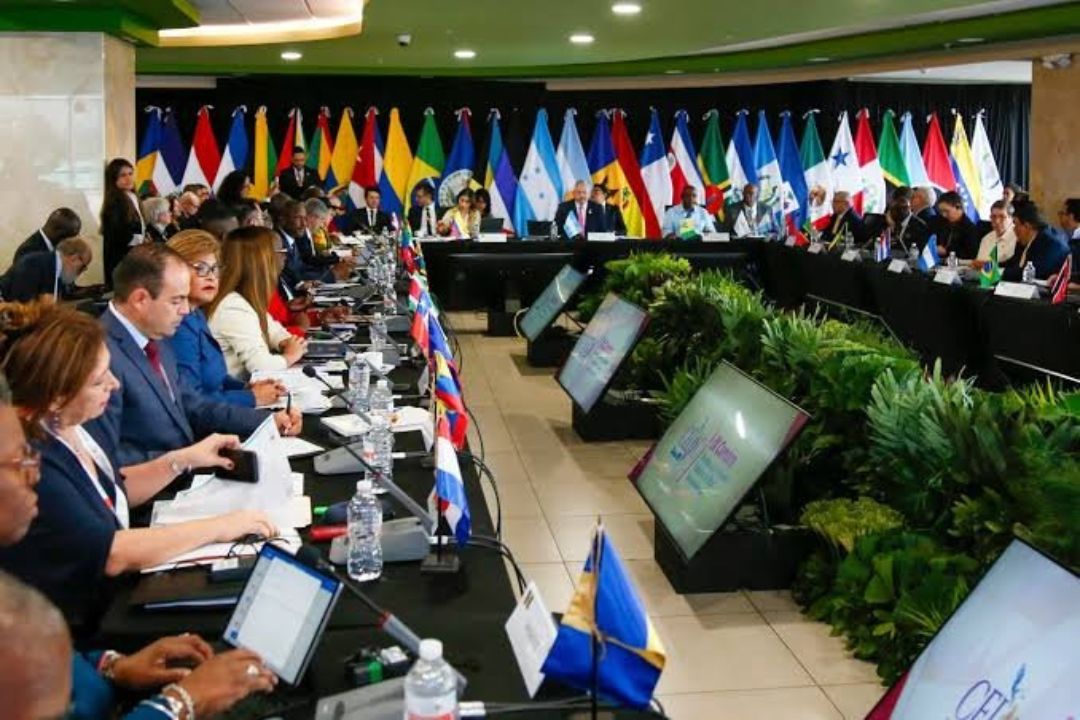
While the South American territory was attacked by the forces commanded by Donald Trump, the agencies of the capitalist regime reacted with the slowness and inefficiency that characterizes them. The urgent convocation of the Community of Latin American and Caribbean States (CELAC) ended in a resounding failure, exposing a political fracture that even made the drafting of a unified communiqué impossible. This sort of institutional paralysis ends up being the confirmation that these organizations lack the necessary tools to curb the arrogance of an imperialism that has decided to reconfigure the world order based on brute force and disregard for international law.
The CELAC ministerial meeting, held virtually, revealed positions that today are irreconcilable within the region, at least from the discursive point of view. On the one hand, a bloc of progressive governments (to give them a classification) headed by Brazil, Colombia and Mexico tried to promote a declaration rejecting the military action, warning about the dangerous precedent set by the violation of national sovereignty. On the opposite side, Javier Milei led a bloc of ten countries that blocked any attempt at condemnation. The blind alignment of the Argentinean government with Washington was such that delegations of low diplomatic rank were sent to detract weight from the summit, while alternative communiqués were worked on, celebrating the kidnapping of Maduro as a milestone in the defense of freedom. This division transformed the summit into an express procedure, demonstrating that while the powers bombard, the regional organizations get lost in sterile administrative threads.
This impotence was also transferred to the precincts of the UN, where the Security Council met in a climate of maximum tension, but with no practical results. While the Venezuelan representative denounced an act of colonial war aimed at capturing oil reserves, the Trump administration limited itself to invoking Article 51 of the UN Charter on legitimate self-defense, a legal justification that most of the international community observes with skepticism that does not translate into action.
The reality is that Trump has already declared these institutions dead by publicly assuring that international law is meaningless in the face of his country’s strategic interests. With latent threats to intervene in Colombia or statements on the annexation of Greenland, the US president makes it clear that the new map of imperialism does not admit diplomatic mediations or geographical limits.
Popular mobilization as the only guarantee of sovereignty
The limits of bourgeois diplomacy are structural, especially when the supposed judges of the international system are the very executioners of the peoples. No progressive resolution can be expected from institutions that coexist with joint military exercises with aggressors while pretending to discuss peace.
CELAC and the OAS have proven incapable of confronting the advance of U.S. imperialism because many of their members are direct lackeys of U.S. policy, prioritizing economic coexistence over the defense of regional sovereignty. Likewise, experience shows that no confidence can be placed in the progressive governments of the region either. A scandalous example of this is the attitude of Delcy Rodriguez, who, after assuming the presidency of Venezuela under the tutelage of her country’s justice system, showed immediate subordination to Trump. By inviting him to work on a “cooperation agenda” a few hours after Maduro’s capture, she hints at the existence of previous pacts or negotiations that facilitated the surrender of sovereignty. This institutional sterility and political complicity only serves to gain time while US interference consolidates on the ground.
Faced with this scenario of capitulation by Latin American governments, the only real way out lies in the protagonism of the peoples mobilized in an independent manner. Today more than ever it is urgent to confront U.S. interference and advance in the region, without this meaning to support authoritarian regimes like Maduro’s, but to build an alternative that repudiates any foreign interference and defends the rights of the working class. The real resistance against imperialism will not come from the halls of the UN, but from the workers’ and popular organization capable of demanding the breaking of military treaties, the annulment of plundering agreements and the expulsion of U.S. bases on continental soil.
Faced with this situation, it is urgent to transform all the indignation into a regional plan of struggle. The timorous governments that call for dialogue while bombs are falling only facilitate the path for Trump and his local partners. Only the unity of action of the peoples of Latin America, with class independence and without compromises with the foreign bourgeoisie, will be able to put a stop to this colonialist advance. A concrete example of this necessary way out were the mobilizations that took place in front of the U.S. Embassy and in various points of the region, where it was shown that sovereignty is defended in the streets, confronting both the internal oppressive regimes and the voracity of an empire that seeks to devour the continent. We have to organize the fight and build an anti-capitalist and socialist political tool that will allow the workers to decide their own destiny, sweeping away the swindle of imperial diplomacy and its empty institutions.